Browsing as Guest. Progress, bookmarks and attempts are disabled.
Log in to track your work.
0606 P21 - Jun 2023 - Q3 - 5 marks
7685
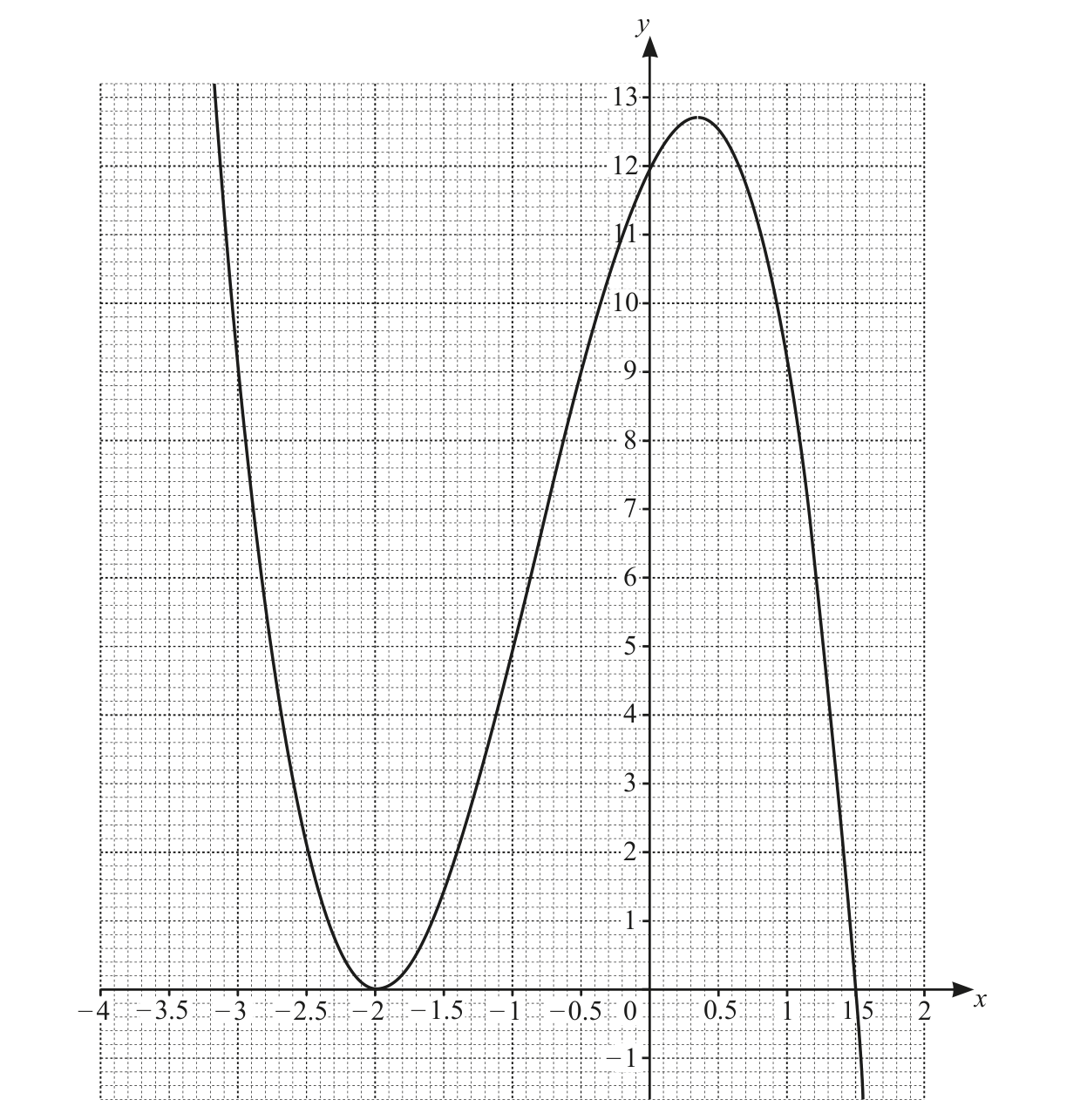
The diagram shows the graph of \(y=h(x)\), where
\(h(x)=(x+a)^2(b+cx)\)
and \(a\), \(b\) and \(c\) are integers. The curve meets the \(x\)-axis at the points \((-2,0)\) and \((1.5,0)\), and the \(y\)-axis at the point \((0,12)\).
(a) Find the values of \(a\), \(b\) and \(c\).
(b) Use the graph to solve the inequality \(h(x)\leq9\).
Solution
Answer: \(a=2\), \(b=3\), \(c=-2\); \(-3\leq x\leq-\frac12\) or \(x\geq1\).
Work through the problem step by step, using exact values where possible before giving any final numerical approximation.
(a) The factor \((x+a)^2\) gives the repeated root. From the graph, the repeated root is \(x=-2\), so
\(x+a=x+2,\)
and therefore
\(a=2.\)
The \(y\)-intercept is \(12\), so \(h(0)=12\). Hence
\((0+2)^2b=12.\)
Thus
\(4b=12,\)
so
\(b=3.\)
The other root is \(x=1.5\). This comes from \(b+cx=0\), so
\(3+1.5c=0.\)
Therefore
\(c=-2.\)
(b) From the graph, the curve \(y=h(x)\) meets the line \(y=9\) at approximately
\(x=-3,\quad x=-\frac12,\quad x=1.\)
The graph is at or below \(y=9\) between the first two values and to the right of the third value. Therefore