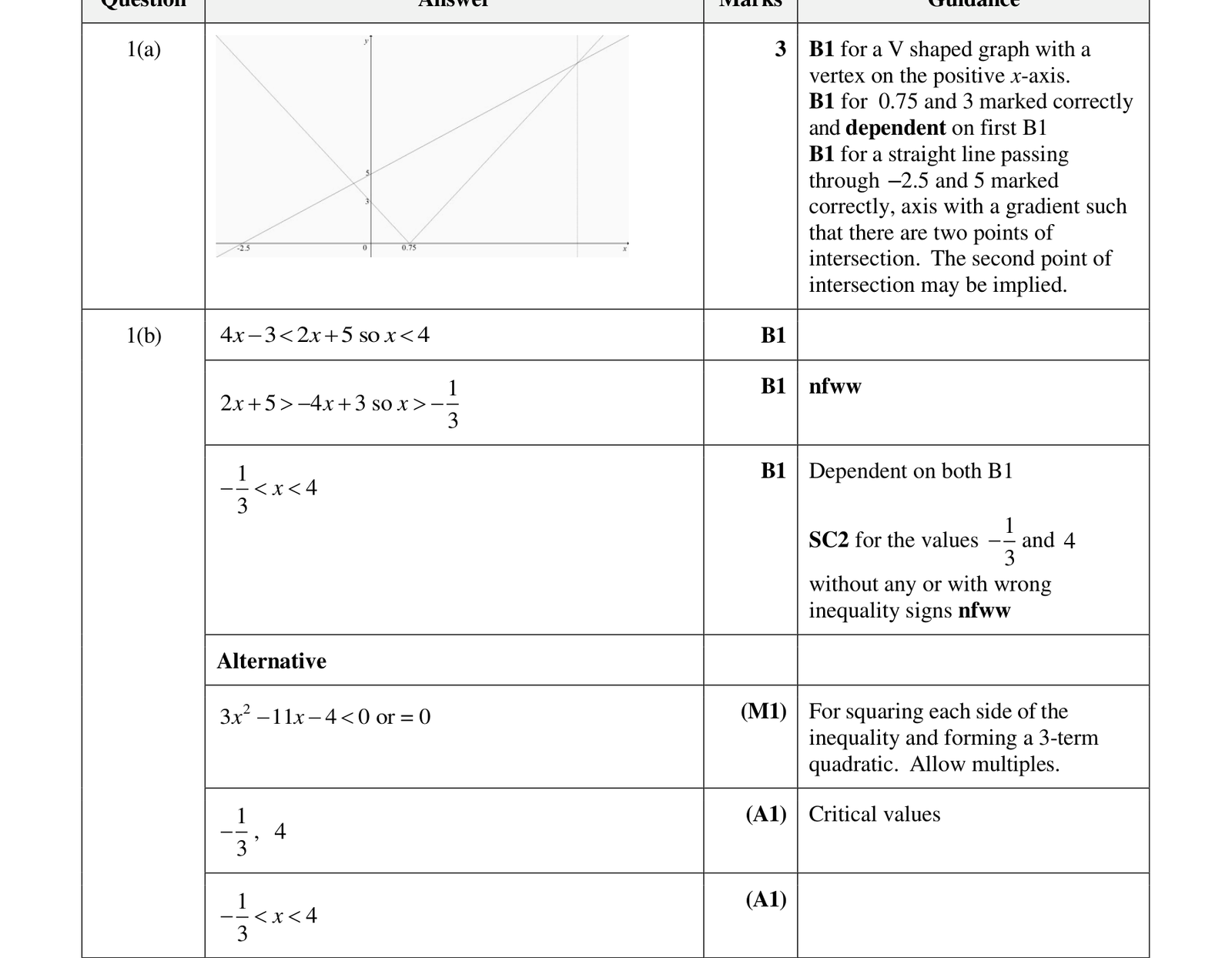
Answer: The graphs have intercepts \((-2.5,0)\), \((0,5)\), \((0.75,0)\) and \((0,3)\). The inequality gives \(-\frac13\lt x\lt4\).
Use the definition of an absolute value: split the equation or inequality into the relevant linear cases, then combine the intervals that satisfy the original statement.
(a) For \(y=2x+5\), the \(y\)-intercept is \((0,5)\). Setting \(y=0\) gives \(2x+5=0\), so the \(x\)-intercept is \((-2.5,0)\).
For \(y=|4x-3|\), the vertex is where \(4x-3=0\), so the vertex and \(x\)-intercept are \((0.75,0)\). The \(y\)-intercept is \(y=|-3|=3\), so it is \((0,3)\).
The graph of \(y=|4x-3|\) is V-shaped, meeting the straight line at the two boundary values used in part (b).
(b) Solve the modulus inequality in two cases.
If \(4x-3\geq0\), then
\(4x-3\lt2x+5\),
so
\(x\lt4\).
If \(4x-3\lt0\), then
\(-(4x-3)\lt2x+5\).
Hence
\(-4x+3\lt2x+5\),
so
\(x\gt-\frac13\).
Combining the two parts gives
\(-\frac13\lt x\lt4.\)