Past Exam Questions
← Back9709 P43 - Nov 2019 - Q7
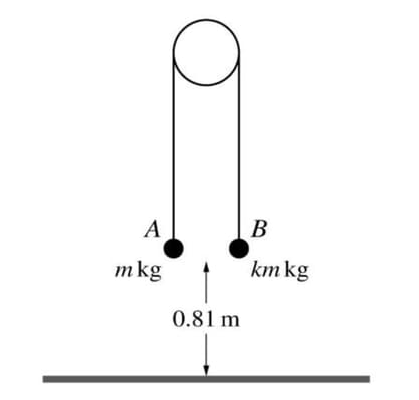
Two particles A and B have masses \(m \text{ kg}\) and \(km \text{ kg}\) respectively, where \(k > 1\). The particles are attached to the ends of a light inextensible string. The string passes over a fixed smooth pulley and the particles hang vertically below it. Both particles are at a height of 0.81 m above horizontal ground (see diagram). The system is released from rest and particle B reaches the ground 0.9 s later. The particle A does not reach the pulley in its subsequent motion.
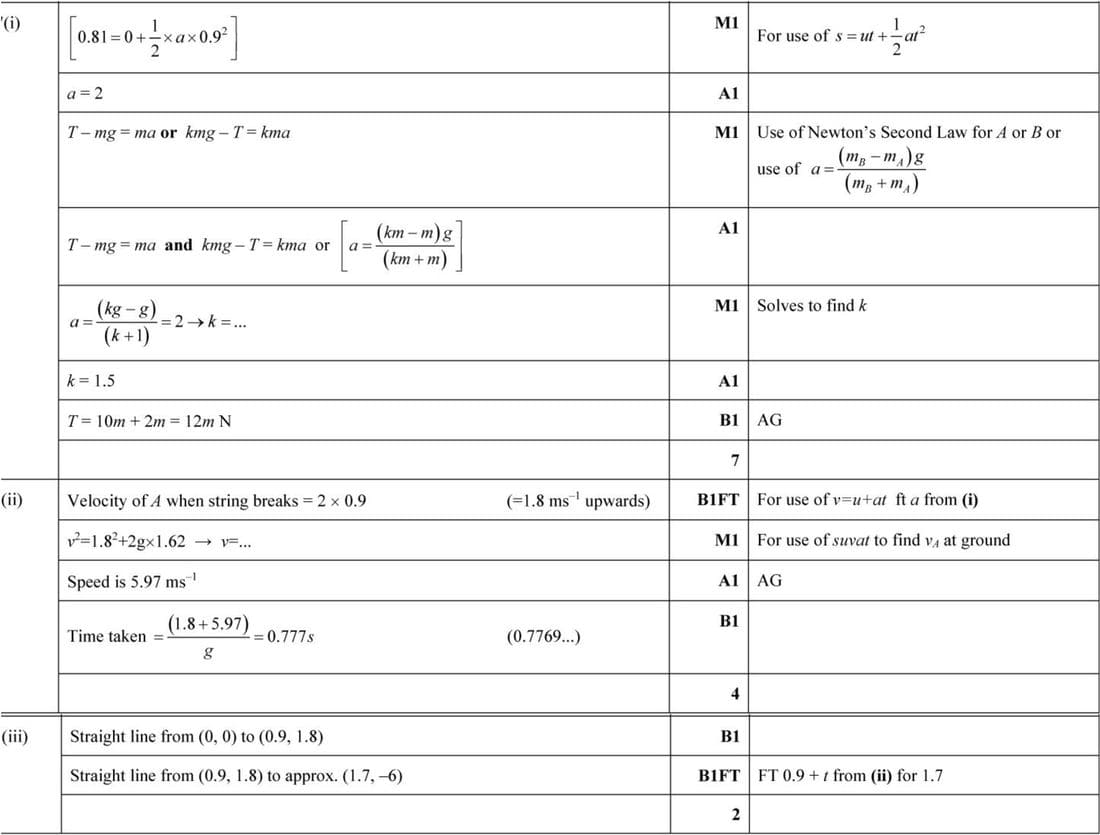
(i) Find the value of \(k\) and show that the tension in the string before B reaches the ground is equal to \(12m \text{ N}\).
At the instant when B reaches the ground, the string breaks.
(ii) Show that the speed of A when it reaches the ground is \(5.97 \text{ m s}^{-1}\), correct to 3 significant figures, and find the time taken, after the string breaks, for A to reach the ground.
(iii) Sketch a velocity-time graph for the motion of particle A from the instant when the system is released until A reaches the ground.
9709 P43 - Jun 2019 - Q4
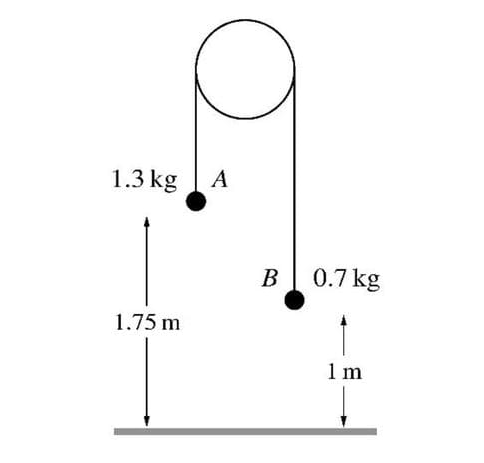
Two particles A and B, of masses 1.3 kg and 0.7 kg respectively, are connected by a light inextensible string which passes over a smooth fixed pulley. Particle A is 1.75 m above the floor and particle B is 1 m above the floor (see diagram). The system is released from rest with the string taut, and the particles move vertically. When the particles are at the same height the string breaks.
(i) Show that, before the string breaks, the magnitude of the acceleration of each particle is 3 m s-2 and find the tension in the string.
(ii) Find the difference in the times that it takes the particles to hit the ground.

9709 P42 - Jun 2019 - Q5
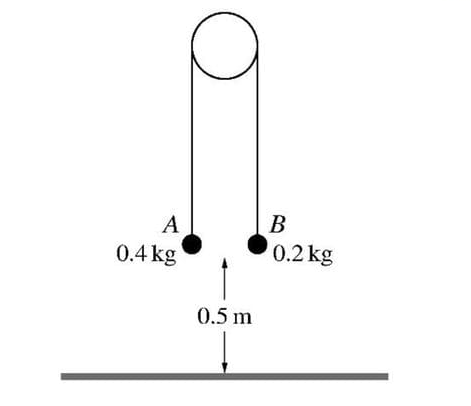
Two particles A and B, of masses 0.4 kg and 0.2 kg respectively, are connected by a light inextensible string which passes over a fixed smooth pulley. Both A and B are 0.5 m above the ground. The particles hang vertically (see diagram). The particles are released from rest. In the subsequent motion B does not reach the pulley and A remains at rest after reaching the ground.
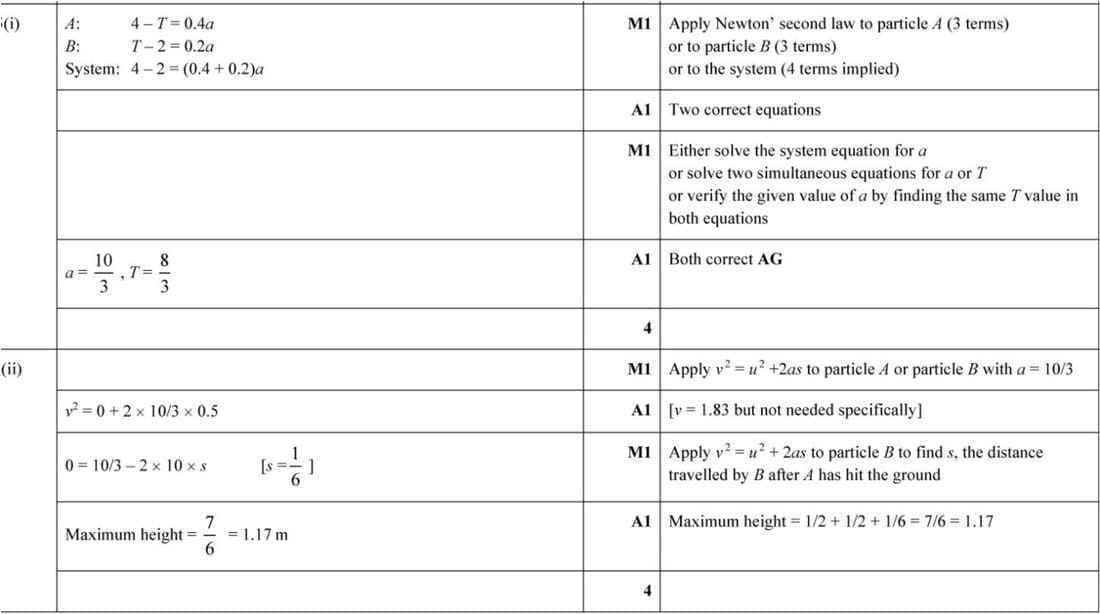
(i) For the motion before A reaches the ground, show that the magnitude of the acceleration of each particle is \(\frac{10}{3} \text{ m s}^{-2}\) and find the tension in the string. [4]
(ii) Find the maximum height of B above the ground. [4]
9709 P43 - Nov 2018 - Q5
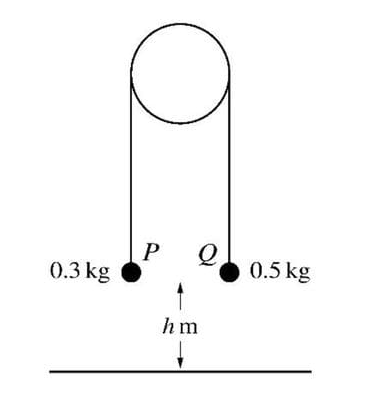
Two particles P and Q, of masses 0.3 kg and 0.5 kg respectively, are attached to the ends of a light inextensible string. The string passes over a fixed smooth pulley with the particles hanging freely below it. Q is held at rest with the string taut at a height of h m above a horizontal floor (see diagram). Q is now released and both particles start to move. The pulley is sufficiently high so that P does not reach it at any stage. The time taken for Q to reach the floor is 0.6 s.
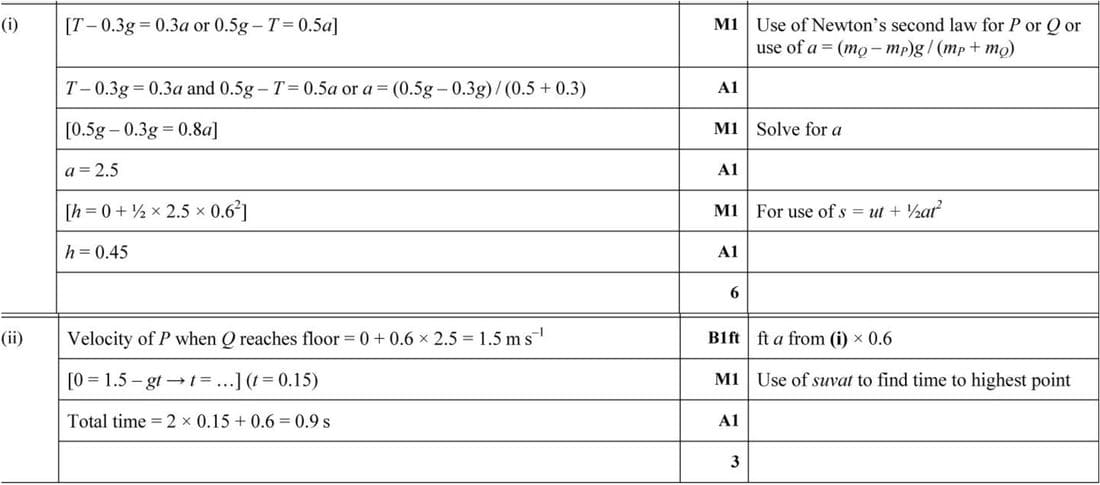
(i) Find the acceleration of Q before it reaches the floor and hence find the value of h.
Q remains at rest when it reaches the floor, and P continues to move upwards.
(ii) Find the velocity of P at the instant when Q reaches the floor and the total time taken from the instant at which Q is released until the string becomes taut again.
9709 P41 - Nov 2018 - Q4
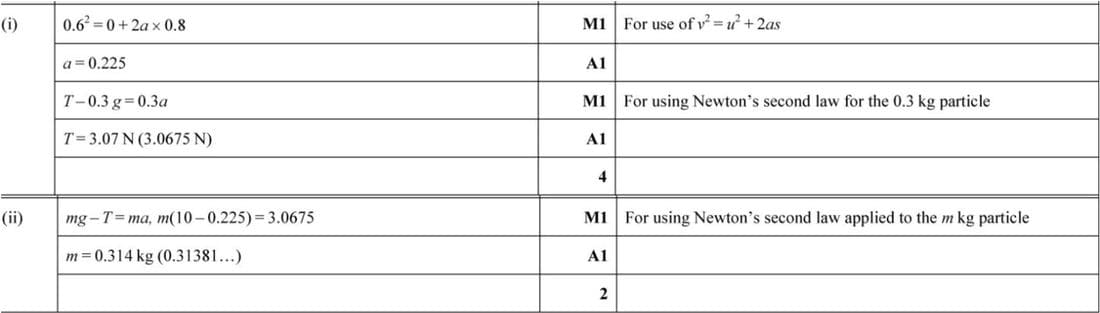
Two particles A and B, of masses m kg and 0.3 kg respectively, are attached to the ends of a light inextensible string. The string passes over a fixed smooth pulley and the particles hang freely below it. The system is released from rest, with both particles 0.8 m above horizontal ground. Particle A reaches the ground with a speed of 0.6 m s-1.
(i) Find the tension in the string during the motion before A reaches the ground.
(ii) Find the value of m.
9709 P42 - Mar 2018 - Q1
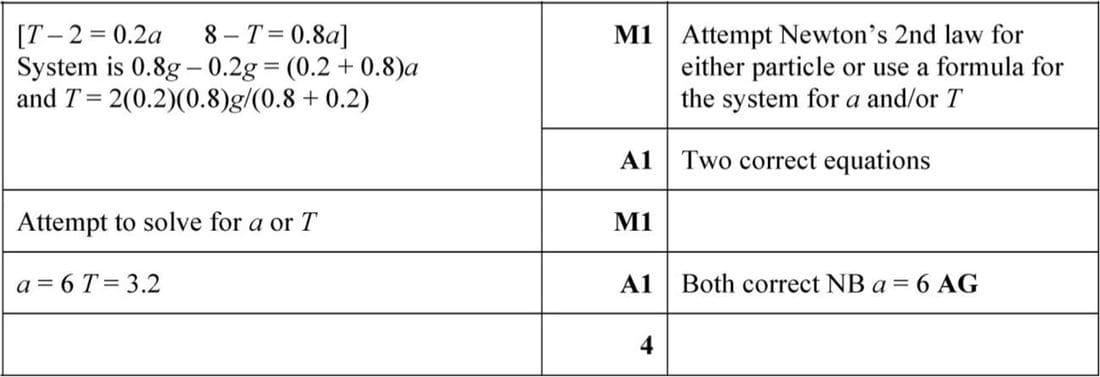
Two particles A and B, of masses 0.8 kg and 0.2 kg respectively, are connected by a light inextensible string that passes over a fixed smooth pulley. The particles hang vertically. The system is released from rest. Show that the acceleration of A has magnitude 6 m s-2 and find the tension in the string.
9231 P11 - Nov 2019 - Q8 - 10 marks
The matrix \(\mathbf{M}\) is defined by
\(\mathbf{M}=\left(\begin{array}{ccc}
2 & m & 1 \\
0 & m & 7 \\
0 & 0 & 1
\end{array}\right),\)
where \(m \neq 0,1,2\).
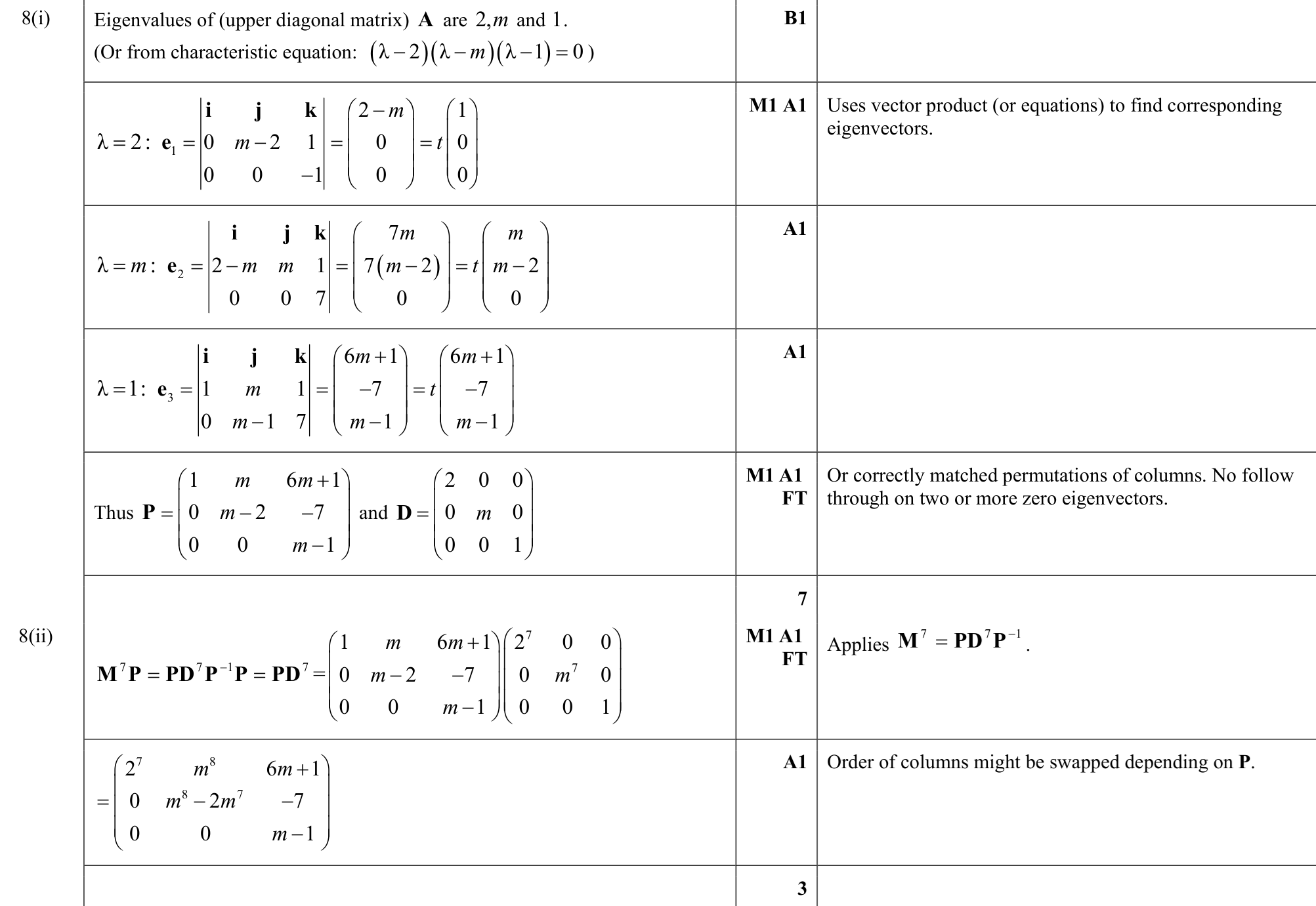
(i) Find a matrix \(\mathbf{P}\) and a diagonal matrix \(\mathbf{D}\) such that \(\mathbf{M}=\mathbf{P D P}^{-1}\).
(ii) Find \(\mathbf{M}^{7} \mathbf{P}\).
9231 P12 - Nov 2025 - Q4 - 10 marks
(a(i)) For \(B=\begin{pmatrix}k&0\\0&m\end{pmatrix}\), give full details of the transformation represented by \(B\) when \(m=1\).
(a(ii)) For \(B=\begin{pmatrix}k&0\\0&m\end{pmatrix}\), give full details of the transformation represented by \(B\) when \(m=k\).
(b) For \(A=\begin{pmatrix}0&1\\-1&1\\1&1\end{pmatrix}\), \(B=\begin{pmatrix}k&0\\0&m\end{pmatrix}\), and \(C=\begin{pmatrix}2&-1&1\\1&1&2\end{pmatrix}\), show that \(ABC\) is singular.
9231 P1 - Nov 2008 - Q6 - 7 marks
The matrix \(\mathbf{A}\) is defined by
\(\mathbf{A}=\left(\begin{array}{rrrr} 1 & -1 & -2 & -3 \\ -2 & 1 & 7 & 2 \\ -3 & 3 & 6 & \alpha \\ 7 & -6 & -17 & -17 \end{array}\right) .\)
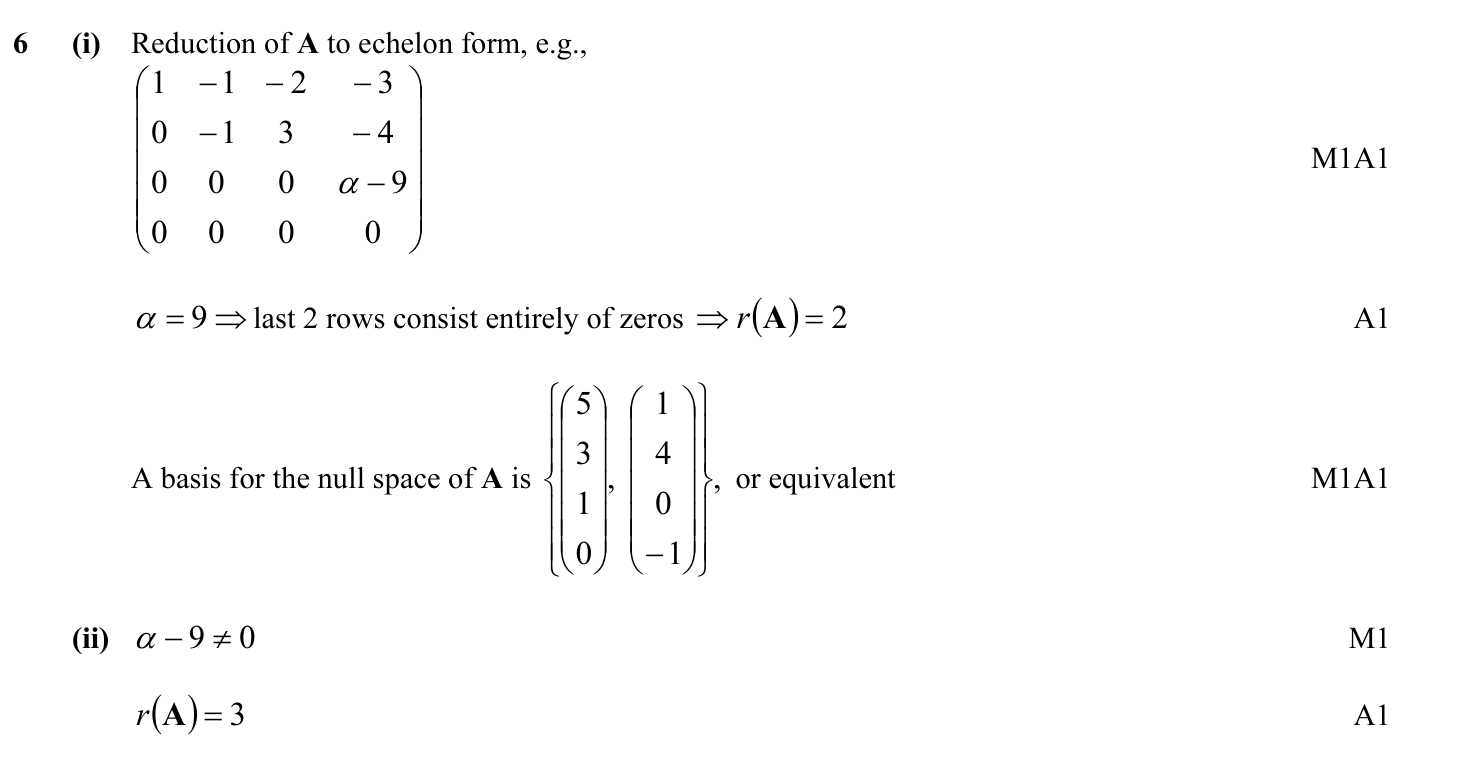
(i) Show that if \(\alpha=9\) then the rank of \(\mathbf{A}\) is 2 , and find a basis for the null space of \(\mathbf{A}\) in this case.
(ii) Find the rank of \(\mathbf{A}\) when \(\alpha \neq 9\).
9231 P13 - Jun 2024 - Q01 - 5 marks
The matrix A is given by
\(A = \begin{pmatrix} k & 1 & 0 \\ 6 & 5 & 2 \\ -1 & 3 & -k \end{pmatrix}\),
where \(k\) is a real constant.
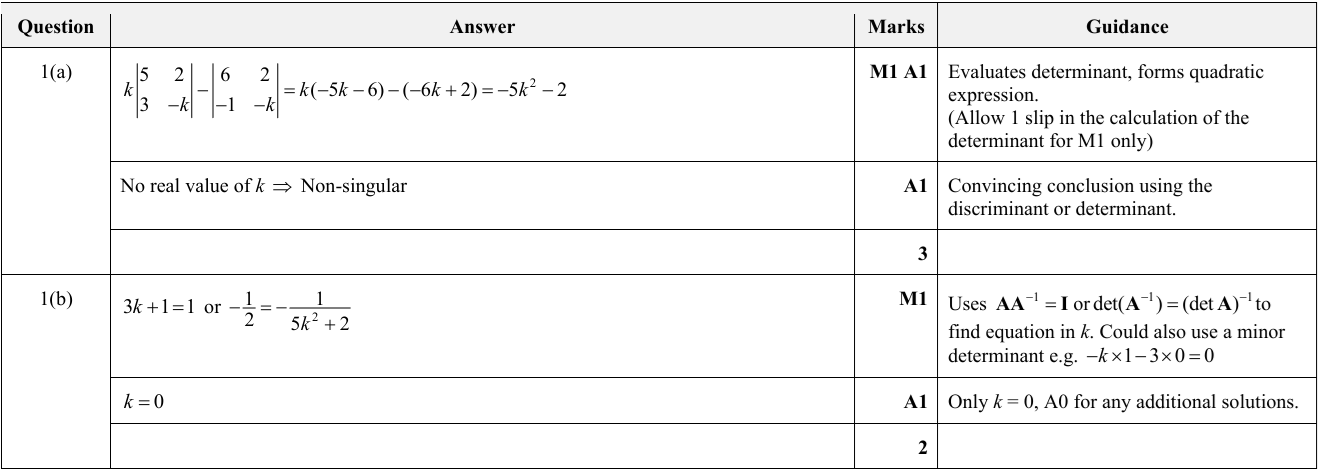
(a) Show that A is non-singular.
(b) Given that \(A^{-1} = \begin{pmatrix} 3 & 0 & -1 \\ 1 & 0 & 0 \\ -\frac{23}{2} & \frac{1}{2} & 3 \end{pmatrix}\), find the value of \(k\).
9231 P13 - Jun 2023 - Q04 - 14 marks
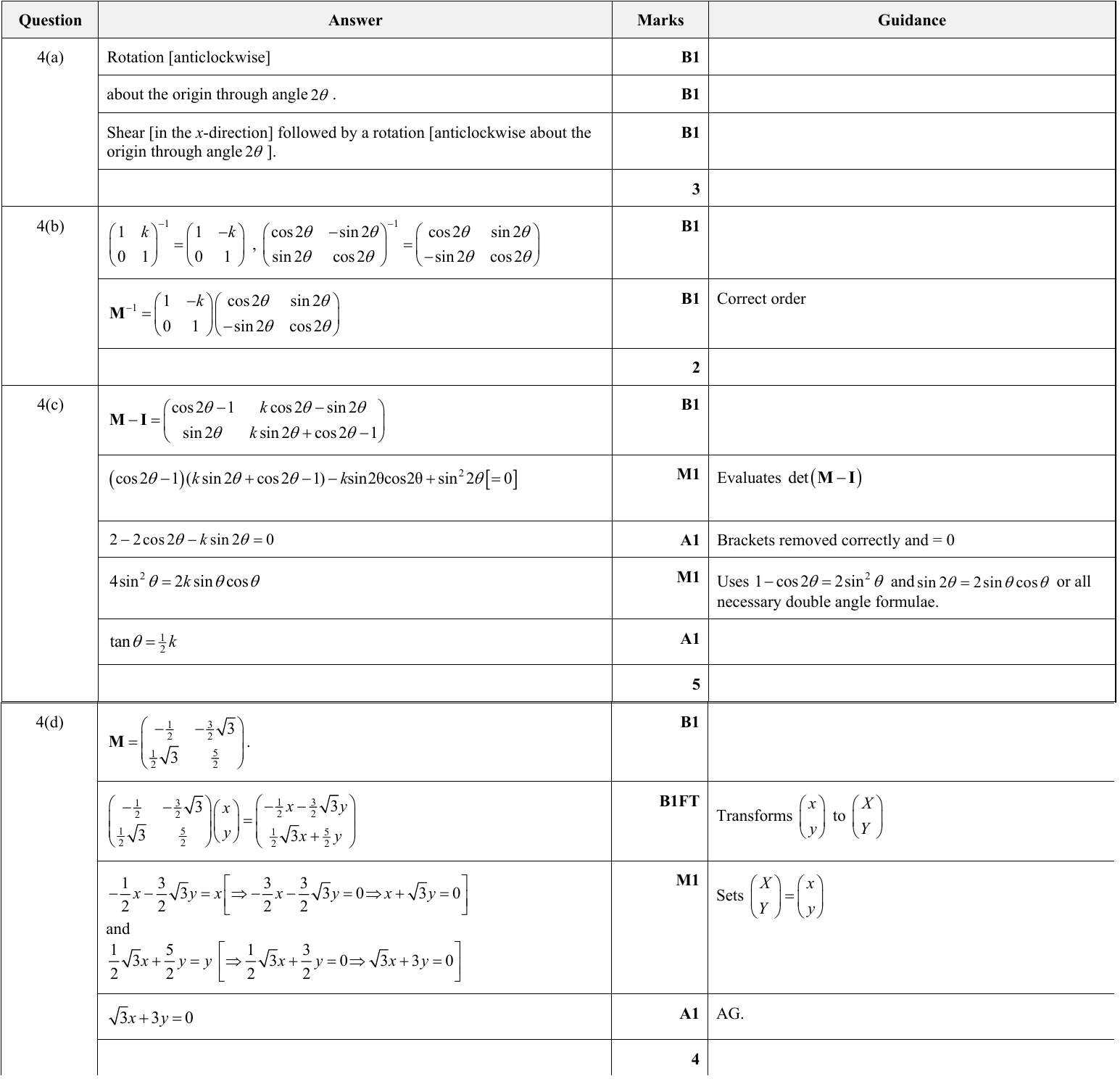
The matrix M is given by M = \(\begin{pmatrix} \cos 2\theta & -\sin 2\theta \\ \sin 2\theta & \cos 2\theta \end{pmatrix} \begin{pmatrix} 1 & k \\ 0 & 1 \end{pmatrix}\), where \(0 < \theta < \pi\) and \(k\) is a non-zero constant. The matrix M represents a sequence of two geometrical transformations, one of which is a shear.
- Describe fully the other transformation and state the order in which the transformations are applied. [3]
- Write M-1 as the product of two matrices, neither of which is I. [2]
- Find, in terms of \(k\), the value of \(\tan \theta\) for which M - I is singular. [5]
- Given that \(k = 2\sqrt{3}\) and \(\theta = \frac{1}{3}\pi\), show that the invariant points of the transformation represented by M lie on the line \(3y + \sqrt{3}x = 0\). [4]
9231 P11 - Nov 2021 - Q04 - 11 marks
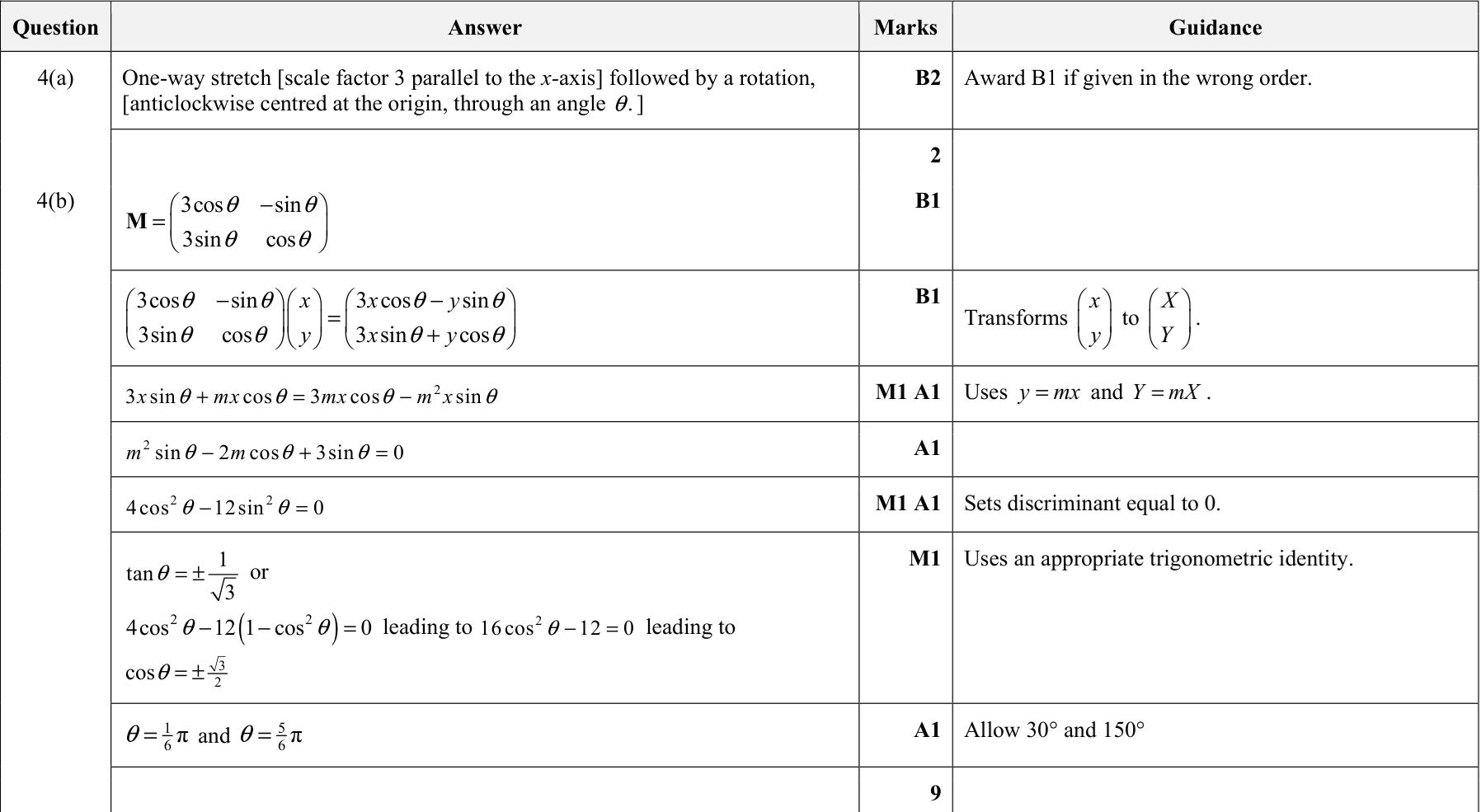
The matrix M is given by \(\mathbf{M} = \begin{pmatrix} \cos \theta & -\sin \theta \\ \sin \theta & \cos \theta \end{pmatrix} \begin{pmatrix} 3 & 0 \\ 0 & 1 \end{pmatrix}\).
(a) The matrix M represents a sequence of two geometrical transformations. State the type of each transformation, and make clear the order in which they are applied. [2]
(b) Find the values of \(\theta\), for \(0 \leq \theta \leq \pi\), for which the transformation represented by M has exactly one invariant line through the origin, giving your answers in terms of \(\pi\). [9]
9231 P11 - Nov 2020 - Q1 - 9 marks
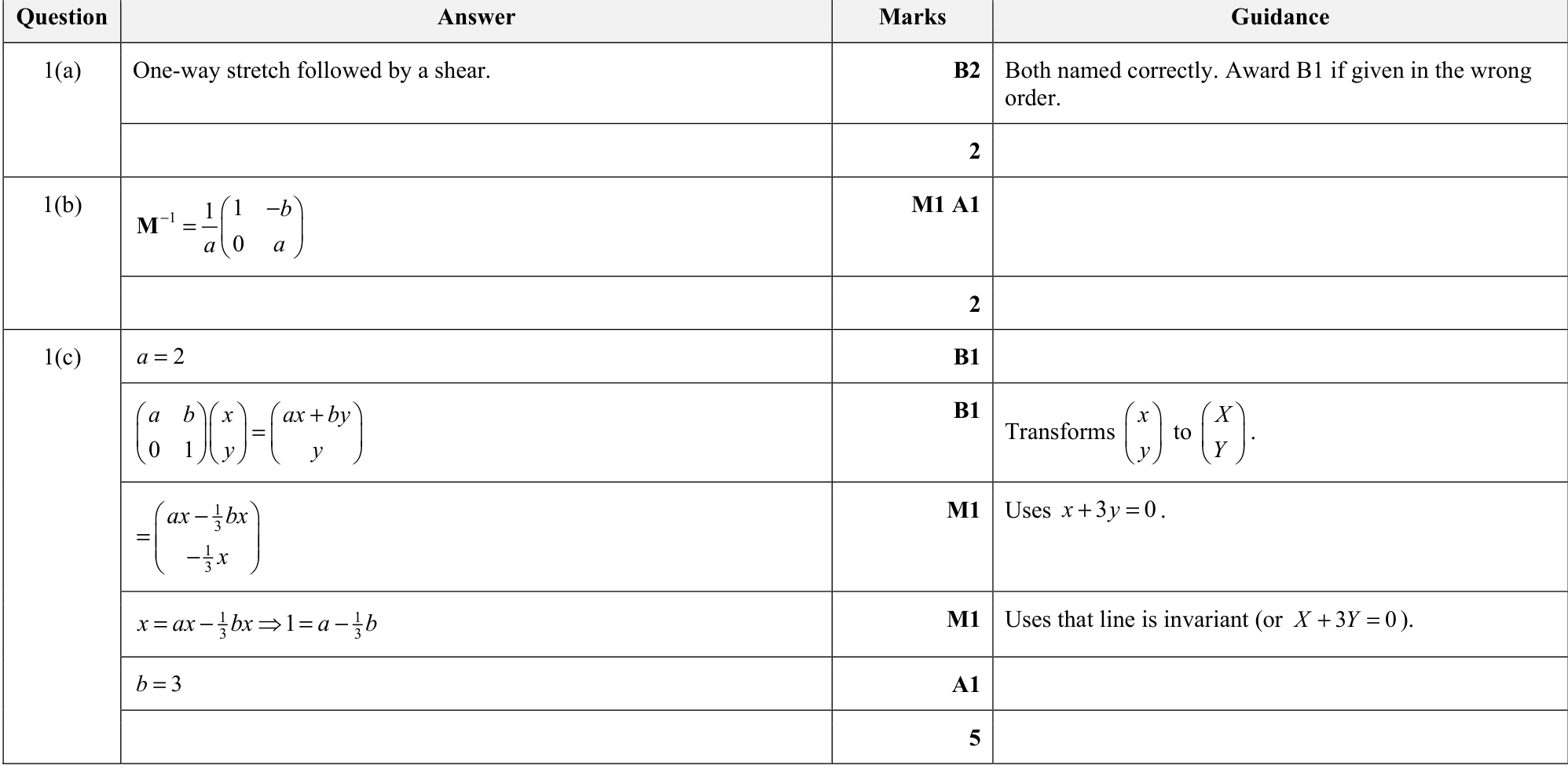
1 The matrix \(\mathbf{M}\) is given by \(\mathbf{M}=\left(\begin{array}{ll}1 & b \\ 0 & 1\end{array}\right)\left(\begin{array}{ll}a & 0 \\ 0 & 1\end{array}\right)\), where \(a\) and \(b\) are positive constants.
(a) The matrix \(\mathbf{M}\) represents a sequence of two geometrical transformations.
State the type of each transformation, and make clear the order in which they are applied.
The unit square in the \(x-y\) plane is transformed by \(\mathbf{M}\) onto parallelogram \(O P Q R\).
(b) Find, in terms of \(a\) and \(b\), the matrix which transforms parallelogram \(O P Q R\) onto the unit square.
It is given that the area of \(O P Q R\) is \(2 \mathrm{~cm}^{2}\) and that the line \(x+3 y=0\) is invariant under the transformation represented by \(\mathbf{M}\).
(c) Find the values of \(a\) and \(b\).
9231 P13 - Jun 2019 - Q5 - 8 marks
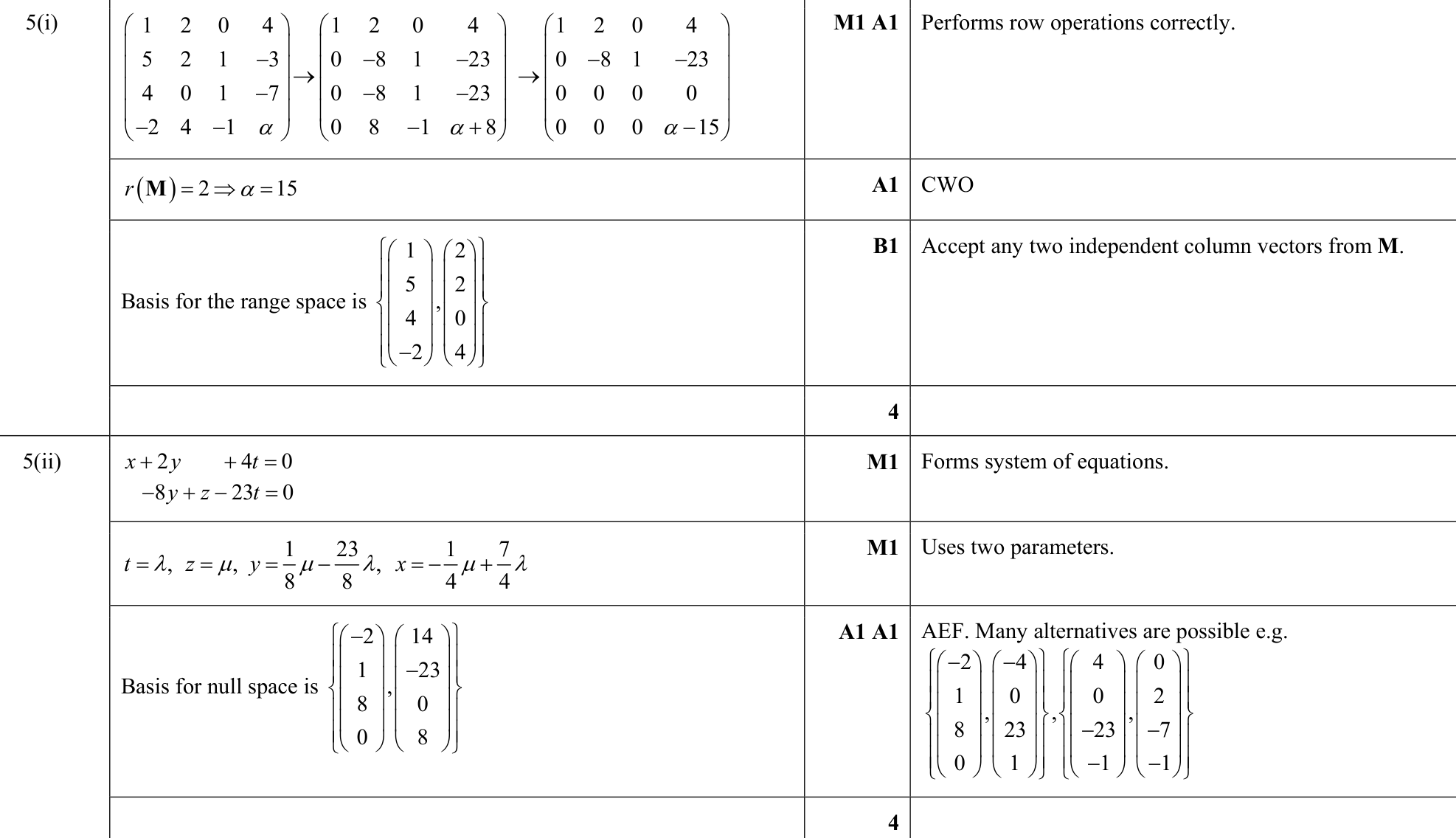
5 The linear transformation \(T:\mathbb{R}^4\to\mathbb{R}^4\) is represented by the matrix \(M\), where
\(M=\begin{pmatrix}1&2&0&4\\5&2&1&-3\\4&0&1&-7\\-2&4&-1&\alpha\end{pmatrix}\).
It is given that the rank of \(M\) is \(2\).
(i) Find the value of \(\alpha\) and state a basis for the range space of \(T\).
(ii) Obtain a basis for the null space of \(T\).
9231 P11 - Jun 2018 - Q8 - 10 marks
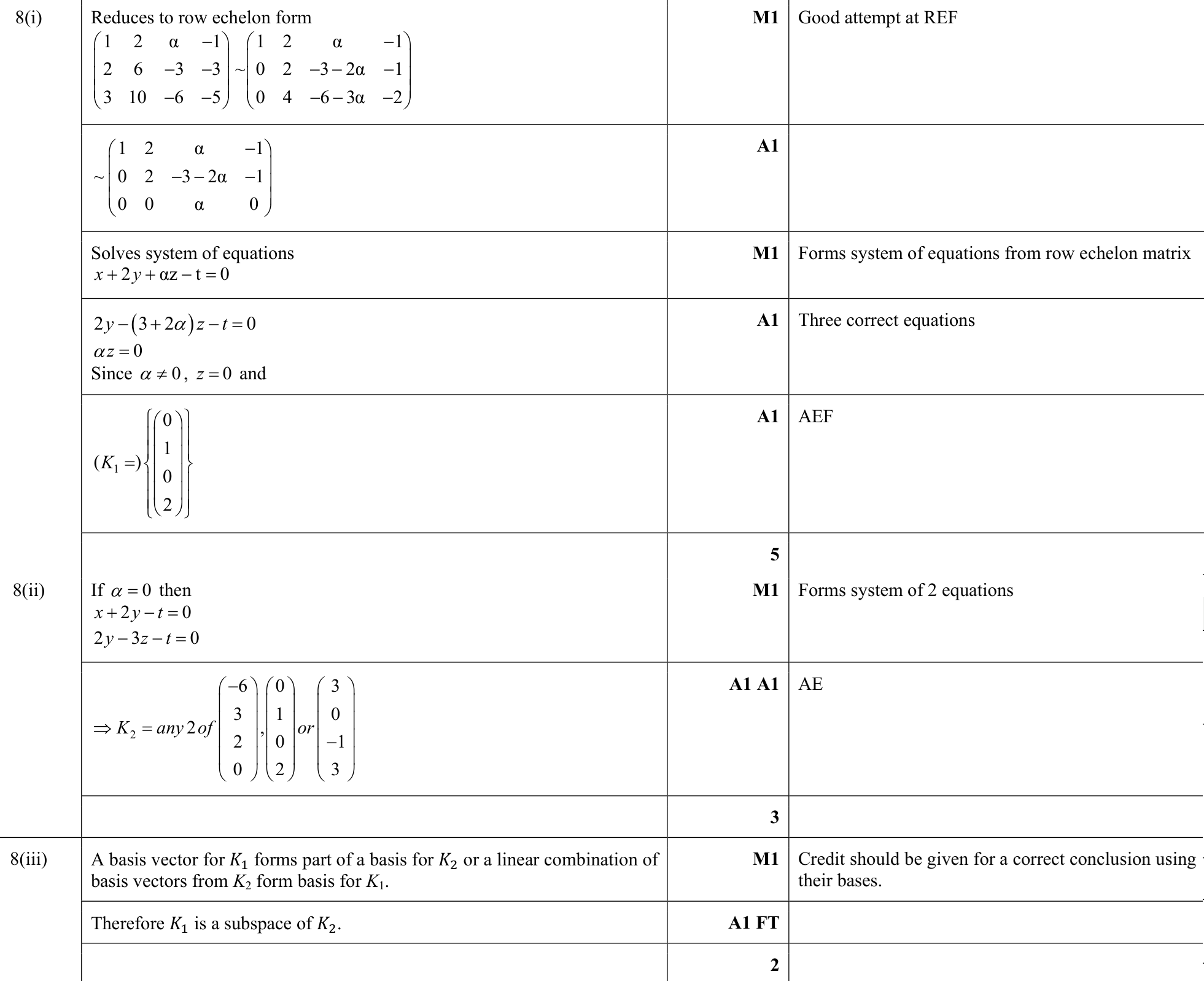
The linear transformation \(\mathrm{T}: \mathbb{R}^{4} \rightarrow \mathbb{R}^{3}\) is represented by the matrix \(\mathbf{M}\), where
\(\mathbf{M}=\left(\begin{array}{cccc}
1 & 2 & \alpha & -1 \\
2 & 6 & -3 & -3 \\
3 & 10 & -6 & -5
\end{array}\right)\)
and \(\alpha\) is a constant. When \(\alpha \neq 0\) the null space of T is denoted by \(K_{1}\).
(i) Find a basis for \(K_{1}\).
When \(\alpha=0\) the null space of T is denoted by \(K_{2}\).
(ii) Find a basis for \(K_{2}\).
(iii) Determine, justifying your answer, whether \(K_{1}\) is a subspace of \(K_{2}\).
9231 P11 - Nov 2025 - Q2 - 11 marks
(a) For \(A=\begin{pmatrix}1&\frac32\\0&1\end{pmatrix}\), give full details of the geometrical transformation represented by \(A\).
(b) For \(B=\begin{pmatrix}1&0\\\frac32&1\end{pmatrix}\), give full details of the geometrical transformation represented by \(B\).
(c) The triangle \(DEF\) is transformed by \(AB\) onto \(PQR\). Show that the triangles have the same area.
(d) Find the equations of the invariant lines through the origin of the transformation represented by \(AB\).
9231 P11 - Jun 2014 - Q6 - 8 marks
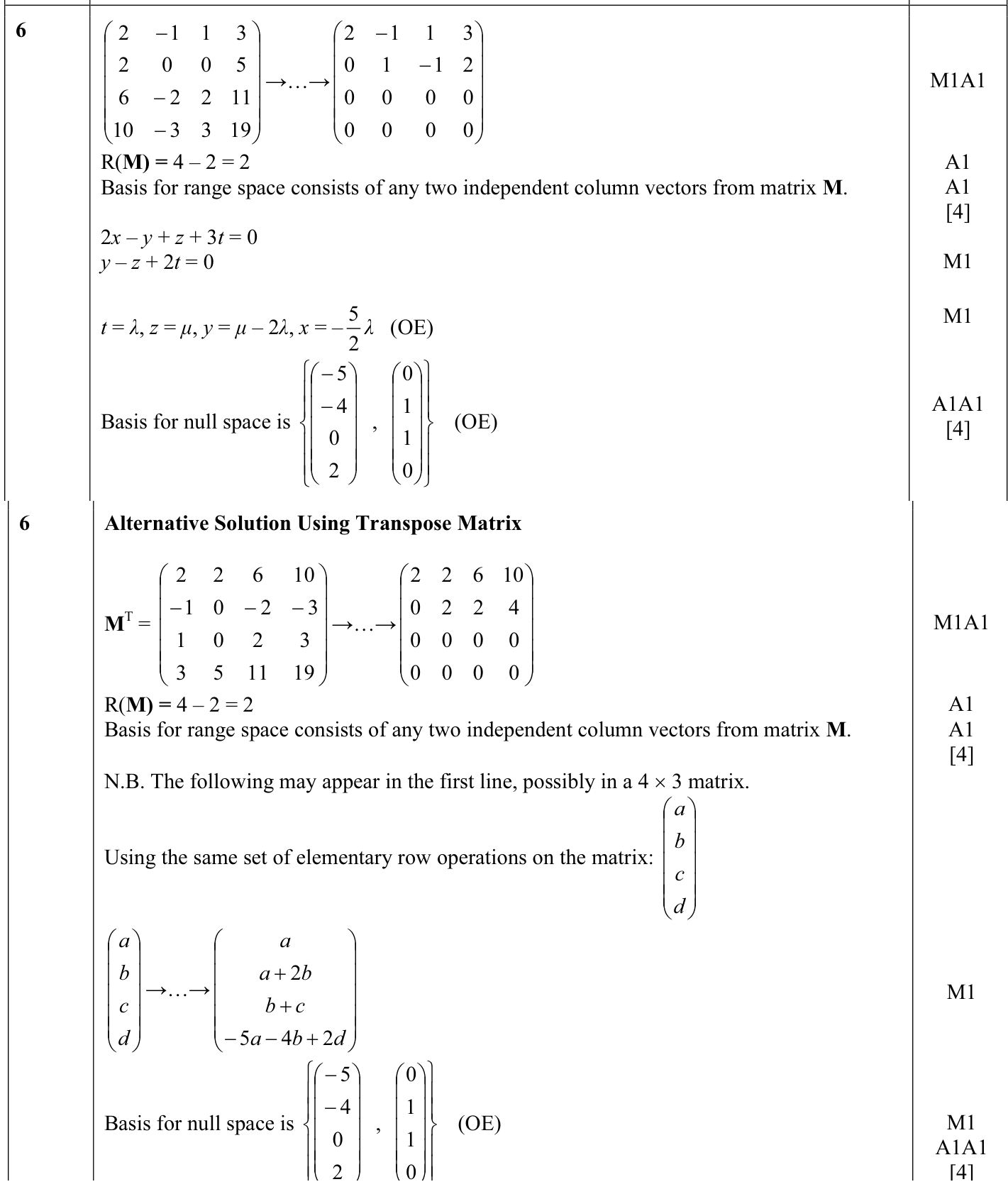
The linear transformation \(\mathrm{T}: \mathbb{R}^{4} \rightarrow \mathbb{R}^{4}\) is represented by the matrix \(\mathbf{M}\), where
\(\mathbf{M}=\left(\begin{array}{rrrr} 2 & -1 & 1 & 3 \\ 2 & 0 & 0 & 5 \\ 6 & -2 & 2 & 11 \\ 10 & -3 & 3 & 19 \end{array}\right) .\)
(i) Find the rank of \(\mathbf{M}\) and state a basis for the range space of T .
(ii) Obtain a basis for the null space of T .
9231 P11 - Jun 2013 - Q8 - 10 marks
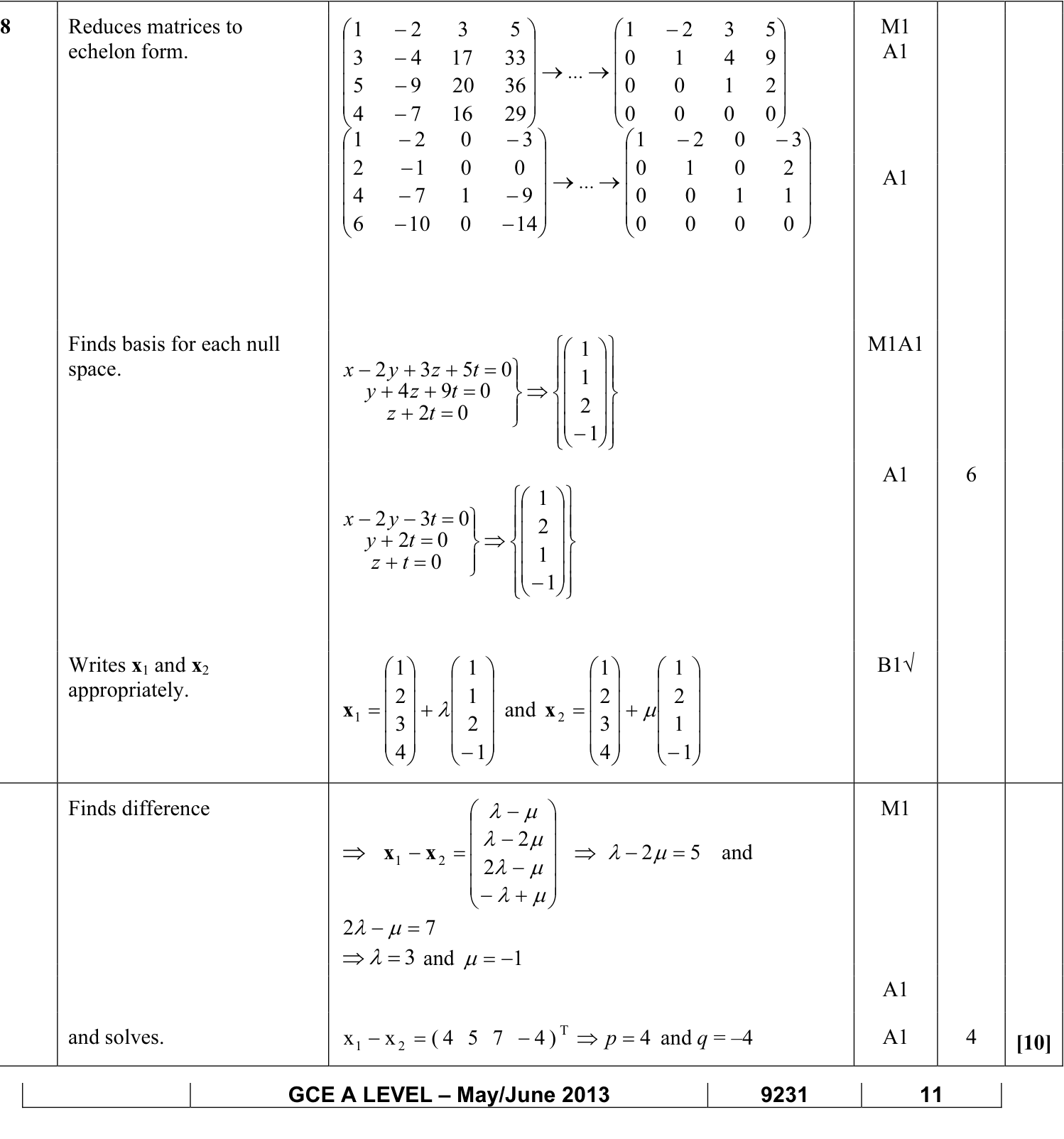
The linear transformations \(\mathrm{T}_{1}: \mathbb{R}^{4} \rightarrow \mathbb{R}^{4}\) and \(\mathrm{T}_{2}: \mathbb{R}^{4} \rightarrow \mathbb{R}^{4}\) are represented by the matrices \(\mathbf{M}_{1}\) and \(\mathbf{M}_{2}\) respectively, where
\(\mathbf{M}_{1}=\left(\begin{array}{rrrr} 1 & -2 & 3 & 5 \\ 3 & -4 & 17 & 33 \\ 5 & -9 & 20 & 36 \\ 4 & -7 & 16 & 29 \end{array}\right) \quad \text { and } \quad \mathbf{M}_{2}=\left(\begin{array}{rrrr} 1 & -2 & 0 & -3 \\ 2 & -1 & 0 & 0 \\ 4 & -7 & 1 & -9 \\ 6 & -10 & 0 & -14 \end{array}\right) .\)
The null spaces of \(\mathrm{T}_{1}\) and \(\mathrm{T}_{2}\) are denoted by \(K_{1}\) and \(K_{2}\) respectively. Find a basis for \(K_{1}\) and a basis for \(K_{2}\).
It is given that \(\mathbf{a}=\left(\begin{array}{l}1 \\ 2 \\ 3 \\ 4\end{array}\right)\). The vectors \(\mathbf{x}_{1}\) and \(\mathbf{x}_{2}\) are such that \(\mathbf{M}_{1} \mathbf{x}_{1}=\mathbf{M}_{1} \mathbf{a}\) and \(\mathbf{M}_{2} \mathbf{x}_{2}=\mathbf{M}_{2} \mathbf{a}\). Given that \(\mathbf{x}_{1}-\mathbf{x}_{2}=\left(\begin{array}{c}p \\ 5 \\ 7 \\ q\end{array}\right)\), find \(p\) and \(q\).
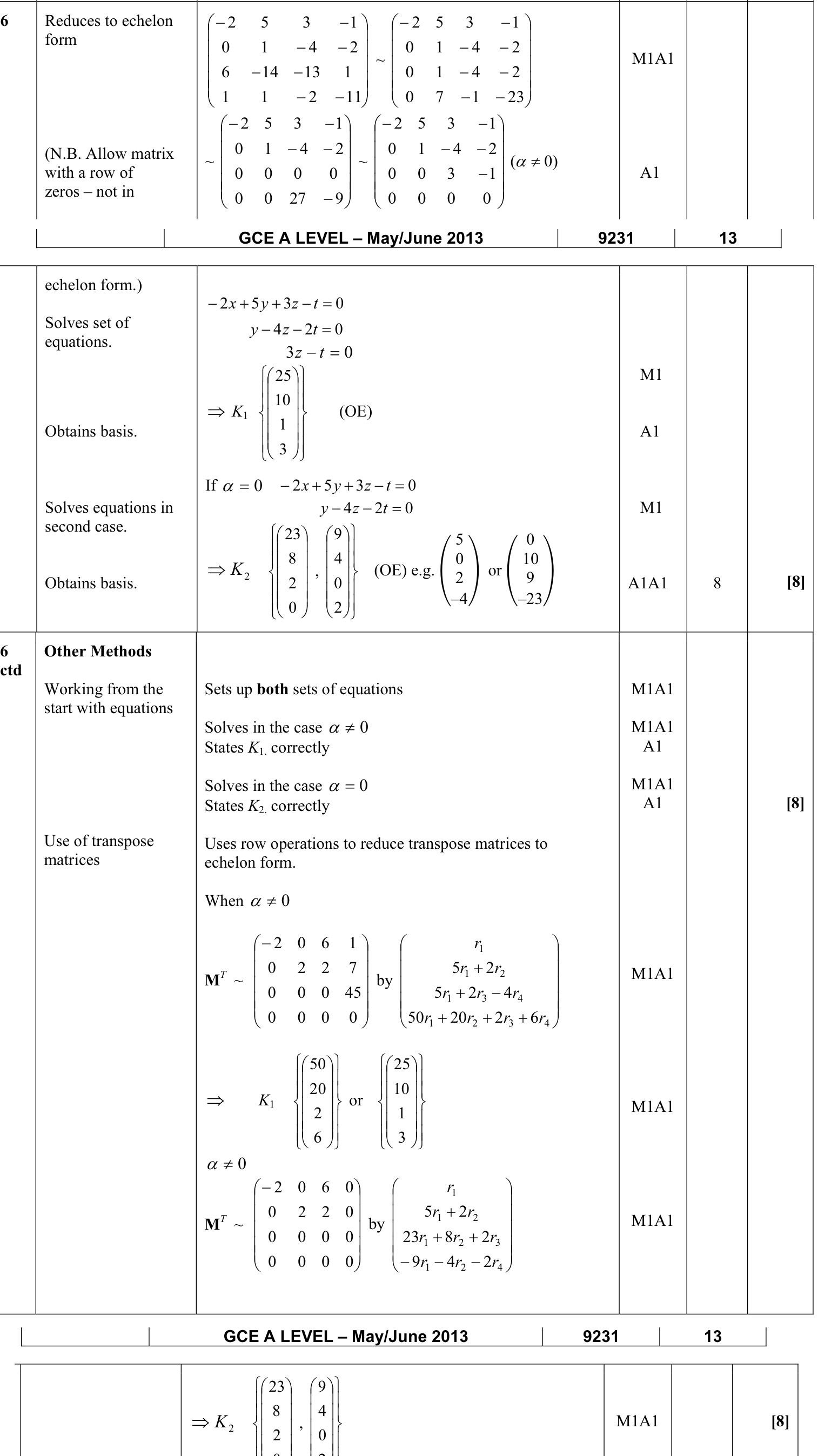
9231 P13 - Jun 2013 - Q6 - 8 marks
The linear transformation \(\mathrm{T}: \mathbb{R}^{4} \rightarrow \mathbb{R}^{4}\) is represented by the matrix \(\mathbf{M}\), where
\(\mathbf{M}=\left(\begin{array}{rrrr} -2 & 5 & 3 & -1 \\ 0 & 1 & -4 & -2 \\ 6 & -14 & -13 & 1 \\ \alpha & \alpha & -2 \alpha & -11 \alpha \end{array}\right)\)
and \(\alpha\) is a constant. The null space of T is denoted by \(K_{1}\) when \(\alpha \neq 0\), and by \(K_{2}\) when \(\alpha=0\). Find a basis for \(K_{1}\) and a basis for \(K_{2}\).
9231 P11 - Nov 2013 - Q6 - 9 marks
The linear transformation \(\mathrm{T}: \mathbb{R}^{4} \rightarrow \mathbb{R}^{4}\) is represented by the matrix \(\mathbf{M}\), where
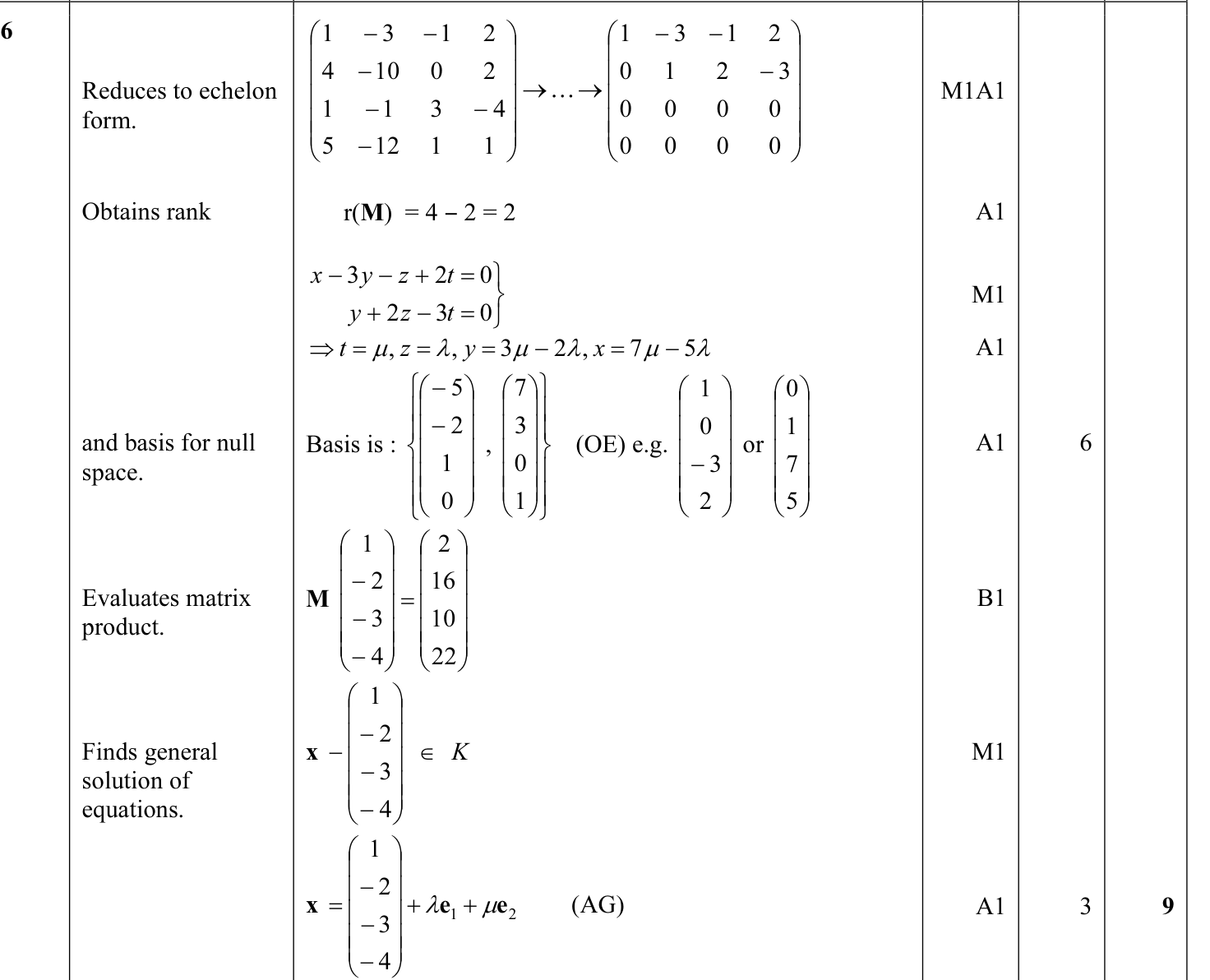
\(\mathbf{M}=\left(\begin{array}{rrrr} 1 & -3 & -1 & 2 \\ 4 & -10 & 0 & 2 \\ 1 & -1 & 3 & -4 \\ 5 & -12 & 1 & 1 \end{array}\right) .\)
Find, in either order, the rank of \(\mathbf{M}\) and a basis for the null space \(K\) of T .
Evaluate
\(\mathbf{M}\left(\begin{array}{r} 1 \\ -2 \\ -3 \\ -4 \end{array}\right),\)
and hence show that every solution of
\(\mathbf{M x}=\left(\begin{array}{r} 2 \\ 16 \\ 10 \\ \end{array}\right)\)
has the form
\(\mathbf{x}=\left(\begin{array}{r} 1 \\ -2 \\ -3 \\ -4 \end{array}\right)+\lambda \mathbf{e}_{1}+\mu \mathbf{e}_{2},\)
where \(\lambda\) and \(\mu\) are real numbers and \(\left\{\mathbf{e}_{1}, \mathbf{e}_{2}\right\}\) is a basis for \(K\).