Browsing as Guest. Progress, bookmarks and attempts are disabled.
Log in to track your work.
Problem 519
519
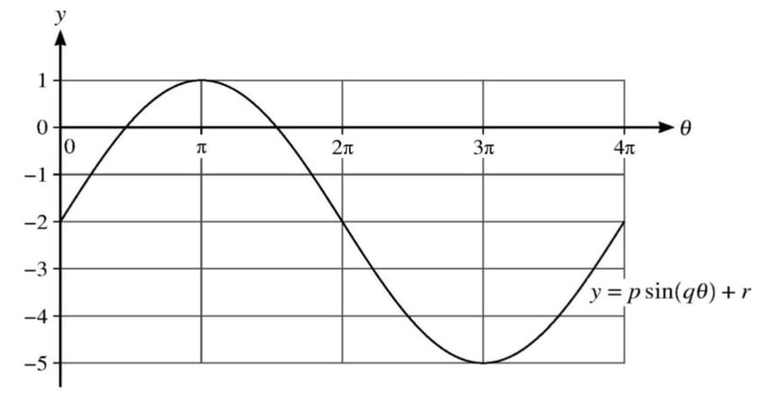
The diagram shows part of the curve with equation \(y = p \sin(q\theta) + r\), where \(p, q\) and \(r\) are constants.
(a) State the value of \(p\).
(b) State the value of \(q\).
(c) State the value of \(r\).
Solution
The equation of the curve is given by \(y = p \sin(q\theta) + r\).
(a) The amplitude of the sine function is the coefficient \(p\). From the graph, the maximum value is 1 and the minimum value is -5, giving an amplitude of \(\frac{1 - (-5)}{2} = 3\). Thus, \(p = 3\).
(b) The period of the sine function is given by \(\frac{2\pi}{q}\). From the graph, the period is \(4\pi\), so \(\frac{2\pi}{q} = 4\pi\). Solving for \(q\), we get \(q = \frac{1}{2}\).
(c) The vertical shift \(r\) is the average of the maximum and minimum values of the function. Thus, \(r = \frac{1 + (-5)}{2} = -2\).