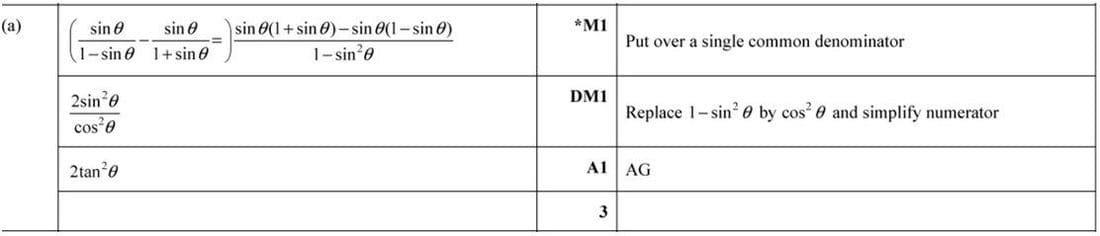
9709 P11 - Nov 2020 - Q7A - 3 marks
483
Show that \(\frac{\sin \theta}{1 - \sin \theta} - \frac{\sin \theta}{1 + \sin \theta} \equiv 2 \tan^2 \theta\).
Solution
Start by combining the fractions over a common denominator:
\(\frac{\sin \theta}{1 - \sin \theta} - \frac{\sin \theta}{1 + \sin \theta} = \frac{\sin \theta (1 + \sin \theta) - \sin \theta (1 - \sin \theta)}{(1 - \sin \theta)(1 + \sin \theta)}\)
Simplify the numerator:
\(\sin \theta (1 + \sin \theta) - \sin \theta (1 - \sin \theta) = \sin \theta + \sin^2 \theta - \sin \theta + \sin^2 \theta = 2 \sin^2 \theta\)
The denominator simplifies using the identity \((1 - \sin \theta)(1 + \sin \theta) = 1 - \sin^2 \theta = \cos^2 \theta\):
\(\frac{2 \sin^2 \theta}{\cos^2 \theta} = 2 \tan^2 \theta\)
Thus, the expression simplifies to \(2 \tan^2 \theta\), as required.