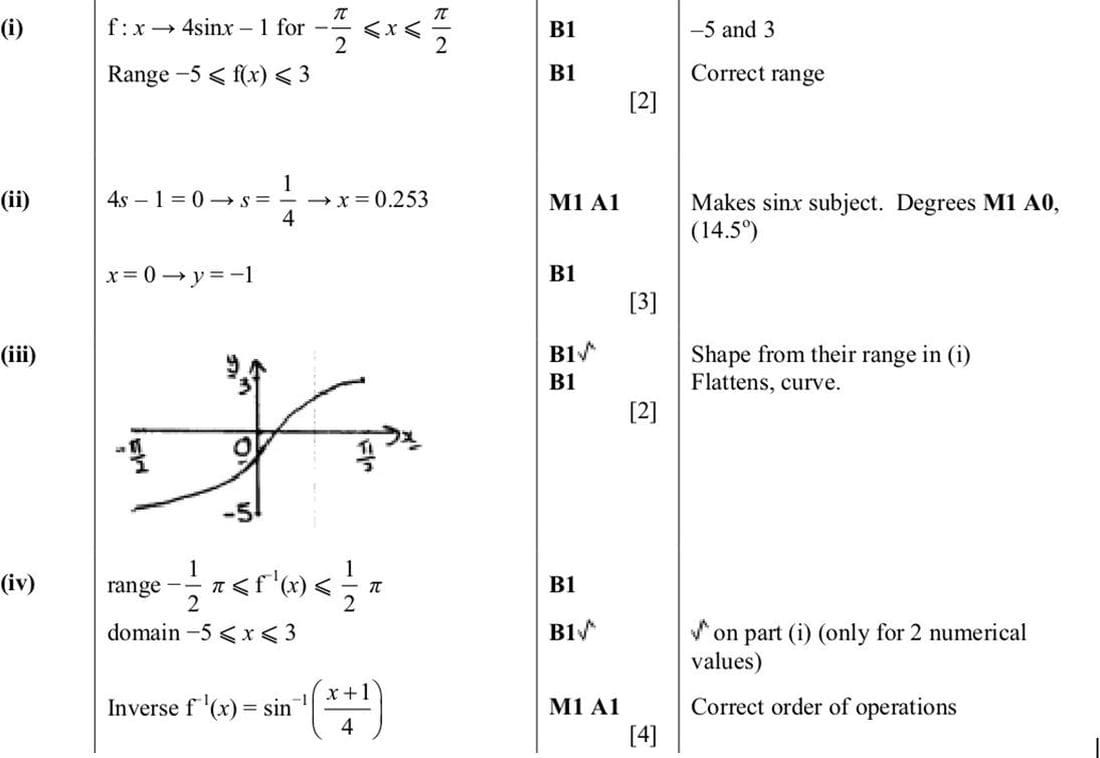
(i) The function \(f(x) = 4 \sin x - 1\) has a maximum value when \(\sin x = 1\) and a minimum value when \(\sin x = -1\). Therefore, the range of \(f(x)\) is:
\(4(-1) - 1 \leq f(x) \leq 4(1) - 1\)
\(-5 \leq f(x) \leq 3\)
(ii) To find the x-intercept, set \(f(x) = 0\):
\(4 \sin x - 1 = 0\)
\(\sin x = \frac{1}{4}\)
\(x = \sin^{-1}\left(\frac{1}{4}\right) \approx 0.253\)
So, the x-intercept is \((0.253, 0)\).
For the y-intercept, set \(x = 0\):
\(f(0) = 4 \sin 0 - 1 = -1\)
So, the y-intercept is \((0, -1)\).
(iii) The graph of \(y = f(x)\) is a sinusoidal curve starting at \((0, -1)\), peaking at \((\frac{1}{2}\pi, 3)\), and troughing at \((-\frac{1}{2}\pi, -5)\).
(iv) To find the inverse, solve \(y = 4 \sin x - 1\) for \(x\):
\(y + 1 = 4 \sin x\)
\(\sin x = \frac{y + 1}{4}\)
\(x = \sin^{-1}\left(\frac{y + 1}{4}\right)\)
Thus, \(f^{-1}(x) = \sin^{-1}\left(\frac{x + 1}{4}\right)\).
The domain of \(f^{-1}\) is the range of \(f\), \(-5 \leq x \leq 3\), and the range of \(f^{-1}\) is the domain of \(f\), \(-\frac{1}{2}\pi \leq f^{-1}(x) \leq \frac{1}{2}\pi\).