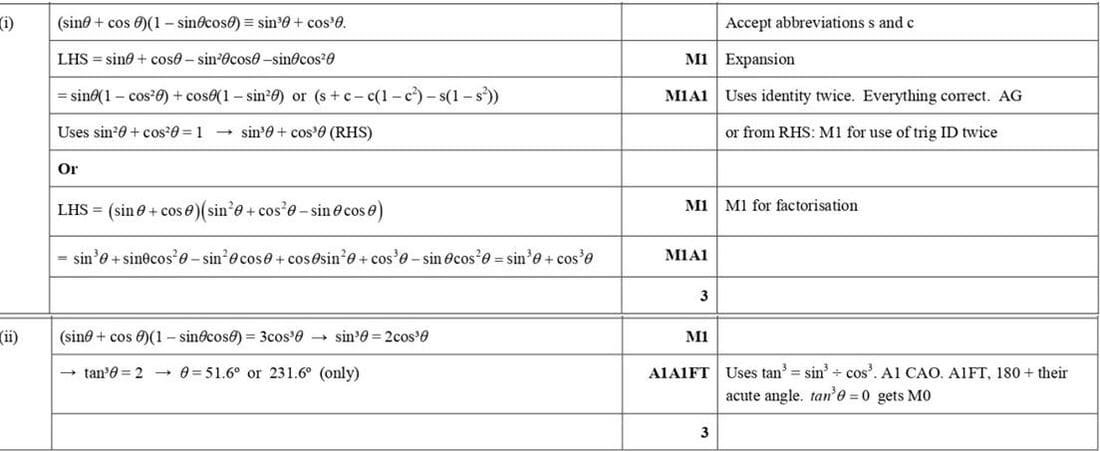
(i) To prove the identity \((\sin \theta + \cos \theta)(1 - \sin \theta \cos \theta) \equiv \sin^3 \theta + \cos^3 \theta\):
Expand the left-hand side (LHS):
\(\sin \theta + \cos \theta - \sin^2 \theta \cos \theta - \sin \theta \cos^2 \theta\)
Rearrange terms:
\(= \sin \theta (1 - \cos^2 \theta) + \cos \theta (1 - \sin^2 \theta)\)
Using \(\sin^2 \theta + \cos^2 \theta = 1\), this simplifies to:
\(= \sin^3 \theta + \cos^3 \theta\)
Thus, the identity is proven.
(ii) Solve \((\sin \theta + \cos \theta)(1 - \sin \theta \cos \theta) = 3 \cos^3 \theta\):
From part (i), \(\sin^3 \theta + \cos^3 \theta = 3 \cos^3 \theta\)
Rearrange to get:
\(\sin^3 \theta = 2 \cos^3 \theta\)
Divide both sides by \(\cos^3 \theta\):
\(\tan^3 \theta = 2\)
Taking the cube root gives:
\(\tan \theta = \sqrt[3]{2}\)
Calculate \(\theta\) using \(\tan^{-1}(\sqrt[3]{2})\):
\(\theta = 51.6^\circ\) or \(231.6^\circ\) (considering the periodicity of tangent).