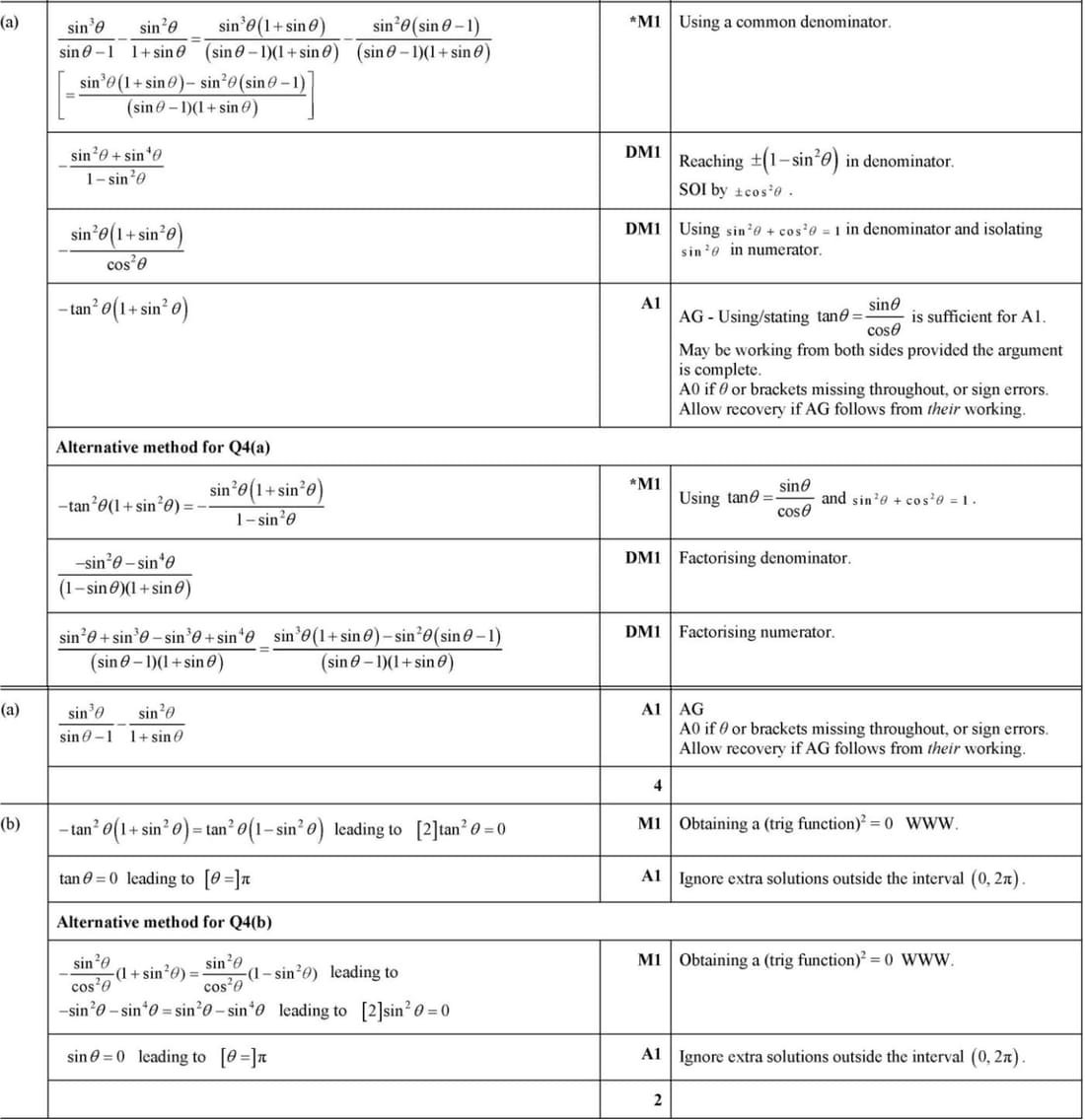
(a) To prove the identity, start by using a common denominator:
\(\frac{\sin^3 \theta}{\sin \theta - 1} - \frac{\sin^2 \theta}{1 + \sin \theta} = \frac{\sin^3 \theta (1 + \sin \theta) - \sin^2 \theta (\sin \theta - 1)}{(\sin \theta - 1)(1 + \sin \theta)}\)
Simplify the numerator:
\(\sin^3 \theta + \sin^4 \theta - \sin^3 \theta + \sin^2 \theta = \sin^4 \theta + \sin^2 \theta\)
Factor the numerator:
\(\sin^2 \theta (\sin^2 \theta + 1)\)
Recognize that \(\sin^2 \theta + \cos^2 \theta = 1\), so \(\cos^2 \theta = 1 - \sin^2 \theta\).
Thus, the expression becomes:
\(\frac{\sin^2 \theta (1 + \sin^2 \theta)}{\cos^2 \theta} = \tan^2 \theta (1 + \sin^2 \theta)\)
Therefore, the identity is proven.
(b) To solve the equation:
\(\frac{\sin^3 \theta}{\sin \theta - 1} - \frac{\sin^2 \theta}{1 + \sin \theta} = \tan^2 \theta (1 - \sin^2 \theta)\)
From part (a), we have:
\(-\tan^2 \theta (1 + \sin^2 \theta) = \tan^2 \theta (1 - \sin^2 \theta)\)
Equating gives:
\(2 \tan^2 \theta = 0\)
Thus, \(\tan^2 \theta = 0\), leading to \(\tan \theta = 0\).
The solutions for \(\tan \theta = 0\) in the interval \(0 < \theta < 2\pi\) are \(\theta = \pi\).