Start with the equation:
\(3 \tan^2 \theta + 1 = \frac{2}{\tan^2 \theta}\)
Multiply through by \(\tan^2 \theta\) to eliminate the fraction:
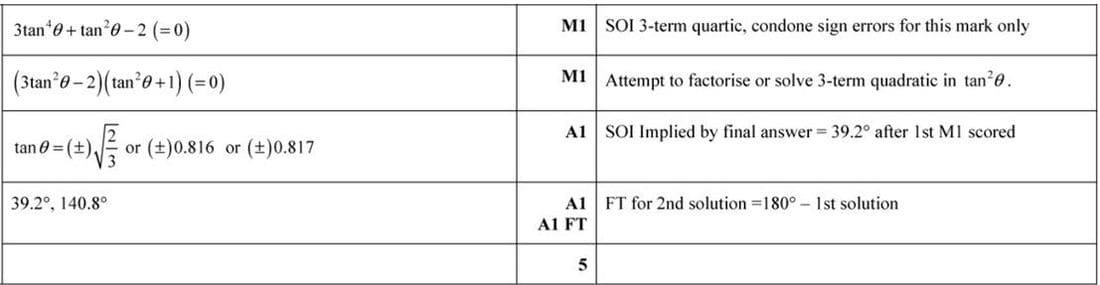
\(3 \tan^4 \theta + \tan^2 \theta - 2 = 0\)
Let \(x = \tan^2 \theta\), then the equation becomes:
\(3x^2 + x - 2 = 0\)
Factor the quadratic equation:
\((3x - 2)(x + 1) = 0\)
Thus, \(x = \frac{2}{3}\) or \(x = -1\).
Since \(x = \tan^2 \theta\), \(x\) must be non-negative, so \(x = -1\) is not valid.
Therefore, \(\tan^2 \theta = \frac{2}{3}\).
Take the square root to find \(\tan \theta\):
\(\tan \theta = \pm \sqrt{\frac{2}{3}}\)
Calculate \(\theta\) using the inverse tangent function:
\(\theta = \tan^{-1}(\sqrt{\frac{2}{3}}) \approx 39.2^\circ\)
Since \(\tan \theta\) is positive in the first and third quadrants, the solutions are:
\(\theta = 39.2^\circ\) and \(\theta = 180^\circ - 39.2^\circ = 140.8^\circ\)