(i) Start with the expression:
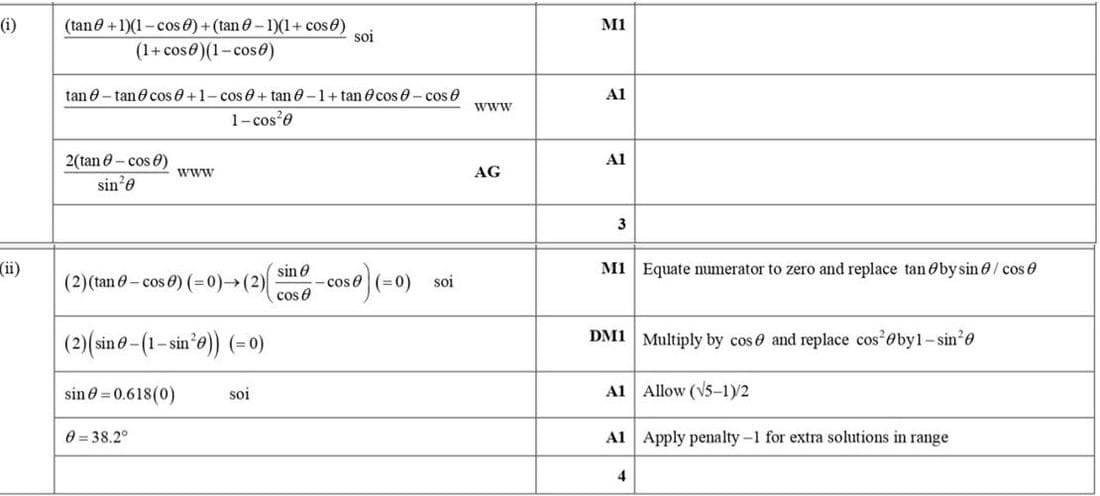
\(\frac{\tan \theta + 1}{1 + \cos \theta} + \frac{\tan \theta - 1}{1 - \cos \theta}\)
Combine the fractions:
\(\frac{(\tan \theta + 1)(1 - \cos \theta) + (\tan \theta - 1)(1 + \cos \theta)}{(1 + \cos \theta)(1 - \cos \theta)}\)
Simplify the numerator:
\(\tan \theta - \tan \theta \cos \theta + 1 - \cos \theta + \tan \theta + \tan \theta \cos \theta - 1 - \cos \theta\)
\(= 2\tan \theta - 2\cos \theta\)
The denominator is:
\(1 - \cos^2 \theta = \sin^2 \theta\)
Thus, the expression simplifies to:
\(\frac{2(\tan \theta - \cos \theta)}{\sin^2 \theta}\)
(ii) Set the expression to zero:
\(\frac{2(\tan \theta - \cos \theta)}{\sin^2 \theta} = 0\)
This implies:
\(\tan \theta - \cos \theta = 0\)
\(\frac{\sin \theta}{\cos \theta} = \cos \theta\)
\(\sin \theta = \cos^2 \theta\)
\(\sin \theta = 1 - \sin^2 \theta\)
\(\sin^2 \theta + \sin \theta - 1 = 0\)
Using the quadratic formula, solve for \(\sin \theta\):
\(\sin \theta = \frac{-1 \pm \sqrt{1 + 4}}{2} = \frac{-1 \pm \sqrt{5}}{2}\)
\(\sin \theta = 0.618\)
\(\theta = 38.2^\circ\)