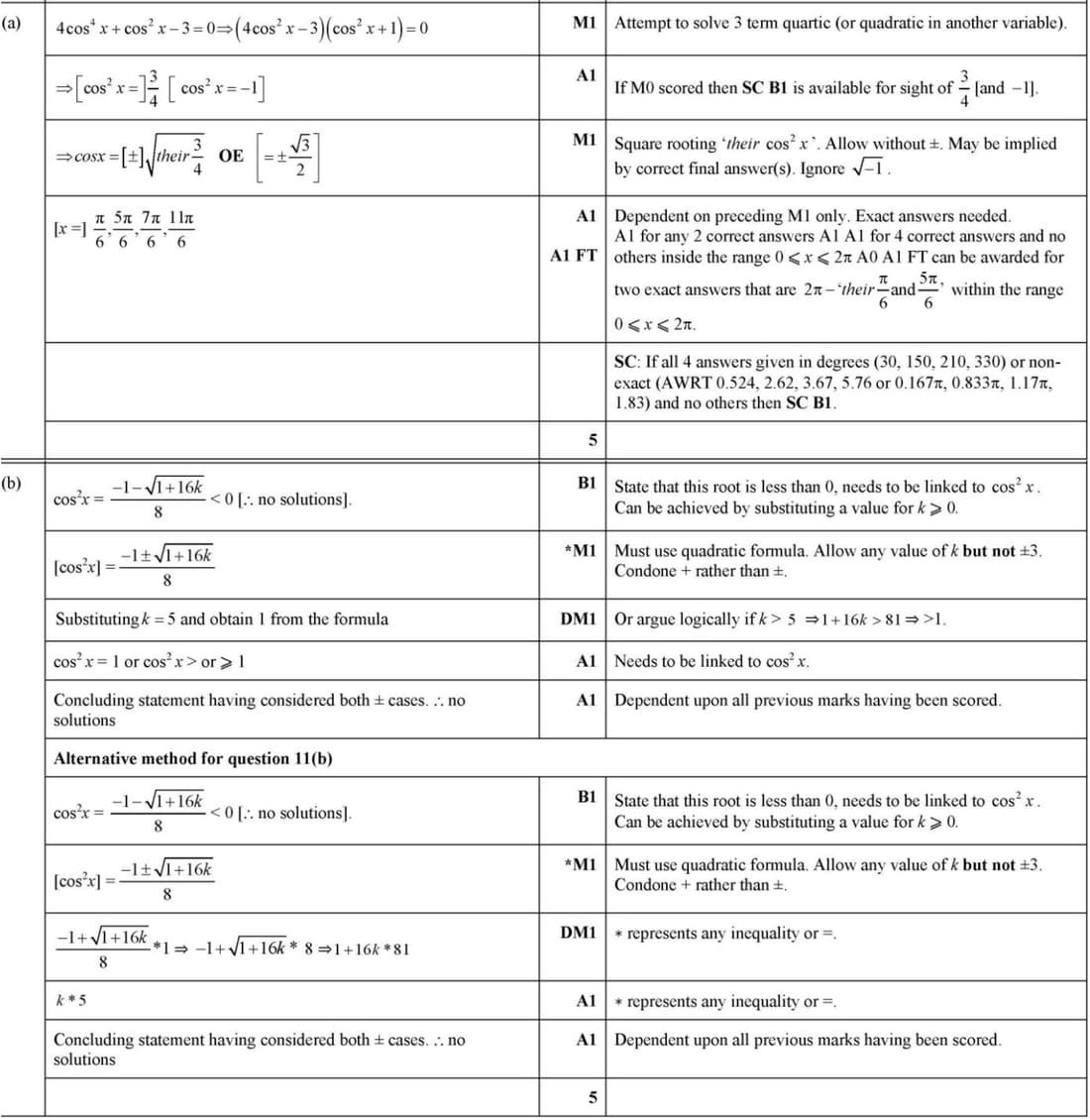
(a) Start with the equation \(4 \cos^4 x + \cos^2 x - 3 = 0\).
Let \(y = \cos^2 x\), then the equation becomes \(4y^2 + y - 3 = 0\).
Factor the quadratic: \((4y - 3)(y + 1) = 0\).
Thus, \(y = \frac{3}{4}\) or \(y = -1\).
Since \(y = \cos^2 x\), \(\cos^2 x = \frac{3}{4}\) (ignore \(y = -1\) as \(\cos^2 x \geq 0\)).
\(\cos x = \pm \frac{\sqrt{3}}{2}\).
Solutions for \(x\) are \(x = \frac{\pi}{6}, \frac{5\pi}{6}, \frac{7\pi}{6}, \frac{11\pi}{6}\).
(b) Use the quadratic formula for \(4 \cos^4 x + \cos^2 x - k = 0\).
Let \(y = \cos^2 x\), then \(4y^2 + y - k = 0\).
Using the quadratic formula: \(y = \frac{-1 \pm \sqrt{1 + 16k}}{8}\).
For \(k > 5\), \(1 + 16k > 81\), so \(\sqrt{1 + 16k} > 9\).
Thus, \(y = \frac{-1 \pm \text{something greater than 9}}{8}\).
This implies \(y < 0\) or \(y > 1\), which are not possible for \(\cos^2 x\).
Therefore, no solutions exist for \(k > 5\).