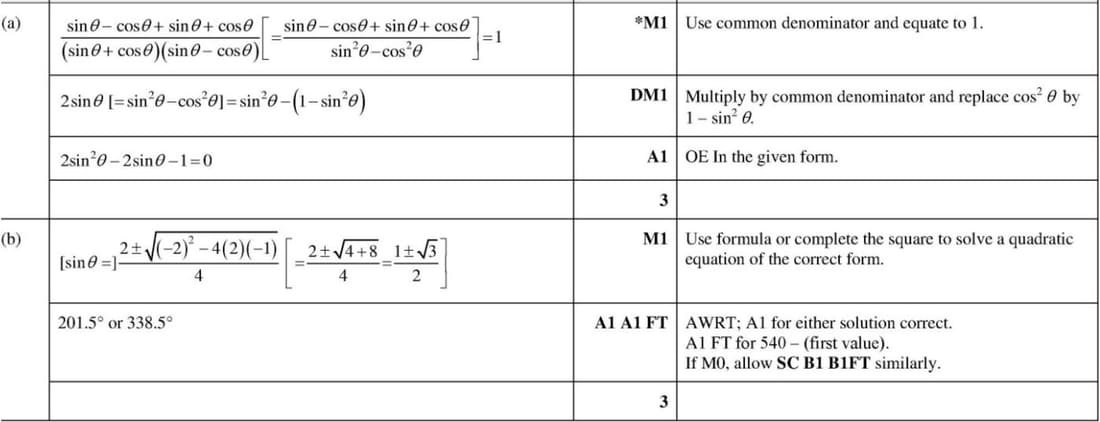
(a) Start with the equation:
\(\frac{1}{\sin \theta + \cos \theta} + \frac{1}{\sin \theta - \cos \theta} = 1\)
Find a common denominator:
\(\frac{\sin \theta - \cos \theta + \sin \theta + \cos \theta}{(\sin \theta + \cos \theta)(\sin \theta - \cos \theta)} = 1\)
Simplify the numerator:
\(\frac{2\sin \theta}{\sin^2 \theta - \cos^2 \theta} = 1\)
Use the identity \(\cos^2 \theta = 1 - \sin^2 \theta\):
\(2\sin \theta = \sin^2 \theta - (1 - \sin^2 \theta)\)
Simplify to get:
\(2\sin^2 \theta - 2\sin \theta - 1 = 0\)
Thus, the equation is in the form \(a \sin^2 \theta + b \sin \theta + c = 0\) with \(a = 2, b = -2, c = -1\).
(b) Solve the quadratic equation \(2\sin^2 \theta - 2\sin \theta - 1 = 0\) using the quadratic formula:
\(\sin \theta = \frac{-b \pm \sqrt{b^2 - 4ac}}{2a}\)
Substitute \(a = 2, b = -2, c = -1\):
\(\sin \theta = \frac{2 \pm \sqrt{(-2)^2 - 4 \times 2 \times (-1)}}{4}\)
\(\sin \theta = \frac{2 \pm \sqrt{4 + 8}}{4}\)
\(\sin \theta = \frac{2 \pm \sqrt{12}}{4}\)
\(\sin \theta = \frac{2 \pm 2\sqrt{3}}{4}\)
\(\sin \theta = \frac{1 \pm \sqrt{3}}{2}\)
For \(\sin \theta = \frac{1 + \sqrt{3}}{2}\), \(\theta \approx 201.5^\circ\).
For \(\sin \theta = \frac{1 - \sqrt{3}}{2}\), \(\theta \approx 338.5^\circ\).