Learn the method, study an example, then explain your reasoning in an exam-style problem. Work on paper before opening the solution and compare each step with the marking guidance.
Finite binomial expansions and signs
Expand a binomial with a nonnegative integer power, keeping coefficients and signs correct.
Notes
Before you start: multiply brackets, use integer powers and collect like terms.
For a nonnegative integer n, the binomial theorem is the exact finite identity
\[(a+b)^n=\sum_{r=0}^n\binom nr a^{n-r}b^r,\qquad \binom nr=\frac{n!}{r!(n-r)!}.\]
Here 0!=1 and the index r runs through integers 0,…,n. For n=0 the expansion is the constant 1 as a polynomial identity. This block uses finite expansions only: it does not apply an infinite-series rule to a negative or fractional exponent.
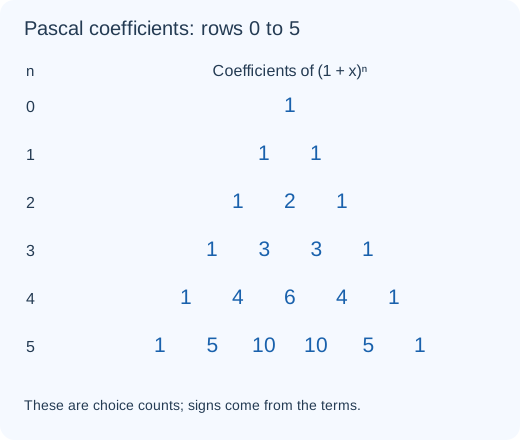
In \((a+bx)^n\), choose the second term from r of the n factors. There are \(\binom nr\) such choices. The powers of a decrease as the powers of bx increase. In \((a-bx)^n\), odd r gives a minus sign and even r a plus sign; the Pascal coefficient itself remains nonnegative.
“First three terms in ascending powers of x” means the constant, x and x² terms, when present. Keep the power of the constant a: the x² coefficient is \(\binom n2 a^{n-2}b^2\), not just the Pascal number.
Recall later
\((1-2x)^3=1-6x+12x^2-8x^3\). The coefficients of the even powers are positive, while those of the odd powers are negative.
Common mistakes
Dropping the power of the constant part.
Alternating the signs of Pascal numbers instead of applying the power to the entire negative term.
Using a finite integer-power formula for a negative or fractional exponent.
Three worked examples
Example 1
Expand \((1+3x)^4\) completely.
Show the reasoning
The Pascal row is 1,4,6,4,1. Multiplying by successive powers of 3x gives \(1+12x+54x^2+108x^3+81x^4\). Check at x=0: both sides equal 1.
Example 2
Find the first three terms of \((2-x)^5\) in ascending powers of x.
Show the reasoning
The terms are \(2^5+5(2^4)(-x)+10(2^3)(-x)^2=32-80x+80x^2\). In particular, the third term still contains a factor 2³.
Example 3
Simplify \((1+x)^4+(1-x)^4\).
Show the reasoning
The expansions differ only in the signs of the odd powers. Adding cancels those terms and doubles the even ones, giving \(2+12x^2+2x^4\).
Translate a requested power into an integer index and distinguish a coefficient from a term.
Notes
Before you start: use the binomial theorem and the laws of indices, including negative powers.
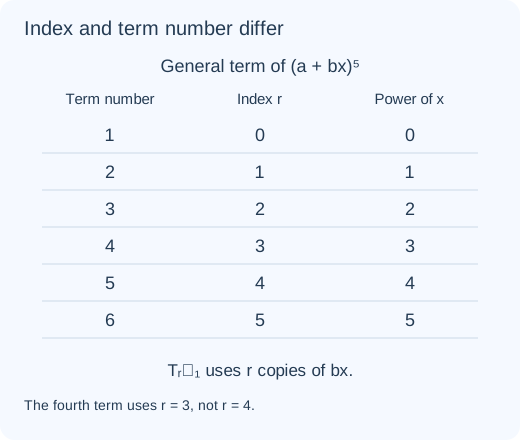
For \((a+bx)^n\), the general term in binomial order is \(T_{r+1}=\binom nr a^{n-r}b^r x^r\), for integers 0≤r≤n. The first term uses r=0, so the fourth term uses r=3. A coefficient is the factor multiplying a power of x; a term includes that power.
For integer p and q in \((Ax^p+Bx^q)^n\), combine the powers before solving for an index:
\[T_{r+1}=\binom nr A^{n-r}B^r x^{p(n-r)+qr}.\]
Set the exponent equal to the requested power. A solution contributes only when r is an integer in [0,n]. If no such r exists, that coefficient is zero. For negative powers, x≠0; a “constant term” has exponent zero and is not found by substituting x=0 into an undefined expression.
Recall later
The coefficient of x² in \((1+2x)^5\) is 40; its third term is 40x². These are different answers to different requests.
Common mistakes
Confusing the index r with the term number r+1.
Accepting a fractional or out-of-range index as a contributing term.
Substituting zero to find a constant term when negative powers make the expression undefined there.
Three worked examples
Example 1
Find the coefficient of x³ in \((3-2x)^5\).
Show the reasoning
Use r=3: \(\binom53 3^2(-2)^3=10(9)(-8)=-720\). The term is −720x³, but the requested coefficient is −720.
Example 2
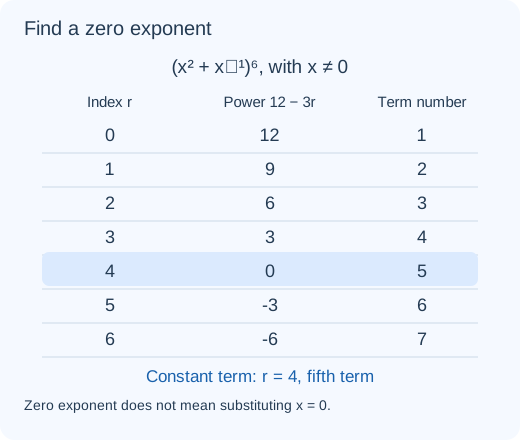
Find the constant term in \((x^2+x^{-1})^6\), with x≠0.
Show the reasoning
The exponent is 2(6−r)−r=12−3r. Set it to zero, obtaining r=4. The coefficient is \(\binom64=15\). It is the fifth term, not the fourth.
Example 3
Find the fourth and last terms in binomial order for \((1+2x)^5\).
Show the reasoning
The fourth uses r=3 and equals \(\binom53(2x)^3=80x^3\). The last uses r=5 and equals \((2x)^5=32x^5\).
Collect every contributing power pair and use identities to simplify coefficient questions.
Notes
Before you start: find a binomial coefficient and multiply polynomials.
If \(A(x)=\sum a_i x^i\) and \(B(x)=\sum b_j x^j\) are polynomials in nonnegative powers, the coefficient of xᵐ in A(x)B(x) is \(\sum_{i=0}^m a_i b_{m-i}\). List all power pairs that add to m. For m=2 these are (0,2), (1,1) and (2,0); the middle product is easy to miss.
For ordinary polynomials, powers higher than m cannot contribute to xᵐ, so it is safe to truncate each factor above that degree. This shortcut needs care with negative powers: a high positive power can combine with a negative one to give the target.
Before multiplying, look for \((1+x)^n(1-x)^n=(1-x^2)^n\). This contains only even powers. More generally, if F is a polynomial, its even- and odd-power coefficient sums are \((F(1)+F(-1))/2\) and \((F(1)-F(-1))/2\). This follows because (−1) to an even power is 1 and to an odd power is −1.
Recall later
The coefficient of x² in \((1+2x)(1+3x)\) is 6, from the pair (1,1). Adding the separate x² coefficients would give the wrong answer.
Common mistakes
Missing the cross-product when collecting a coefficient.
Keeping only same-degree terms instead of pairs whose powers add to the target.
Applying polynomial truncation to factors with negative powers without checking other possible pairs.
Three worked examples
Example 1
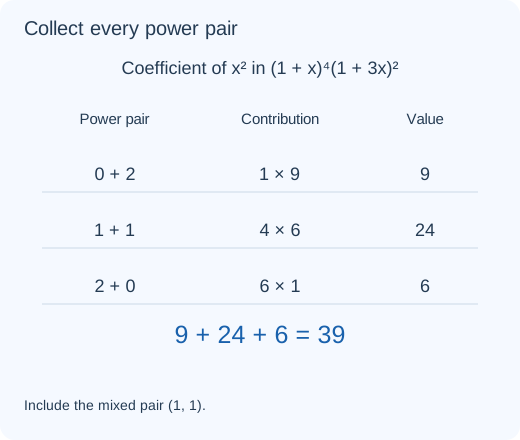
Find the x² coefficient in \((1+x)^4(1+3x)^2\).
Show the reasoning
Relevant terms are \(1+4x+6x^2\) and \(1+6x+9x^2\). The coefficient is \(1(9)+4(6)+6(1)=39\).
Example 2
Find the coefficient of x⁶ in \((1+x)^5(1-x)^5\).
Show the reasoning
Rewrite the product as \((1-x^2)^5\). The target uses r=3, giving \(\binom53(-1)^3=-10\). All odd-power coefficients are zero.
Example 3
Let \(F(x)=(2+x)^3(1-x)^2\). Find the sum of its odd-power coefficients.
Show the reasoning
\(F(1)=0\) and \(F(-1)=4\). If E and O are the even and odd coefficient sums, then E+O=0 and E−O=4. Thus \(O=(0-4)/2=-2\). This is a coefficient sum, not the coefficient of a single power.
Turn coefficient information into equations and retain every admissible parameter value.
Notes
Before you start: solve linear and quadratic equations, and use the first coefficients of a binomial expansion.
For \((1+ax)^n\), the x and x² coefficients are \(c_1=na\) and \(c_2=n(n-1)a^2/2\). With n≥2 and a≠0,
\[\frac{c_2}{c_1^2}=\frac{n-1}{2n}.\]
The ratio can recover n before a. State why any division is valid. The exponent must still be a nonnegative integer in this finite-expansion setting; do not accept an algebraic value that violates the question.
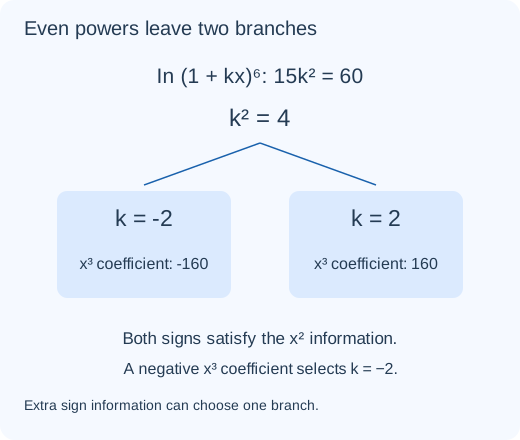
An even-power coefficient may determine a² without choosing a sign. If no additional information selects a branch, both values must be retained. An odd-power coefficient or a stated sign condition can distinguish them.
Recall later
From k²=4 alone, k=−2 or k=2. Reporting only the positive root loses an admissible parameter.
Common mistakes
Discarding the negative parameter root without a reason.
Treating n as an unrestricted real number in a finite binomial formula.
Dividing by a coefficient or parameter without checking that it is nonzero.
Three worked examples
Example 1
The coefficient of x in \((1+cx)^5\) is 20. Find c and the x² coefficient.
Show the reasoning
5c=20 gives c=4. Then \(\binom52c^2=10(16)=160\).
Example 2
The coefficient of x² in \((1+kx)^6\) is 60. Find all real k.
Show the reasoning
\(15k^2=60\), so k²=4 and k=±2. Neither sign is excluded by the given information.
Example 3
In \((1+ax)^n\), n is an integer at least 2 and a≠0. The x and x² coefficients are 15 and 90. Find n and a.
Show the reasoning
\(na=15\) and \(n(n-1)a^2/2=90\). Divide the second equation by the square of the first: \((n-1)/(2n)=90/225=2/5\). Hence 5n−5=4n, so n=5 and a=3. Checking gives 5(3)=15 and 10(9)=90.
Finite expansions as approximations: keep the remainder
Choose a substitution, evaluate a truncated expansion and determine its actual error.
Notes
Before you start: expand integer powers, substitute decimals accurately and use units for modelled quantities.
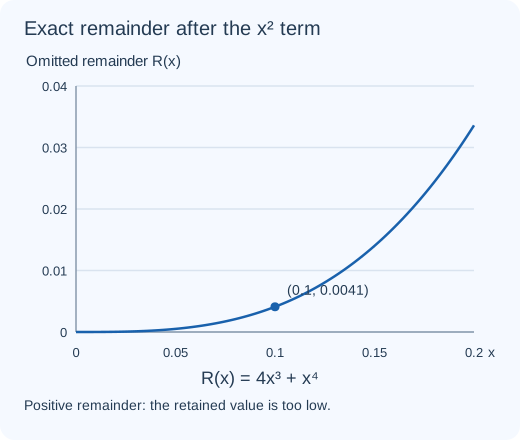
A finite binomial expansion is exact. An approximation is introduced only when terms are omitted. Write \(F(x)=P(x)+R(x)\), where P is the retained polynomial and R is the exact omitted remainder. If R>0, P underestimates F; if R<0, it overestimates F. The absolute error is |R|.
For a positive integer n, the first terms of \((1+x)^n\) are \(1+nx+\binom n2x^2+\cdots\). A small |x| often makes later terms less important, but it does not on its own prove a requested error bound. Check the actual remainder and the stated substitution. A finite expansion has no |x|<1 convergence requirement.
For a relative change t in the side of a cube, the volume factor is \((1+t)^3\). First-order volume growth is approximately 3t, while 3t²+t³ is the discarded factor. Keep a percentage such as 2% as t=0.02, and distinguish an error in volume units from a percentage error.
Recall later
Using 1+3x+3x² for \((1+x)^3\) leaves the exact remainder x³. Its sign changes when x changes sign.
Common mistakes
Claiming the full finite expansion is only an approximation.
Assuming the sign of an omitted sum from its first term without checking the rest.
Using 2 instead of 0.02 for a 2% change or mixing relative and absolute error.
Three worked examples
Example 1
Use terms through x² to estimate \(1.01^4\), and find the exact error.
Show the reasoning
Put x=0.01 into \(1+4x+6x^2\), giving 1.0406. The omitted remainder is \(4x^3+x^4=0.00000401\). Thus the estimate is low and the exact value is 1.04060401.
Example 2
Use the first three terms of \((1-x)^6\) to estimate \(0.98^6\).
Show the reasoning
The retained polynomial is \(1-6x+15x^2\). Put x=0.02 to obtain 0.886. The exact remainder is \(-20x^3+15x^4-6x^5+x^6=-0.000157619136\). It is negative here, so the estimate is high; the exact value is 0.885842380864.
Example 3
Approximate \(0.96^3\) by the first three terms of \((1-x)^3\), and identify the error direction.
Show the reasoning
With x=0.04, \(1-3x+3x^2=0.8848\). The remainder is −x³=−0.000064. Therefore the approximation overestimates the exact value 0.884736 by 0.000064.