Learn the method, study an example, then explain your reasoning in an exam-style problem. Work on paper before opening the solution and compare each step with the marking guidance.
Power integrals, constants and limits
Find an antiderivative, retain its domain and evaluate a definite integral in the correct order.
Notes
Before you start: differentiate powers, simplify indices and substitute into an expression.
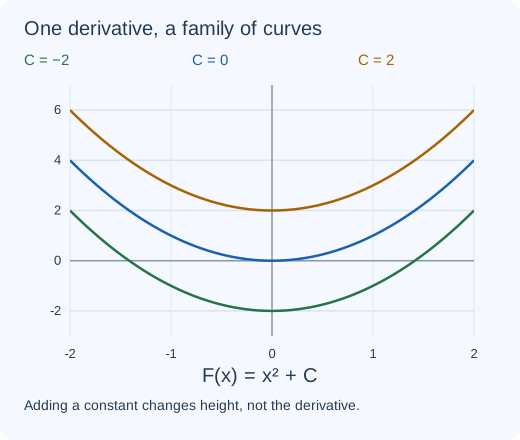
An antiderivative F satisfies F′=f on the interval being considered. The indefinite integral describes the family F+C, because differentiating a constant gives zero. On a connected interval any two antiderivatives differ by a constant; separate intervals of a disconnected domain need not share one constant.
Increase the power and divide by the new power. Integrate sums term by term and keep constant multipliers. Negative powers require x≠0; fractional-power examples here use positive bases. The n=−1 case cannot use this formula: it would divide by zero and requires a logarithmic antiderivative.
For a nonzero constant a and n≠−1, reverse the linear-inner-function chain rule:
Check by differentiating. If a=0 and the integrand is defined, integrate the resulting constant instead of dividing by a. For a continuous integrand on [u,v] with antiderivative F throughout the interval,
\[\int_u^v f(x)\,dx=F(v)-F(u).\]
Upper limit first, lower limit second. A constant cancels, so a definite integral is a number without an arbitrary +C. Reversing limits changes its sign. Check the entire interval: endpoint subtraction alone does not justify crossing a singularity.
Recall later
\(\int 3x^2\,dx=x^3+C\), while \(\int_0^2 3x^2\,dx=8\). The two requests have different types of answer.
Common mistakes
Using the differentiation power rule instead of increasing the exponent.
Omitting an indefinite constant or adding an arbitrary constant to a definite answer.
Forgetting the inner-function divisor, using the n=−1 formula or crossing a zero denominator.
Three worked examples
Example 1
Find \(\int(4x^3-6x+5)\,dx\).
Show the reasoning
Integrating each term gives \(x^4-3x^2+5x+C\). Differentiation recovers all three original terms, including the constant integrand 5.
Example 2
Find \(\int(3x+2)^2\,dx\).
Show the reasoning
The result is \((3x+2)^3/9+C\). Differentiating multiplies by 3 from the cube and by 3 from the inner function, cancelling the denominator 9. Expanding first gives an equivalent answer differing only by a constant.
Example 3
Evaluate \(\int_1^4(\sqrt{x}+2x^{-2})\,dx\).
Show the reasoning
On [1,4] the integrand is continuous. An antiderivative is \((2/3)x^{3/2}-2/x\). The endpoint values are 29/6 and −4/3, so the integral is \(29/6-(-4/3)=37/6\).
Use point and slope data to determine each integration constant.
Notes
Before you start: integrate powers and substitute a point into a curve equation.
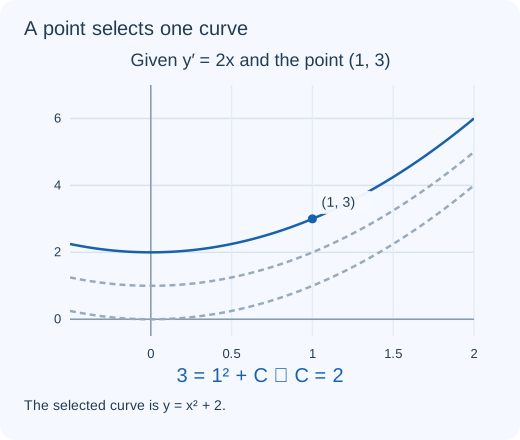
If dy/dx is known, integrate once to obtain y=F(x)+C. A point (a,b) gives b=F(a)+C and selects one curve from the family. Substitute into the curve, not into the given gradient, to determine C.
If the second derivative is given, two integrations introduce two independent constants. Use slope data to determine the first and point data to determine the second. Do not reuse one symbol as if the constants must be equal.
After recovering the curve, check every original condition: differentiate once or twice, test the supplied slope and substitute the point. A tangent or normal then uses the recovered ordinate and the appropriate derivative. All checks must stay inside the stated domain.
Recall later
If y′=2x and y(1)=3, then y=x²+2. Knowing the gradient alone would leave C undetermined.
Common mistakes
Using a point condition in the derivative instead of the curve equation.
Losing the second independent constant when integrating twice.
Giving a family of curves when the supplied conditions determine a single member.
Three worked examples
Example 1
A curve has y′=2x and passes through (1,3). Find its equation.
Show the reasoning
Integrate to y=x²+C. Substituting (1,3) gives 3=1+C, so C=2 and y=x²+2. Its derivative is 2x as required.
Example 2
A curve has y′=4x−3 and passes through (2,7). Find y.
Show the reasoning
Integrate to y=2x²−3x+C. At x=2 this is 2+C, so C=5. The equation is \(y=2x^2-3x+5\).
Example 3
Given y″=6x, y′(0)=−2 and y(1)=4, find y.
Show the reasoning
First, y′=3x²+A and A=−2. Next, y=x³−2x+B. The point condition gives 4=1−2+B, so B=5. Thus y=x³−2x+5; differentiation and both conditions check.
Split at crossings and subtract the lower curve from the upper curve.
Notes
Before you start: find roots and intersections, determine signs and evaluate definite integrals.
A definite integral measures signed accumulation. Above-axis contributions are positive and below-axis contributions negative. Geometric area is nonnegative: split at each sign-changing crossing and add the magnitudes of the pieces. Taking the absolute value only after all pieces have cancelled can give the wrong area.
Between two curves, solve their intersection equation to find the relevant boundaries. On an interval where U is the upper curve and L the lower curve,
\[A=\int_a^b\{U(x)-L(x)\}\,dx.\]
Check which curve is above rather than using the order in which they were named. Split again if that order changes. Axis crossings alone do not force a split for U−L if the same curve stays upper: vertical separation is the quantity being integrated.
Recall later
If an integral is zero, positive and negative contributions may cancel. The graph need not lie on the axis and its geometric area need not be zero.
Common mistakes
Treating a negative integral as a negative geometric area.
Taking one absolute value after cancellation instead of splitting the region.
Using lower minus upper or forgetting an intersection inside the interval.
Three worked examples
Example 1
Compare the signed integral and total area for y=x²−1 on [−2,2].
Show the reasoning
An antiderivative is x³/3−x. The signed integral is 4/3. The middle piece from −1 to 1 has signed value −4/3; the two outer pieces total 8/3. The geometric area is 8/3+4/3=4.
Example 2
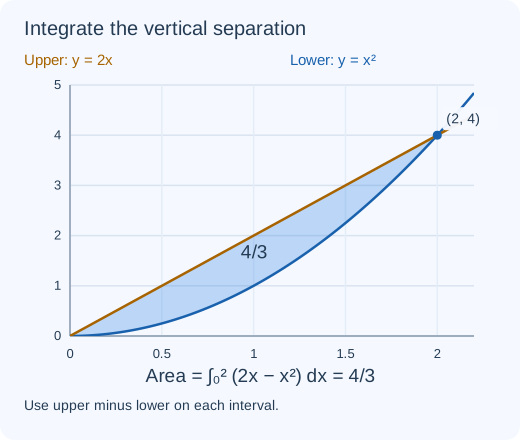
Find the area enclosed by y=2x and y=x².
Show the reasoning
The intersections solve x²=2x, giving x=0 and 2. On (0,2), 2x>x². The area is \(\int_0^2(2x-x^2)\,dx=[x^2-x^3/3]_0^2=4/3\).
Example 3
Find the total area between y=2−x and the x-axis for 0≤x≤5.
Show the reasoning
The crossing is x=2. The positive piece has area 2 and the below-axis piece has area 9/2, so the total is 13/2. The signed integral is −5/2, whose absolute value 5/2 is not the total area.
Choose the axis, radii and integration variable before squaring the radius.
Notes
Before you start: evaluate definite integrals, rearrange a curve and interpret cross-sections.
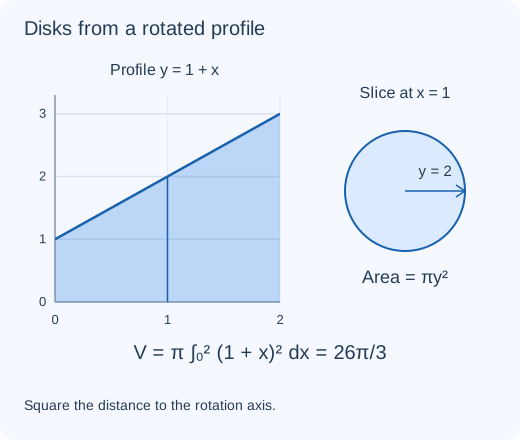
Rotating a region between a curve and the x-axis gives circular cross-sections perpendicular to that axis. The radius is the distance to the axis, |y|, so a disk has area πy². Its thin-slice volume is approximately πy²Δx; adding slices and taking the limit gives
\[V=\pi\int_a^b y(x)^2\,dx.\]
About the y-axis, use horizontal disks: express the radius as x(y), integrate with respect to y and use y-limits. For a first-quadrant region touching the y-axis, \(V=\pi\int_c^d x(y)^2\,dy\).
If a cross-section has a hole, it is a washer with area \(\pi(R^2-r^2)\), where 0≤r≤R are distances from the rotation axis. Draw the region to decide whether a hole exists; subtract the squares, not the radii. If the region crosses the axis, simple subtraction of signed ordinates may not describe the cross-section.
Lengths squared give cross-sectional area; integrating over a length gives cubic units. π is a factor outside the integral, not part of the radius. Reversing integration limits would produce the wrong sign for a physical volume.
Recall later
For y=x over 0≤x≤3, the x-axis volume is \(\pi\int_0^3x^2\,dx=9\pi\), not \(\pi\int_0^3x\,dx\).
Common mistakes
Integrating the radius instead of its square.
Mixing x-limits with an integral in y or rotating about the wrong axis.
Using (R−r)² in place of R²−r² or inventing a hole where the region touches the axis.
Three worked examples
Example 1
The region under y=x on 0≤x≤3 is rotated about the x-axis. Find the volume.
Show the reasoning
The disk radius is x, so \(V=\pi\int_0^3x^2\,dx=\pi[x^3/3]_0^3=9\pi\) cubic units.
Example 2
The region between x=0 and x=√y for 0≤y≤9 is rotated about the y-axis. Find the volume.
Show the reasoning
Horizontal disks have radius √y and area πy. Thus \(V=\pi\int_0^9y\,dy=81\pi/2\) cubic units. The upper integration limit is 9, a y-coordinate.
Example 3
The region between y=3 and y=x on 0≤x≤2 is rotated about the x-axis. Find the volume.
Show the reasoning
Each washer has outer radius 3 and inner radius x. Hence \(V=\pi\int_0^2(9-x^2)\,dx=\pi[9x-x^3/3]_0^2=46\pi/3\) cubic units.
Recover an amount from its rate and connect a variable-limit integral with differentiation.
Notes
Before you start: use definite integrals, an initial condition and derivative signs.
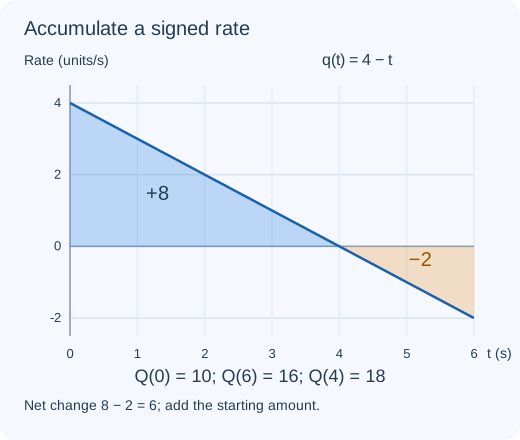
If a quantity Q changes smoothly at rate q(t), its net change from a to b is \(\int_a^b q(t)\,dt\). Add the starting amount to obtain the final amount. A negative rate represents removal or decrease, not a negative amount by itself. Rate units multiplied by time give amount units.
For a continuous integrand f, define \(H(x)=\int_a^x f(t)\,dt\). At interior points of its domain, H′(x)=f(x). The letter t inside the integral is a dummy variable; x is the variable upper limit. Distinguish the integral H from its integrand f.
Derivative signs of H describe whether accumulated value rises or falls. H=0 need not mean zero geometric area. For one-dimensional motion, integrating velocity gives displacement; integrating its absolute value gives distance. Split at direction changes when calculating distance.
Recall later
If Q(0)=10 and the net change is 6, the final amount is 16. The integral alone gives the change, not the starting amount.
Common mistakes
Reporting the integral of a rate as the final amount without adding the initial value.
Confusing an accumulated quantity with its derivative.
Equating displacement with distance when the velocity changes sign.
Three worked examples
Example 1
An amount starts at 10 units and has rate 4−t units/s on 0≤t≤6. Find the final amount and its maximum.
Show the reasoning
\(Q(t)=10+4t-t^2/2\). The final amount is Q(6)=16 units. The rate is positive before t=4 and negative afterwards, so the maximum is Q(4)=18 units. Positive change 8 and negative change −2 give net change 6.
Example 2
A particle has velocity 3t−6 m/s on 0≤t≤4 and initial position 5 m. Find displacement, final position and total distance.
Show the reasoning
The displacement is \(\int_0^4(3t-6)\,dt=0\), so the final position is 5 m. Velocity changes sign at t=2. Each side contributes a distance of 6 m, giving total distance 12 m, despite zero net displacement.
Example 3
For x≥0, let \(J(x)=\int_0^x(2t+1)\,dt\). Solve J(x)=12.
Show the reasoning
J(x)=x²+x, so x²+x−12=(x+4)(x−3)=0. Only x=3 is permitted. Also J′(x)=2x+1>0 for x>0, so J is strictly increasing on the nonnegative domain and the solution is unique.