Learn the method, study an example, then explain your reasoning in an exam-style problem. Work on paper before opening the solution and compare each step with the marking guidance.
Signed integrals and geometric areas
Split at crossings and subtract the lower curve from the upper curve.
Notes
Before you start: find roots and intersections, determine signs and evaluate definite integrals.
A definite integral measures signed accumulation. Above-axis contributions are positive and below-axis contributions negative. Geometric area is nonnegative: split at each sign-changing crossing and add the magnitudes of the pieces. Taking the absolute value only after all pieces have cancelled can give the wrong area.
Between two curves, solve their intersection equation to find the relevant boundaries. On an interval where U is the upper curve and L the lower curve,
\[A=\int_a^b\{U(x)-L(x)\}\,dx.\]
Check which curve is above rather than using the order in which they were named. Split again if that order changes. Axis crossings alone do not force a split for U−L if the same curve stays upper: vertical separation is the quantity being integrated.
Recall later
If an integral is zero, positive and negative contributions may cancel. The graph need not lie on the axis and its geometric area need not be zero.
Common mistakes
Treating a negative integral as a negative geometric area.
Taking one absolute value after cancellation instead of splitting the region.
Using lower minus upper or forgetting an intersection inside the interval.
Three worked examples
Example 1
Compare the signed integral and total area for y=x²−1 on [−2,2].
Show the reasoning
An antiderivative is x³/3−x. The signed integral is 4/3. The middle piece from −1 to 1 has signed value −4/3; the two outer pieces total 8/3. The geometric area is 8/3+4/3=4.
Example 2
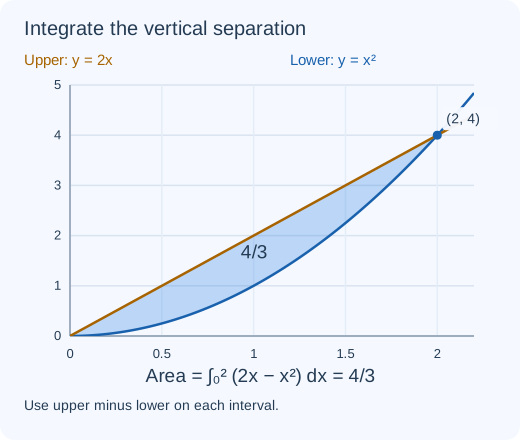
Find the area enclosed by y=2x and y=x².
Show the reasoning
The intersections solve x²=2x, giving x=0 and 2. On (0,2), 2x>x². The area is \(\int_0^2(2x-x^2)\,dx=[x^2-x^3/3]_0^2=4/3\).
Example 3
Find the total area between y=2−x and the x-axis for 0≤x≤5.
Show the reasoning
The crossing is x=2. The positive piece has area 2 and the below-axis piece has area 9/2, so the total is 13/2. The signed integral is −5/2, whose absolute value 5/2 is not the total area.