Learn the method, study an example, then explain your reasoning in an exam-style problem. Work on paper before opening the solution and compare each step with the marking guidance.
Exact values, quadrants and general angles
Use reference angles and coordinate signs to find exact trigonometric ratios.
Notes
Before you start: use Pythagoras and convert degrees to radians. Angles here are in radians unless a degree symbol is shown.
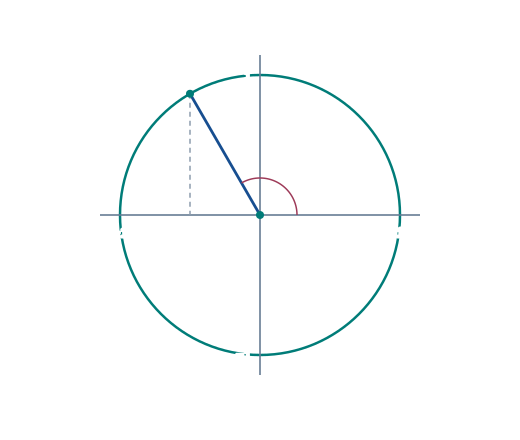
On the unit circle, the point at angle θ has coordinates \((\cos\theta,\sin\theta)\). Hence cosine is the horizontal coordinate and sine is the vertical coordinate. Their signs follow the quadrant; tangent is \(\sin\theta/\cos\theta\), defined only when cosine is nonzero.
At \(\pi/6\): sine is \(1/2\), cosine is \(\sqrt3/2\).
At \(\pi/4\): both are \(\sqrt2/2\).
At \(\pi/3\): sine is \(\sqrt3/2\), cosine is \(1/2\).
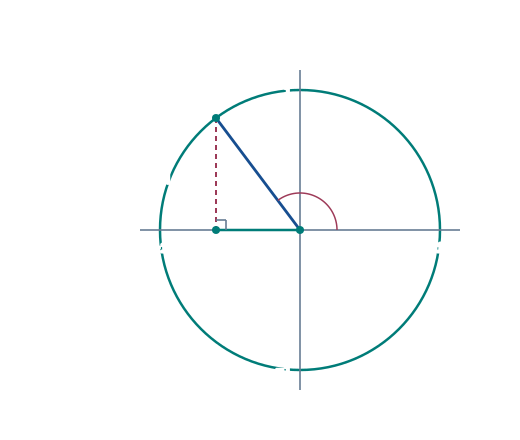
Sine and cosine repeat after 2π; tangent repeats after π. A reference triangle supplies magnitudes, while the quadrant supplies signs. The identity \(\sin^2\theta+\cos^2\theta=1\) does not choose a sign for a square root.
Recall later
At \(5\pi/6\), sine is \(1/2\), cosine is \(-\sqrt3/2\), and tangent is \(-1/\sqrt3\).
Common mistakes
Choosing a square-root sign without using the quadrant.
Treating an inverse-calculator output as every solution.
Using tangent where cosine is zero.
Three worked examples
Example 1
If \(\cos\theta=-3/5\) and \(\pi/2<\theta<\pi\), find sine and tangent.
Show the reasoning
\(\sin^2\theta=1-9/25=16/25\). In quadrant II sine is positive, so \(\sin\theta=4/5\). Then \(\tan\theta=(4/5)/(-3/5)=-4/3\).
Example 2
Find the exact sine, cosine and tangent of \(7\pi/6\).
Show the reasoning
The reference angle is π/6 and the angle is in quadrant III. Thus sine=−1/2, cosine=−√3/2 and tangent=1/√3.
Example 3
Find every x in \(0\le x<2\pi\) with \(\cos x=-1/2\).
Show the reasoning
The inverse-cosine principal value is \(2\pi/3\), but cosine is also negative in quadrant III. The two angles are \(2\pi/3\) and \(4\pi/3\).
Read amplitude, midline, period, range and excluded points from a formula.
Notes
Before you start: recognise sine, cosine and tangent on a radian axis, and recall function transformations.
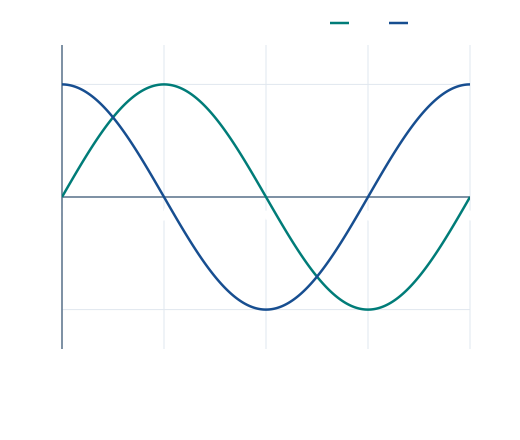
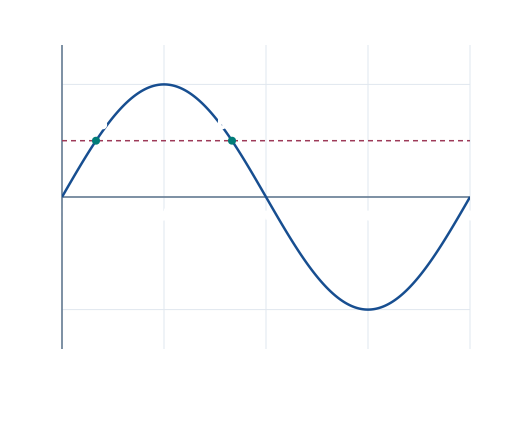
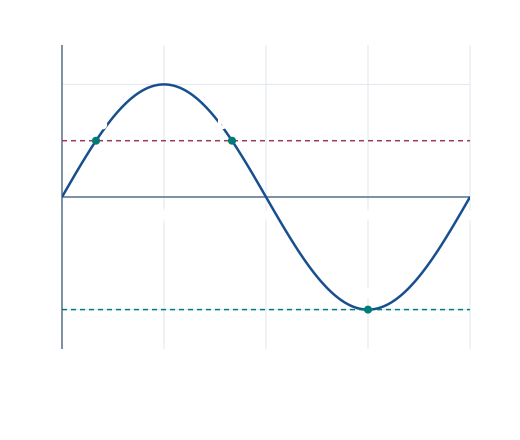
For \(y=a+b\sin(kx+c)\) or its cosine version, with \(b\ne0\) and \(k\ne0\), the midline is y=a, amplitude is |b| and least positive period is \(2\pi/|k|\). On the whole real line the range is \([a-|b|,a+|b|]\). A restricted domain may attain less of that range.
The inside shift is \(-c/k\), and a negative outside multiplier reflects the wave. Maximum and minimum points require both x- and y-coordinates. Endpoints count when the stated interval includes them.
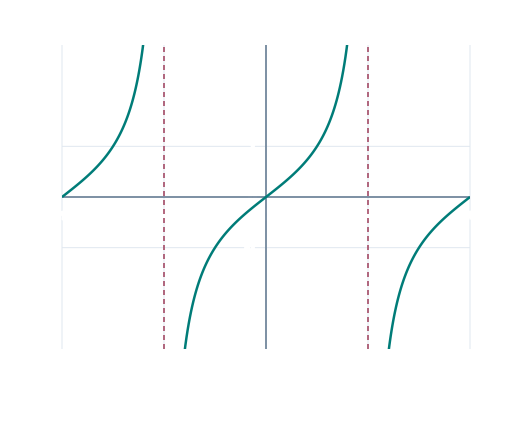
Tangent has period π, is unbounded and is undefined where cosine is zero. For \(\tan(kx+c)\), asymptotes occur at \(kx+c=\pi/2+n\pi\), with integer n. Do not join a tangent graph across these gaps.
Recall later
\(y=2-5\sin(3x)\) has amplitude 5, midline y=2, period \(2\pi/3\) and whole-line range [−3,7].
Common mistakes
Using the inside multiplier itself as the period.
Confusing the vertical shift with the amplitude.
Connecting tangent branches or counting an excluded endpoint.
Three worked examples
Example 1
Give the main features of \(y=3+2\sin(4x)\).
Show the reasoning
The amplitude is 2, midline y=3, period \(2\pi/4=\pi/2\), and range [1,5]. The value at x=0 is 3.
Example 2
Find the range and period of \(y=-1+3\cos(x/2)\).
Show the reasoning
The range is [−4,2]. The inner multiplier is 1/2, so the period is \(2\pi/(1/2)=4\pi\), not π.
Example 3
Find the period and asymptotes of \(y=\tan(2x)\).
Show the reasoning
The period is π/2. The excluded points satisfy \(2x=\pi/2+n\pi\), so \(x=\pi/4+n\pi/2\). Each is a vertical asymptote.
Transform trigonometric expressions while retaining every domain restriction.
Notes
Before you start: simplify fractions and factor a product without losing a zero factor.
The core relations are \(\sin^2x+\cos^2x=1\) for real x and \(\tan x=\sin x/\cos x\) where \(\cos x\ne0\). Dividing the first identity by cos²x gives \(1+\tan^2x=1/\cos^2x\) only on that same domain.
In a proof, start with one side and transform it into the other using valid equalities. An identity holds at every point of its stated domain; an equation may hold only at selected angles. A cancellation can simplify a formula without filling a hole in the original domain.
If sin x or cos x is a factor in an equation, check its zero case before division. Multiplying by a denominator or squaring can admit extra candidates, so check solutions in the original expression.
Recall later
\((1-\cos^2x)/\sin x=\sin x\) when \(\sin x\ne0\); the original quotient is still undefined at x=0.
Common mistakes
Cancelling a factor without retaining its excluded values.
Dividing an equation by sine or cosine and losing roots.
Using a chain of implications in place of valid equalities in an identity proof.
Three worked examples
Example 1
Simplify \((1-\sin^2x)/\cos x\) and state its restriction.
Show the reasoning
Replace the numerator by cos²x and cancel one cosine: the result is cos x, with the original restriction \(\cos x\ne0\), or \(x\ne\pi/2+n\pi\).
Example 2
Show that \(\sin^2x+2\cos^2x=1+\cos^2x\).
Show the reasoning
Group one sin²x+cos²x pair: \((\sin^2x+\cos^2x)+\cos^2x=1+\cos^2x\). No division is used, so this identity is valid for every real x.
Example 3
Solve \(2\sin x\cos x=\sin x\) for \(0\le x<2\pi\).
Show the reasoning
Factor \(\sin x(2\cos x-1)=0\). The first factor gives x=0,π; the second gives x=π/3,5π/3. Dividing by sine would lose the first two solutions.
Find all angle branches, using the full transformed interval and the original domain.
Notes
Before you start: use exact values and inverse functions, and recognise each ratio's period.
For integer n, if \(\sin u=a\) and α=arcsin a, the families are \(u=\alpha+2n\pi\) and \(u=\pi-\alpha+2n\pi\). If \(\cos u=a\) and α=arccos a, use \(u=\pm\alpha+2n\pi\). These require |a|≤1. Duplicate angles at extreme values are counted once.
For \(\tan u=a\), use \(u=\arctan a+n\pi\), retaining excluded cosine-zero values. Calculator inverses return principal values, not a complete interval solution.
The principal output ranges are \([-\pi/2,\pi/2]\) for arcsine, \([0,\pi]\) for arccosine, and \((-\pi/2,\pi/2)\) for arctangent.
When u=kx+c, transform the entire x-interval into a u-interval first, find every branch in it, and transform back. Reverse inequalities if dividing by a negative coefficient. Check open/closed endpoints and substitute candidates into the original equation.
Recall later
\(\cos x=0\) has x=π/2,3π/2 on \(0\le x<2\pi\); \(\tan x\) is undefined at those same points.
Common mistakes
Giving only the inverse-calculator value.
Solving for 2x only between 0 and 2π when x spans that interval.
Mixing a degree period with radian inputs.
Three worked examples
Example 1
Solve \(\sin x=-\sqrt3/2\) for \(0\le x<2\pi\).
Show the reasoning
The reference angle is π/3. Sine is negative in quadrants III and IV, giving \(x=4\pi/3,5\pi/3\).
Example 2
Solve \(\cos(2x)=1/2\) for \(0\le x<2\pi\).
Show the reasoning
The doubled angle runs through \(0\le2x<4\pi\). It has values π/3,5π/3,7π/3,11π/3. Dividing by 2 gives x=π/6,5π/6,7π/6,11π/6.
Example 3
Solve \(\tan(x-\pi/6)=0\) for \(0\le x<2\pi\).
Show the reasoning
Tangent is zero at integer multiples of π. Thus x=π/6+nπ. The permitted values are π/6 and 7π/6.
Solve a polynomial in one ratio, reject impossible ratio values and recover all angles.
Notes
Before you start: factor quadratics or use the quadratic formula, and solve basic trigonometric equations.
Substitute u=sin x, cos x or tan x to isolate the algebraic step. Solve for every u, then reject values outside [−1,1] for sine/cosine. Tangent can take every real value where it is defined.
Use sin²x+cos²x=1 to replace mixed squared ratios before forming the quadratic. Each admissible u still requires all appropriate angle branches. Two quadratic roots do not necessarily produce four angles: u=±1 gives only one sine angle per turn, and an impossible u gives none.
Finally check the original equation and interval, especially if you divided by a ratio, cleared a denominator or squared an expression.
Recall later
If an algebraic step gives \(\cos x=2\), reject it: no real angle has that cosine.
Common mistakes
Keeping a sine/cosine value outside [−1,1].
Taking only the positive square root of a squared ratio.
Counting a duplicated endpoint or assuming two angles for an extreme sine value.
Three worked examples
Example 1
Solve \(2\cos^2x-\cos x-1=0\) for \(0\le x<2\pi\).
Show the reasoning
\((2\cos x+1)(\cos x-1)=0\). The values cos x=−1/2 or 1 give x=2π/3,4π/3 or 0. The endpoint 2π is excluded, so there are three solutions.
Example 2
Solve \(\sin^2x-3\sin x+2=0\) for \(0\le x<2\pi\).
Show the reasoning
The factorisation is (sin x−1)(sin x−2)=0. Reject sin x=2; sin x=1 gives the sole solution x=π/2.
Example 3
Solve \(\tan^2x=3\) for \(0\le x<2\pi\).
Show the reasoning
Take both signs: tan x=±√3. The four permitted angles are π/3,2π/3,4π/3,5π/3, none at a tangent asymptote.