Learn the method, study an example, then explain your reasoning in an exam-style problem. Work on paper before opening the solution and compare each step with the marking guidance.
Exact values, quadrants and general angles
Use reference angles and coordinate signs to find exact trigonometric ratios.
Notes
Before you start: use Pythagoras and convert degrees to radians. Angles here are in radians unless a degree symbol is shown.
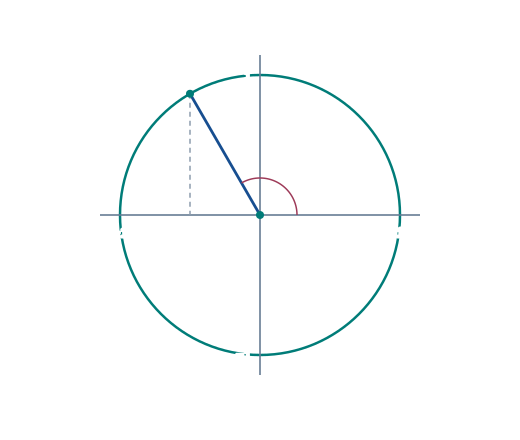
On the unit circle, the point at angle θ has coordinates \((\cos\theta,\sin\theta)\). Hence cosine is the horizontal coordinate and sine is the vertical coordinate. Their signs follow the quadrant; tangent is \(\sin\theta/\cos\theta\), defined only when cosine is nonzero.
At \(\pi/6\): sine is \(1/2\), cosine is \(\sqrt3/2\).
At \(\pi/4\): both are \(\sqrt2/2\).
At \(\pi/3\): sine is \(\sqrt3/2\), cosine is \(1/2\).
Sine and cosine repeat after 2π; tangent repeats after π. A reference triangle supplies magnitudes, while the quadrant supplies signs. The identity \(\sin^2\theta+\cos^2\theta=1\) does not choose a sign for a square root.
Recall later
At \(5\pi/6\), sine is \(1/2\), cosine is \(-\sqrt3/2\), and tangent is \(-1/\sqrt3\).
Common mistakes
Choosing a square-root sign without using the quadrant.
Treating an inverse-calculator output as every solution.
Using tangent where cosine is zero.
Three worked examples
Example 1
If \(\cos\theta=-3/5\) and \(\pi/2<\theta<\pi\), find sine and tangent.
Show the reasoning
\(\sin^2\theta=1-9/25=16/25\). In quadrant II sine is positive, so \(\sin\theta=4/5\). Then \(\tan\theta=(4/5)/(-3/5)=-4/3\).
Example 2
Find the exact sine, cosine and tangent of \(7\pi/6\).
Show the reasoning
The reference angle is π/6 and the angle is in quadrant III. Thus sine=−1/2, cosine=−√3/2 and tangent=1/√3.
Example 3
Find every x in \(0\le x<2\pi\) with \(\cos x=-1/2\).
Show the reasoning
The inverse-cosine principal value is \(2\pi/3\), but cosine is also negative in quadrant III. The two angles are \(2\pi/3\) and \(4\pi/3\).