Learn the method, study an example, then explain your reasoning in an exam-style problem. Work on paper before opening the solution and compare each step with the marking guidance.
Radians, degrees and complete rotations
Convert angle units and distinguish a swept rotation from the final direction.
Notes
Before you start: work with fractions of a full turn and keep exact multiples of π.
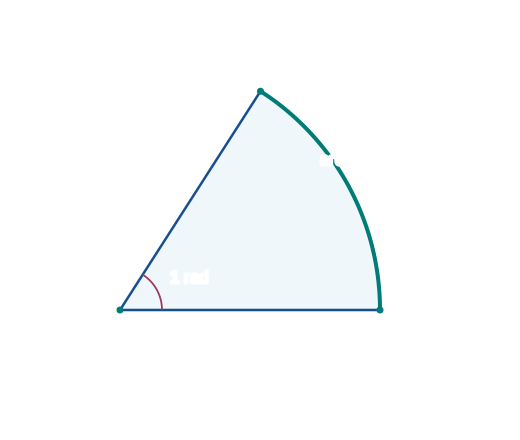
One radian is the central angle subtended by an arc whose length equals the radius. In general \(\theta=s/r\), so \(2\pi\) radians make one complete turn and \(\pi\) radians equal \(180^\circ\).
A minor positive angle is less than π; a reflex angle is between π and 2π. The minor and reflex angles between the same two radii add to 2π. A physical rotation can exceed 2π: for distance travelled, retain every full revolution rather than reducing the angle to the final orientation.
Radian formulae require radian inputs. Keep π exact until the last numerical step and use radians in a calculator when evaluating trigonometric functions of radian angles.
Recall later
\(\pi/3\) rad = \(60^\circ\); \(450^\circ=5\pi/2\) rad is one full turn plus a quarter turn.
Common mistakes
Multiplying by 180/π when converting degrees to radians.
Using the minor angle when a reflex arc is specified.
Discarding complete turns in a travelled-distance calculation.
Three worked examples
Example 1
Convert \(150^\circ\) to radians exactly.
Show the reasoning
Multiply by π/180: \(150\pi/180=5\pi/6\) rad. This is less than π, as expected for an angle below 180°.
Example 2
Convert \(7\pi/4\) radians to degrees.
Show the reasoning
\((7\pi/4)(180/\pi)=315^\circ\). It is a reflex angle, between 180° and 360°.
Example 3
Two angles around a point are in the ratio 3:5 and sum to a full turn. Find both in radians.
Show the reasoning
Eight parts make 2π, so one part is π/4. The angles are \(3\pi/4\) and \(5\pi/4\), equivalent to 135° and 225°.
Choose the correct arc and count every part of the required boundary.
Notes
Before you start: convert degrees to radians and distinguish radius from diameter.
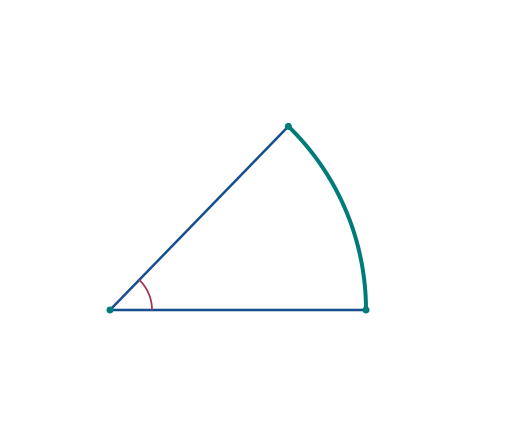
For radius r and an angle θ in radians, the arc length is \(s=r\theta\). For a proper sector, \(0<\theta<2\pi\), its boundary consists of the arc and two radii:
\[P=2r+r\theta=r(2+\theta).\]
At a full circle the radial edges are not part of the outside boundary: its circumference is 2πr, not 2r+2πr. A chord is a straight segment; it cannot replace an arc in these formulae.
A wheel rolling without slipping travels one circumference per revolution. More generally, travelled distance is radius times total swept angle. With constant angular speed ω in rad/s, distance after t seconds is \(r\omega t\). Check that all lengths use compatible units.
Recall later
An arc of length 2.4 cm on a radius of 4 cm subtends \(\theta=2.4/4=0.6\) rad.
Common mistakes
Giving only rθ when the question asks for sector perimeter.
Including two radii in the outside boundary of a full disk.
Using wheel diameter in place of radius in rθ.
Three worked examples
Example 1
For a sector of radius 6 cm and angle 0.8 rad, find arc length and perimeter.
Show the reasoning
The arc is \(6(0.8)=4.8\) cm. Its complete perimeter is \(4.8+2(6)=16.8\) cm.
Example 2
An arc has length 9 m on a circle of radius 3 m. Find its central angle.
Show the reasoning
\(\theta=s/r=9/3=3\) rad. The angle is not 3 degrees; the quotient of two compatible lengths defines radians.
Example 3
A wheel of radius 0.4 m rolls five complete revolutions without slipping. Find its travelled distance.
Show the reasoning
The total angle is \(10\pi\) rad, so distance \(=0.4(10\pi)=4\pi\) m, approximately 12.6 m to 3 significant figures.
Use radians and squared length units. The formula gives the ordinary sector area for angles up to one turn. For a sweep beyond 2π it counts repeated coverage, not the distinct area of the disk.
If a proper sector has fixed perimeter L, then \(\theta=L/r-2\) and \(A=Lr/2-r^2\). Complete the square to locate a maximum, then check that its radius is positive and its angle lies strictly between 0 and 2π.
Recall later
A sector with r=4 cm and θ=0.75 rad has area \(\frac12(16)(0.75)=6\text{ cm}^2\).
Common mistakes
Using radius rather than radius squared in the area formula.
Reporting square centimetres as centimetres.
Accepting an algebraic maximum without checking the sector angle.
Three worked examples
Example 1
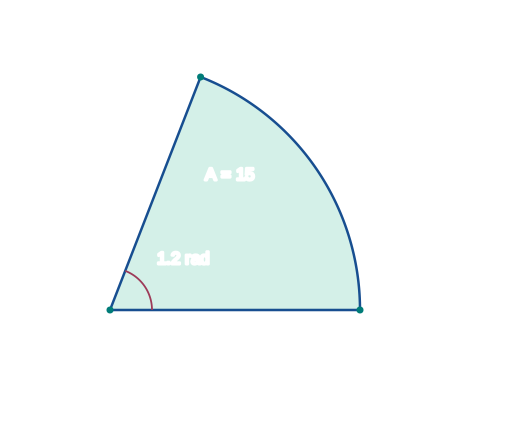
Find the area of a sector with radius 5 cm and angle 1.2 rad.
Show the reasoning
\(A=\frac12(5^2)(1.2)=15\text{ cm}^2\). The square is on the radius, not on the angle.
Example 2
A sector has area 30 cm² and arc length 10 cm. Find r and θ.
Show the reasoning
From \(A=rs/2\), \(r=2A/s=6\) cm. Then \(\theta=s/r=5/3\) rad.
Example 3
A proper sector has perimeter 20 cm. Find its largest area.
Show the reasoning
\(A=10r-r^2=25-(r-5)^2\), so the maximum is 25 cm² at r=5 cm. Its angle is \(20/5-2=2\) rad, which is permitted.
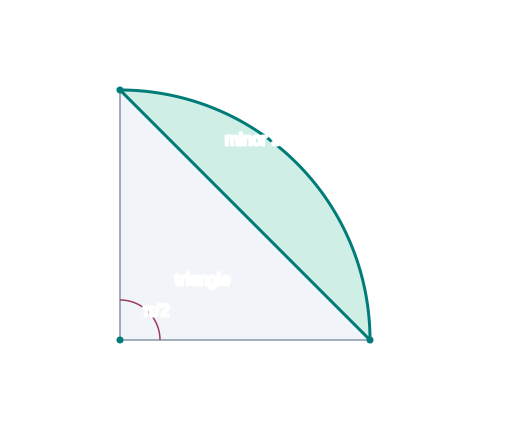
The chord length is \(c=2r\sin(\theta/2)\). A minor segment perimeter is the minor arc plus the chord, not two radii plus an arc. The major segment area is \(\pi r^2-A_{\mathrm{minor}}\).
If a chord is perpendicular distance d from the centre, its half-length is \(\sqrt{r^2-d^2}\), and its minor angle is \(2\arccos(d/r)\). Keep the unrounded angle in later area calculations. Check that the requested region is minor or major before subtracting.
Recall later
For a diameter chord, θ=π and the triangle area is zero; either segment is a semicircle of area \(\pi r^2/2\).
Common mistakes
Subtracting a triangle from the wrong sector.
Using the minor angle but reporting its area as the major segment.
Using degrees in sin θ after substituting a radian angle.
Three worked examples
Example 1
Find the minor segment area for r=4 cm and θ=π/2.
Show the reasoning
The sector area is 4π cm² and the triangle area is 8 cm². The segment area is \(4\pi-8\text{ cm}^2\). Its boundary length is \(2\pi+4\sqrt2\) cm.
Example 2
Find the minor segment area for r=6 cm and θ=0.9 rad.
Show the reasoning
\(A=18(0.9-\sin0.9)\text{ cm}^2\), approximately \(2.10\text{ cm}^2\) to 3 significant figures. The sine must be evaluated in radians.
Example 3
Find the major segment area when r=3 cm and the minor angle is 2π/3.
Show the reasoning
The minor sector area is 3π and its triangle area is \(9\sqrt3/4\). Subtract the minor segment from the disk to obtain \(6\pi+9\sqrt3/4\text{ cm}^2\).
Add areas and trace only the exposed boundary of a composite region.
Notes
Before you start: find sector and rectangle areas, and distinguish an internal join from an outside edge.
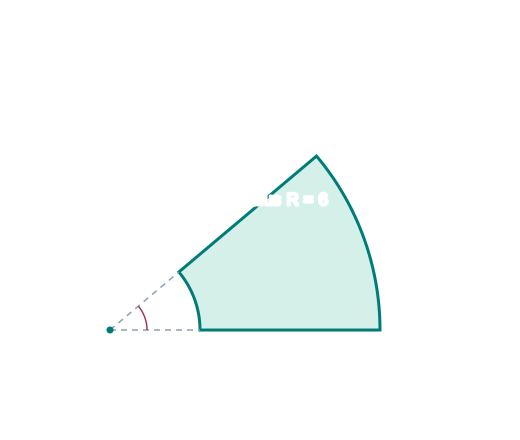
An annular sector lies between radii R and r, with \(0
\[A=\frac12(R^2-r^2)\theta,\qquad P=(R+r)\theta+2(R-r).\]
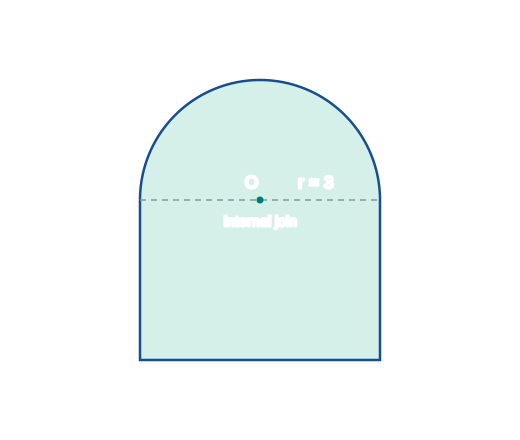
A complete annulus has no exposed radial connectors. For a rectangle topped by a semicircle, the shared diameter is internal: count the bottom, two vertical sides and semicircular arc. Its area still includes both pieces.
Under an enlargement of factor k>0, all lengths and perimeters multiply by k, areas multiply by k², and angles do not change.
Recall later
For R=5 cm, r=3 cm and θ=1 rad, annular-sector area is 8 cm² and perimeter is 12 cm.
Common mistakes
Counting the shared diameter as an outside edge.
Using two full outer radii for the straight edges of an annular sector.
Multiplying area by k instead of k² under enlargement.
Three worked examples
Example 1
Find area and perimeter for an annular sector with R=6 cm, r=2 cm and θ=0.7 rad.
Show the reasoning
The area is \(\frac12(36-4)(0.7)=11.2\text{ cm}^2\). The perimeter is \((6+2)(0.7)+2(6-2)=13.6\) cm.
Example 2
A rectangle of width 6 cm and height 4 cm is topped by a semicircle of radius 3 cm. Find outside perimeter and total area.
Show the reasoning
The exposed perimeter is \(2(4)+6+3\pi=14+3\pi\) cm. The shared diameter is not counted again. The area is \(6(4)+\frac12\pi(3^2)=24+9\pi/2\text{ cm}^2\).
Example 3
The annular sector in example 1 is enlarged by factor 3. Find its new area, perimeter and angle.
Show the reasoning
The area becomes \(9(11.2)=100.8\text{ cm}^2\), and the perimeter becomes \(3(13.6)=40.8\) cm. Its angle remains 0.7 rad.