9709 P11 - Jun 2023 - Q4
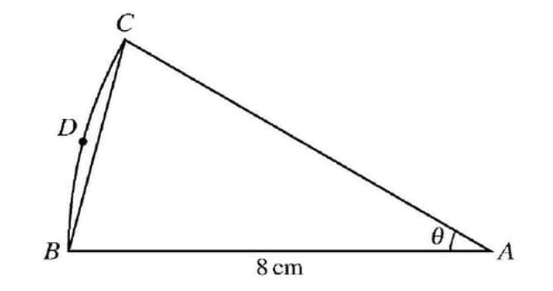
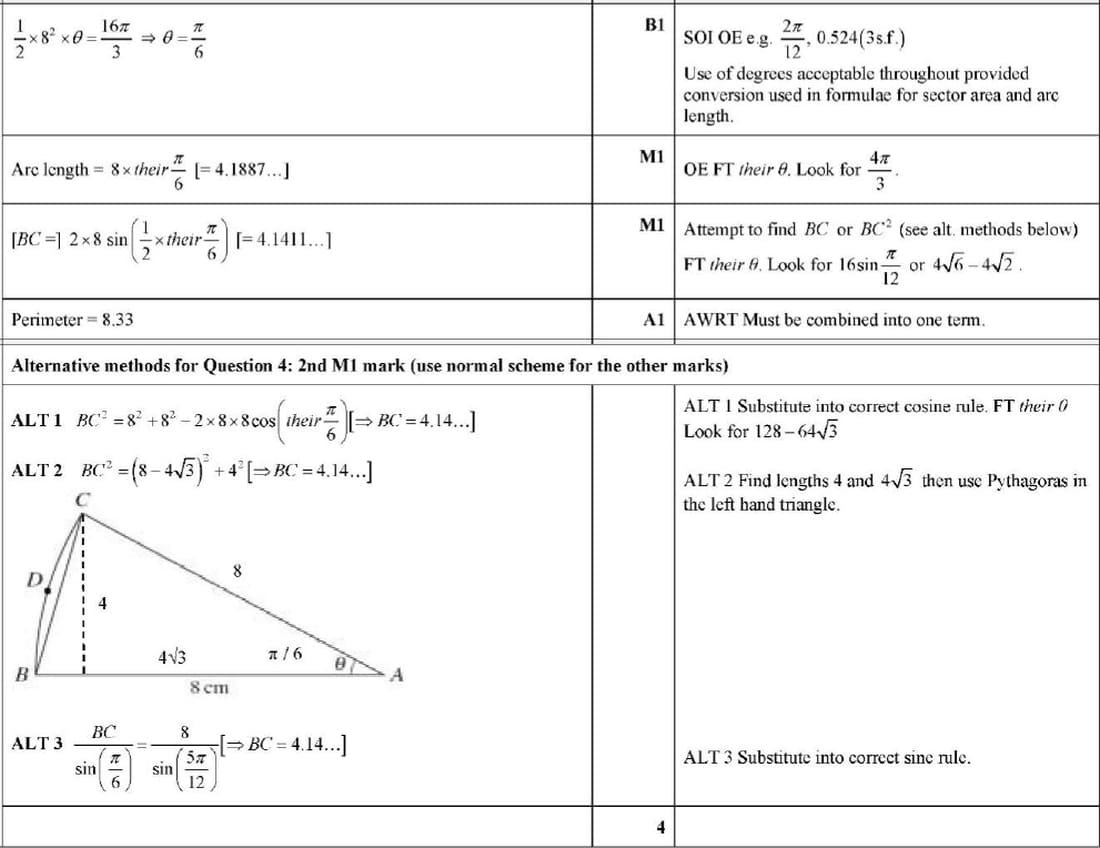
The diagram shows a sector ABC of a circle with centre A and radius 8 cm. The area of the sector is \(\frac{16}{3} \pi \text{ cm}^2\). The point D lies on the arc BC.
Find the perimeter of the segment BCD.
9709 P13 - Jun 2014 - Q3
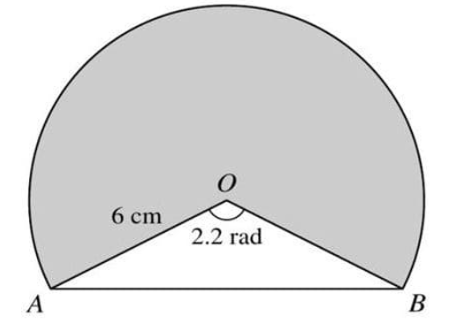
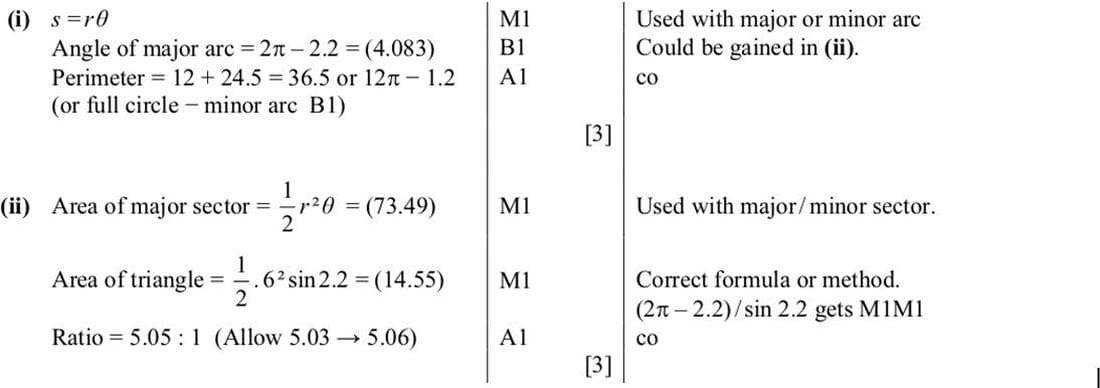
The diagram shows part of a circle with centre O and radius 6 cm. The chord AB is such that angle AOB = 2.2 radians. Calculate:
(i) the perimeter of the shaded region,
(ii) the ratio of the area of the shaded region to the area of the triangle AOB, giving your answer in the form k : 1.
9709 P13 - Nov 2013 - Q6
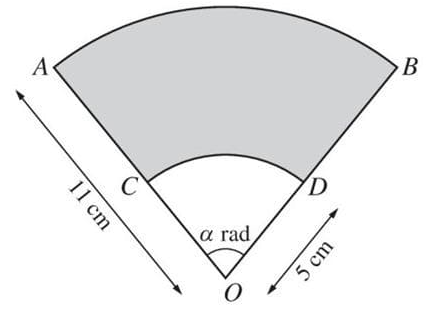
The diagram shows sector OAB with centre O and radius 11 cm. Angle AOB = \(\alpha\) radians. Points C and D lie on OA and OB respectively. Arc CD has centre O and radius 5 cm.
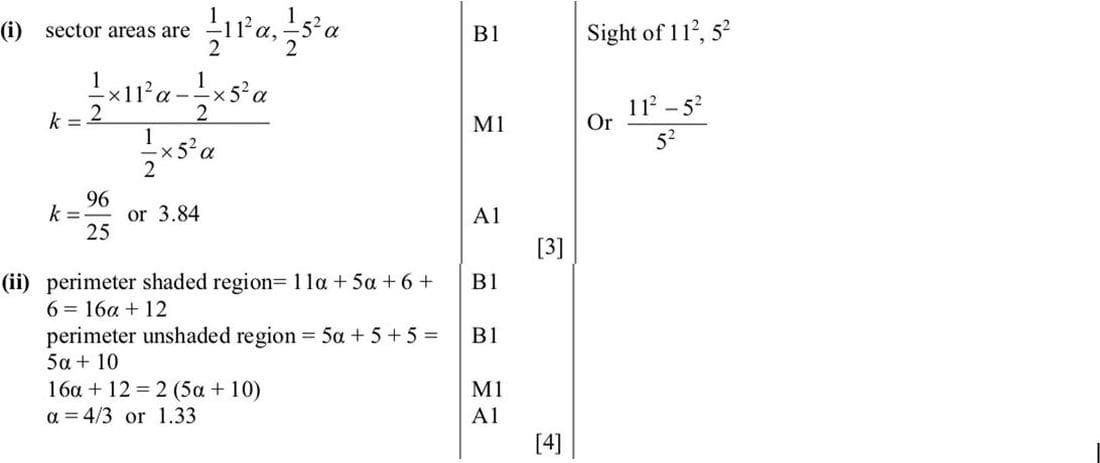
(i) The area of the shaded region ABDC is equal to \(k\) times the area of the unshaded region OCD. Find \(k\).
(ii) The perimeter of the shaded region ABDC is equal to twice the perimeter of the unshaded region OCD. Find the exact value of \(\alpha\).
Problem #271
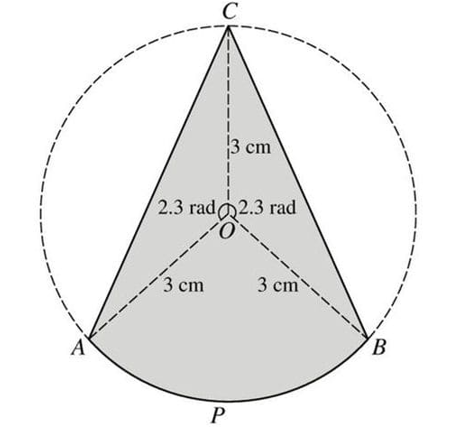
The diagram shows points A, C, B, P on the circumference of a circle with centre O and radius 3 cm. Angle AOC = angle BOC = 2.3 radians.
(i) Find angle AOB in radians, correct to 4 significant figures.
(ii) Find the area of the shaded region ACBP, correct to 3 significant figures.
Problem #284
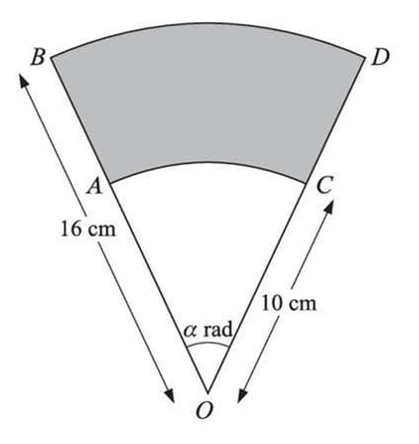
In the diagram, OAB and OCD are radii of a circle, centre O and radius 16 cm. Angle AOC = \(\alpha\) radians. AC and BD are arcs of circles, centre O and radii 10 cm and 16 cm respectively.
(i) In the case where \(\alpha = 0.8\), find the area of the shaded region.
(ii) Find the value of \(\alpha\) for which the perimeter of the shaded region is 28.9 cm.