Learn the method, study an example, then explain your reasoning in an exam-style problem. Work on paper before opening the solution and compare each step with the marking guidance.
Chords, minor segments and major segments
Subtract a triangle from a sector and identify the required curved region.
Notes
Before you start: use basic triangle trigonometry and set the calculator to radians.
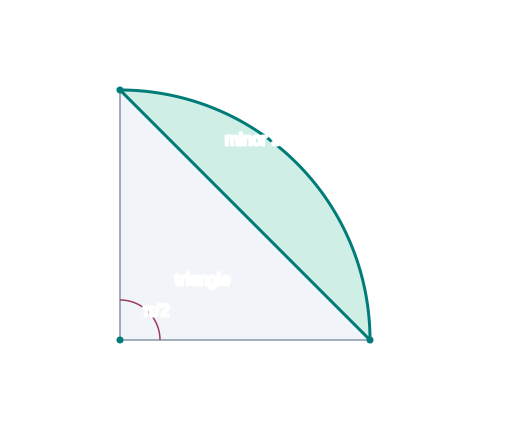
A segment is bounded by a chord and an arc. For the minor central angle \(0<\theta\le\pi\), its area is sector minus triangle:
The chord length is \(c=2r\sin(\theta/2)\). A minor segment perimeter is the minor arc plus the chord, not two radii plus an arc. The major segment area is \(\pi r^2-A_{\mathrm{minor}}\).
If a chord is perpendicular distance d from the centre, its half-length is \(\sqrt{r^2-d^2}\), and its minor angle is \(2\arccos(d/r)\). Keep the unrounded angle in later area calculations. Check that the requested region is minor or major before subtracting.
Recall later
For a diameter chord, θ=π and the triangle area is zero; either segment is a semicircle of area \(\pi r^2/2\).
Common mistakes
Subtracting a triangle from the wrong sector.
Using the minor angle but reporting its area as the major segment.
Using degrees in sin θ after substituting a radian angle.
Three worked examples
Example 1
Find the minor segment area for r=4 cm and θ=π/2.
Show the reasoning
The sector area is 4π cm² and the triangle area is 8 cm². The segment area is \(4\pi-8\text{ cm}^2\). Its boundary length is \(2\pi+4\sqrt2\) cm.
Example 2
Find the minor segment area for r=6 cm and θ=0.9 rad.
Show the reasoning
\(A=18(0.9-\sin0.9)\text{ cm}^2\), approximately \(2.10\text{ cm}^2\) to 3 significant figures. The sine must be evaluated in radians.
Example 3
Find the major segment area when r=3 cm and the minor angle is 2π/3.
Show the reasoning
The minor sector area is 3π and its triangle area is \(9\sqrt3/4\). Subtract the minor segment from the disk to obtain \(6\pi+9\sqrt3/4\text{ cm}^2\).