Learn the method, study an example, then explain your reasoning in an exam-style problem. Work on paper before opening the solution and compare each step with the marking guidance.
Arithmetic progressions: terms, sums and integer thresholds
Find terms and finite sums, then interpret an inequality with an integer index.
Notes
Before you start: solve linear equations and inequalities, and distinguish an individual value from a total.
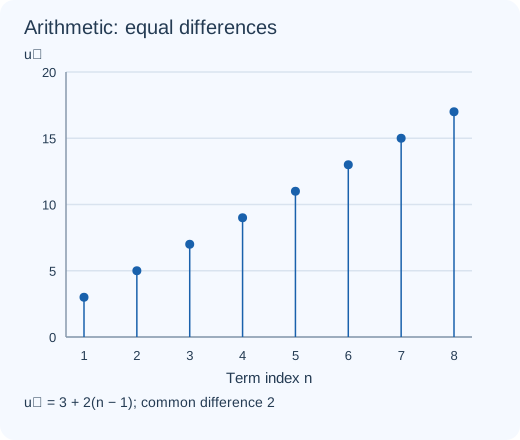
A sequence is an ordered list of terms. A series adds terms. In an arithmetic progression (AP), each term is obtained by adding the same real number d. If the first term is a and n is a positive integer,
There are n−1 steps from term 1 to term n. Two known terms give \(u_q-u_p=(q-p)d\); their index gap matters. The sum formula follows by pairing first with last, second with second-last, and so on.
A strict threshold, such as u_n>T, must be solved and then checked at adjacent integer indices. Negative differences can make later terms zero or negative. For a largest partial sum, compare integer n values: a continuous quadratic vertex alone is insufficient.
Recall later
For a=4 and d=3, u_7=22 and S_7=91. Seven terms contain six differences.
Common mistakes
Using nd instead of (n−1)d for the nth term.
Confusing a term inequality with a partial-sum inequality.
Rounding an index without checking the strict inequality at neighbouring integers.
Three worked examples
Example 1
An AP has a=7 and d=4. Find u_12 and S_12.
Show the reasoning
\(u_{12}=7+11(4)=51\). Then \(S_{12}=12(7+51)/2=348\). The last term is not the total.
Example 2
An AP has u_5=19 and u_10=39. Find a and d.
Show the reasoning
Subtract: \(5d=39-19=20\), so d=4. Then \(a+4d=19\) gives a=3. Substitution checks both given terms.
Example 3
For a=20 and d=−3, find the sum of all strictly positive terms.
Show the reasoning
\(u_n=23-3n>0\) means n<23/3, so n=1,…,7. The seventh term is 2 and the eighth is −1. The required total is \(7(20+2)/2=77\).
Geometric progressions: finite sums and convergence
Use a common ratio, distinguish finite and infinite sums, and bound a remainder.
Notes
Before you start: use powers, simplify fractions and recognise absolute value.
A geometric progression (GP) obeys \(u_{n+1}=ru_n\) for a fixed finite real ratio r. With first term a, \(u_n=ar^{n-1}\) for r≠0. For r=0, write the sequence directly as a,0,0,…; its first term is a, without evaluating 0⁰. The finite sums are
Subtracting rS_n from S_n leaves a−arⁿ. Negative ratios alternate signs, so partial sums need not increase. Do not use an infinite-sum formula merely because many terms are present.
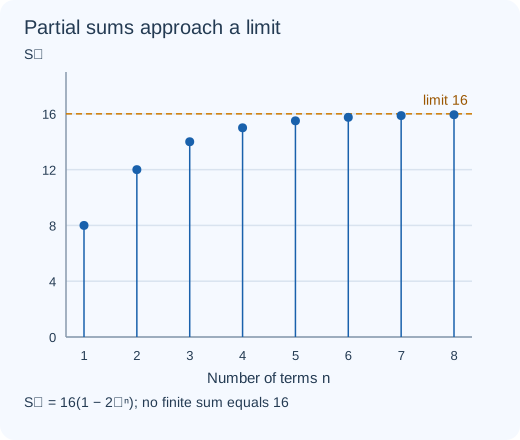
For a≠0, the infinite series converges exactly when |r|<1, in which case \(S_\infty=a/(1-r)\). This includes r=0. The trivial a=0 recurrence is all zero and sums to zero for any finite r. If a≠0 and |r|≥1, terms do not tend to zero, so the series cannot converge.
When |r|<1, the signed remainder is \(R_n=S_\infty-S_n=ar^n/(1-r)\). Use |R_n| for an error tolerance. A negative remainder means the partial sum overshoots the limit.
Recall later
For a=5, r=1, S_8=40; the fraction with denominator 1−r is not available. For a=5, r=−1, partial sums alternate between 5 and 0 and have no limit.
Common mistakes
Using a/(1−r) without checking convergence.
Forgetting that negative ratios can give alternating partial sums.
Dividing by 1−r when r=1, or treating a zero first term by an undefined ratio quotient.
Three worked examples
Example 1
For a=5 and r=2, find u_6 and S_6.
Show the reasoning
\(u_6=5(2^5)=160\). The finite sum is \(5(2^6-1)/(2-1)=315\). There is no infinite sum because r=2.
Example 2
For a=6 and r=−1/2, find u_4, S_4 and S_∞.
Show the reasoning
The terms are 6,−3,3/2,−3/4,… . Thus \(u_4=-3/4\) and \(S_4=15/4\). Since |r|=1/2<1, \(S_\infty=6/(1+1/2)=4\). The third partial sum is 9/2, showing an overshoot.
Example 3
For a=8 and r=1/4, find S_∞ and the remainder after four terms.
Show the reasoning
\(S_\infty=8/(3/4)=32/3\). The remainder is \(R_4=(32/3)(1/4)^4=1/24\). The finite total is \(S_4=32/3-1/24=85/8\).
Translate equal differences into an equation and recover every permitted angle.
Notes
Before you start: use sin²x+cos²x=1, exact values, quadrants and radian intervals.
Three real numbers u,v,w are consecutive AP terms exactly when v−u=w−v, or \(2v=u+w\). This works even when a term or the common difference is zero.
Substitute the given trigonometric expressions into this condition before simplifying. Retain any stated angle interval. If division by sin x or cos x is helpful, test its zero cases in the original equation first.
After solving for an angle, use d=v−u to find the common difference. The AP condition by itself does not mean the terms are positive or increasing. A principal inverse value can miss another branch.
Recall later
For consecutive terms sin²x,k,cos²x, the AP condition gives 2k=1, so k=1/2 independently of x.
Common mistakes
Setting a product condition instead of equal differences for an AP.
Dividing by cosine without checking cosine-zero cases.
Assuming the difference is positive or omitting a second quadrant branch.
Three worked examples
Example 1
Show that cos x, 0, −cos x are consecutive AP terms for every real x.
Show the reasoning
The differences are both −cos x. Equivalently \(2(0)=\cos x-\cos x\). At cosine-zero angles all three terms and the difference are zero, which is still an AP.
Example 2
Find x in 0≤x<2π when sin x, cos x, 0 are consecutive AP terms.
Show the reasoning
The condition is \(2\cos x=\sin x\). If cos x=0, sine is ±1 and the equation fails. Otherwise tan x=2. Hence \(x=\arctan(2)\) or \(\pi+\arctan(2)\), approximately 1.11 and 4.25 rad to 3 significant figures.
Example 3
For consecutive AP terms sin²x,k,cos²x, find k and d.
Show the reasoning
\(2k=\sin^2x+\cos^2x=1\) gives k=1/2. Then \(d=1/2-\sin^2x=\cos^2x-1/2\). Its sign depends on the angle.
Use the product condition with its domain and zero-term qualifications.
Notes
Before you start: solve trigonometric equations and use the GP recurrence.
For consecutive nonzero real GP terms u,v,w, \(v/u=w/v=r\), so \(v^2=uw\). Conversely, when the terms are nonzero, the product condition guarantees the common ratio r=v/u. It does not by itself test every zero case.
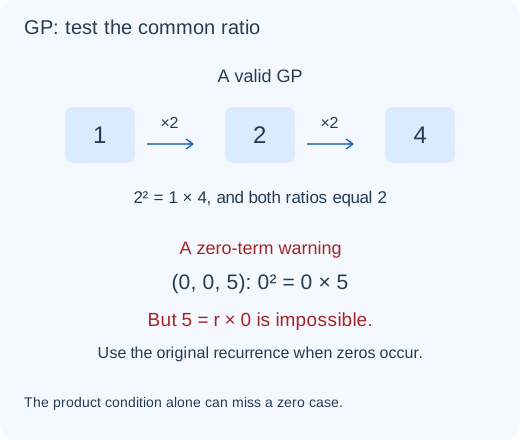
When zero terms are allowed, return to \(v=ru\) and \(w=rv\) with a finite real r. For example, (0,0,5) cannot satisfy the second equation. If the convention allows r=0, (2,0,0) is valid. An exercise involving zero terms must state the convention; check it before dividing.
Substitute the trigonometric terms, use identities to obtain one ratio, and keep signs, positivity and the angle interval. Squaring may remove sign information. Verify each candidate in the original recurrence. An infinite sum needs the additional condition |r|<1 for a nonzero first term.
Recall later
Positive consecutive GP terms 1,t,1/4 have t²=1/4, so t=1/2. Positivity removes t=−1/2.
Common mistakes
Treating the squared condition as sufficient without checking zero terms.
Keeping the wrong sign after squaring despite a positivity condition.
Finding an infinite sum before testing the ratio magnitude.
Three worked examples
Example 1
Positive consecutive GP terms are 1, cos x, 1/4, with 0<x<π/2. Find x and r.
Show the reasoning
\(\cos^2x=1/4\). Acuteness gives cos x=1/2, so x=π/3 and r=1/2. The recurrence verifies the third term. The infinite sum starting at 1 would be 2.
Example 2
Positive consecutive GP terms are 2, sin x, 1/8, with 0<x<π/2. Find x and r.
Show the reasoning
\(\sin^2x=2(1/8)=1/4\). Thus sine=1/2, x=π/6 and \(r=(1/2)/2=1/4\). Then (1/2)(1/4)=1/8 as required.
Example 3
Is the condition v²=uw sufficient for (u,v,w)=(0,0,5) to be a GP with a finite real ratio?
Show the reasoning
No. The equality 0²=0·5 holds, but a recurrence would require 5=r·0=0, a contradiction. The divided-ratio argument was invalid because its denominators vanished.
Series models: accumulation, decay and repeated motion
Choose the correct progression, index the first event and test integer thresholds.
Notes
Before you start: use AP/GP formulas and identify what a quantity measures.
A fixed additive change suggests an AP; a fixed multiplicative factor suggests a GP. State which event has index 1 (or index 0), and whether the question asks for one amount, a running total or a tail. Check the units of every result.
For an integer threshold, derive a term or sum formula and test the proposed first successful index together with its predecessor. A rounded continuous root need not satisfy the requested strict or inclusive inequality.
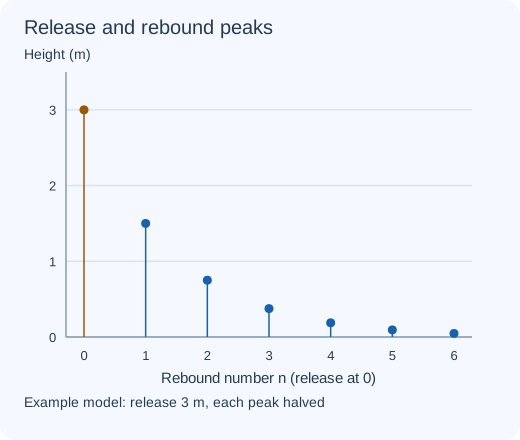
In an ideal vertical rebound model, an object released from height H first falls H once. If each rebound reaches a fraction r of the previous peak, 0<r<1, the upward heights are Hr,Hr²,… . Every rebound height is travelled twice, upwards and downwards, giving total distance \(H+2Hr/(1-r)\). This is a distance model, not a statement about elapsed time.
Recall later
If a process starts with 60 at stage 0 and retains 80% per step, the amount at stage n is 60(0.8)ⁿ, not 60(0.8)ⁿ⁻¹. The description sets the index origin.
Common mistakes
Summing weekly amounts when only a single week is asked for, or doing the reverse.
Counting the initial drop twice in a rebound-distance model.
Changing the index origin silently or ignoring whether a threshold is strict.
Three worked examples
Example 1
A club collects 25 tokens in week 1 and five more each successive week. Find the week-10 amount and first-ten-week total.
Show the reasoning
The weekly amounts form an AP: \(u_{10}=25+9(5)=70\). The cumulative amount is \(S_{10}=10(25+70)/2=475\) tokens.
Example 2
An ideal ball falls from 3 m and each rebound peak is half the preceding peak. Find its total vertical distance over all rebounds.
Show the reasoning
Upward heights sum to \(1.5/(1-1/2)=3\) m. There is one initial fall and two journeys for each rebound height, so the distance is 3+2(3)=9 m. The height series converges since |r|=1/2<1.
Example 3
An amount starts at 60 at stage 0 and is multiplied by 0.8 at each step. Find the first stage with an amount strictly below 20.
Show the reasoning
The model is \(V_n=60(0.8)^n\). Consecutive checks give V_4=24.576 and V_5=19.6608. Since the positive amounts decrease, the first successful stage is n=5.