Learn the method, study an example, then explain your reasoning in an exam-style problem. Work on paper before opening the solution and compare each step with the marking guidance.
Series models: accumulation, decay and repeated motion
Choose the correct progression, index the first event and test integer thresholds.
Notes
Before you start: use AP/GP formulas and identify what a quantity measures.
A fixed additive change suggests an AP; a fixed multiplicative factor suggests a GP. State which event has index 1 (or index 0), and whether the question asks for one amount, a running total or a tail. Check the units of every result.
For an integer threshold, derive a term or sum formula and test the proposed first successful index together with its predecessor. A rounded continuous root need not satisfy the requested strict or inclusive inequality.
In an ideal vertical rebound model, an object released from height H first falls H once. If each rebound reaches a fraction r of the previous peak, 0<r<1, the upward heights are Hr,Hr²,… . Every rebound height is travelled twice, upwards and downwards, giving total distance \(H+2Hr/(1-r)\). This is a distance model, not a statement about elapsed time.
Recall later
If a process starts with 60 at stage 0 and retains 80% per step, the amount at stage n is 60(0.8)ⁿ, not 60(0.8)ⁿ⁻¹. The description sets the index origin.
Common mistakes
Summing weekly amounts when only a single week is asked for, or doing the reverse.
Counting the initial drop twice in a rebound-distance model.
Changing the index origin silently or ignoring whether a threshold is strict.
Three worked examples
Example 1
A club collects 25 tokens in week 1 and five more each successive week. Find the week-10 amount and first-ten-week total.
Show the reasoning
The weekly amounts form an AP: \(u_{10}=25+9(5)=70\). The cumulative amount is \(S_{10}=10(25+70)/2=475\) tokens.
Example 2
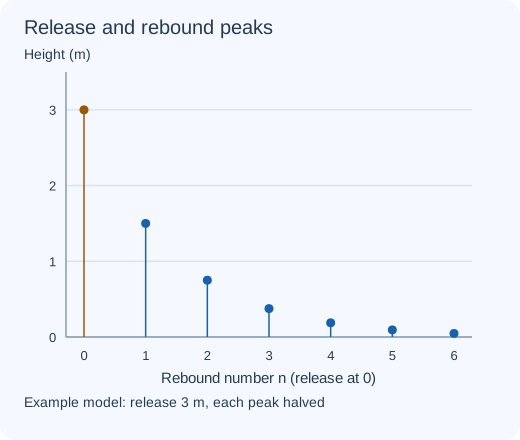
An ideal ball falls from 3 m and each rebound peak is half the preceding peak. Find its total vertical distance over all rebounds.
Show the reasoning
Upward heights sum to \(1.5/(1-1/2)=3\) m. There is one initial fall and two journeys for each rebound height, so the distance is 3+2(3)=9 m. The height series converges since |r|=1/2<1.
Example 3
An amount starts at 60 at stage 0 and is multiplied by 0.8 at each step. Find the first stage with an amount strictly below 20.
Show the reasoning
The model is \(V_n=60(0.8)^n\). Consecutive checks give V_4=24.576 and V_5=19.6608. Since the positive amounts decrease, the first successful stage is n=5.