Learn the method, study an example, then explain your reasoning in an exam-style problem. Work on paper before opening the solution and compare each step with the marking guidance.
Distance, midpoint and geometric reasoning
Use coordinate differences to calculate lengths and recover missing vertices.
Notes
Before you start: subtract signed numbers, square a negative number and simplify a square root.
For \(A=(x_1,y_1)\) and \(B=(x_2,y_2)\), Pythagoras gives
If the midpoint and one endpoint are known, the other endpoint is \((2M_x-x_1,2M_y-y_1)\). A midpoint uses addition; a distance uses differences. Squared lengths can establish a right angle without rounding square roots. Identify the longest side before applying the converse of Pythagoras.
Recall later
For \((-1,4)\) and \((5,-4)\), the midpoint is \((2,0)\) and the length is 10.
Common mistakes
Using coordinate sums inside the distance formula.
Averaging x with y instead of corresponding coordinates.
Treating the midpoint as an endpoint when identifying a diagonal.
Three worked examples
Example 1
Find the length and midpoint of the segment from \((1,2)\) to \((7,10)\).
Show the reasoning
The differences are 6 and 8. Thus length \(=\sqrt{36+64}=10\), and midpoint \(=((1+7)/2,(2+10)/2)=(4,6)\).
Example 2
One endpoint is \((-4,5)\), and the midpoint is \((-1,3)\). Find the other endpoint.
Show the reasoning
Reflect the known endpoint through the midpoint: \((2(-1)-(-4),2(3)-5)=(2,1)\). Averaging the two endpoints checks the result.
Example 3
Show that the triangle with vertices \((0,0),(4,0),(4,3)\) is right-angled.
Show the reasoning
The squared side lengths are 16, 9 and 25. Since \(16+9=25\), the right angle is between the horizontal and vertical sides, at \((4,0)\).
Compare gradients while handling horizontal and vertical lines correctly.
Notes
Before you start: rearrange a line equation and work with fractions.
For two distinct points with different x-coordinates, the gradient is \(m=(y_2-y_1)/(x_2-x_1)\). Distinct nonvertical lines are parallel when their gradients agree. Equal gradients and equal intercepts give the same line, rather than two distinct parallel lines.
For two nonvertical perpendicular lines, \(m_1m_2=-1\). Thus the perpendicular gradient is \(-1/m\) when \(m\ne0\). Both the sign and reciprocal matter.
A vertical line has equation \(x=c\), with undefined gradient. Its perpendicular lines are horizontal, \(y=d\), with gradient zero. Do not apply the reciprocal formula to zero or call a vertical gradient infinity.
Recall later
A line perpendicular to gradient \(-3/4\) has gradient \(4/3\). A line perpendicular to \(x=7\) is horizontal.
Common mistakes
Taking only the reciprocal and forgetting the negative sign.
Using m₁m₂=−1 for a vertical/horizontal pair.
Calling coincident lines distinct parallel lines.
Three worked examples
Example 1
Find the gradient through \((-1,2),(3,8)\), and compare it with \(y=\frac32x-5\).
Show the reasoning
\(m=(8-2)/(3-(-1))=6/4=3/2\). The first line is \(y=\frac32x+\frac72\); the intercepts differ, so the two lines are distinct and parallel.
Example 2
Find the line through \((4,3)\) perpendicular to \(y=2x+1\).
Show the reasoning
The required gradient is \(-1/2\). Hence \(y-3=-\frac12(x-4)\), or \(y=-\frac12x+5\).
Example 3
Find the line through \((1,5)\) perpendicular to \(x=-2\).
Show the reasoning
The given line is vertical. The required line is horizontal through y=5, so its equation is \(y=5\).
Straight-line equations, intercepts and intersections
Build a line equation from geometric information and use it in a system.
Notes
Before you start: find a gradient and solve two linear equations.
A nonvertical line with gradient m through \((x_0,y_0)\) satisfies \(y-y_0=m(x-x_0)\). Substitute the known point to check the constant. The form \(ax+by=c\) also represents vertical lines and avoids unnecessary fractions.
For an x-intercept, set y=0; for a y-intercept, set x=0. Do not exchange these substitutions. When two nonzero intercepts make a triangle with the origin, its area is half the product of their absolute values.
At an intersection both equations hold. Solve simultaneously, then substitute the paired coordinates into both original equations. Parallel distinct lines have no intersection; coincident equations describe infinitely many common points.
Recall later
A line of gradient −2 through \((1,3)\) is \(y=-2x+5\). Check the point before using the equation.
Common mistakes
Using y=mx+c without calculating c from the point.
Setting x=0 when finding an x-intercept.
Giving two separate coordinates without checking they form the same solution pair.
Identify a circle, complete squares and find a tangent from its radius.
Notes
Before you start: complete the square and recognise perpendicular directions.
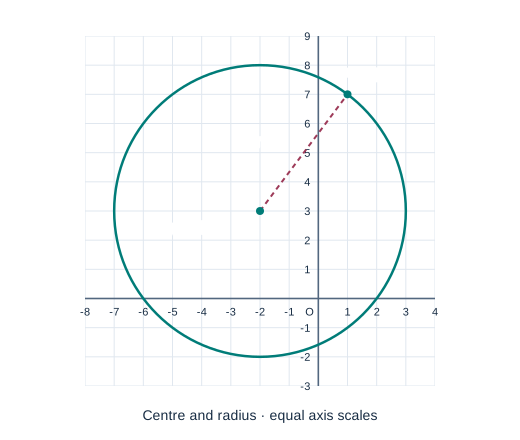
The circle with centre \((a,b)\) and radius \(r>0\) has equation
\[(x-a)^2+(y-b)^2=r^2.\]
In an expanded equation, group the x-terms and y-terms separately and complete both squares. The constant obtained is the squared radius, not the radius. A zero squared radius describes a single point; a negative value gives no real points, rather than a nondegenerate circle.
A tangent at \(P=(u,v)\) is perpendicular to the radius CP. Once P is checked on the circle, a slope-free tangent equation is
\[(u-a)(x-u)+(v-b)(y-v)=0.\]
This also handles horizontal or vertical radii: the radius vector is normal to the tangent, and cannot be zero on a circle of positive radius.
Recall later
For \((x-2)^2+(y+1)^2=9\), the centre is \((2,-1)\) and the radius is 3.
Common mistakes
Reading the centre with the wrong signs.
Using the diameter as the radius or reporting r² as r.
Finding the radius equation and labelling it as the tangent.
Three worked examples
Example 1
Find the centre and radius of \(x^2+y^2+4x-6y-12=0\).
Show the reasoning
Completing squares gives \((x+2)^2+(y-3)^2=25\). The centre is \((-2,3)\) and the radius is 5.
Example 2
Find the circle whose diameter endpoints are \((-1,2),(5,10)\).
Show the reasoning
The centre is their midpoint \((2,6)\). The diameter length is 10, so radius=5. The equation is \((x-2)^2+(y-6)^2=25\).
Example 3
Find the tangent to \(x^2+y^2=25\) at \((3,4)\).
Show the reasoning
The point is on the circle since 9+16=25. The radius vector is (3,4), so the tangent is \(3(x-3)+4(y-4)=0\), or \(3x+4y=25\).
Substitute to find intersections and use a repeated root to identify tangency.
Notes
Before you start: solve a quadratic, interpret its discriminant and recover a matching coordinate.
Substitute the line equation into the circle. The resulting quadratic describes the coordinate of each intersection: a positive discriminant gives two distinct points, zero gives one tangent point and a negative value gives no real intersection. A vertical line can be substituted directly as x=c.
For every root, calculate the other coordinate and check the pair in both original equations. If the question concerns a segment or ray, also check that the point lies on that segment or ray.
The midpoint of a chord lies on its perpendicular bisector. A chord through the centre is a diameter, so its length is 2r. For a tangent family, form the intersection quadratic first; the discriminant of the circle formula alone is not the relevant expression.
Recall later
The line y=5 touches \(x^2+y^2=25\) at \((0,5)\), while y=6 has no real intersection.
Common mistakes
Stopping after finding x without the paired y-coordinate.
Using two distinct intersections as evidence of tangency.
Keeping an intersection on the full line but outside the specified segment.
Three worked examples
Example 1
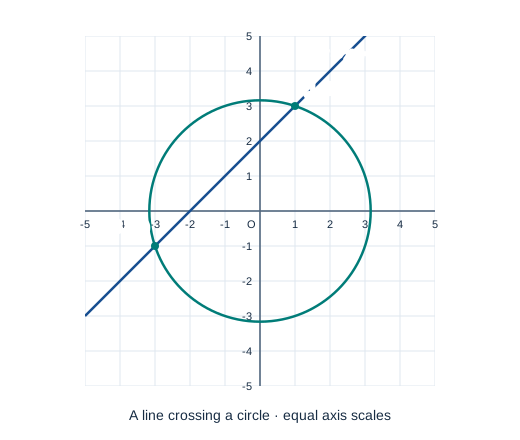
Find the intersections of \(x^2+y^2=10\) and \(y=x+2\).
Show the reasoning
Substitution gives \(2x^2+4x-6=0\), or \((x+3)(x-1)=0\). Thus the points are \((-3,-1)\) and \((1,3)\).
Example 2
For which c is \(y=x+c\) tangent to \(x^2+y^2=18\)?
Show the reasoning
The intersection equation is \(2x^2+2cx+c^2-18=0\). Its discriminant is \(4(36-c^2)\). Setting this to zero gives \(c=6\) or \(c=-6\).
Example 3
Find where the segment from \((0,3)\) to \((6,3)\) meets \(x^2+y^2=25\).
Show the reasoning
On its supporting line, y=3 gives x²=16, so x=±4. The segment only has 0≤x≤6; the sole permitted intersection is \((4,3)\).