Learn the method, study an example, then explain your reasoning in an exam-style problem. Work on paper before opening the solution and compare each step with the marking guidance.
Circle equations and tangents
Identify a circle, complete squares and find a tangent from its radius.
Notes
Before you start: complete the square and recognise perpendicular directions.
The circle with centre \((a,b)\) and radius \(r>0\) has equation
\[(x-a)^2+(y-b)^2=r^2.\]
In an expanded equation, group the x-terms and y-terms separately and complete both squares. The constant obtained is the squared radius, not the radius. A zero squared radius describes a single point; a negative value gives no real points, rather than a nondegenerate circle.
A tangent at \(P=(u,v)\) is perpendicular to the radius CP. Once P is checked on the circle, a slope-free tangent equation is
\[(u-a)(x-u)+(v-b)(y-v)=0.\]
This also handles horizontal or vertical radii: the radius vector is normal to the tangent, and cannot be zero on a circle of positive radius.
Recall later
For \((x-2)^2+(y+1)^2=9\), the centre is \((2,-1)\) and the radius is 3.
Common mistakes
Reading the centre with the wrong signs.
Using the diameter as the radius or reporting r² as r.
Finding the radius equation and labelling it as the tangent.
Three worked examples
Example 1
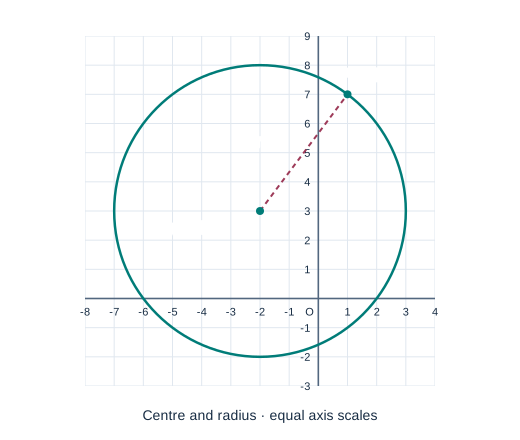
Find the centre and radius of \(x^2+y^2+4x-6y-12=0\).
Show the reasoning
Completing squares gives \((x+2)^2+(y-3)^2=25\). The centre is \((-2,3)\) and the radius is 5.
Example 2
Find the circle whose diameter endpoints are \((-1,2),(5,10)\).
Show the reasoning
The centre is their midpoint \((2,6)\). The diameter length is 10, so radius=5. The equation is \((x-2)^2+(y-6)^2=25\).
Example 3
Find the tangent to \(x^2+y^2=25\) at \((3,4)\).
Show the reasoning
The point is on the circle since 9+16=25. The radius vector is (3,4), so the tangent is \(3(x-3)+4(y-4)=0\), or \(3x+4y=25\).