Learn the method, study an example, then explain your reasoning in an exam-style problem. Work on paper before opening the solution and compare each step with the marking guidance.
Line–circle intersections, chords and tangency
Substitute to find intersections and use a repeated root to identify tangency.
Notes
Before you start: solve a quadratic, interpret its discriminant and recover a matching coordinate.
Substitute the line equation into the circle. The resulting quadratic describes the coordinate of each intersection: a positive discriminant gives two distinct points, zero gives one tangent point and a negative value gives no real intersection. A vertical line can be substituted directly as x=c.
For every root, calculate the other coordinate and check the pair in both original equations. If the question concerns a segment or ray, also check that the point lies on that segment or ray.
The midpoint of a chord lies on its perpendicular bisector. A chord through the centre is a diameter, so its length is 2r. For a tangent family, form the intersection quadratic first; the discriminant of the circle formula alone is not the relevant expression.
Recall later
The line y=5 touches \(x^2+y^2=25\) at \((0,5)\), while y=6 has no real intersection.
Common mistakes
Stopping after finding x without the paired y-coordinate.
Using two distinct intersections as evidence of tangency.
Keeping an intersection on the full line but outside the specified segment.
Three worked examples
Example 1
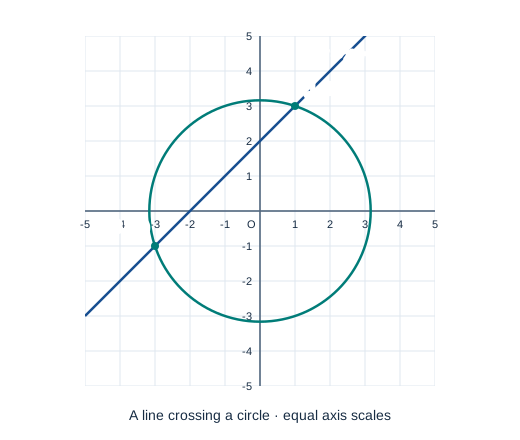
Find the intersections of \(x^2+y^2=10\) and \(y=x+2\).
Show the reasoning
Substitution gives \(2x^2+4x-6=0\), or \((x+3)(x-1)=0\). Thus the points are \((-3,-1)\) and \((1,3)\).
Example 2
For which c is \(y=x+c\) tangent to \(x^2+y^2=18\)?
Show the reasoning
The intersection equation is \(2x^2+2cx+c^2-18=0\). Its discriminant is \(4(36-c^2)\). Setting this to zero gives \(c=6\) or \(c=-6\).
Example 3
Find where the segment from \((0,3)\) to \((6,3)\) meets \(x^2+y^2=25\).
Show the reasoning
On its supporting line, y=3 gives x²=16, so x=±4. The segment only has 0≤x≤6; the sole permitted intersection is \((4,3)\).