9709 P11 - Jun 2019 - Q4
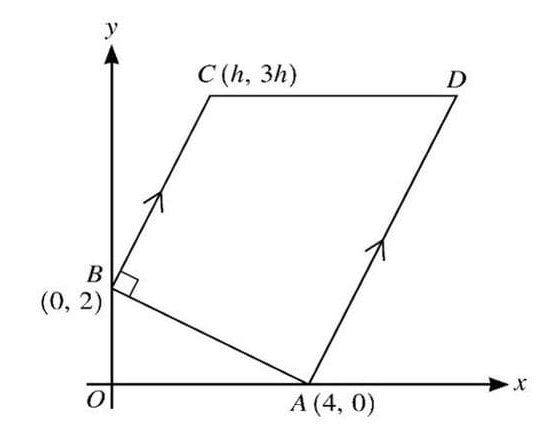
The diagram shows a trapezium ABCD in which the coordinates of A, B, and C are (4, 0), (0, 2), and (h, 3h) respectively. The lines BC and AD are parallel, angle ∠ABC = 90° and CD is parallel to the x-axis.
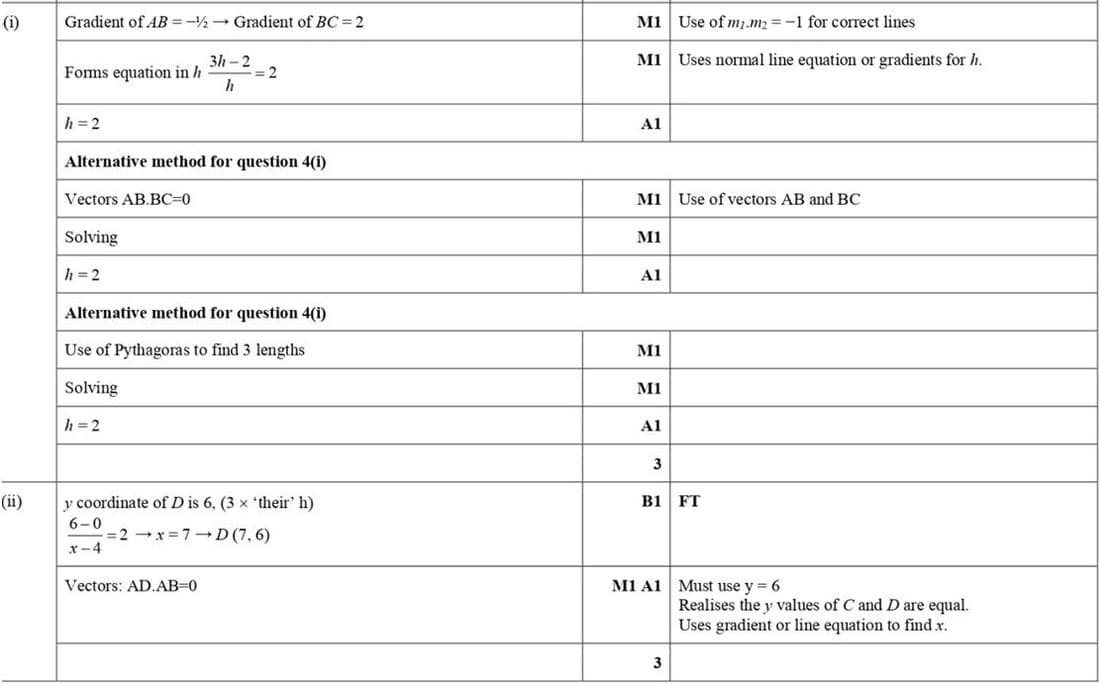
(i) Find, by calculation, the value of h.
(ii) Hence find the coordinates of D.
9709 P13 - Jun 2010 - Q8
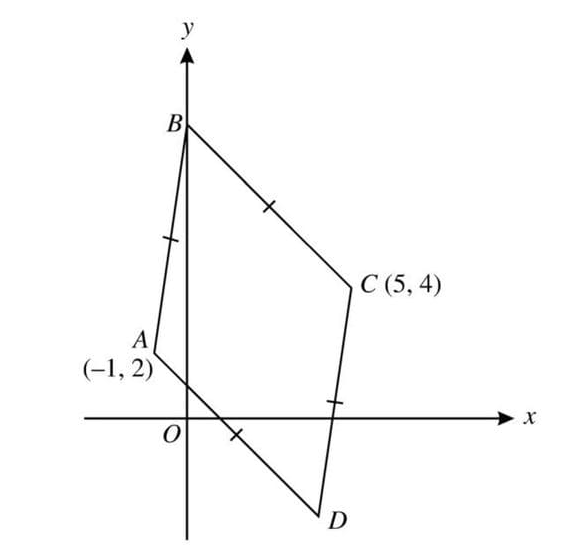
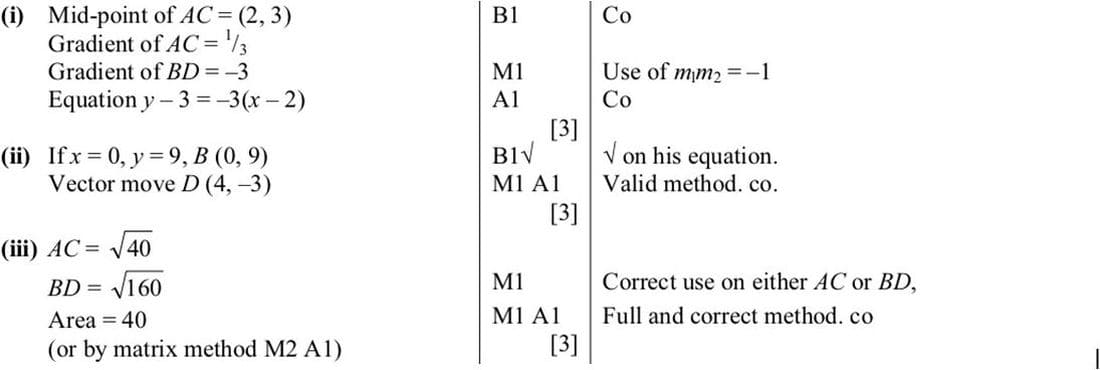
The diagram shows a rhombus ABCD in which the point A is (-1, 2), the point C is (5, 4) and the point B lies on the y-axis. Find
- the equation of the perpendicular bisector of AC,
- the coordinates of B and D,
- the area of the rhombus.
9709 P12 - Jun 2010 - Q4
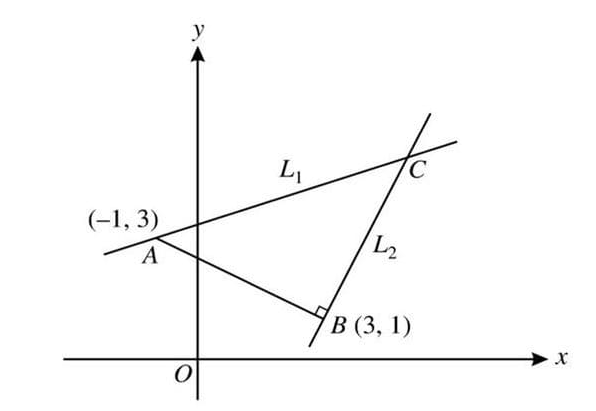
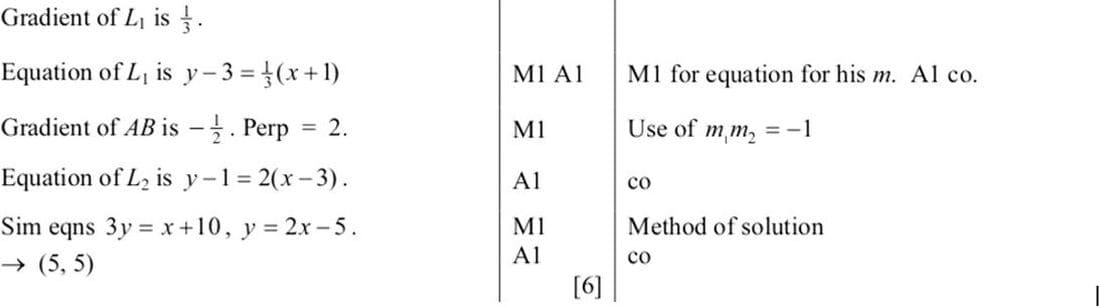
In the diagram, A is the point (-1, 3) and B is the point (3, 1). The line L1 passes through A and is parallel to OB. The line L2 passes through B and is perpendicular to AB. The lines L1 and L2 meet at C. Find the coordinates of C.
9709 P11 - Jun 2010 - Q8
The diagram shows a triangle ABC in which A is (3, -2) and B is (15, 22). The gradients of AB, AC and BC are 2m, -2m and m respectively, where m is a positive constant.
- Find the gradient of AB and deduce the value of m.
- Find the coordinates of C.
- Find the coordinates of D.
The perpendicular bisector of AB meets BC at D.


9709 P12 - Nov 2009 - Q9
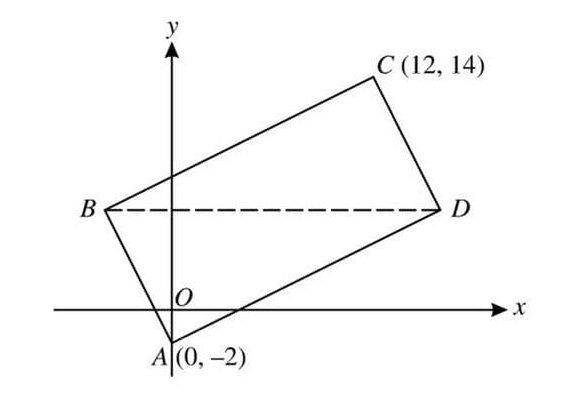
The diagram shows a rectangle ABCD. The point A is (0, -2) and C is (12, 14). The diagonal BD is parallel to the x-axis.
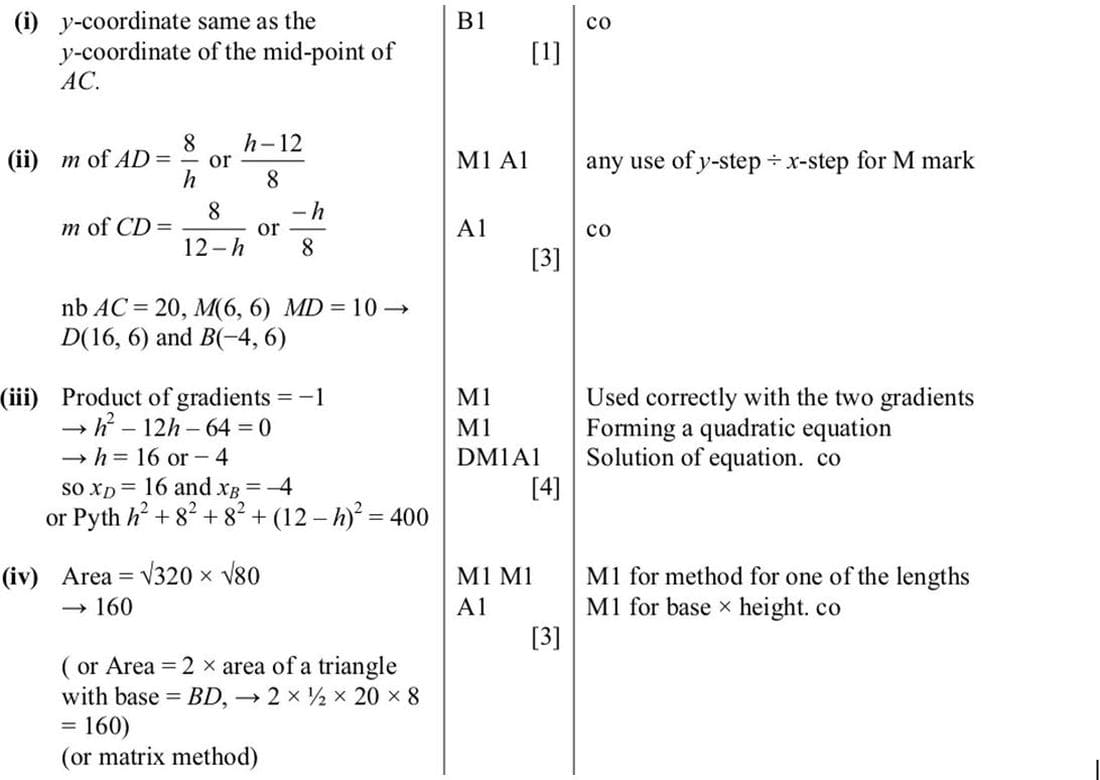
- Explain why the y-coordinate of D is 6.
- The x-coordinate of D is h. Express the gradients of AD and CD in terms of h.
- Calculate the x-coordinates of D and B.
- Calculate the area of the rectangle ABCD.
9709 P1 - Jun 2009 - Q8
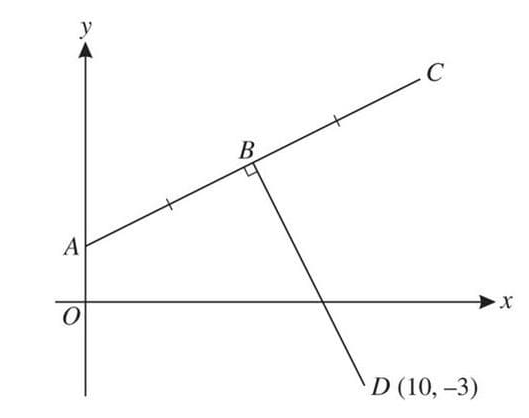
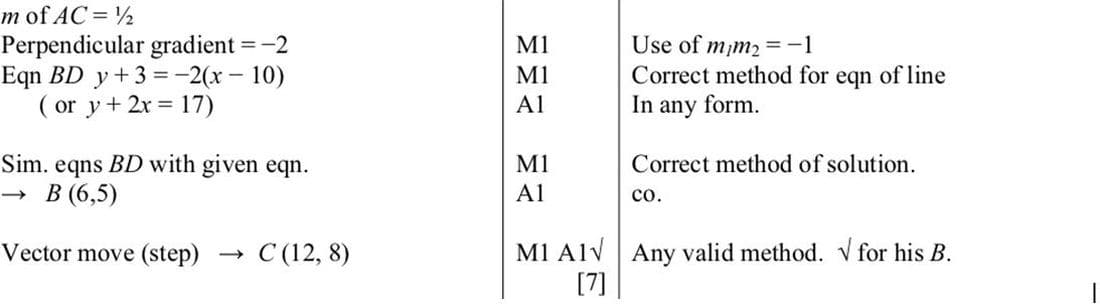
The diagram shows points A, B, and C lying on the line \(2y = x + 4\). The point A lies on the y-axis and \(AB = BC\). The line from D \((10, -3)\) to B is perpendicular to AC. Calculate the coordinates of B and C.
9709 P1 - Jun 2008 - Q11
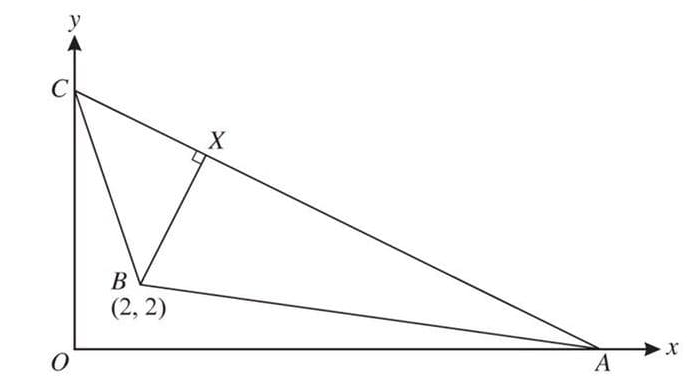
In the diagram, the points A and C lie on the x- and y-axes respectively and the equation of AC is \(2y + x = 16\). The point B has coordinates \((2, 2)\). The perpendicular from B to AC meets AC at the point X.
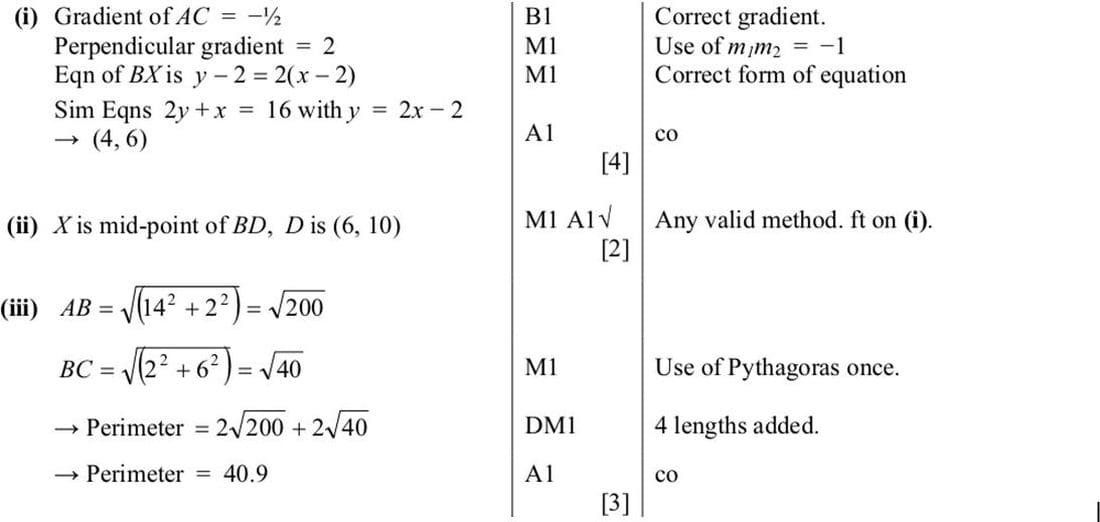
(i) Find the coordinates of X.
The point D is such that the quadrilateral ABCD has AC as a line of symmetry.
(ii) Find the coordinates of D.
(iii) Find, correct to 1 decimal place, the perimeter of ABCD.
9709 P1 - Nov 2007 - Q6
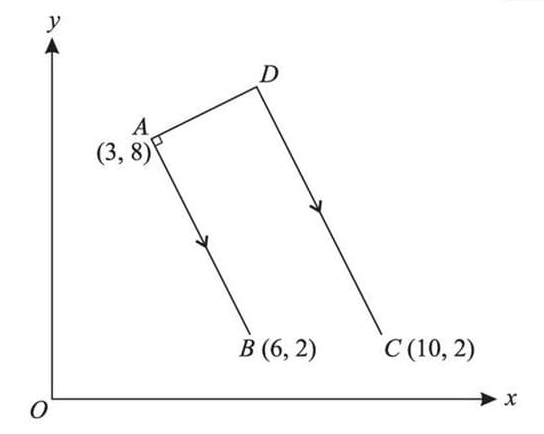
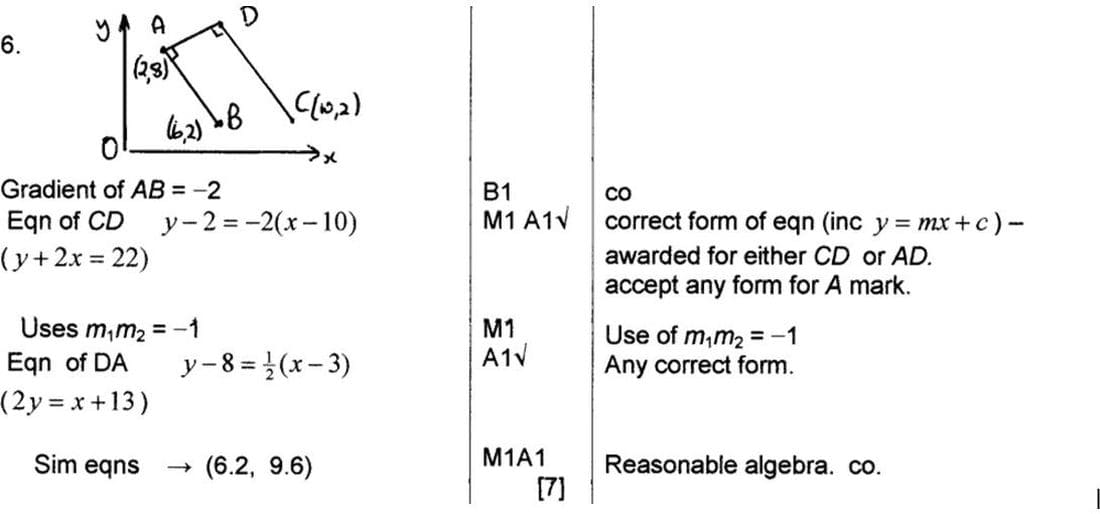
The three points A (3, 8), B (6, 2) and C (10, 2) are shown in the diagram. The point D is such that the line DA is perpendicular to AB and DC is parallel to AB. Calculate the coordinates of D.
9709 P1 - Jun 2007 - Q6
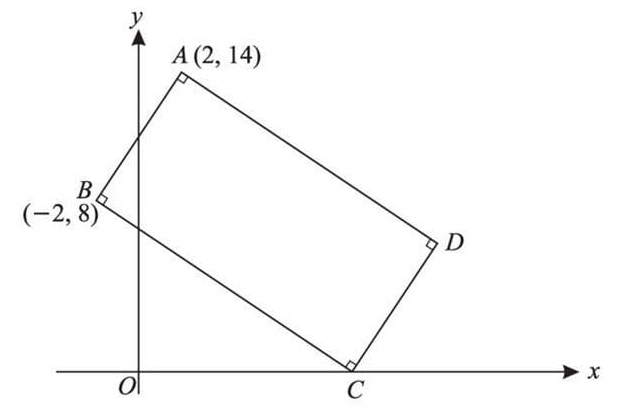
The diagram shows a rectangle ABCD. The point A is (2, 14), B is (-2, 8) and C lies on the x-axis. Find
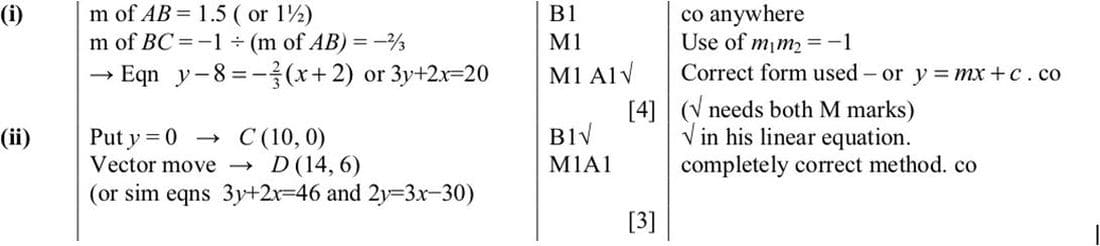
- the equation of BC,
- the coordinates of C and D.
9709 P1 - Nov 2006 - Q5
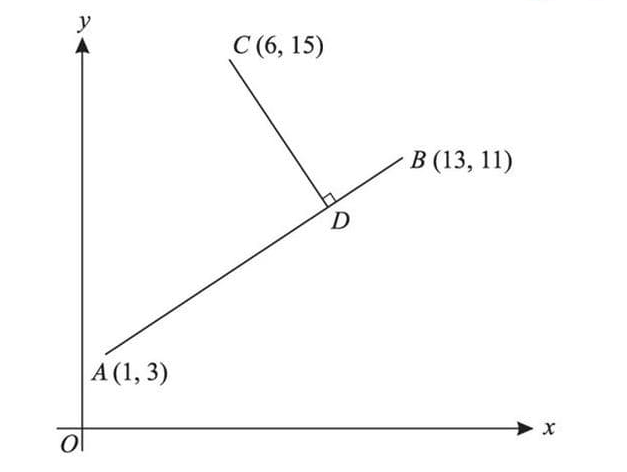
The three points A (1, 3), B (13, 11) and C (6, 15) are shown in the diagram. The perpendicular from C to AB meets AB at the point D. Find
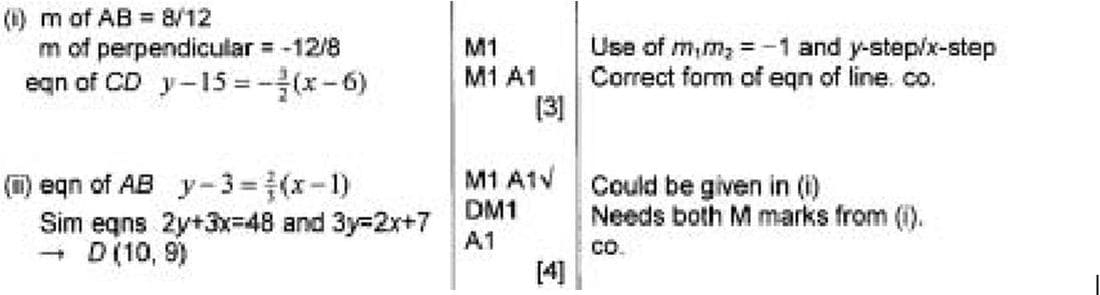
(i) the equation of CD,
(ii) the coordinates of D.
9709 P1 - Jun 2005 - Q5
The diagram shows a rhombus ABCD. The points B and D have coordinates (2, 10) and (6, 2) respectively, and A lies on the x-axis. The mid-point of BD is M. Find, by calculation, the coordinates of each of M, A, and C.


9709 P11 - Jun 2018 - Q5
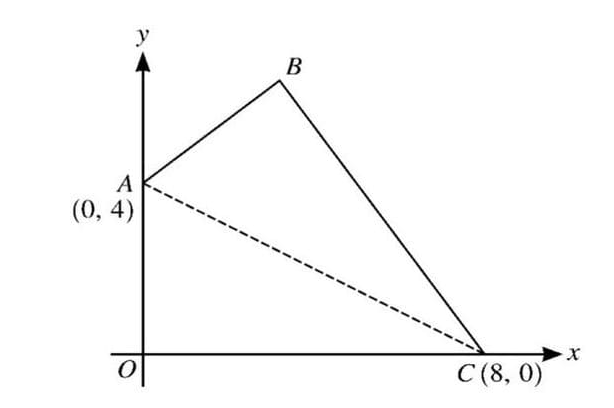
The diagram shows a kite OABC in which AC is the line of symmetry. The coordinates of A and C are (0, 4) and (8, 0) respectively and O is the origin.
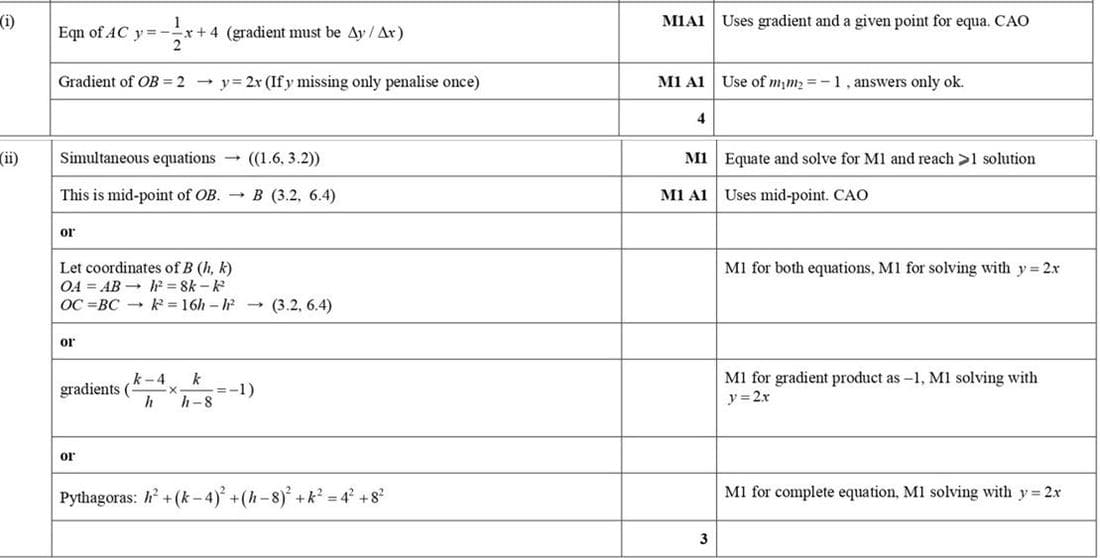
(i) Find the equations of AC and OB.
(ii) Find, by calculation, the coordinates of B.
9709 P1 - Nov 2003 - Q5
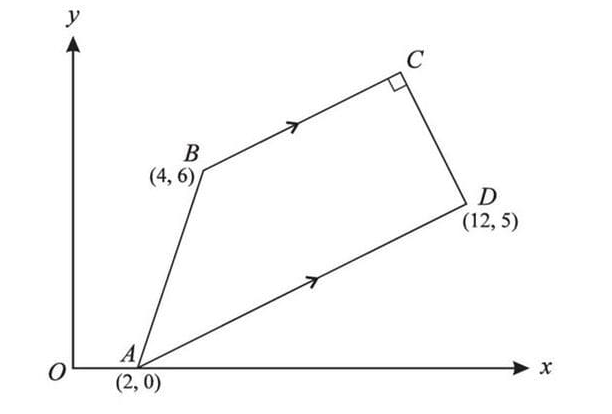
The diagram shows a trapezium ABCD in which BC is parallel to AD and angle BCD = 90°. The coordinates of A, B and D are (2, 0), (4, 6) and (12, 5) respectively.
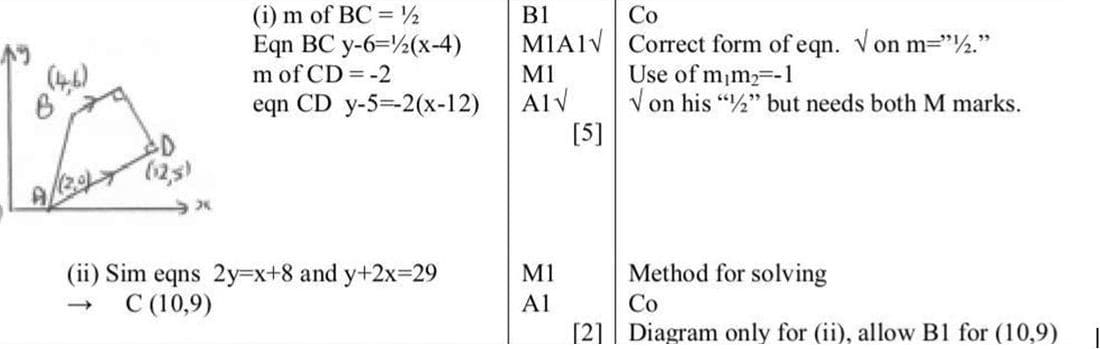
(i) Find the equations of BC and CD.
(ii) Calculate the coordinates of C.
9709 P1 - Nov 2002 - Q9
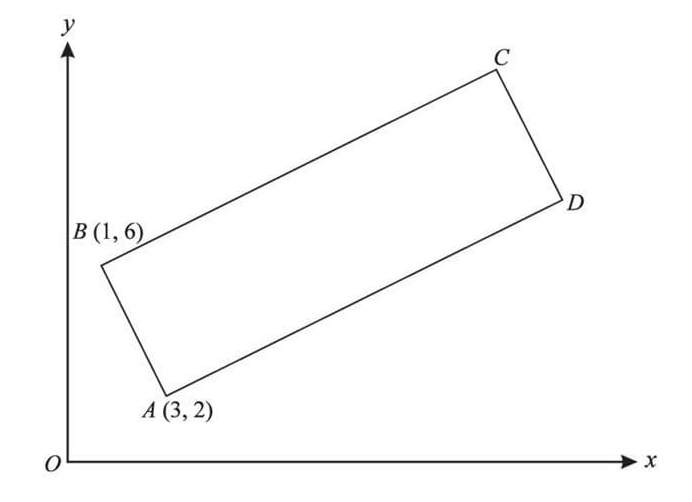
The diagram shows a rectangle ABCD, where A is (3, 2) and B is (1, 6).
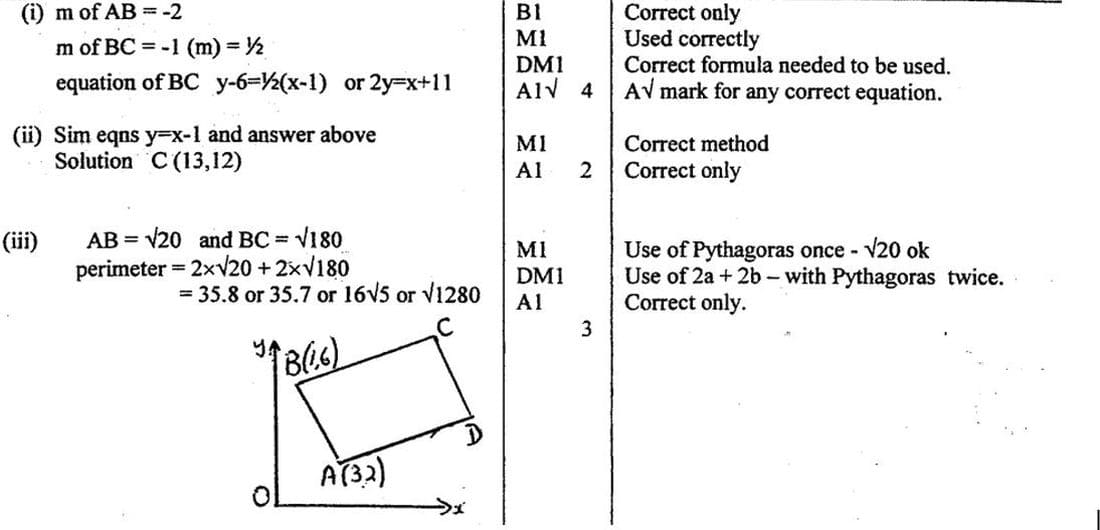
- Find the equation of BC.
- Given that the equation of AC is y = x - 1, find the coordinates of C.
- Find the perimeter of the rectangle ABCD.
9709 P12 - Nov 2014 - Q9
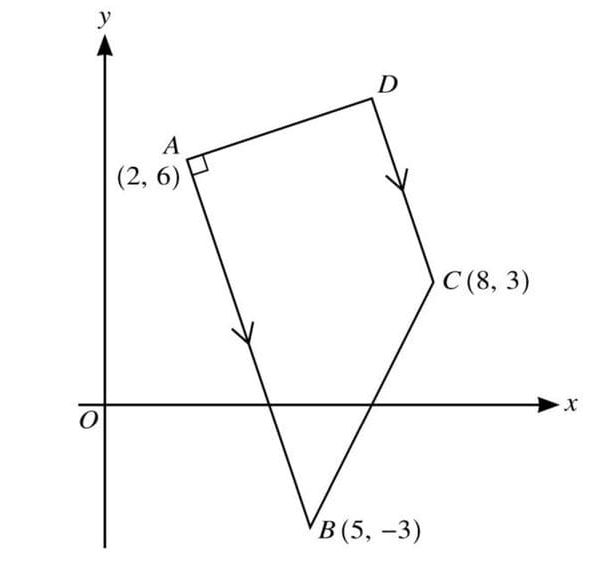
The diagram shows a trapezium ABCD in which AB is parallel to DC and angle BAD is 90°. The coordinates of A, B, and C are (2, 6), (5, -3), and (8, 3) respectively.
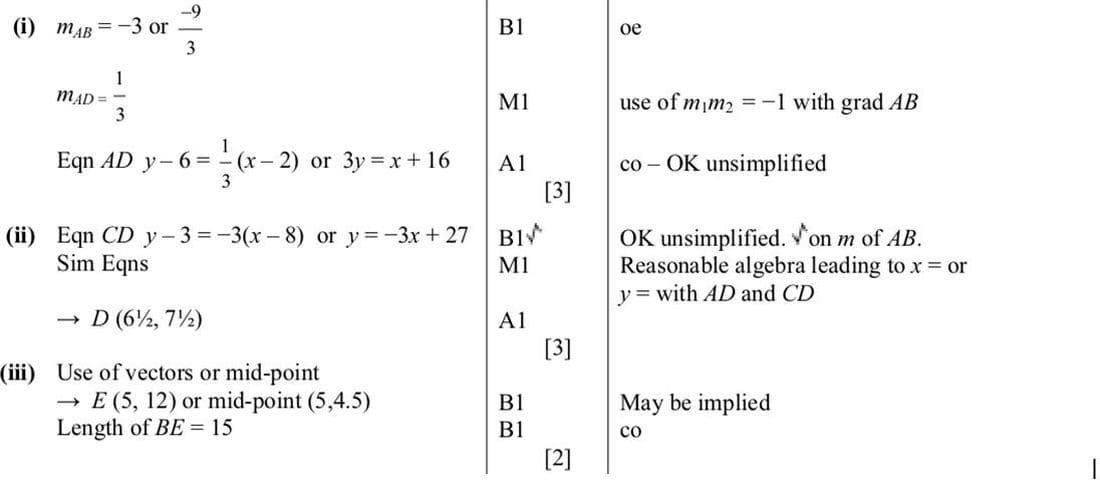
- Find the equation of AD.
- Find, by calculation, the coordinates of D.
The point E is such that ABCE is a parallelogram.
- Find the length of BE.
9709 P13 - Jun 2014 - Q11
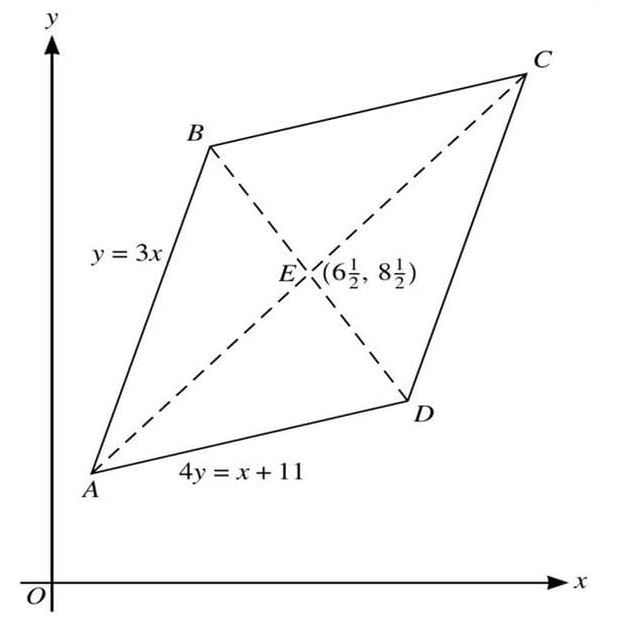
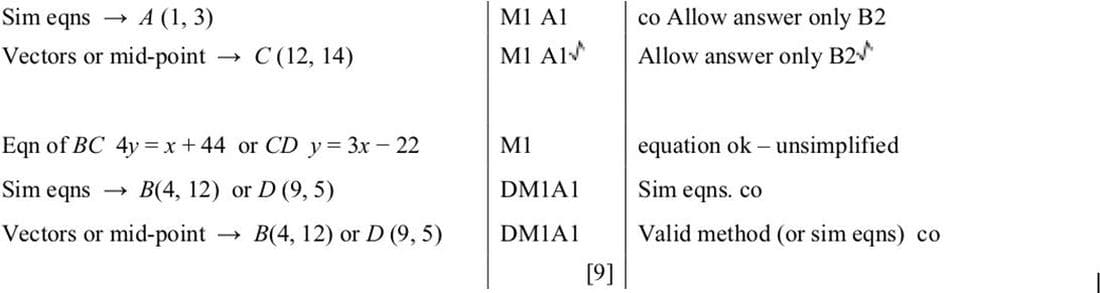
The diagram shows a parallelogram ABCD, in which the equation of AB is y = 3x and the equation of AD is 4y = x + 11. The diagonals AC and BD meet at the point E \\(\left( 6 \frac{1}{2}, 8 \frac{1}{2} \right) \\). Find, by calculation, the coordinates of A, B, C, and D.
9709 P12 - Nov 2013 - Q5
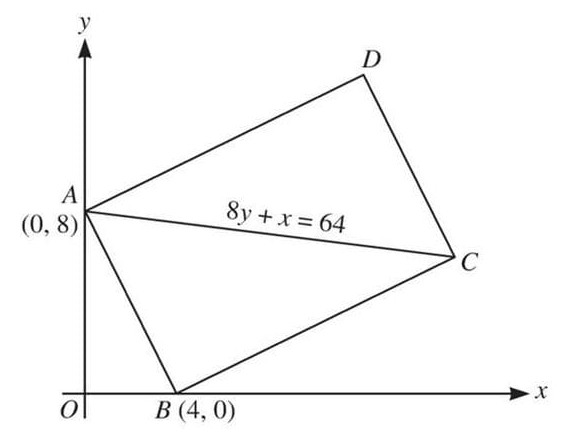
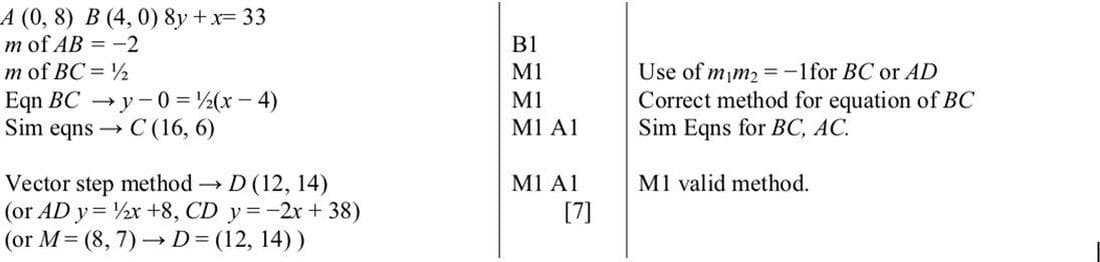
The diagram shows a rectangle ABCD in which point A is (0, 8) and point B is (4, 0). The diagonal AC has equation \(8y + x = 64\). Find, by calculation, the coordinates of C and D.
9709 P13 - Jun 2013 - Q7
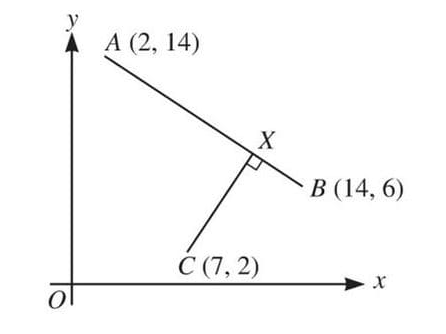
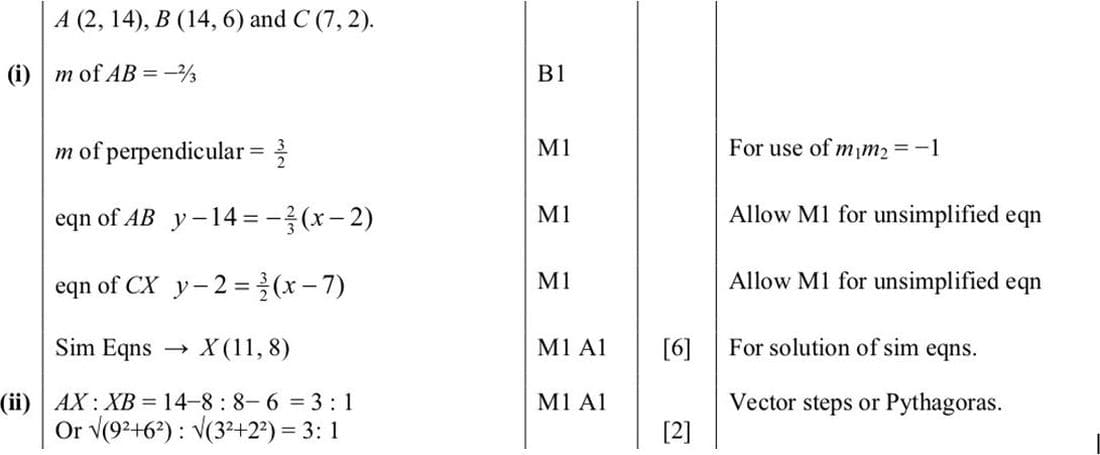
The diagram shows three points \(A (2, 14)\), \(B (14, 6)\) and \(C (7, 2)\). The point \(X\) lies on \(AB\), and \(CX\) is perpendicular to \(AB\). Find, by calculation,
- the coordinates of \(X\),
- the ratio \(AX : XB\).
9709 P12 - Nov 2012 - Q5
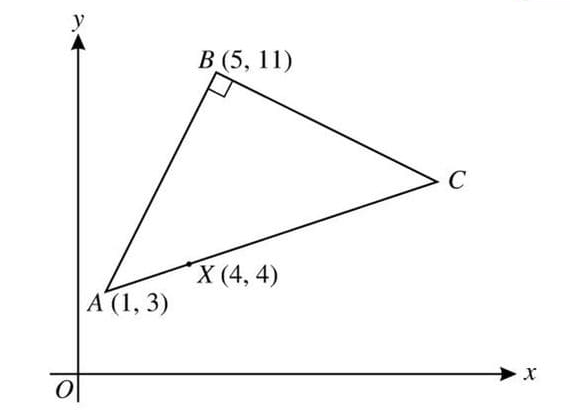
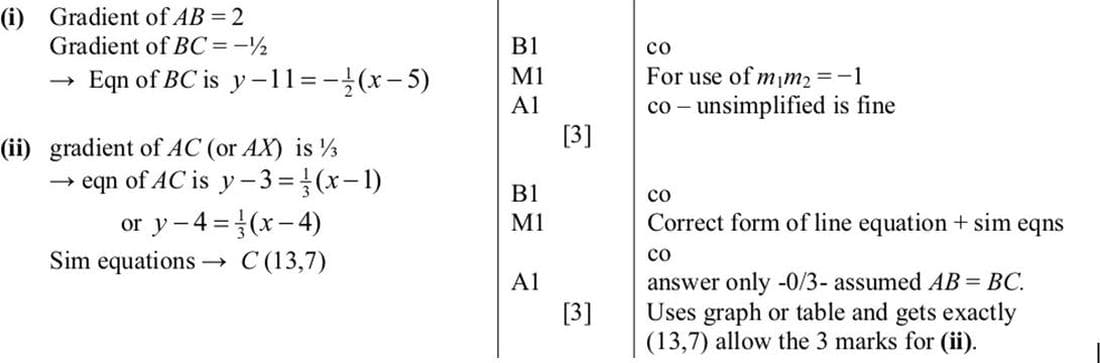
The diagram shows a triangle ABC in which A has coordinates (1, 3), B has coordinates (5, 11) and angle ABC is 90°. The point X (4, 4) lies on AC. Find
- the equation of BC,
- the coordinates of C.
9709 P12 - Nov 2011 - Q9
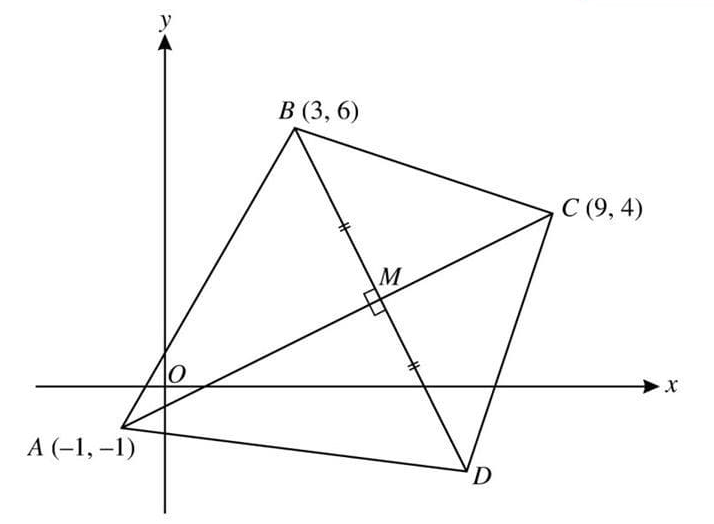
The diagram shows a quadrilateral ABCD in which the point A is (-1, -1), the point B is (3, 6) and the point C is (9, 4). The diagonals AC and BD intersect at M. Angle BMA = 90^ 0 and BM = MD. Calculate
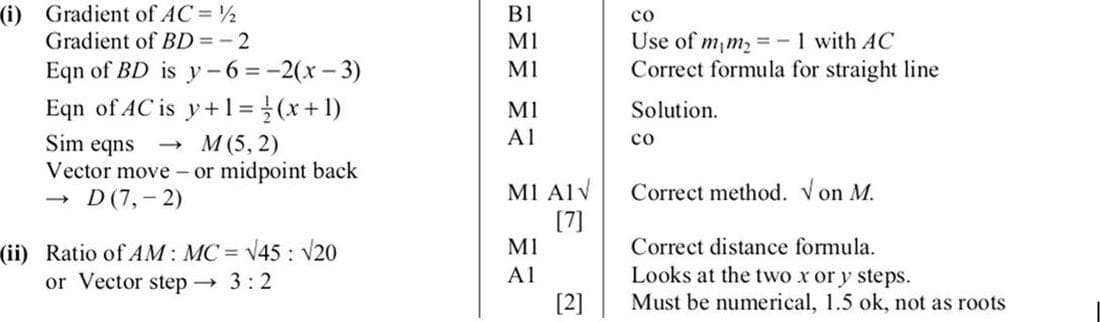
- the coordinates of M and D,
- the ratio AM : MC.
9709 P12 - Nov 2010 - Q8
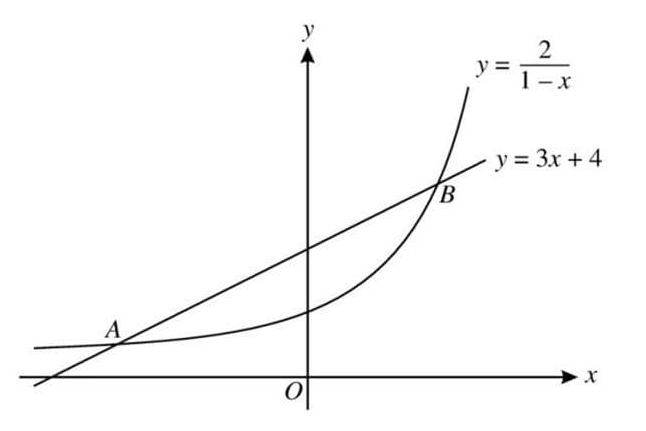
The diagram shows part of the curve \(y = \frac{2}{1-x}\) and the line \(y = 3x + 4\). The curve and the line meet at points \(A\) and \(B\).
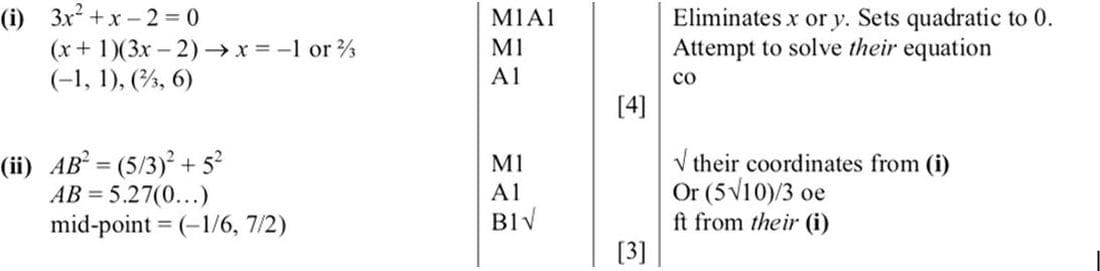
(i) Find the coordinates of \(A\) and \(B\).
(ii) Find the length of the line \(AB\) and the coordinates of the mid-point of \(AB\).