9709 P12 - Nov 2021 - Q5
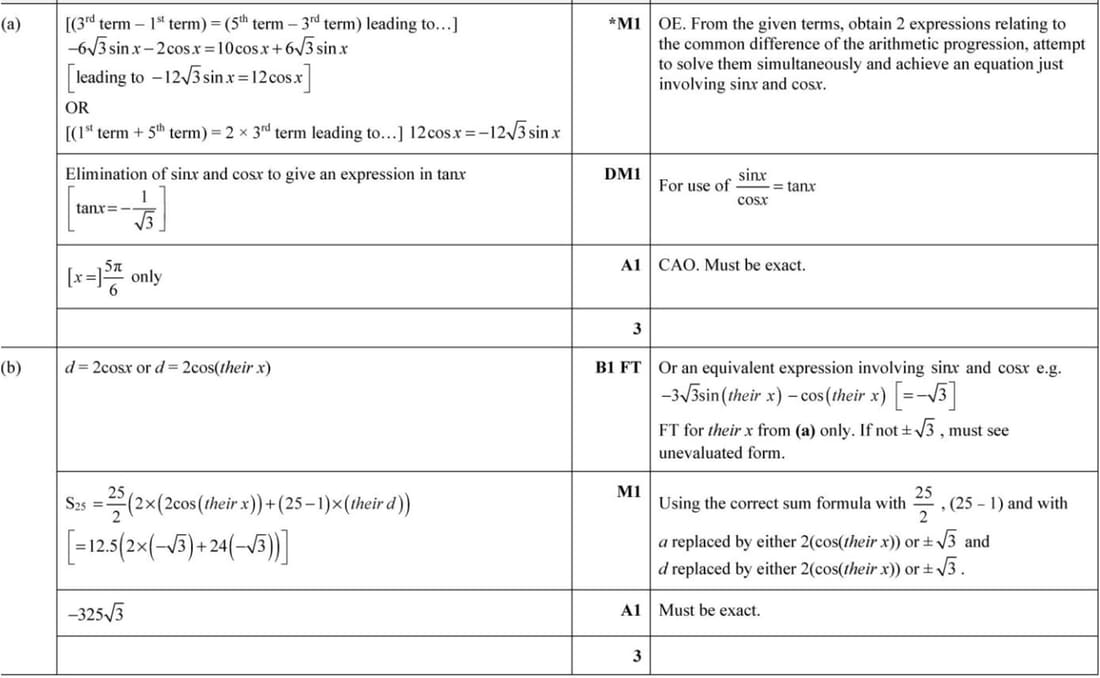
The first, third and fifth terms of an arithmetic progression are \(2 \cos x\), \(-6\sqrt{3} \sin x\) and \(10 \cos x\) respectively, where \(\frac{1}{2}\pi < x < \pi\).
(a) Find the exact value of \(x\). [3]
(b) Hence find the exact sum of the first 25 terms of the progression. [3]
9709 P13 - Nov 2020 - Q7
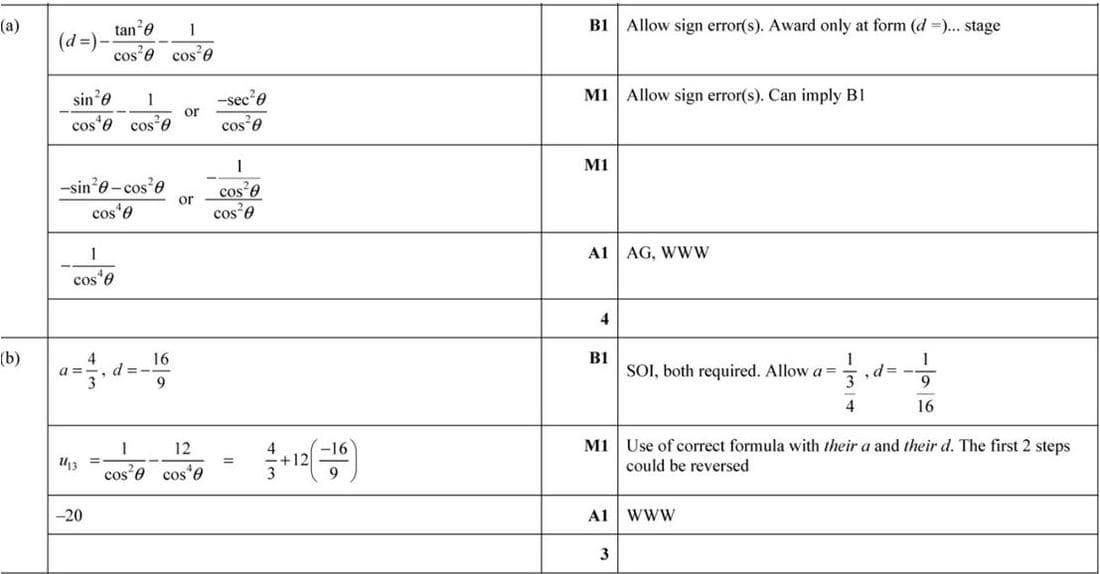
The first and second terms of an arithmetic progression are \(\frac{1}{\cos^2 \theta}\) and \(-\frac{\tan^2 \theta}{\cos^2 \theta}\), respectively, where \(0 < \theta < \frac{1}{2} \pi\).
(a) Show that the common difference is \(-\frac{1}{\cos^4 \theta}\).
(b) Find the exact value of the 13th term when \(\theta = \frac{1}{6} \pi\).
9709 P13 - Jun 2020 - Q8
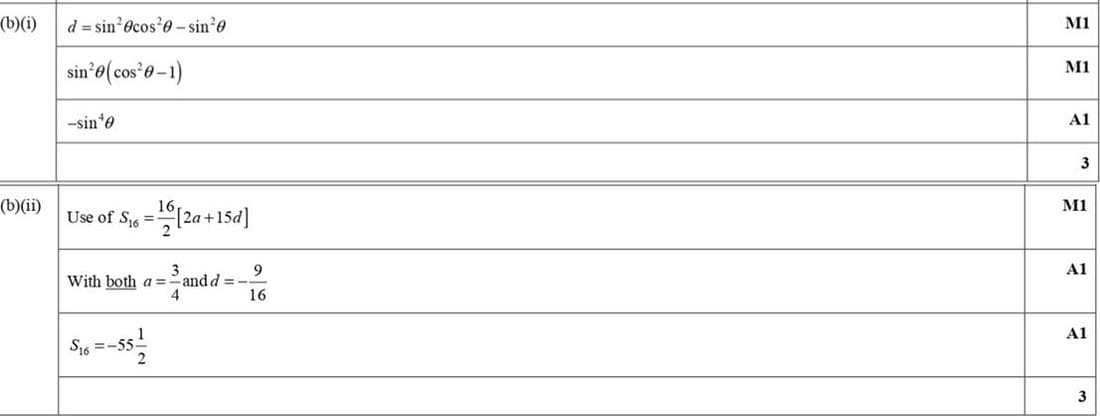
The first term of a progression is \(\sin^2 \theta\), where \(0 < \theta < \frac{1}{2} \pi\). The second term of the progression is \(\sin^2 \theta \cos^2 \theta\).
It is now given instead that the progression is arithmetic.
(i) Find the common difference of the progression in terms of \(\sin \theta\).
(ii) Find the sum of the first 16 terms when \(\theta = \frac{1}{3} \pi\).
9709 P13 - Nov 2016 - Q9
The first term of an arithmetic progression is \(\cos \theta\) and the second term is \(\cos \theta + \sin^2 \theta\), where \(0 \leq \theta \leq \pi\). The sum of the first 13 terms is 52. Find the possible values of \(\theta\).

9709 P11 - Jun 2016 - Q9
The first three terms of an arithmetic progression are \(2 \sin x\), \(3 \cos x\) and \((\sin x + 2 \cos x)\) respectively, where \(x\) is an acute angle.
(i) Show that \(\tan x = \frac{4}{3}\).
(ii) Find the sum of the first twenty terms of the progression.

9709 P11 - Jun 2012 - Q7
The first two terms of an arithmetic progression are 1 and \(\cos^2 x\) respectively. Show that the sum of the first ten terms can be expressed in the form \(a - b \sin^2 x\), where \(a\) and \(b\) are constants to be found.
