9709 P12 - Nov 2023 - Q5
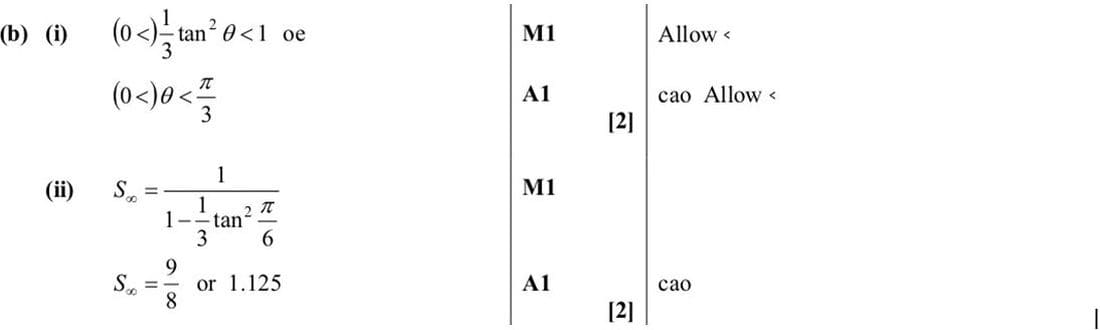
The first, second and third terms of a geometric progression are \(\sin \theta\), \(\cos \theta\) and \(2 - \sin \theta\) respectively, where \(\theta\) radians is an acute angle.
(a) Find the value of \(\theta\).
(b) Using this value of \(\theta\), find the sum of the first 10 terms of the progression. Give the answer in the form \(\frac{b}{\sqrt{c} - 1}\), where \(b\) and \(c\) are integers to be found.
9709 P12 - Mar 2021 - Q9
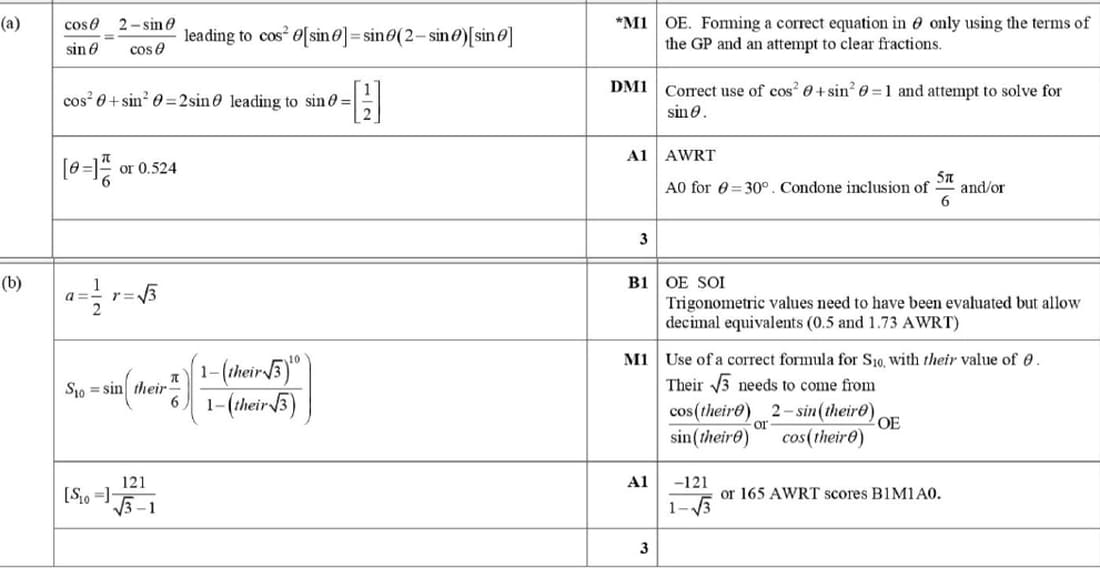
The first term of a progression is \(\cos \theta\), where \(0 < \theta < \frac{1}{2} \pi\).
(a) For the case where the progression is geometric, the sum to infinity is \(\frac{1}{\cos \theta}\).
(i) Show that the second term is \(\cos \theta \sin^2 \theta\).
(ii) Find the sum of the first 12 terms when \(\theta = \frac{1}{3} \pi\), giving your answer correct to 4 significant figures.
(b) For the case where the progression is arithmetic, the first two terms are again \(\cos \theta\) and \(\cos \theta \sin^2 \theta\) respectively.
Find the 85th term when \(\theta = \frac{1}{3} \pi\).
9709 P13 - Jun 2020 - Q8
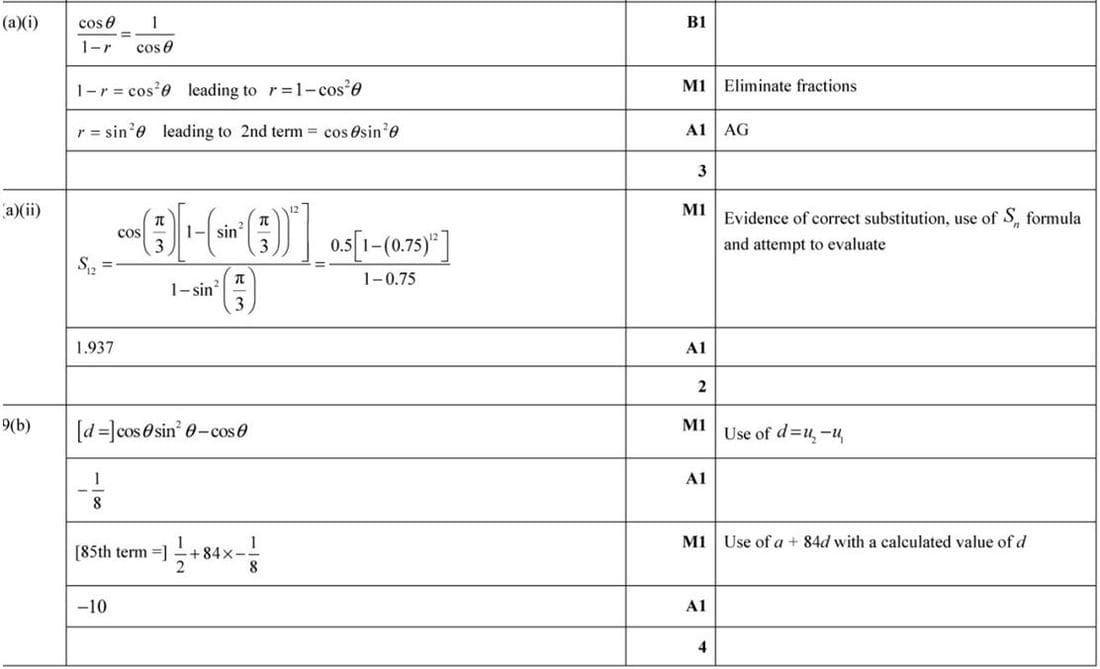
The first term of a progression is \(\sin^2 \theta\), where \(0 < \theta < \frac{1}{2}\pi\). The second term of the progression is \(\sin^2 \theta \cos^2 \theta\).
Given that the progression is geometric, find the sum to infinity.

9709 P13 - Jun 2015 - Q9
The first term of a geometric progression is \(\sqrt{3}\) and the second term is \(2 \cos \theta\), where \(0 < \theta < \pi\). Find the set of values of \(\theta\) for which the progression is convergent.
9709 P11 - Jun 2012 - Q7
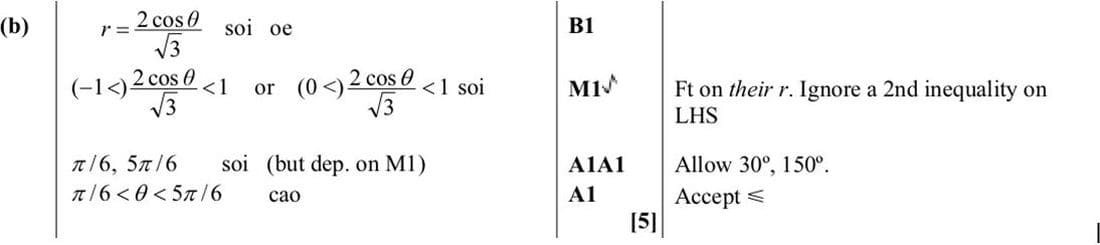
The first two terms of a geometric progression are 1 and \(\frac{1}{3} \tan^2 \theta\) respectively, where \(0 < \theta < \frac{1}{2} \pi\).
(i) Find the set of values of \(\theta\) for which the progression is convergent.
(ii) Find the exact value of the sum to infinity when \(\theta = \frac{1}{6} \pi\).