9709 P13 - Nov 2023 - Q5
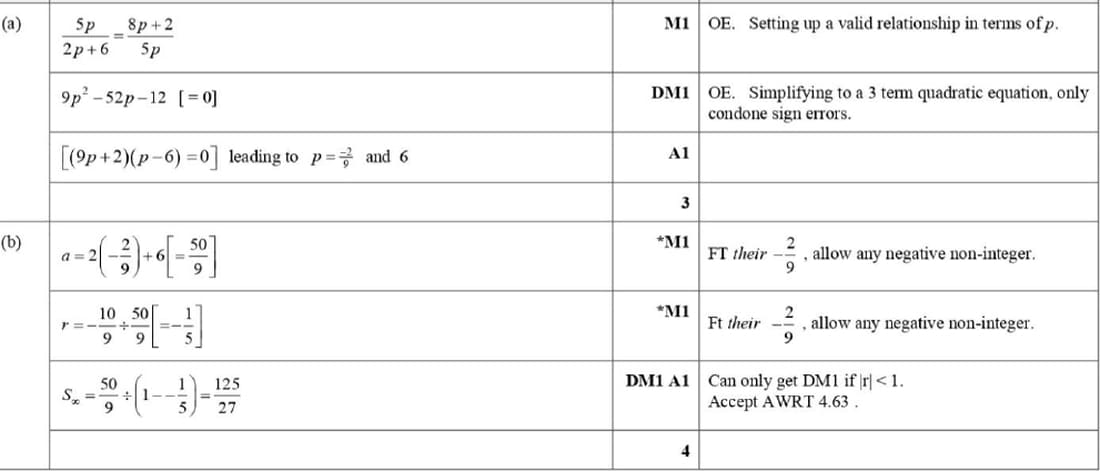
The first, second and third terms of a geometric progression are \(2p + 6\), \(5p\) and \(8p + 2\) respectively.
(a) Find the possible values of the constant \(p\).
(b) One of the values of \(p\) found in (a) is a negative fraction. Use this value of \(p\) to find the sum to infinity of this progression.
9709 P12 - Nov 2021 - Q6
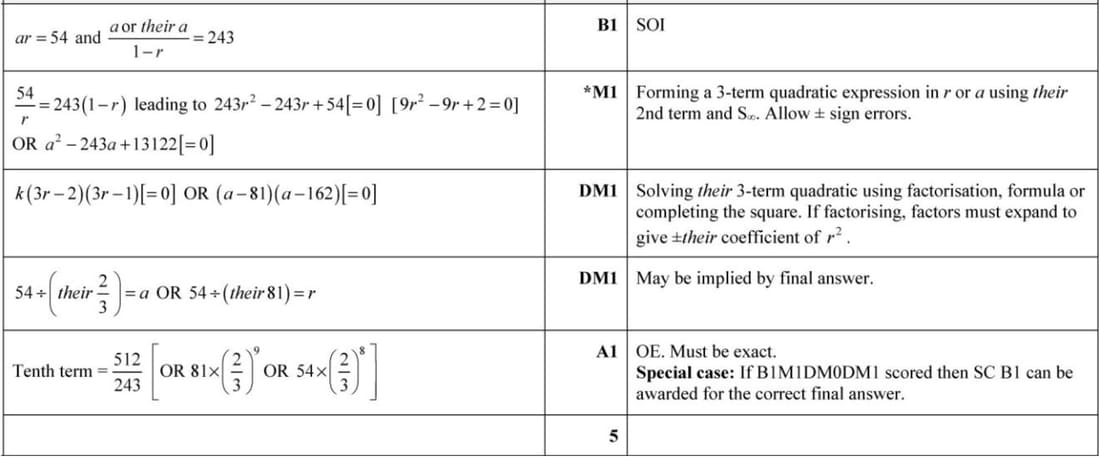
The second term of a geometric progression is 54 and the sum to infinity of the progression is 243. The common ratio is greater than \(\frac{1}{2}\).
Find the tenth term, giving your answer in exact form.
9709 P13 - Jun 2021 - Q9
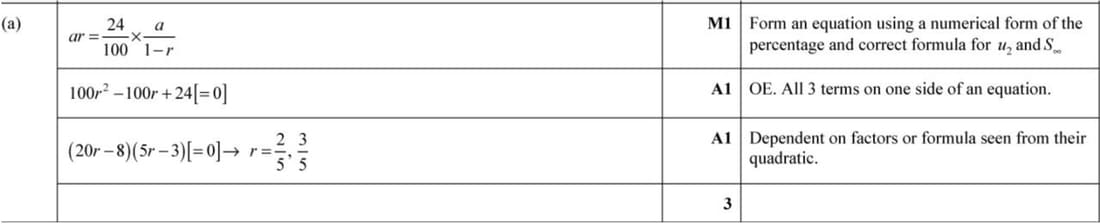
A geometric progression is such that the second term is equal to 24% of the sum to infinity.
Find the possible values of the common ratio.
9709 P11 - Jun 2021 - Q5
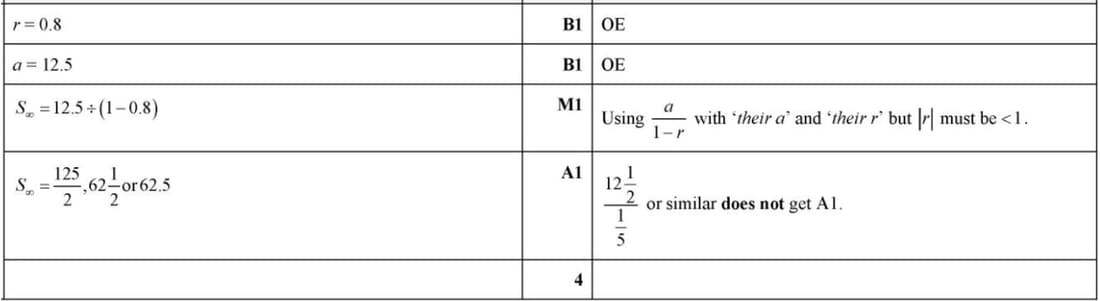
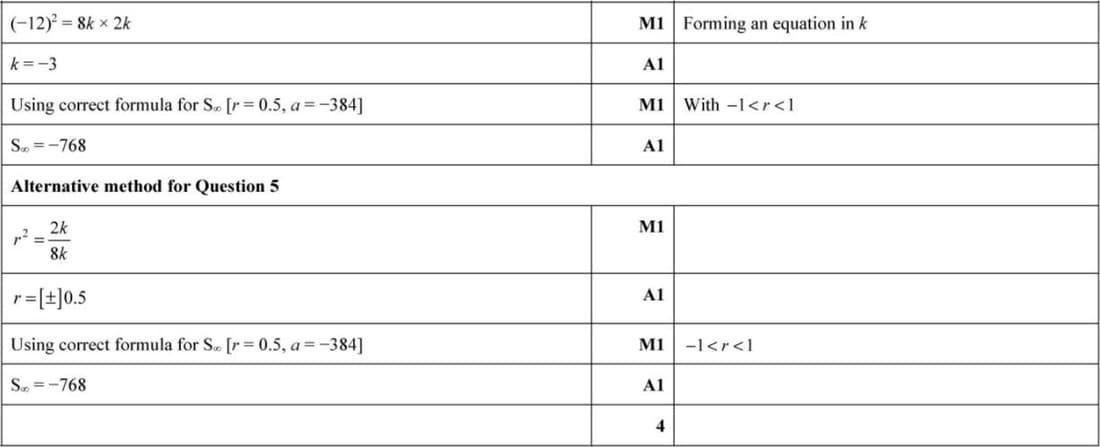
The fifth, sixth and seventh terms of a geometric progression are \(8k\), \(-12\) and \(2k\) respectively.
Given that \(k\) is negative, find the sum to infinity of the progression.
9709 P13 - Nov 2020 - Q5
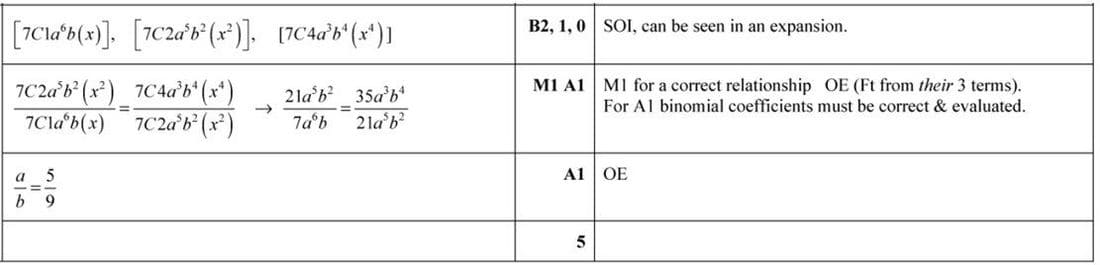
In the expansion of \((a + bx)^7\), where \(a\) and \(b\) are non-zero constants, the coefficients of \(x\), \(x^2\) and \(x^4\) are the first, second and third terms respectively of a geometric progression.
Find the value of \(\frac{a}{b}\).
9709 P12 - Nov 2020 - Q2
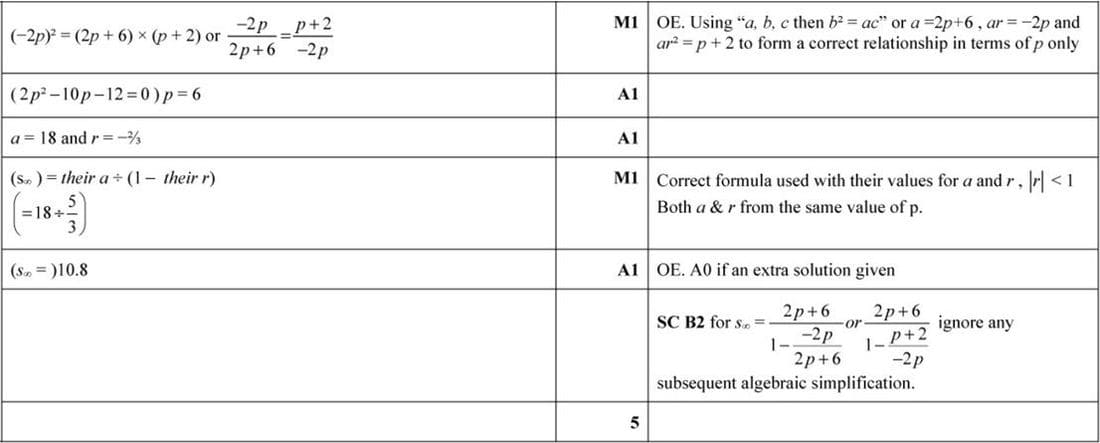
The first, second and third terms of a geometric progression are \(2p + 6\), \(-2p\) and \(p + 2\) respectively, where \(p\) is positive.
Find the sum to infinity of the progression.
9709 P11 - Nov 2020 - Q8
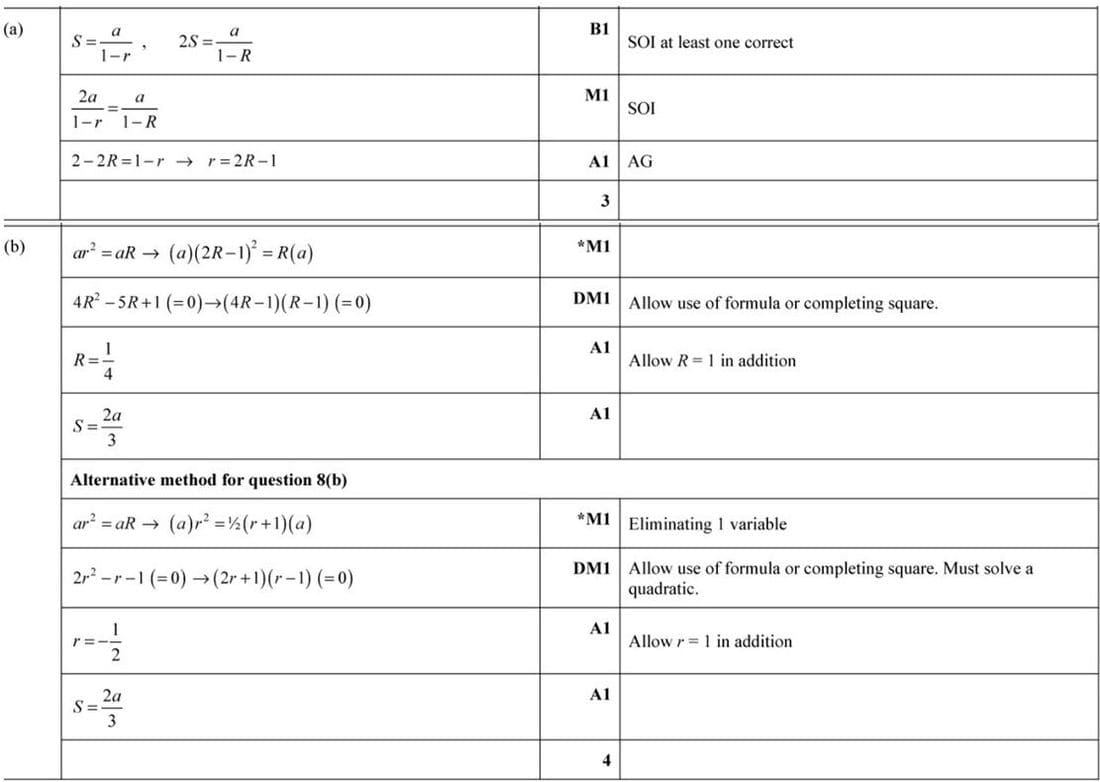
A geometric progression has first term a, common ratio r and sum to infinity S. A second geometric progression has first term a, common ratio R and sum to infinity 2S.
\((a) Show that r = 2R - 1.\)
It is now given that the 3rd term of the first progression is equal to the 2nd term of the second progression.
(b) Express S in terms of a.
9709 P11 - Jun 2020 - Q3
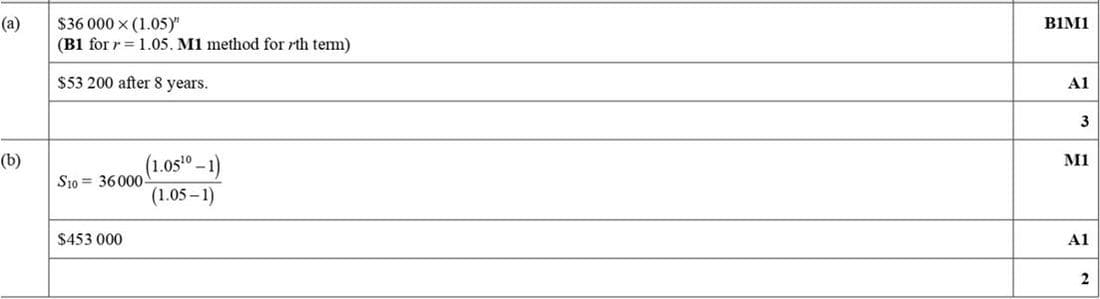
Each year the selling price of a diamond necklace increases by 5% of the price the year before. The selling price of the necklace in the year 2000 was $36,000.
(a) Write down an expression for the selling price of the necklace n years later and hence find the selling price in 2008.
(b) The company that makes the necklace only sells one each year. Find the total amount of money obtained in the ten-year period starting in the year 2000.
Problem #886
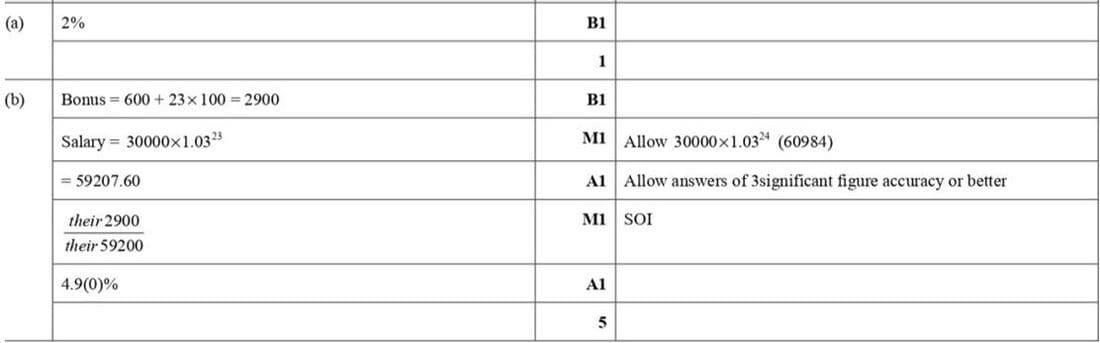
A woman’s basic salary for her first year with a particular company is $30,000 and at the end of the year she also gets a bonus of $600.
(a) For her first year, express her bonus as a percentage of her basic salary.
At the end of each complete year, the woman’s basic salary will increase by 3% and her bonus will increase by $100.
(b) Express the bonus she will be paid at the end of her 24th year as a percentage of the basic salary paid during that year.
9709 P13 - Nov 2019 - Q9
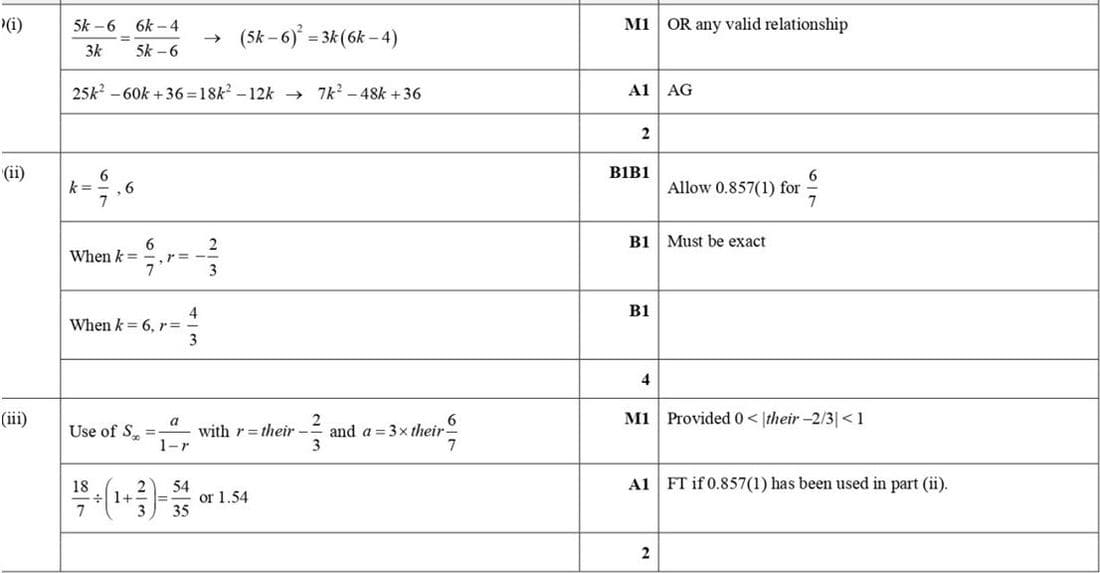
The first, second and third terms of a geometric progression are \(3k\), \(5k - 6\) and \(6k - 4\), respectively.
- Show that \(k\) satisfies the equation \(7k^2 - 48k + 36 = 0\).
- Find, showing all necessary working, the exact values of the common ratio corresponding to each of the possible values of \(k\).
- One of these ratios gives a progression which is convergent. Find the sum to infinity.
9709 P12 - Nov 2019 - Q8
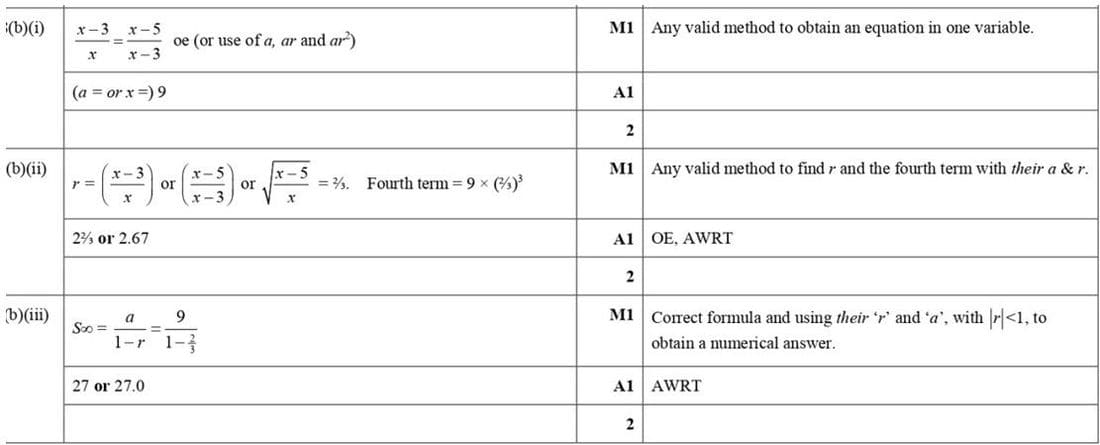
The first, second and third terms of a geometric progression are \(x\), \(x - 3\) and \(x - 5\) respectively.
- Find the value of \(x\).
- Find the fourth term of the progression.
- Find the sum to infinity of the progression.
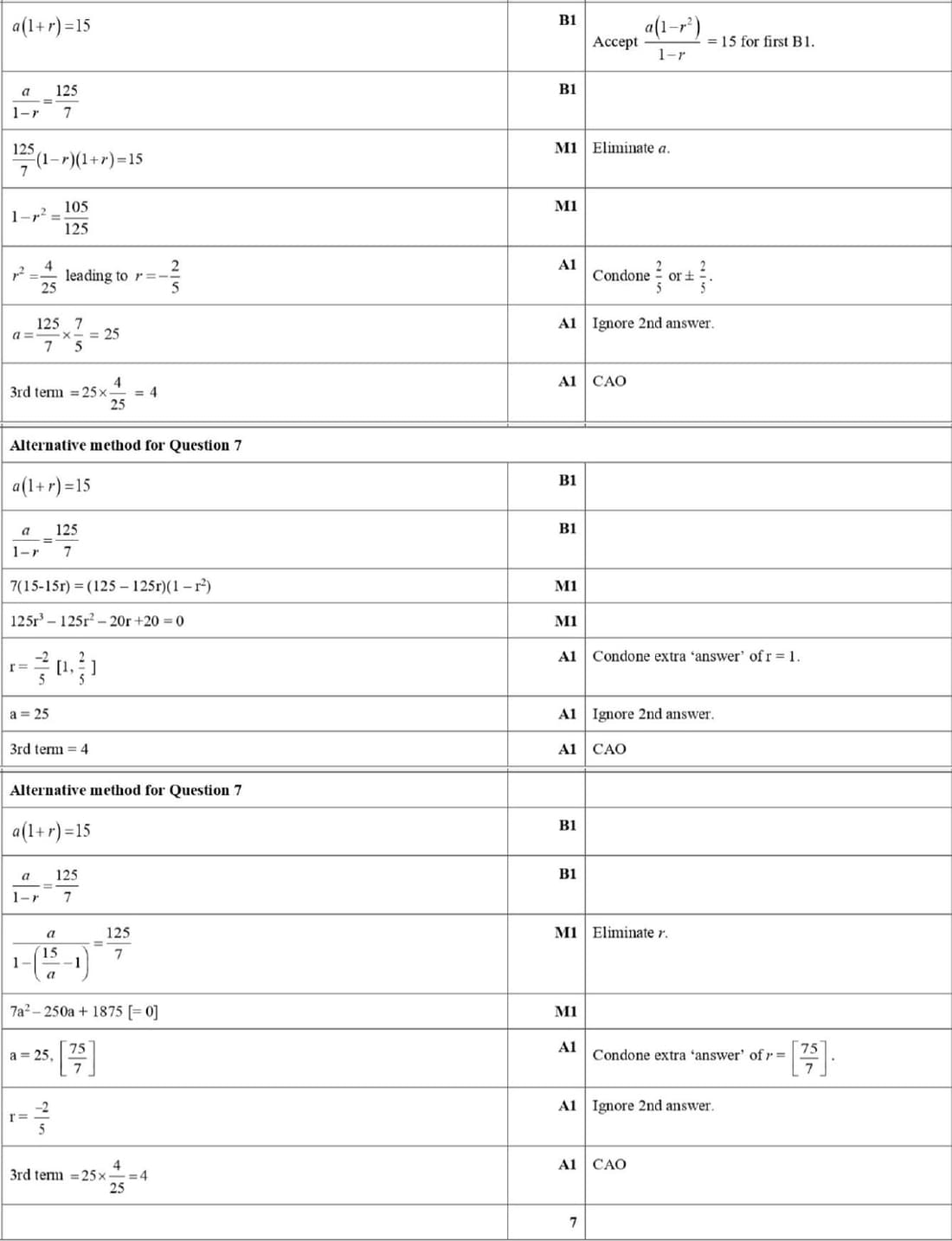
9709 P11 - Nov 2023 - Q7
The sum of the first two terms of a geometric progression is 15 and the sum to infinity is \(\frac{125}{7}\). The common ratio of the progression is negative.
Find the third term of the progression.
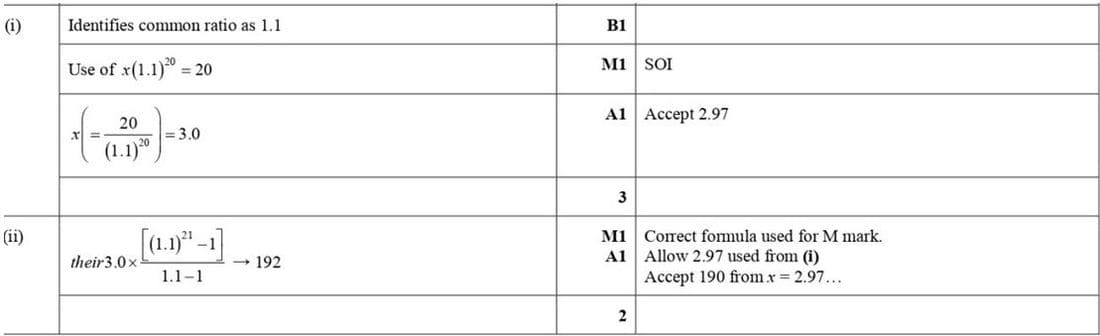
9709 P11 - Nov 2019 - Q4
A runner who is training for a long-distance race plans to run increasing distances each day for 21 days. She will run x km on day 1, and on each subsequent day she will increase the distance by 10% of the previous day's distance. On day 21 she will run 20 km.
(i) Find the distance she must run on day 1 in order to achieve this. Give your answer in km correct to 1 decimal place.
(ii) Find the total distance she runs over the 21 days.
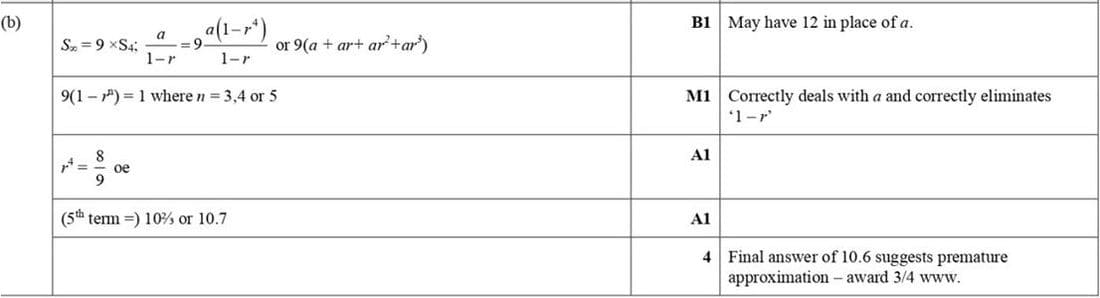
9709 P12 - Jun 2019 - Q10
The sum to infinity of a geometric progression is 9 times the sum of the first four terms. Given that the first term is 12, find the value of the fifth term.
9709 P11 - Jun 2019 - Q8
The third and fourth terms of a geometric progression are 48 and 32 respectively. Find the sum to infinity of the progression.

9709 P12 - Mar 2019 - Q6
The first and second terms of a geometric progression are p and 2p respectively, where p is a positive constant. The sum of the first n terms is greater than 1000p. Show that 2n > 1001.

9709 P11 - Nov 2018 - Q4
The first term of a series is 6 and the second term is 2. For the case where the series is a geometric progression, find the sum to infinity.

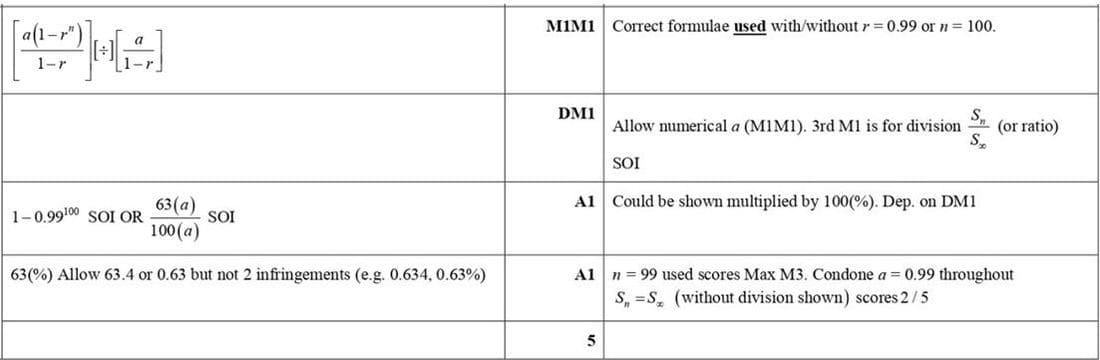
9709 P13 - Jun 2018 - Q3
The common ratio of a geometric progression is 0.99. Express the sum of the first 100 terms as a percentage of the sum to infinity, giving your answer correct to 2 significant figures.
9709 P12 - Jun 2018 - Q3
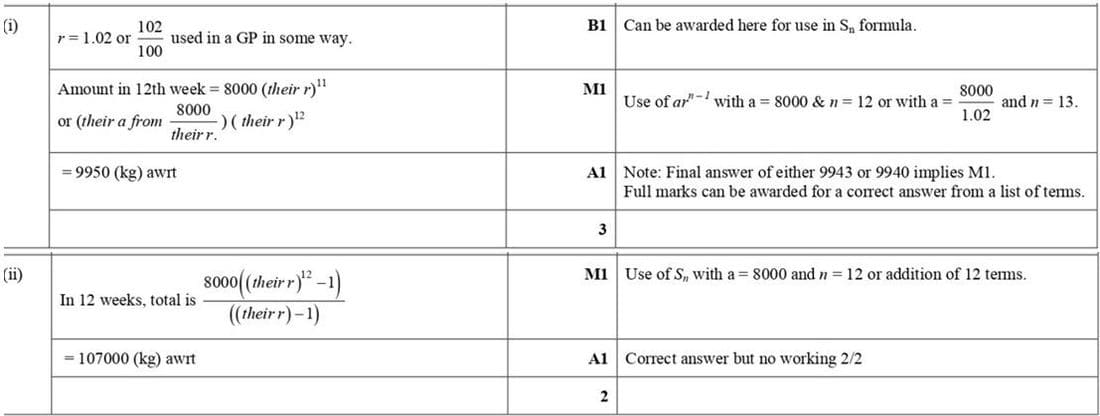
A company producing salt from sea water changed to a new process. The amount of salt obtained each week increased by 2% of the amount obtained in the preceding week. It is given that in the first week after the change the company obtained 8000 kg of salt.
(i) Find the amount of salt obtained in the 12th week after the change.
(ii) Find the total amount of salt obtained in the first 12 weeks after the change.
9709 P11 - Jun 2018 - Q8
A geometric progression has a second term of 12 and a sum to infinity of 54. Find the possible values of the first term of the progression.

9709 P12 - Nov 2017 - Q3
Each year, the value of a certain rare stamp increases by 5% of its value at the beginning of the year. A collector bought the stamp for $10,000 at the beginning of 2005. Find its value at the beginning of 2015 correct to the nearest $100.

9709 P11 - Nov 2017 - Q3
A geometric progression has first term \(3a\) and common ratio \(r\). A second geometric progression has first term \(a\) and common ratio \(-2r\). The two progressions have the same sum to infinity. Find the value of \(r\).

9709 P13 - Jun 2023 - Q8
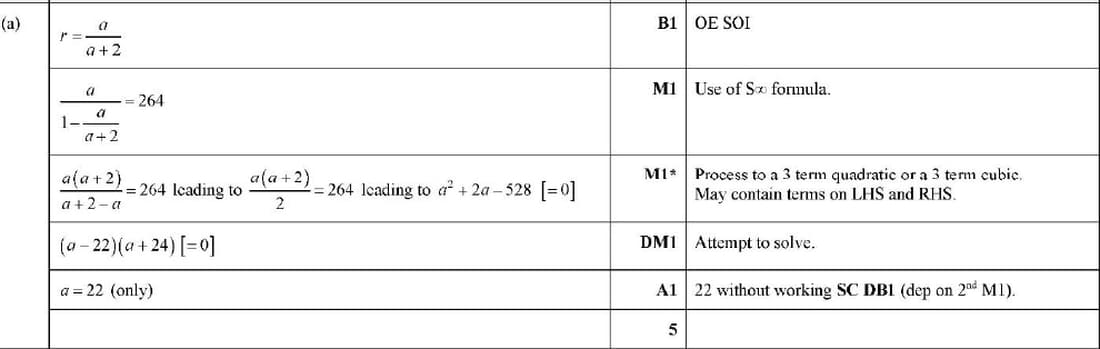
A progression has first term a and second term \(\frac{a^2}{a+2}\), where a is a positive constant.
For the case where the progression is geometric and the sum to infinity is 264, find the value of a.
9709 P13 - Jun 2017 - Q2
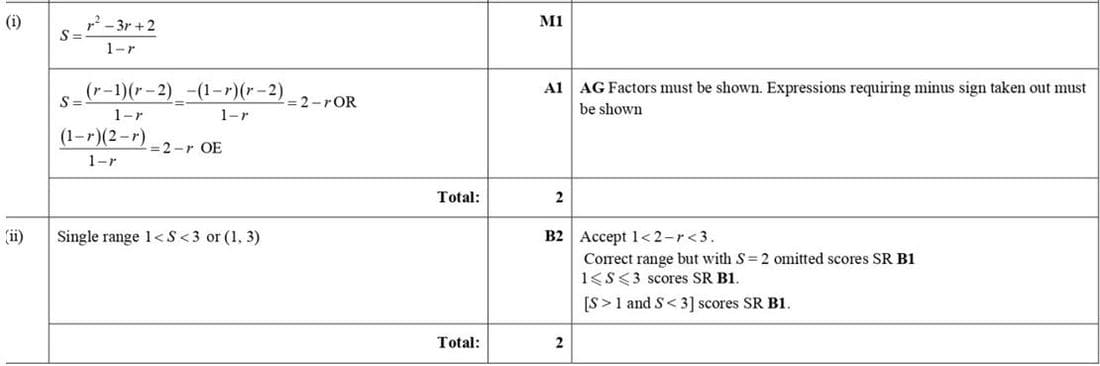
The common ratio of a geometric progression is \(r\). The first term of the progression is \((r^2 - 3r + 2)\) and the sum to infinity is \(S\).
- Show that \(S = 2 - r\). [2]
- Find the set of possible values that \(S\) can take. [2]
9709 P12 - Jun 2017 - Q7
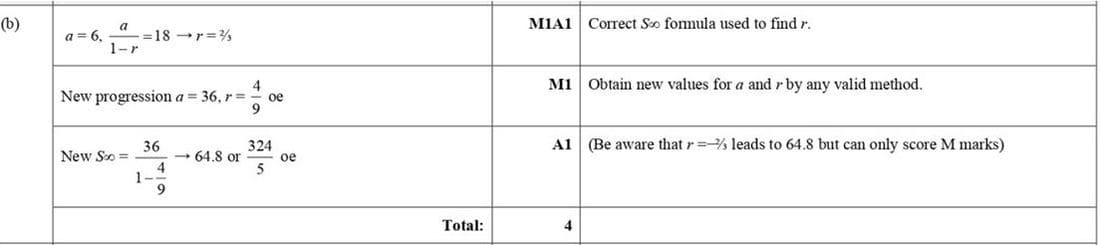
A geometric progression has a first term of 6 and a sum to infinity of 18. A new geometric progression is formed by squaring each of the terms of the original progression. Find the sum to infinity of the new progression.
9709 P11 - Jun 2017 - Q4
Each year a school allocates a sum of money for the library. The amount allocated each year increases by 2.5% of the amount allocated the previous year. In 2005 the school allocated $2000. Find the total amount allocated in the years 2005 to 2014 inclusive.

9709 P13 - Nov 2016 - Q9
Two convergent geometric progressions, P and Q, have the same sum to infinity. The first and second terms of P are 6 and 6r respectively. The first and second terms of Q are 12 and -12r respectively. Find the value of the common sum to infinity.

9709 P12 - Nov 2016 - Q8
A geometric progression is such that the third term is 8 times the sixth term, and the sum of the first six terms is 31\(\frac{1}{2}\). Find
- the first term of the progression,
- the sum to infinity of the progression.

9709 P11 - Nov 2016 - Q5
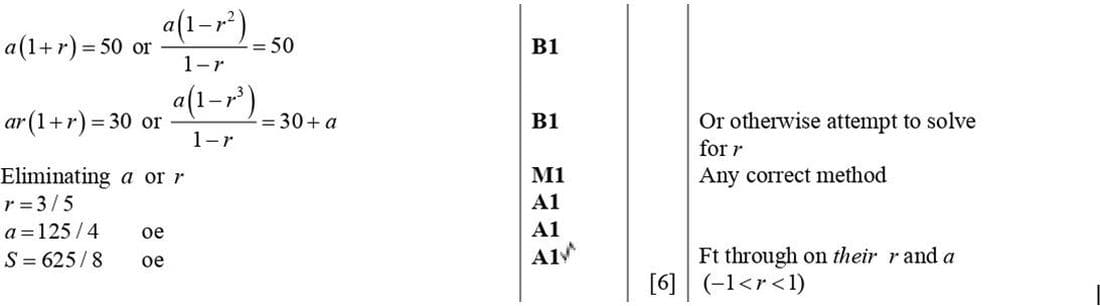
The sum of the 1st and 2nd terms of a geometric progression is 50 and the sum of the 2nd and 3rd terms is 30. Find the sum to infinity.
9709 P12 - Jun 2016 - Q9
A water tank holds 2000 litres when full. A small hole in the base is gradually getting bigger so that each day a greater amount of water is lost.
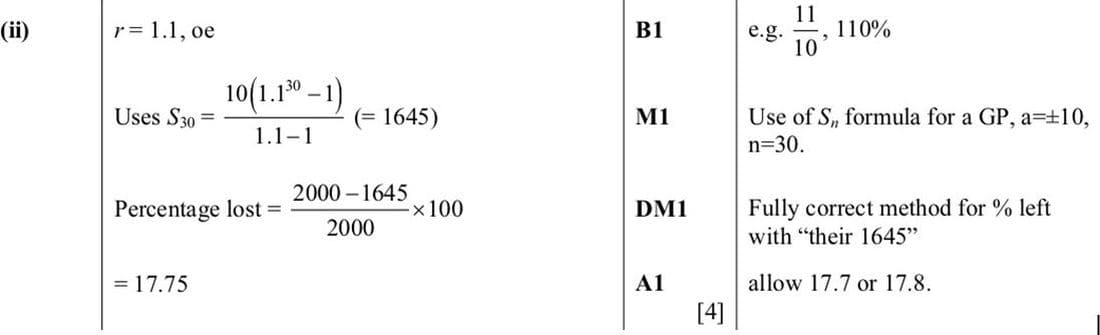
Assume instead that 10 litres of water are lost on the first day and that the amount of water lost increases by 10% on each succeeding day. Find what percentage of the original 2000 litres is left in the tank at the end of the 30th day after filling.
9709 P11 - Jun 2016 - Q9
The first term of a geometric progression in which all the terms are positive is 50. The third term is 32. Find the sum to infinity of the progression.

9709 P11 - Nov 2015 - Q8
The first term of a progression is \(4x\) and the second term is \(x^2\).
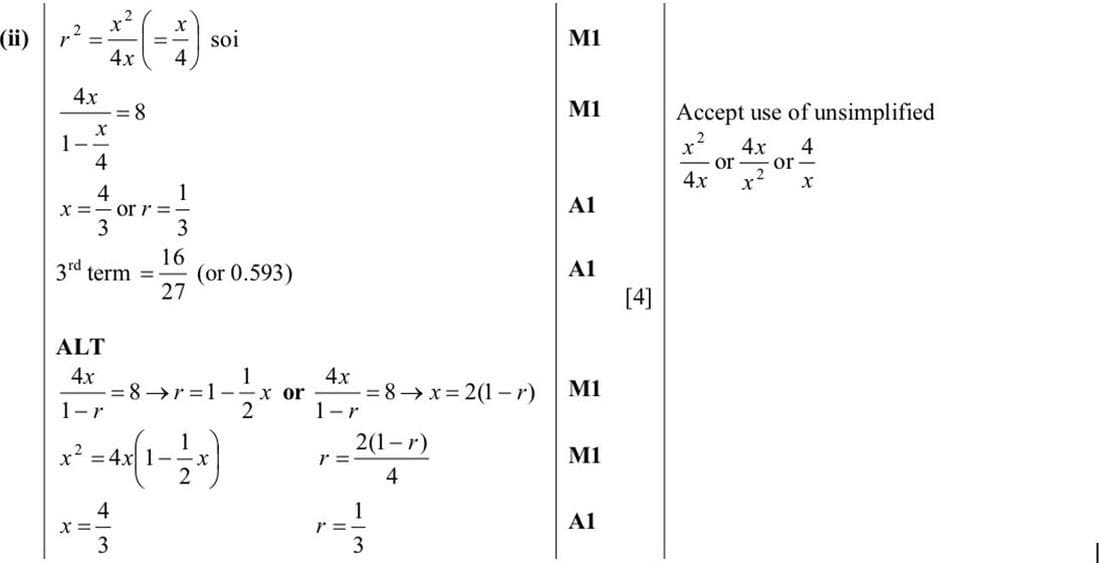
For the case where the progression is geometric with a sum to infinity of 8, find the third term.
9709 P12 - Jun 2015 - Q8
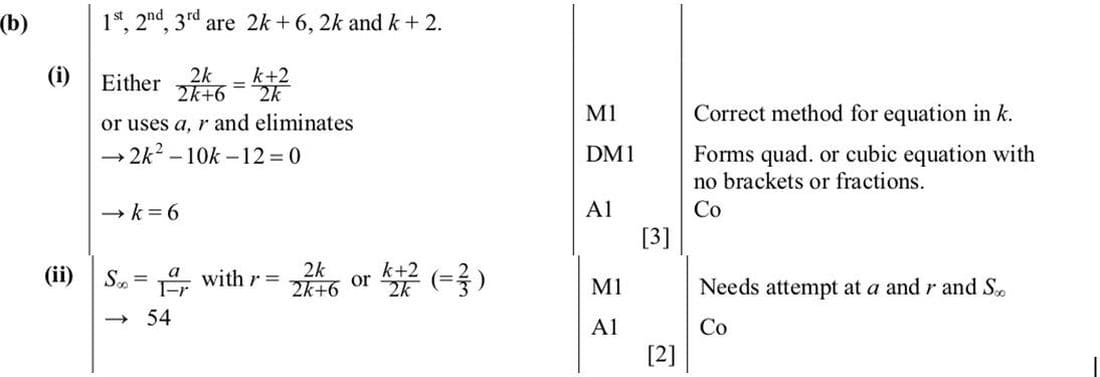
The first, second and third terms of a geometric progression are \(2k + 6\), \(2k\) and \(k + 2\) respectively, where \(k\) is a positive constant.
(i) Find the value of \(k\).
(ii) Find the sum to infinity of the progression.
9709 P12 - Jun 2023 - Q9
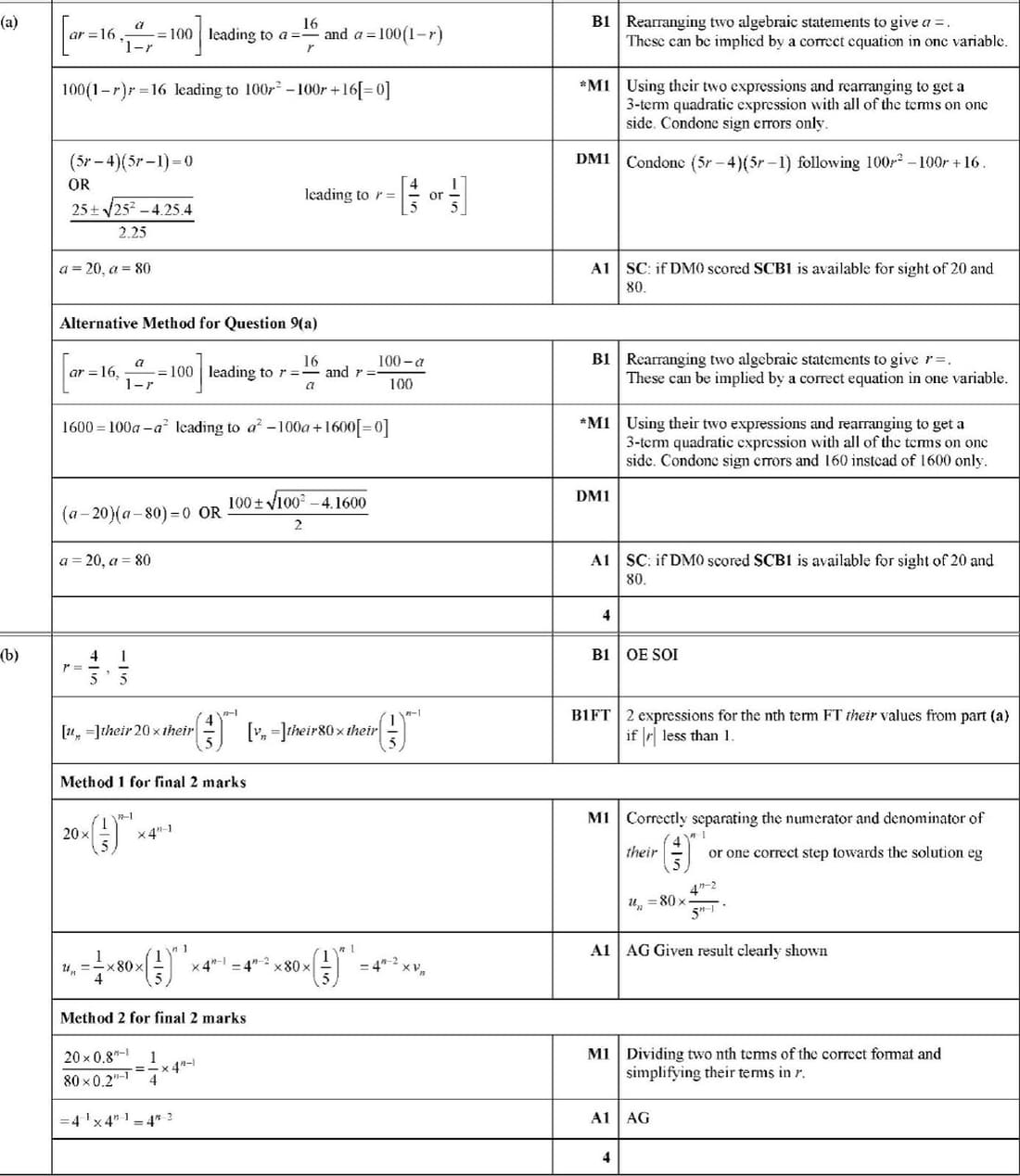
The second term of a geometric progression is 16 and the sum to infinity is 100.
(a) Find the two possible values of the first term.
(b) Show that the nth term of one of the two possible geometric progressions is equal to \(4^{n-2}\) multiplied by the nth term of the other geometric progression.
9709 P11 - Jun 2015 - Q7
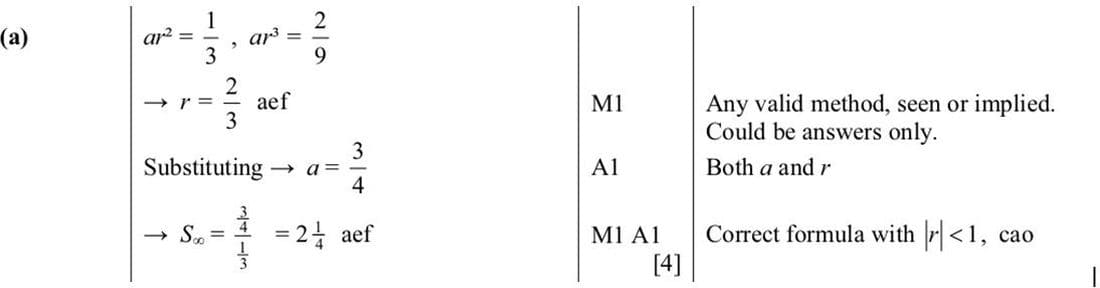
The third and fourth terms of a geometric progression are \(\frac{1}{3}\) and \(\frac{2}{9}\) respectively. Find the sum to infinity of the progression.
9709 P12 - Nov 2014 - Q8
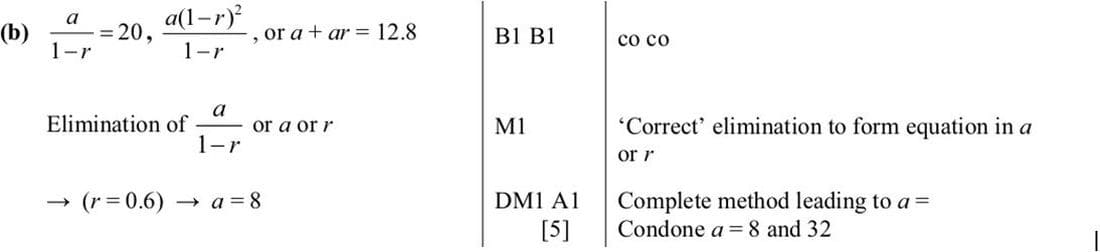
A geometric progression in which all the terms are positive has sum to infinity 20. The sum of the first two terms is 12.8. Find the first term of the progression.
9709 P11 - Nov 2014 - Q7
A geometric progression has first term \(a\) \((a \neq 0)\), common ratio \(r\) and sum to infinity \(S\). A second geometric progression has first term \(a\), common ratio \(2r\) and sum to infinity \(3S\). Find the value of \(r\).

9709 P13 - Nov 2013 - Q5
In a geometric progression, the sum to infinity is equal to eight times the first term. Find the common ratio.

9709 P12 - Nov 2013 - Q7
The second and third terms of a geometric progression are 48 and 32 respectively. Find the sum to infinity of the progression.

9709 P11 - Nov 2013 - Q9
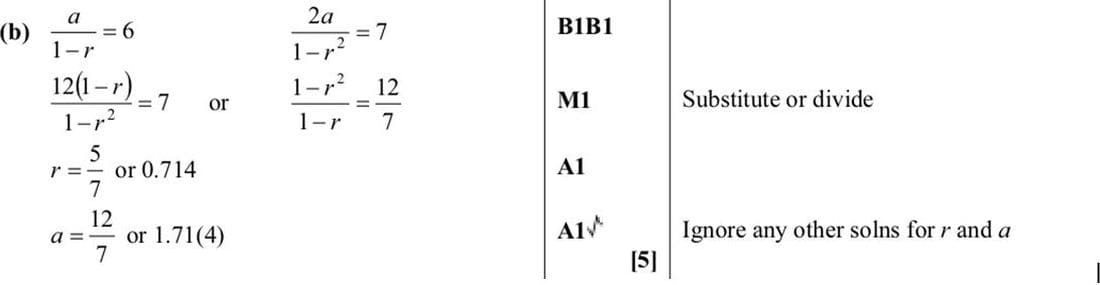
A geometric progression has first term a, common ratio r and sum to infinity 6. A second geometric progression has first term 2a, common ratio r2 and sum to infinity 7. Find the values of a and r.
9709 P12 - Jun 2013 - Q10
The third term of a geometric progression is four times the first term. The sum of the first six terms is k times the first term. Find the possible values of k.

9709 P11 - Jun 2013 - Q4
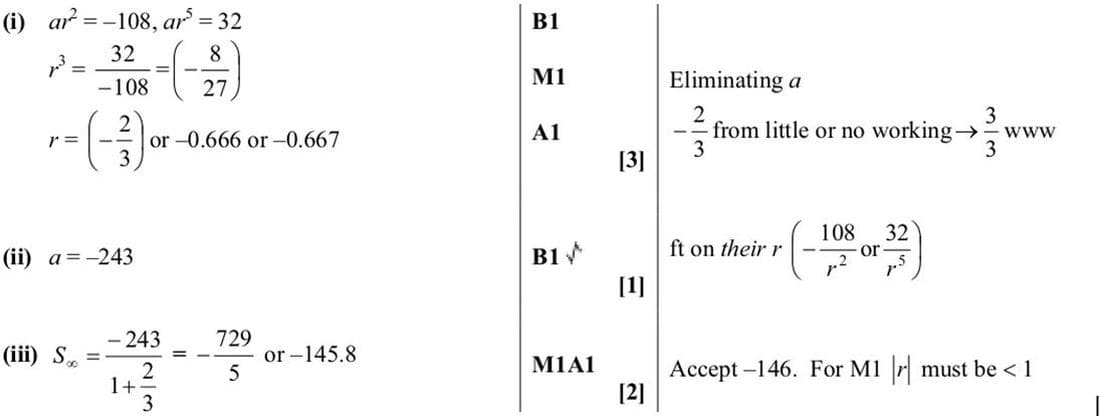
The third term of a geometric progression is -108 and the sixth term is 32. Find
- the common ratio,
- the first term,
- the sum to infinity.
9709 P13 - Nov 2012 - Q5
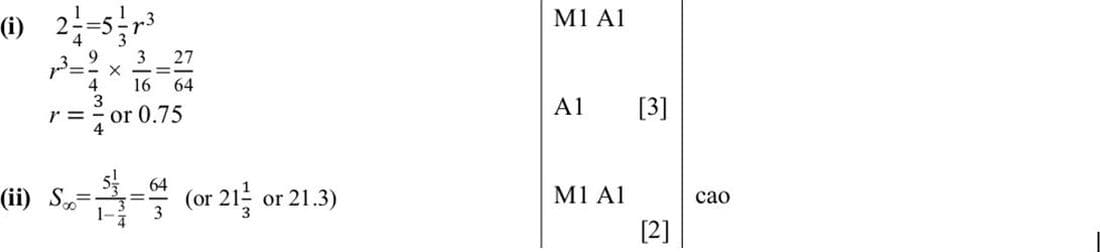
The first term of a geometric progression is \(5\frac{1}{3}\) and the fourth term is \(2\frac{1}{4}\). Find
(i) the common ratio,
(ii) the sum to infinity.
9709 P12 - Nov 2012 - Q8
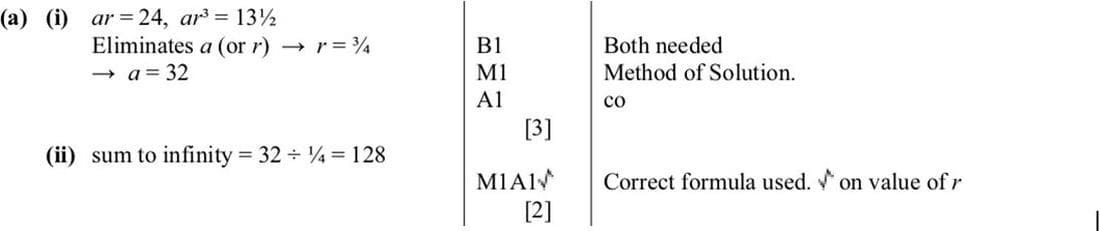
In a geometric progression, all the terms are positive, the second term is 24 and the fourth term is 13\(\frac{1}{2}\). Find
(i) the first term,
(ii) the sum to infinity of the progression.
Problem #922
The circumference round the trunk of a large tree is measured and found to be 5.00 m. After one year the circumference is measured again and found to be 5.02 m.
Given instead that the circumferences at yearly intervals form a geometric progression, find the circumference 20 years after the first measurement.

9709 P12 - Jun 2012 - Q7
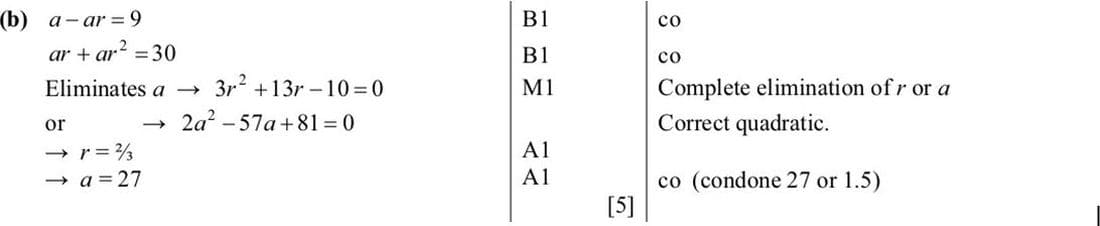
In a geometric progression, the second term is 9 less than the first term. The sum of the second and third terms is 30. Given that all the terms of the progression are positive, find the first term.
9709 P12 - Nov 2011 - Q10
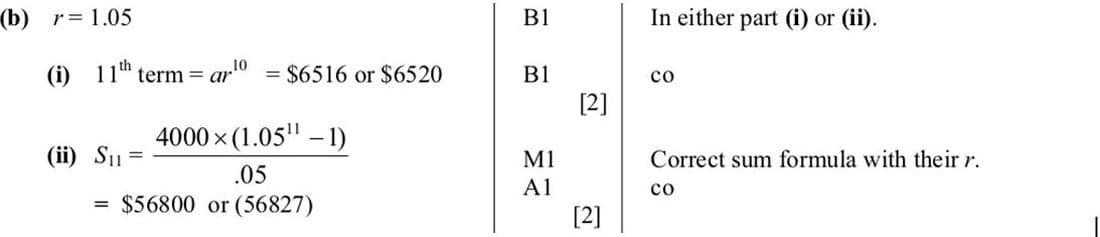
A college agrees a sponsorship deal in which grants will be received each year for sports equipment. This grant will be $4000 in 2012 and will increase by 5% each year. Calculate
(i) the value of the grant in 2022,
(ii) the total amount the college will receive in the years 2012 to 2022 inclusive.
9709 P11 - Nov 2011 - Q6
A geometric progression has first term 1 and common ratio \(r\). A second geometric progression has first term 4 and common ratio \(\frac{1}{4}r\). The two progressions have the same sum to infinity, \(S\). Find the values of \(r\) and \(S\).

9709 P13 - Jun 2011 - Q6
A geometric progression has a third term of 20 and a sum to infinity which is three times the first term. Find the first term.

9709 P12 - Jun 2011 - Q10
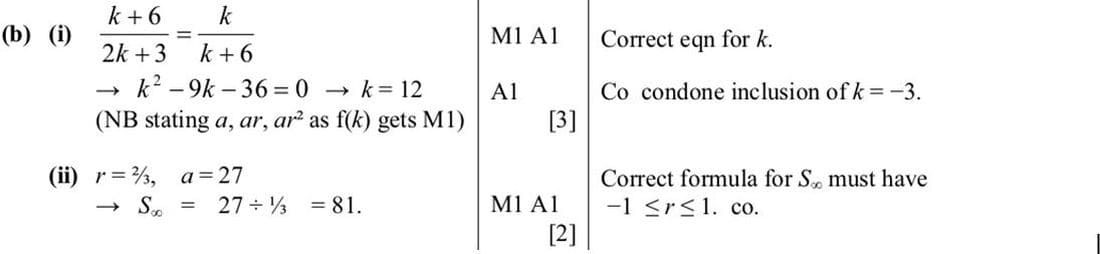
The first, second and third terms of a geometric progression are \(2k + 3\), \(k + 6\) and \(k\), respectively. Given that all the terms of the geometric progression are positive, calculate
(i) the value of the constant \(k\),
(ii) the sum to infinity of the progression.
9709 P13 - Nov 2010 - Q9
A geometric progression has first term 100 and sum to infinity 2000. Find the second term. [3]

9709 P12 - Nov 2010 - Q5
A geometric progression, in which all the terms are positive, has common ratio \(r\). The sum of the first \(n\) terms is less than 90\% of the sum to infinity. Show that \(r^n > 0.1\).

9709 P11 - Nov 2010 - Q6
The first term of a geometric progression is 16 and the fourth term is \(\frac{27}{4}\). Find the sum to infinity of the progression.

9709 P13 - Jun 2010 - Q1
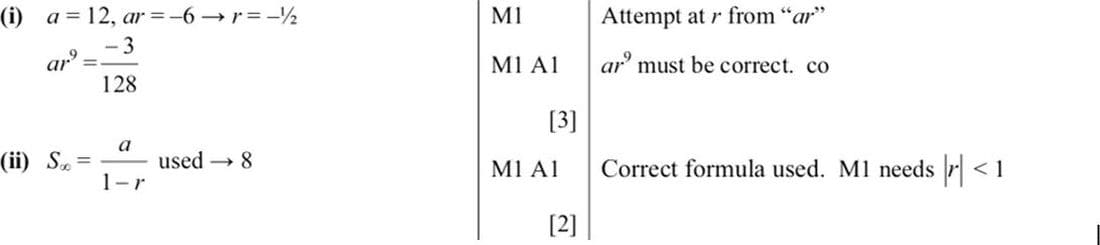
The first term of a geometric progression is 12 and the second term is -6. Find
- the tenth term of the progression,
- the sum to infinity.
9709 P12 - Jun 2010 - Q7
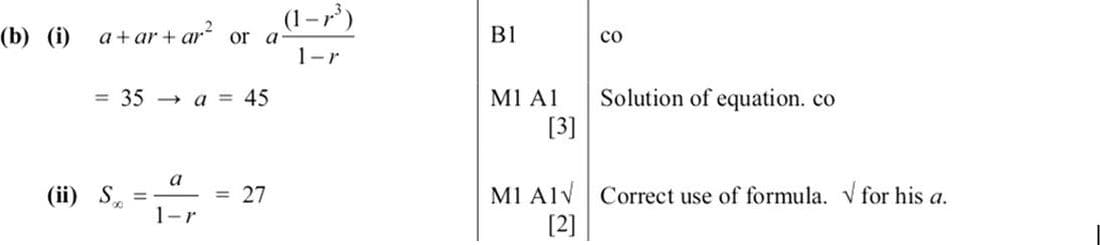
A geometric progression has a common ratio of \(-\frac{2}{3}\) and the sum of the first 3 terms is 35. Find
- the first term of the progression,
- the sum to infinity.
9709 P13 - Nov 2022 - Q9
The first term of a geometric progression is 216 and the fourth term is 64.
Find the sum to infinity of the progression.

9709 P1 - Jun 2009 - Q7
Find the sum to infinity of the geometric progression with first three terms 0.5, 0.5^3 and 0.5^5.

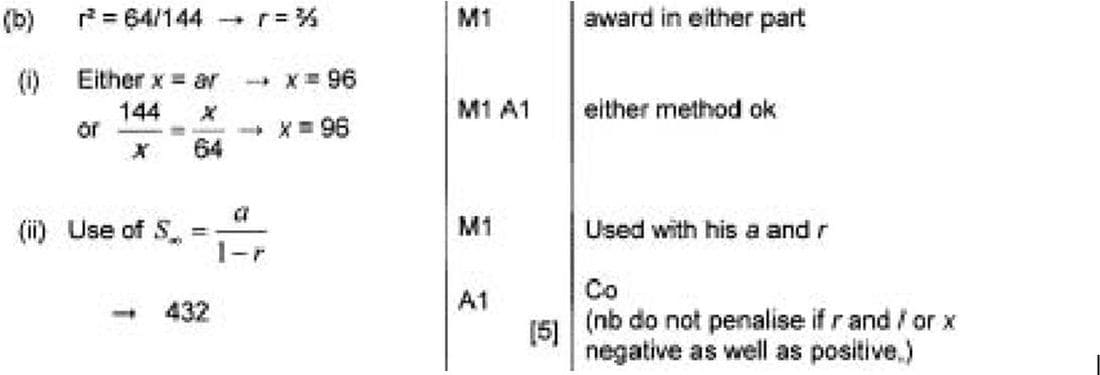
9709 P1 - Nov 2006 - Q6
The first three terms in a geometric progression are 144, x and 64 respectively, where x is positive. Find
- the value of x,
- the sum to infinity of the progression.
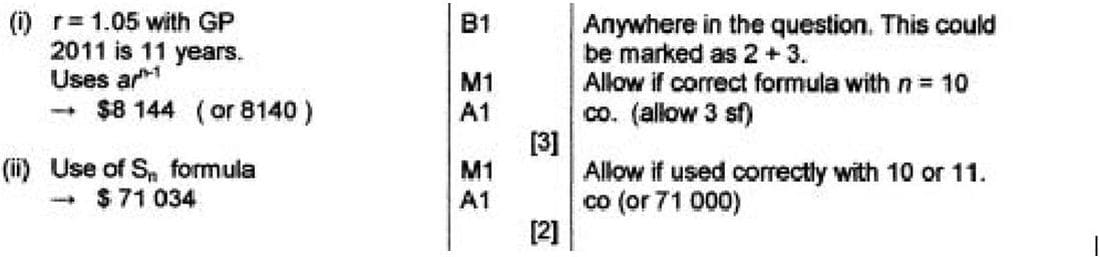
9709 P1 - Jun 2006 - Q3
Each year a company gives a grant to a charity. The amount given each year increases by 5% of its value in the preceding year. The grant in 2001 was $5000. Find
(i) the grant given in 2011,
(ii) the total amount of money given to the charity during the years 2001 to 2011 inclusive.
9709 P1 - Nov 2004 - Q2
Find the sum of the first ten terms of the geometric progression 81, 54, 36, ...

9709 P1 - Jun 2004 - Q1
A geometric progression has first term 64 and sum to infinity 256. Find
- the common ratio,
- the sum of the first ten terms.

9709 P1 - Nov 2003 - Q3
Find the sum to infinity of the geometric progression whose first term is 6 and whose second term is 4.

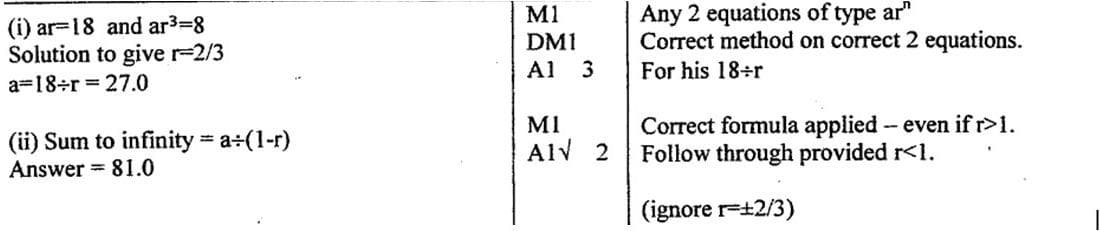
9709 P1 - Nov 2002 - Q2
A geometric progression, for which the common ratio is positive, has a second term of 18 and a fourth term of 8. Find
- the first term and the common ratio of the progression,
- the sum to infinity of the progression.
9709 P12 - Nov 2022 - Q4
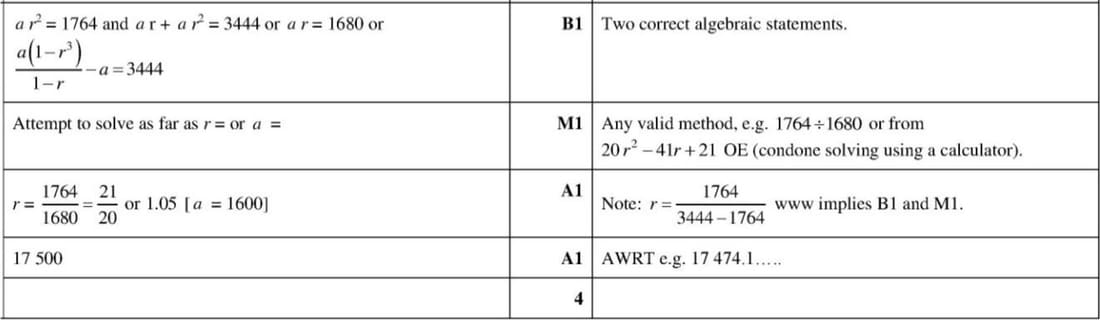
A geometric progression is such that the third term is 1764 and the sum of the second and third terms is 3444.
Find the 50th term.
9709 P11 - Nov 2022 - Q7
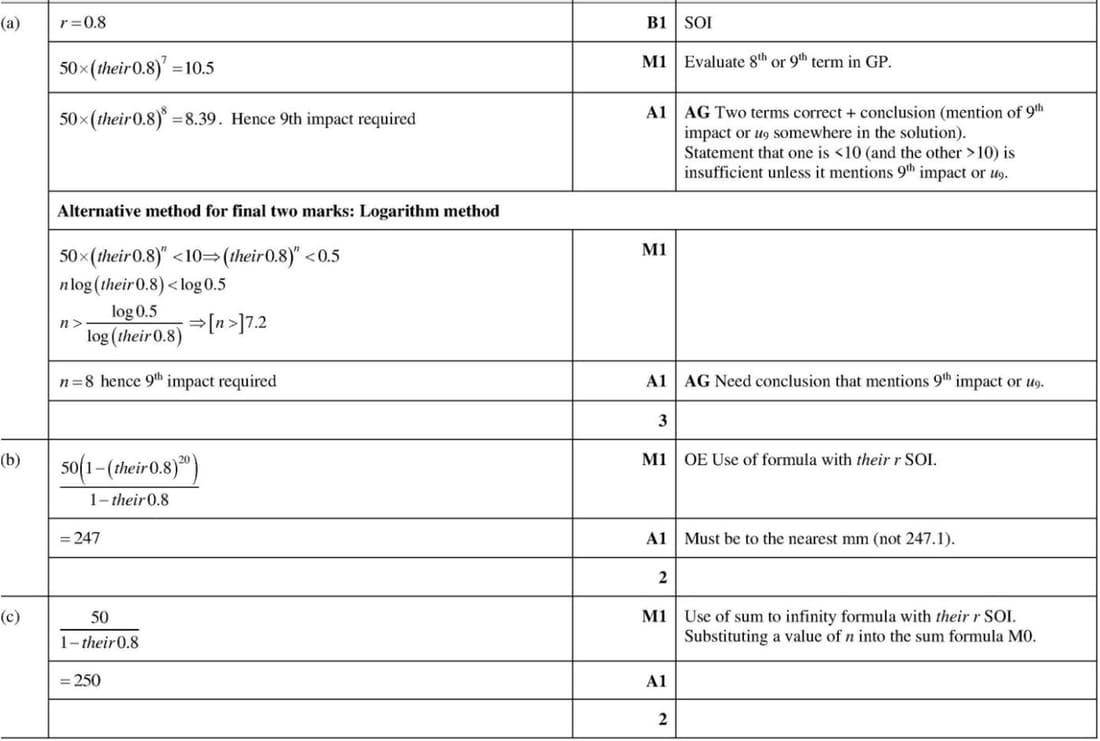
A tool for putting fence posts into the ground is called a 'post-rammer'. The distances in millimetres that the post sinks into the ground on each impact of the post-rammer follow a geometric progression. The first three impacts cause the post to sink into the ground by 50 mm, 40 mm and 32 mm respectively.
(a) Verify that the 9th impact is the first in which the post sinks less than 10 mm into the ground.
(b) Find, to the nearest millimetre, the total depth of the post in the ground after 20 impacts.
(c) Find the greatest total depth in the ground which could theoretically be achieved.
9709 P12 - Jun 2022 - Q2
The second and third terms of a geometric progression are 10 and 8 respectively.
Find the sum to infinity.