Notes
Before you start: use exact values and inverse functions, and recognise each ratio's period.
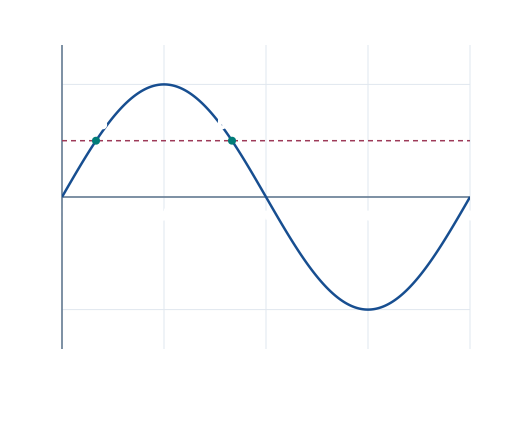
For integer n, if \(\sin u=a\) and α=arcsin a, the families are \(u=\alpha+2n\pi\) and \(u=\pi-\alpha+2n\pi\). If \(\cos u=a\) and α=arccos a, use \(u=\pm\alpha+2n\pi\). These require |a|≤1. Duplicate angles at extreme values are counted once.
For \(\tan u=a\), use \(u=\arctan a+n\pi\), retaining excluded cosine-zero values. Calculator inverses return principal values, not a complete interval solution.
The principal output ranges are \([-\pi/2,\pi/2]\) for arcsine, \([0,\pi]\) for arccosine, and \((-\pi/2,\pi/2)\) for arctangent.
When u=kx+c, transform the entire x-interval into a u-interval first, find every branch in it, and transform back. Reverse inequalities if dividing by a negative coefficient. Check open/closed endpoints and substitute candidates into the original equation.
Recall later
\(\cos x=0\) has x=π/2,3π/2 on \(0\le x<2\pi\); \(\tan x\) is undefined at those same points.
Common mistakes
- Giving only the inverse-calculator value.
- Solving for 2x only between 0 and 2π when x spans that interval.
- Mixing a degree period with radian inputs.