Learn the method, study an example, then explain your reasoning in an exam-style problem. Work on paper before opening the solution and compare each step with the marking guidance.
Trigonometric graphs, periods and transformations
Read amplitude, midline, period, range and excluded points from a formula.
Notes
Before you start: recognise sine, cosine and tangent on a radian axis, and recall function transformations.
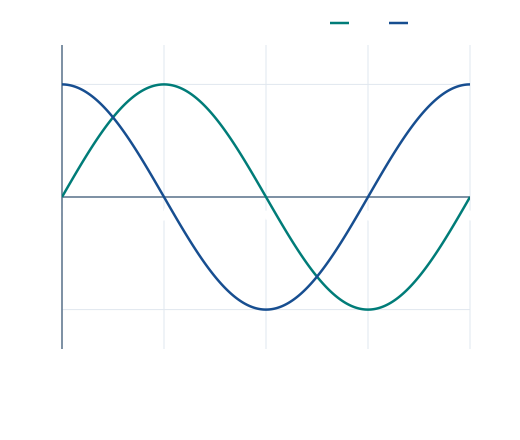
For \(y=a+b\sin(kx+c)\) or its cosine version, with \(b\ne0\) and \(k\ne0\), the midline is y=a, amplitude is |b| and least positive period is \(2\pi/|k|\). On the whole real line the range is \([a-|b|,a+|b|]\). A restricted domain may attain less of that range.
The inside shift is \(-c/k\), and a negative outside multiplier reflects the wave. Maximum and minimum points require both x- and y-coordinates. Endpoints count when the stated interval includes them.
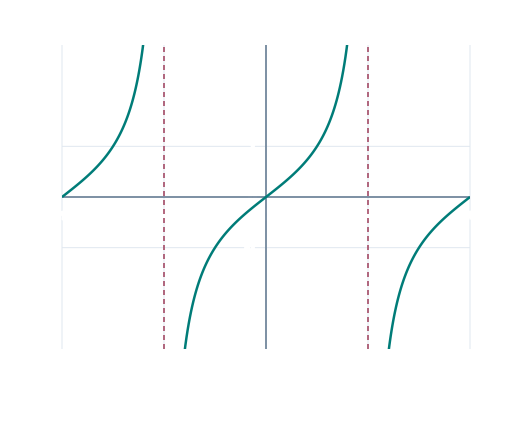
Tangent has period π, is unbounded and is undefined where cosine is zero. For \(\tan(kx+c)\), asymptotes occur at \(kx+c=\pi/2+n\pi\), with integer n. Do not join a tangent graph across these gaps.
Recall later
\(y=2-5\sin(3x)\) has amplitude 5, midline y=2, period \(2\pi/3\) and whole-line range [−3,7].
Common mistakes
Using the inside multiplier itself as the period.
Confusing the vertical shift with the amplitude.
Connecting tangent branches or counting an excluded endpoint.
Three worked examples
Example 1
Give the main features of \(y=3+2\sin(4x)\).
Show the reasoning
The amplitude is 2, midline y=3, period \(2\pi/4=\pi/2\), and range [1,5]. The value at x=0 is 3.
Example 2
Find the range and period of \(y=-1+3\cos(x/2)\).
Show the reasoning
The range is [−4,2]. The inner multiplier is 1/2, so the period is \(2\pi/(1/2)=4\pi\), not π.
Example 3
Find the period and asymptotes of \(y=\tan(2x)\).
Show the reasoning
The period is π/2. The excluded points satisfy \(2x=\pi/2+n\pi\), so \(x=\pi/4+n\pi/2\). Each is a vertical asymptote.