Learn the method, study an example, then explain your reasoning in an exam-style problem. Work on paper before opening the solution and compare each step with the marking guidance.
Recover a curve from its gradient
Use point and slope data to determine each integration constant.
Notes
Before you start: integrate powers and substitute a point into a curve equation.
If dy/dx is known, integrate once to obtain y=F(x)+C. A point (a,b) gives b=F(a)+C and selects one curve from the family. Substitute into the curve, not into the given gradient, to determine C.
If the second derivative is given, two integrations introduce two independent constants. Use slope data to determine the first and point data to determine the second. Do not reuse one symbol as if the constants must be equal.
After recovering the curve, check every original condition: differentiate once or twice, test the supplied slope and substitute the point. A tangent or normal then uses the recovered ordinate and the appropriate derivative. All checks must stay inside the stated domain.
Recall later
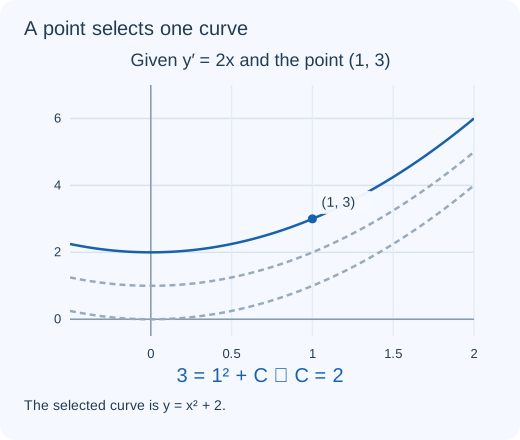
If y′=2x and y(1)=3, then y=x²+2. Knowing the gradient alone would leave C undetermined.
Common mistakes
Using a point condition in the derivative instead of the curve equation.
Losing the second independent constant when integrating twice.
Giving a family of curves when the supplied conditions determine a single member.
Three worked examples
Example 1
A curve has y′=2x and passes through (1,3). Find its equation.
Show the reasoning
Integrate to y=x²+C. Substituting (1,3) gives 3=1+C, so C=2 and y=x²+2. Its derivative is 2x as required.
Example 2
A curve has y′=4x−3 and passes through (2,7). Find y.
Show the reasoning
Integrate to y=2x²−3x+C. At x=2 this is 2+C, so C=5. The equation is \(y=2x^2-3x+5\).
Example 3
Given y″=6x, y′(0)=−2 and y(1)=4, find y.
Show the reasoning
First, y′=3x²+A and A=−2. Next, y=x³−2x+B. The point condition gives 4=1−2+B, so B=5. Thus y=x³−2x+5; differentiation and both conditions check.