Notes
Before you start: evaluate definite integrals, rearrange a curve and interpret cross-sections.
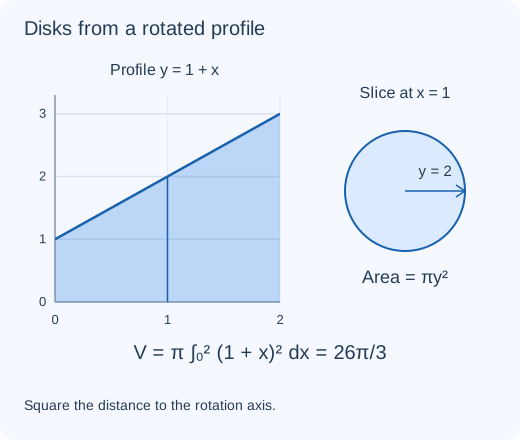
Rotating a region between a curve and the x-axis gives circular cross-sections perpendicular to that axis. The radius is the distance to the axis, |y|, so a disk has area πy². Its thin-slice volume is approximately πy²Δx; adding slices and taking the limit gives
\[V=\pi\int_a^b y(x)^2\,dx.\]
About the y-axis, use horizontal disks: express the radius as x(y), integrate with respect to y and use y-limits. For a first-quadrant region touching the y-axis, \(V=\pi\int_c^d x(y)^2\,dy\).
If a cross-section has a hole, it is a washer with area \(\pi(R^2-r^2)\), where 0≤r≤R are distances from the rotation axis. Draw the region to decide whether a hole exists; subtract the squares, not the radii. If the region crosses the axis, simple subtraction of signed ordinates may not describe the cross-section.
Lengths squared give cross-sectional area; integrating over a length gives cubic units. π is a factor outside the integral, not part of the radius. Reversing integration limits would produce the wrong sign for a physical volume.
Recall later
For y=x over 0≤x≤3, the x-axis volume is \(\pi\int_0^3x^2\,dx=9\pi\), not \(\pi\int_0^3x\,dx\).
Common mistakes
- Integrating the radius instead of its square.
- Mixing x-limits with an integral in y or rotating about the wrong axis.
- Using (R−r)² in place of R²−r² or inventing a hole where the region touches the axis.