Maths4U
Menu

Integration: all learning resources

9709 Pure Mathematics 1 · Maths4U Original

Integration — Maths4U Original

Learn the method, study an example, then explain your reasoning in an exam-style problem. Work on paper before opening the solution and compare each step with the marking guidance.

Power integrals, constants and limits

Find an antiderivative, retain its domain and evaluate a definite integral in the correct order.

Notes

Before you start: differentiate powers, simplify indices and substitute into an expression.

An antiderivative F satisfies F′=f on the interval being considered. The indefinite integral describes the family F+C, because differentiating a constant gives zero. On a connected interval any two antiderivatives differ by a constant; separate intervals of a disconnected domain need not share one constant.

\[\int x^n\,dx=\frac{x^{n+1}}{n+1}+C\qquad(n\ne-1).\]

Increase the power and divide by the new power. Integrate sums term by term and keep constant multipliers. Negative powers require x≠0; fractional-power examples here use positive bases. The n=−1 case cannot use this formula: it would divide by zero and requires a logarithmic antiderivative.
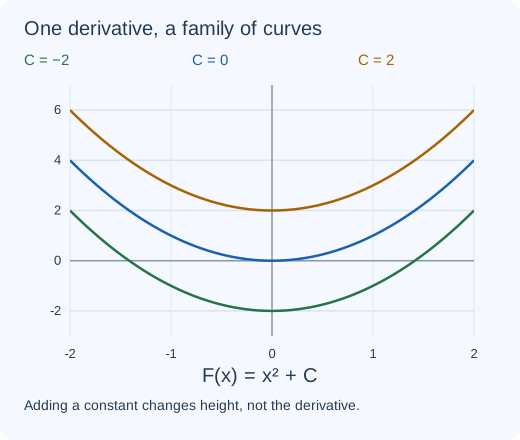
The curves x²−2, x² and x²+2 have the same derivative 2x. An indefinite integral includes an arbitrary vertical constant.

For a nonzero constant a and n≠−1, reverse the linear-inner-function chain rule:

\[\int(ax+b)^n\,dx=\frac{(ax+b)^{n+1}}{a(n+1)}+C.\]

Check by differentiating. If a=0 and the integrand is defined, integrate the resulting constant instead of dividing by a. For a continuous integrand on [u,v] with antiderivative F throughout the interval,

\[\int_u^v f(x)\,dx=F(v)-F(u).\]

Upper limit first, lower limit second. A constant cancels, so a definite integral is a number without an arbitrary +C. Reversing limits changes its sign. Check the entire interval: endpoint subtraction alone does not justify crossing a singularity.

Recall later

\(\int 3x^2\,dx=x^3+C\), while \(\int_0^2 3x^2\,dx=8\). The two requests have different types of answer.

Common mistakes

  • Using the differentiation power rule instead of increasing the exponent.
  • Omitting an indefinite constant or adding an arbitrary constant to a definite answer.
  • Forgetting the inner-function divisor, using the n=−1 formula or crossing a zero denominator.

Three worked examples

Example 1

Find \(\int(4x^3-6x+5)\,dx\).

Show the reasoning

Integrating each term gives \(x^4-3x^2+5x+C\). Differentiation recovers all three original terms, including the constant integrand 5.

Example 2

Find \(\int(3x+2)^2\,dx\).

Show the reasoning

The result is \((3x+2)^3/9+C\). Differentiating multiplies by 3 from the cube and by 3 from the inner function, cancelling the denominator 9. Expanding first gives an equivalent answer differing only by a constant.

Example 3

Evaluate \(\int_1^4(\sqrt{x}+2x^{-2})\,dx\).

Show the reasoning

On [1,4] the integrand is continuous. An antiderivative is \((2/3)x^{3/2}-2/x\). The endpoint values are 29/6 and −4/3, so the integral is \(29/6-(-4/3)=37/6\).

Short practice with answer checking

Original exam-style problems

M4U-ORIG-INT-001 · 7 marks

A family, a definite value and reversed limits

Distinguish an arbitrary integration constant from a definite result and interpret orientation.

This problem is being prepared for publication.

M4U-ORIG-INT-002 · 8 marks

A linear inner function and a fractional power

Apply two reverse power rules on a positive domain and verify the antiderivative.

This problem is being prepared for publication.

Topic practice · Full topic bank

Next skill: Recover a curve from its gradient →