Maths4U
Menu

Binomial Expansion: all learning resources

9709 Pure Mathematics 1 · Maths4U Original

Binomial Expansion — Maths4U Original

Learn the method, study an example, then explain your reasoning in an exam-style problem. Work on paper before opening the solution and compare each step with the marking guidance.

Coefficients in products and parity

Collect every contributing power pair and use identities to simplify coefficient questions.

Notes

Before you start: find a binomial coefficient and multiply polynomials.

If \(A(x)=\sum a_i x^i\) and \(B(x)=\sum b_j x^j\) are polynomials in nonnegative powers, the coefficient of xᵐ in A(x)B(x) is \(\sum_{i=0}^m a_i b_{m-i}\). List all power pairs that add to m. For m=2 these are (0,2), (1,1) and (2,0); the middle product is easy to miss.
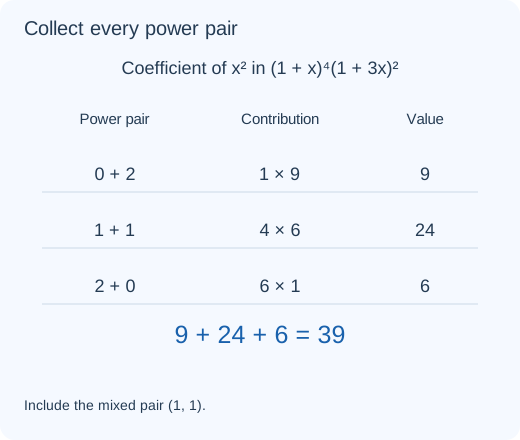
The x² coefficient of (1+x)^4(1+3x)^2 has three contributions: 1 times 9, 4 times 6, and 6 times 1, totalling 39.

For ordinary polynomials, powers higher than m cannot contribute to xᵐ, so it is safe to truncate each factor above that degree. This shortcut needs care with negative powers: a high positive power can combine with a negative one to give the target.

Before multiplying, look for \((1+x)^n(1-x)^n=(1-x^2)^n\). This contains only even powers. More generally, if F is a polynomial, its even- and odd-power coefficient sums are \((F(1)+F(-1))/2\) and \((F(1)-F(-1))/2\). This follows because (−1) to an even power is 1 and to an odd power is −1.

Recall later

The coefficient of x² in \((1+2x)(1+3x)\) is 6, from the pair (1,1). Adding the separate x² coefficients would give the wrong answer.

Common mistakes

  • Missing the cross-product when collecting a coefficient.
  • Keeping only same-degree terms instead of pairs whose powers add to the target.
  • Applying polynomial truncation to factors with negative powers without checking other possible pairs.

Three worked examples

Example 1

Find the x² coefficient in \((1+x)^4(1+3x)^2\).

Show the reasoning

Relevant terms are \(1+4x+6x^2\) and \(1+6x+9x^2\). The coefficient is \(1(9)+4(6)+6(1)=39\).

Example 2

Find the coefficient of x⁶ in \((1+x)^5(1-x)^5\).

Show the reasoning

Rewrite the product as \((1-x^2)^5\). The target uses r=3, giving \(\binom53(-1)^3=-10\). All odd-power coefficients are zero.

Example 3

Let \(F(x)=(2+x)^3(1-x)^2\). Find the sum of its odd-power coefficients.

Show the reasoning

\(F(1)=0\) and \(F(-1)=4\). If E and O are the even and odd coefficient sums, then E+O=0 and E−O=4. Thus \(O=(0-4)/2=-2\). This is a coefficient sum, not the coefficient of a single power.

Short practice with answer checking

Original exam-style problems

Topic practice · Full topic bank

Next skill: Unknown constants and an unknown exponent →