Learn the method, study an example, then explain your reasoning in an exam-style problem. Work on paper before opening the solution and compare each step with the marking guidance.
Unknown constants and an unknown exponent
Turn coefficient information into equations and retain every admissible parameter value.
Notes
Before you start: solve linear and quadratic equations, and use the first coefficients of a binomial expansion.
For \((1+ax)^n\), the x and x² coefficients are \(c_1=na\) and \(c_2=n(n-1)a^2/2\). With n≥2 and a≠0,
\[\frac{c_2}{c_1^2}=\frac{n-1}{2n}.\]
The ratio can recover n before a. State why any division is valid. The exponent must still be a nonnegative integer in this finite-expansion setting; do not accept an algebraic value that violates the question.
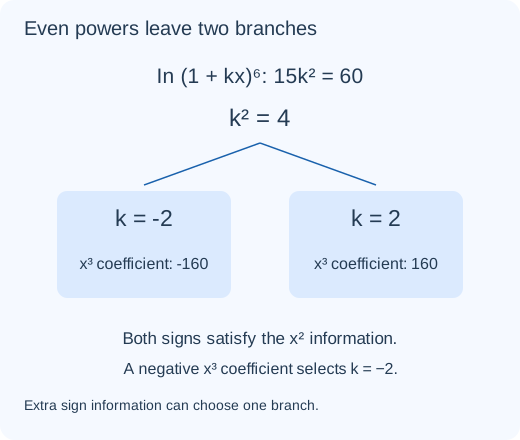
An even-power coefficient may determine a² without choosing a sign. If no additional information selects a branch, both values must be retained. An odd-power coefficient or a stated sign condition can distinguish them.
Recall later
From k²=4 alone, k=−2 or k=2. Reporting only the positive root loses an admissible parameter.
Common mistakes
Discarding the negative parameter root without a reason.
Treating n as an unrestricted real number in a finite binomial formula.
Dividing by a coefficient or parameter without checking that it is nonzero.
Three worked examples
Example 1
The coefficient of x in \((1+cx)^5\) is 20. Find c and the x² coefficient.
Show the reasoning
5c=20 gives c=4. Then \(\binom52c^2=10(16)=160\).
Example 2
The coefficient of x² in \((1+kx)^6\) is 60. Find all real k.
Show the reasoning
\(15k^2=60\), so k²=4 and k=±2. Neither sign is excluded by the given information.
Example 3
In \((1+ax)^n\), n is an integer at least 2 and a≠0. The x and x² coefficients are 15 and 90. Find n and a.
Show the reasoning
\(na=15\) and \(n(n-1)a^2/2=90\). Divide the second equation by the square of the first: \((n-1)/(2n)=90/225=2/5\). Hence 5n−5=4n, so n=5 and a=3. Checking gives 5(3)=15 and 10(9)=90.