Learn the method, study an example, then explain your reasoning in an exam-style problem. Work on paper before opening the solution and compare each step with the marking guidance.
Finite expansions as approximations: keep the remainder
Choose a substitution, evaluate a truncated expansion and determine its actual error.
Notes
Before you start: expand integer powers, substitute decimals accurately and use units for modelled quantities.
A finite binomial expansion is exact. An approximation is introduced only when terms are omitted. Write \(F(x)=P(x)+R(x)\), where P is the retained polynomial and R is the exact omitted remainder. If R>0, P underestimates F; if R<0, it overestimates F. The absolute error is |R|.
For a positive integer n, the first terms of \((1+x)^n\) are \(1+nx+\binom n2x^2+\cdots\). A small |x| often makes later terms less important, but it does not on its own prove a requested error bound. Check the actual remainder and the stated substitution. A finite expansion has no |x|<1 convergence requirement.
For a relative change t in the side of a cube, the volume factor is \((1+t)^3\). First-order volume growth is approximately 3t, while 3t²+t³ is the discarded factor. Keep a percentage such as 2% as t=0.02, and distinguish an error in volume units from a percentage error.
Recall later
Using 1+3x+3x² for \((1+x)^3\) leaves the exact remainder x³. Its sign changes when x changes sign.
Common mistakes
Claiming the full finite expansion is only an approximation.
Assuming the sign of an omitted sum from its first term without checking the rest.
Using 2 instead of 0.02 for a 2% change or mixing relative and absolute error.
Three worked examples
Example 1
Use terms through x² to estimate \(1.01^4\), and find the exact error.
Show the reasoning
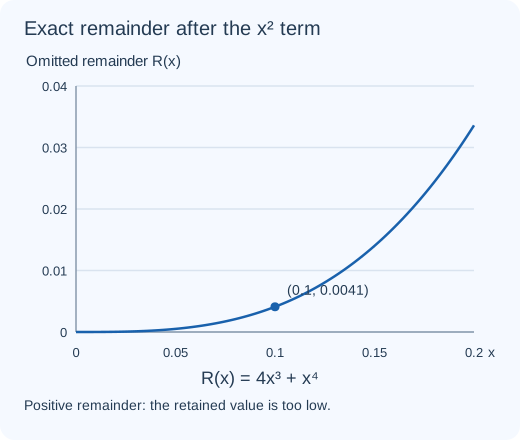
Put x=0.01 into \(1+4x+6x^2\), giving 1.0406. The omitted remainder is \(4x^3+x^4=0.00000401\). Thus the estimate is low and the exact value is 1.04060401.
Example 2
Use the first three terms of \((1-x)^6\) to estimate \(0.98^6\).
Show the reasoning
The retained polynomial is \(1-6x+15x^2\). Put x=0.02 to obtain 0.886. The exact remainder is \(-20x^3+15x^4-6x^5+x^6=-0.000157619136\). It is negative here, so the estimate is high; the exact value is 0.885842380864.
Example 3
Approximate \(0.96^3\) by the first three terms of \((1-x)^3\), and identify the error direction.
Show the reasoning
With x=0.04, \(1-3x+3x^2=0.8848\). The remainder is −x³=−0.000064. Therefore the approximation overestimates the exact value 0.884736 by 0.000064.