Learn the method, study an example, then explain your reasoning in an exam-style problem. Work on paper before opening the solution and compare each step with the marking guidance.
The general term and powers of x
Translate a requested power into an integer index and distinguish a coefficient from a term.
Notes
Before you start: use the binomial theorem and the laws of indices, including negative powers.
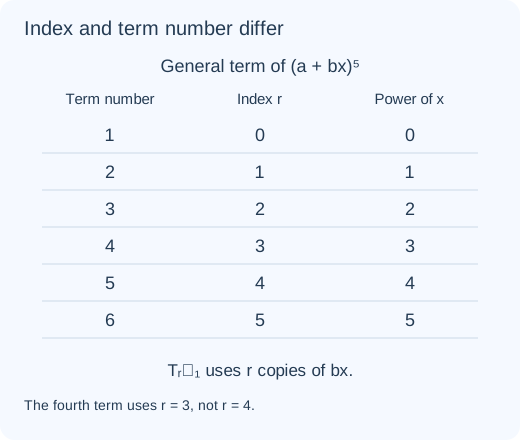
For \((a+bx)^n\), the general term in binomial order is \(T_{r+1}=\binom nr a^{n-r}b^r x^r\), for integers 0≤r≤n. The first term uses r=0, so the fourth term uses r=3. A coefficient is the factor multiplying a power of x; a term includes that power.
For integer p and q in \((Ax^p+Bx^q)^n\), combine the powers before solving for an index:
\[T_{r+1}=\binom nr A^{n-r}B^r x^{p(n-r)+qr}.\]
Set the exponent equal to the requested power. A solution contributes only when r is an integer in [0,n]. If no such r exists, that coefficient is zero. For negative powers, x≠0; a “constant term” has exponent zero and is not found by substituting x=0 into an undefined expression.
Recall later
The coefficient of x² in \((1+2x)^5\) is 40; its third term is 40x². These are different answers to different requests.
Common mistakes
Confusing the index r with the term number r+1.
Accepting a fractional or out-of-range index as a contributing term.
Substituting zero to find a constant term when negative powers make the expression undefined there.
Three worked examples
Example 1
Find the coefficient of x³ in \((3-2x)^5\).
Show the reasoning
Use r=3: \(\binom53 3^2(-2)^3=10(9)(-8)=-720\). The term is −720x³, but the requested coefficient is −720.
Example 2
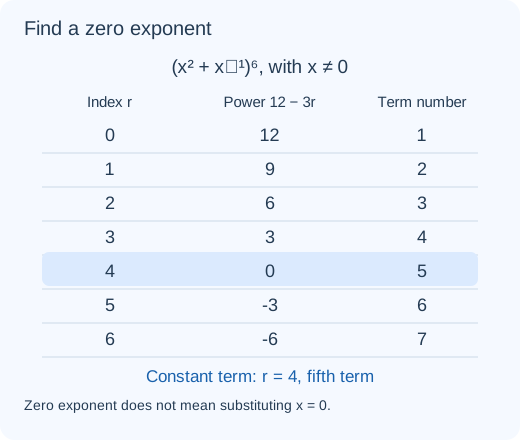
Find the constant term in \((x^2+x^{-1})^6\), with x≠0.
Show the reasoning
The exponent is 2(6−r)−r=12−3r. Set it to zero, obtaining r=4. The coefficient is \(\binom64=15\). It is the fifth term, not the fourth.
Example 3
Find the fourth and last terms in binomial order for \((1+2x)^5\).
Show the reasoning
The fourth uses r=3 and equals \(\binom53(2x)^3=80x^3\). The last uses r=5 and equals \((2x)^5=32x^5\).