9709 P11 - Nov 2023 - Q1
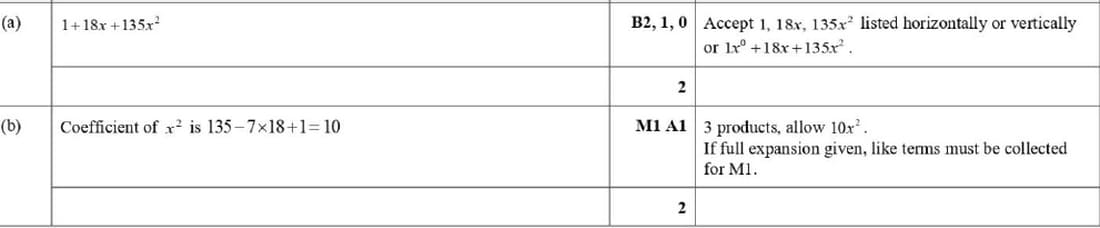
(a) Expand \((1 + 3x)^6\) in ascending powers of \(x\) up to, and including, the term in \(x^2\).
(b) Hence find the coefficient of \(x^2\) in the expansion of \((1 - 7x + x^2)(1 + 3x)^6\).
9709 P11 - Jun 2018 - Q1
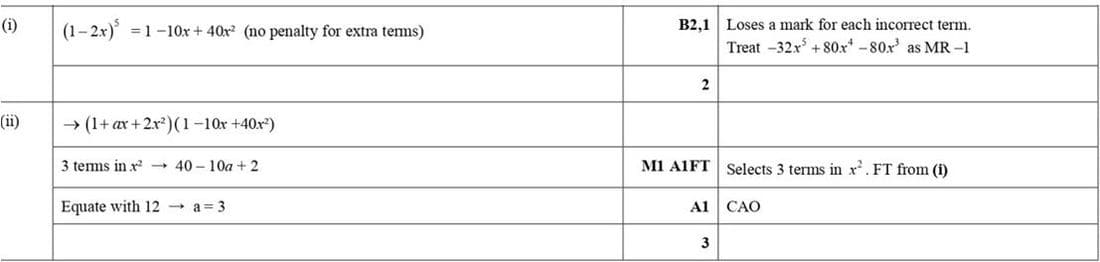
(i) Find the first three terms in the expansion, in ascending powers of x, of \((1 - 2x)^5\).
(ii) Given that the coefficient of \(x^2\) in the expansion of \((1 + ax + 2x^2)(1 - 2x)^5\) is 12, find the value of the constant \(a\).
9709 P13 - Jun 2015 - Q3
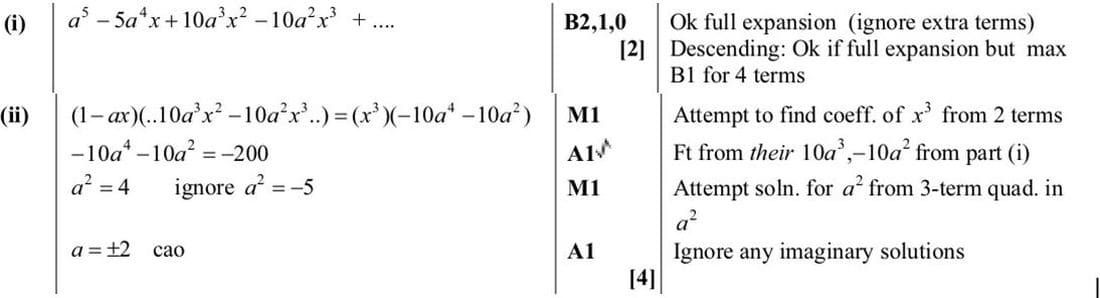
(i) Write down the first 4 terms, in ascending powers of \(x\), of the expansion of \((a-x)^5\).
(ii) The coefficient of \(x^3\) in the expansion of \((1-ax)(a-x)^5\) is \(-200\). Find the possible values of the constant \(a\).
9709 P11 - Jun 2015 - Q3
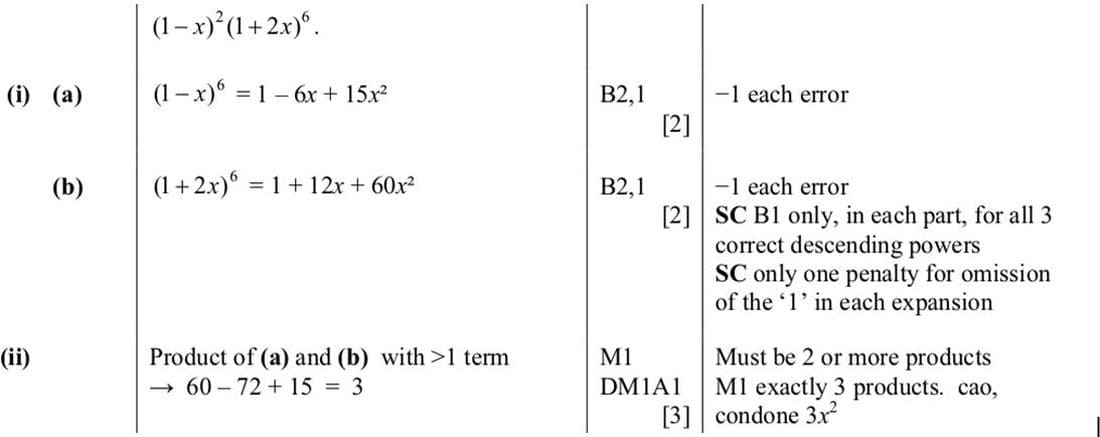
(i) Find the first three terms, in ascending powers of x, in the expansion of
(a) \((1-x)^6\),
(b) \((1+2x)^6\).
(ii) Hence find the coefficient of \(x^2\) in the expansion of \([(1-x)(1+2x)]^6\).
9709 P12 - Nov 2014 - Q3
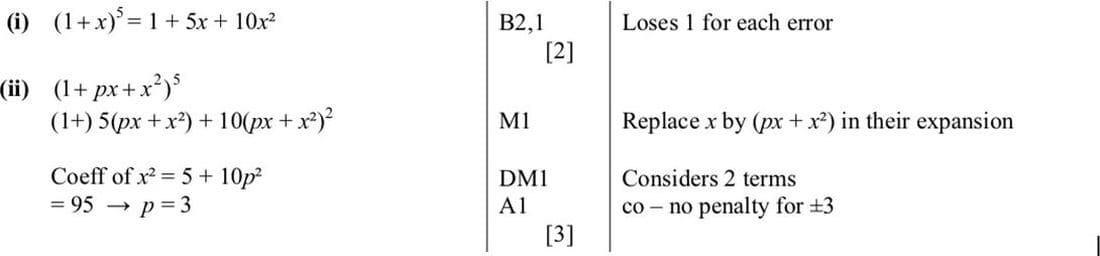
(i) Find the first 3 terms, in ascending powers of \(x\), in the expansion of \((1 + x)^5\).
The coefficient of \(x^2\) in the expansion of \(\left( 1 + (px + x^2) \right)^5\) is 95.
(ii) Use the answer to part (i) to find the value of the positive constant \(p\).
9709 P11 - Nov 2013 - Q1
(i) Find the first three terms when \((2 + 3x)^6\) is expanded in ascending powers of \(x\).
(ii) In the expansion of \((1 + ax)(2 + 3x)^6\), the coefficient of \(x^2\) is zero. Find the value of \(a\).

9709 P13 - Jun 2013 - Q4
(i) Find the first three terms in the expansion of \((2 + ax)^5\) in ascending powers of \(x\).
(ii) Given that the coefficient of \(x^2\) in the expansion of \((1 + 2x)(2 + ax)^5\) is 240, find the possible values of \(a\).

9709 P11 - Jun 2013 - Q2
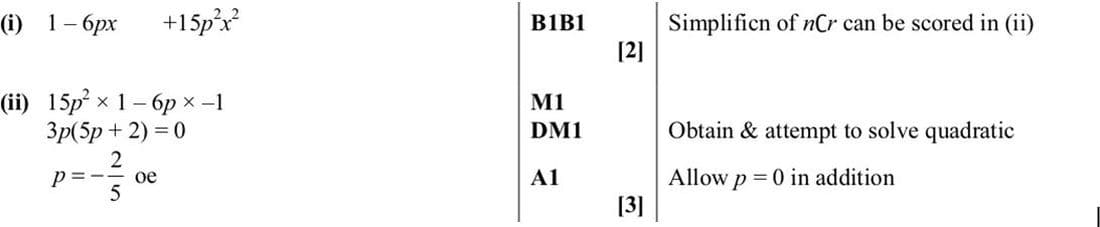
(i) In the expression \((1 - px)^6\), \(p\) is a non-zero constant. Find the first three terms when \((1 - px)^6\) is expanded in ascending powers of \(x\).
(ii) It is given that the coefficient of \(x^2\) in the expansion of \((1 - x)(1 - px)^6\) is zero. Find the value of \(p\).
9709 P11 - Nov 2012 - Q4
(i) Find the first 3 terms in the expansion of \((2x - x^2)^6\) in ascending powers of \(x\).
(ii) Hence find the coefficient of \(x^8\) in the expansion of \((2 + x)(2x - x^2)^6\).

9709 P13 - Jun 2012 - Q3
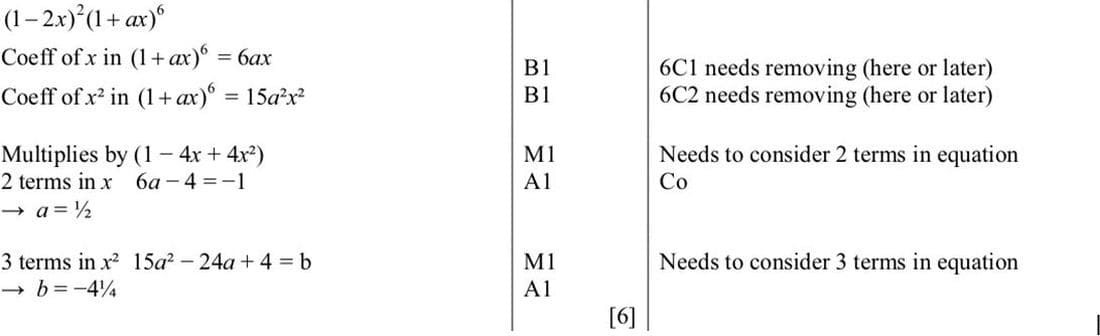
The first three terms in the expansion of \((1 - 2x)^2(1 + ax)^6\), in ascending powers of \(x\), are \(1 - x + bx^2\). Find the values of the constants \(a\) and \(b\).
9709 P12 - Nov 2010 - Q1
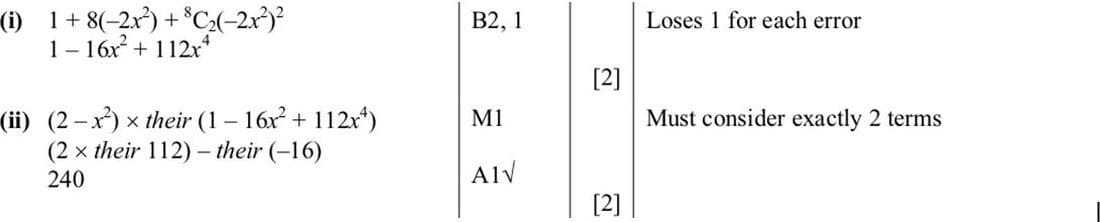
(i) Find the first 3 terms in the expansion, in ascending powers of \(x\), of \((1 - 2x^2)^8\).
(ii) Find the coefficient of \(x^4\) in the expansion of \((2 - x^2)(1 - 2x^2)^8\).
9709 P11 - Jun 2023 - Q2
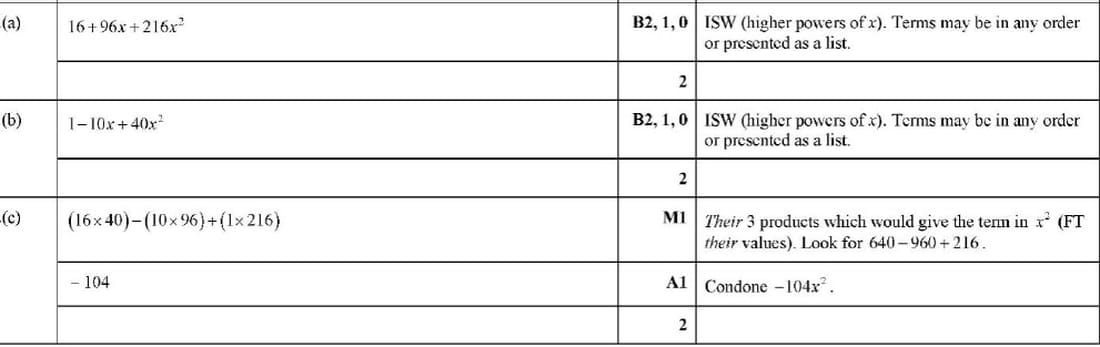
(a) Find the first three terms in the expansion, in ascending powers of \(x\), of \((2 + 3x)^4\).
(b) Find the first three terms in the expansion, in ascending powers of \(x\), of \((1 - 2x)^5\).
(c) Hence find the coefficient of \(x^2\) in the expansion of \((2 + 3x)^4 (1 - 2x)^5\).
9709 P13 - Jun 2010 - Q2
(i) Find the first three terms, in descending powers of x, in the expansion of \(\left( x - \frac{2}{x} \right)^6\).
(ii) Find the coefficient of \(x^4\) in the expansion of \((1 + x^2) \left( x - \frac{2}{x} \right)^6\).

9709 P12 - Jun 2010 - Q6
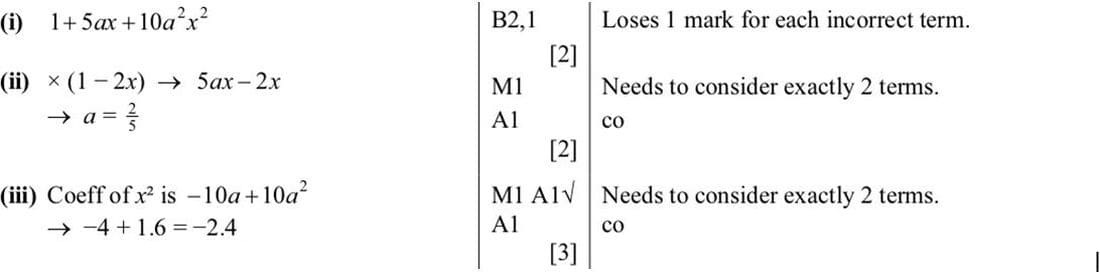
(i) Find the first 3 terms in the expansion of \((1 + ax)^5\) in ascending powers of \(x\).
(ii) Given that there is no term in \(x\) in the expansion of \((1 - 2x)(1 + ax)^5\), find the value of the constant \(a\).
(iii) For this value of \(a\), find the coefficient of \(x^2\) in the expansion of \((1 - 2x)(1 + ax)^5\).
9709 P11 - Jun 2010 - Q2
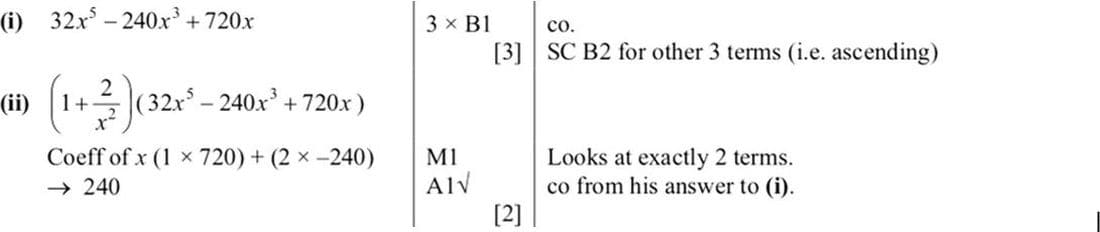
(i) Find the first 3 terms in the expansion of \(\left( 2x - \frac{3}{x} \right)^5\) in descending powers of \(x\).
(ii) Hence find the coefficient of \(x\) in the expansion of \(\left( 1 + \frac{2}{x^2} \right) \left( 2x - \frac{3}{x} \right)^5\).
9709 P11 - Nov 2009 - Q3
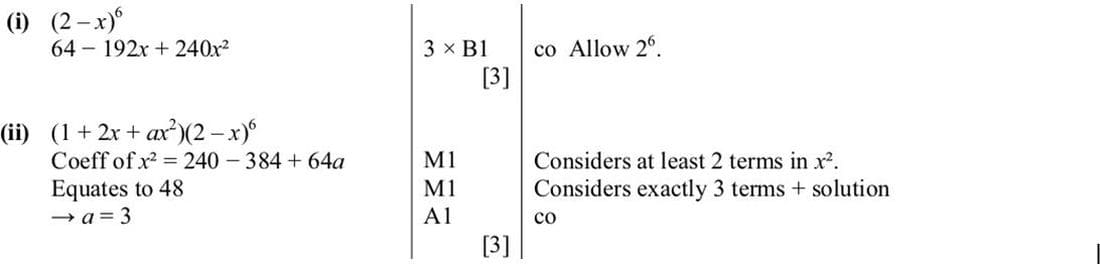
(i) Find the first 3 terms in the expansion of \((2-x)^6\) in ascending powers of \(x\).
(ii) Given that the coefficient of \(x^2\) in the expansion of \((1 + 2x + ax^2)(2-x)^6\) is 48, find the value of the constant \(a\).
9709 P1 - Jun 2009 - Q3
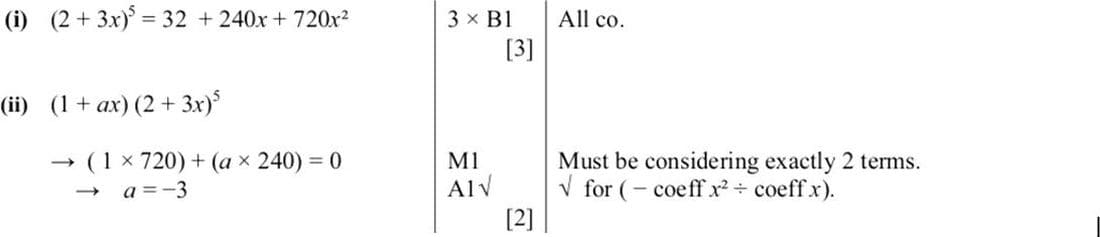
(i) Find the first 3 terms in the expansion of \((2 + 3x)^5\) in ascending powers of \(x\).
(ii) Hence find the value of the constant \(a\) for which there is no term in \(x^2\) in the expansion of \((1 + ax)(2 + 3x)^5\).
9709 P1 - Jun 2008 - Q3
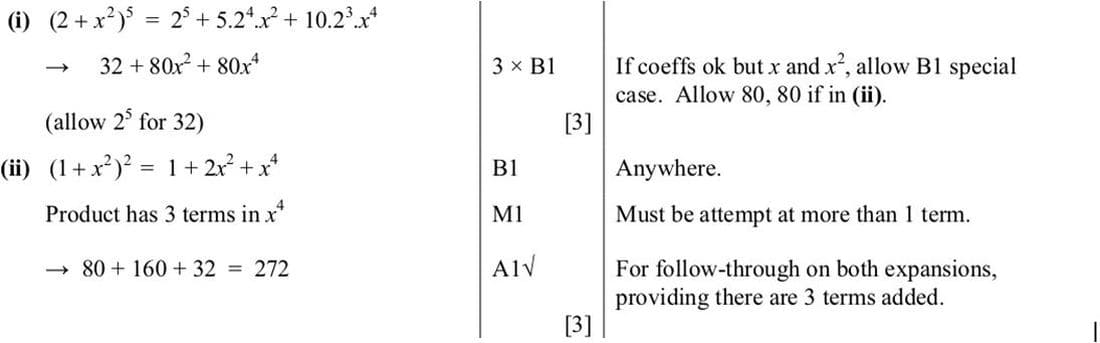
(i) Find the first 3 terms in the expansion, in ascending powers of \(x\), of \((2 + x^2)^5\).
(ii) Hence find the coefficient of \(x^4\) in the expansion of \((1 + x^2)^2(2 + x^2)^5\).
9709 P1 - Jun 2006 - Q4
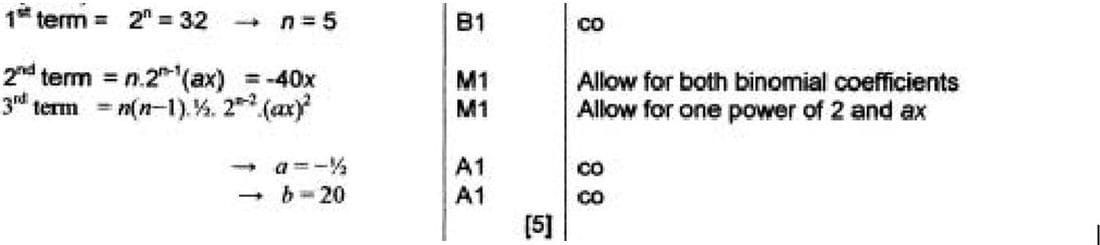
The first three terms in the expansion of \((2+ax)^n\), in ascending powers of \(x\), are 32 - 40x + bx^2. Find the values of the constants \(n, a\) and \(b\).
9709 P1 - Jun 2005 - Q4
(i) Find the first 3 terms in the expansion of \((2-x)^6\) in ascending powers of \(x\).
(ii) Find the value of \(k\) for which there is no term in \(x^2\) in the expansion of \((1+kx)(2-x)^6\).

9709 P13 - Nov 2022 - Q3
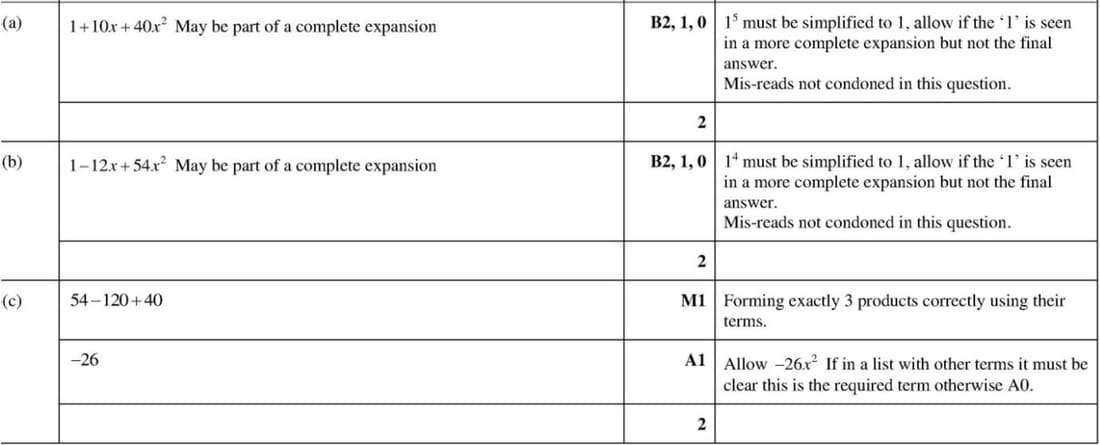
(a) Find the first three terms in ascending powers of x of the expansion of \((1 + 2x)^5\).
(b) Find the first three terms in ascending powers of x of the expansion of \((1 - 3x)^4\).
(c) Hence find the coefficient of \(x^2\) in the expansion of \((1 + 2x)^5(1 - 3x)^4\).
9709 P11 - Nov 2021 - Q1
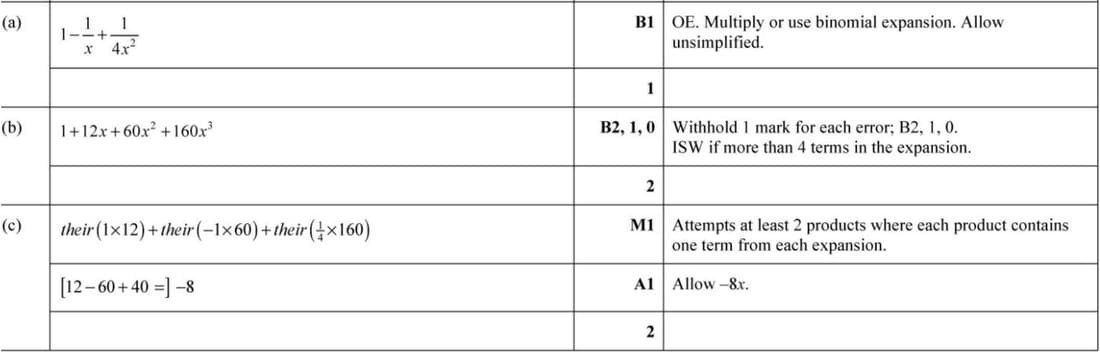
(a) Expand \(\left( 1 - \frac{1}{2x} \right)^2\).
(b) Find the first four terms in the expansion, in ascending powers of \(x\), of \((1 + 2x)^6\).
(c) Hence find the coefficient of \(x\) in the expansion of \(\left( 1 - \frac{1}{2x} \right)^2 (1 + 2x)^6\).
9709 P13 - Jun 2021 - Q7
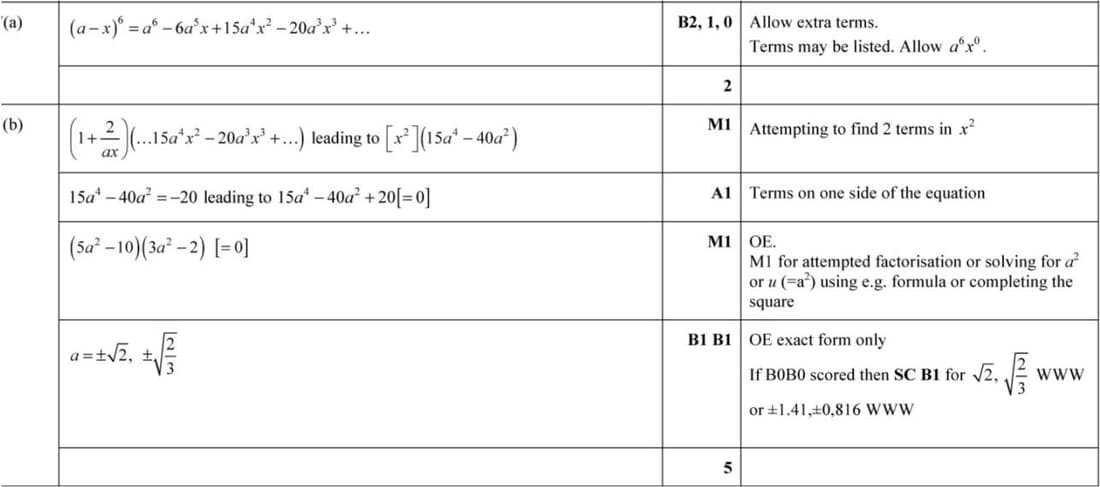
(a) Write down the first four terms of the expansion, in ascending powers of \(x\), of \((a-x)^6\).
(b) Given that the coefficient of \(x^2\) in the expansion of \(\left(1 + \frac{2}{ax}\right)(a-x)^6\) is \(-20\), find in exact form the possible values of the constant \(a\).
9709 P11 - Jun 2021 - Q3
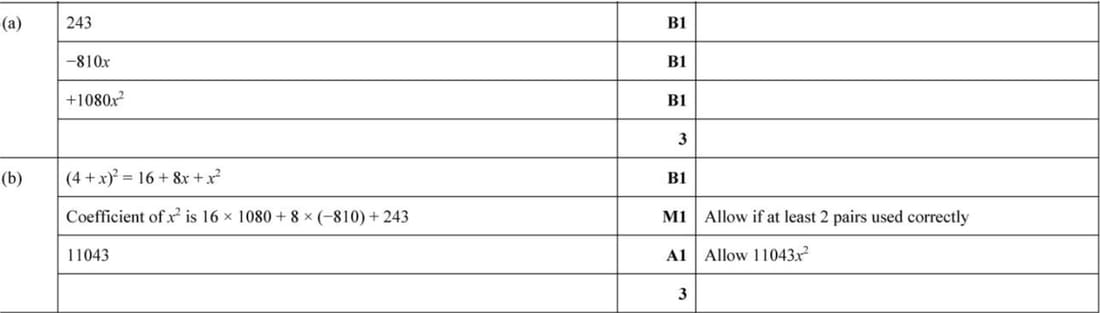
(a) Find the first three terms in the expansion of \((3 - 2x)^5\) in ascending powers of \(x\).
(b) Hence find the coefficient of \(x^2\) in the expansion of \((4 + x)^2(3 - 2x)^5\).
9709 P12 - Mar 2021 - Q1
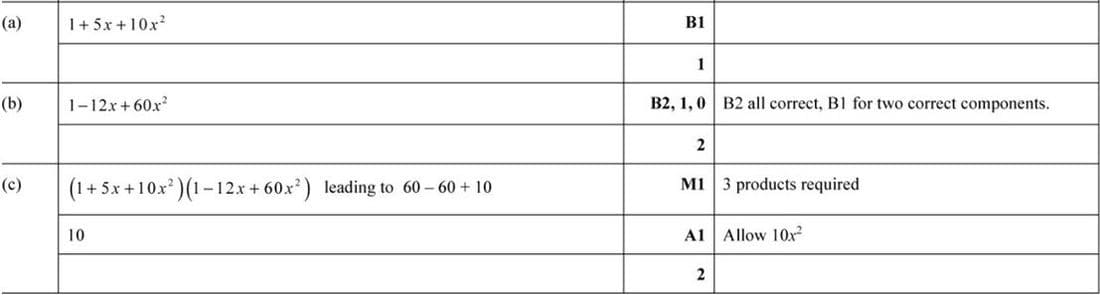
(a) Find the first three terms in the expansion, in ascending powers of \(x\), of \((1 + x)^5\).
(b) Find the first three terms in the expansion, in ascending powers of \(x\), of \((1 - 2x)^6\).
(c) Hence find the coefficient of \(x^2\) in the expansion of \((1 + x)^5 (1 - 2x)^6\).
9709 P13 - Nov 2019 - Q1
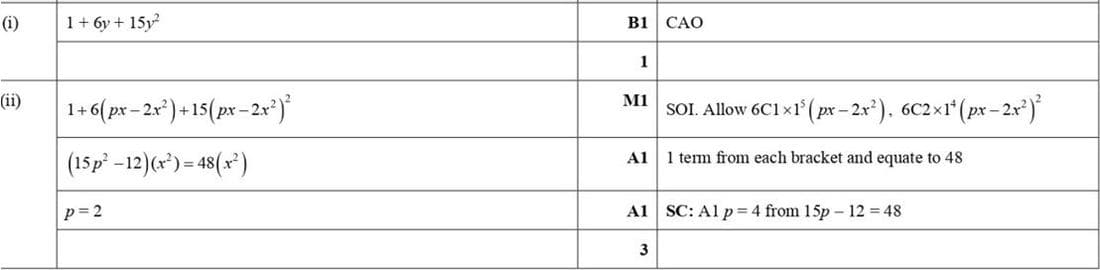
(i) Expand \((1+y)^6\) in ascending powers of \(y\) as far as the term in \(y^2\).
(ii) In the expansion of \((1 + (px - 2x^2))^6\) the coefficient of \(x^2\) is 48. Find the value of the positive constant \(p\).
9709 P13 - Jun 2019 - Q2
(i) In the binomial expansion of \(\left( 2x - \frac{1}{2x} \right)^5\), the first three terms are \(32x^5 - 40x^3 + 20x\). Find the remaining three terms of the expansion.
(ii) Hence find the coefficient of \(x\) in the expansion of \((1 + 4x^2) \left( 2x - \frac{1}{2x} \right)^5\).
