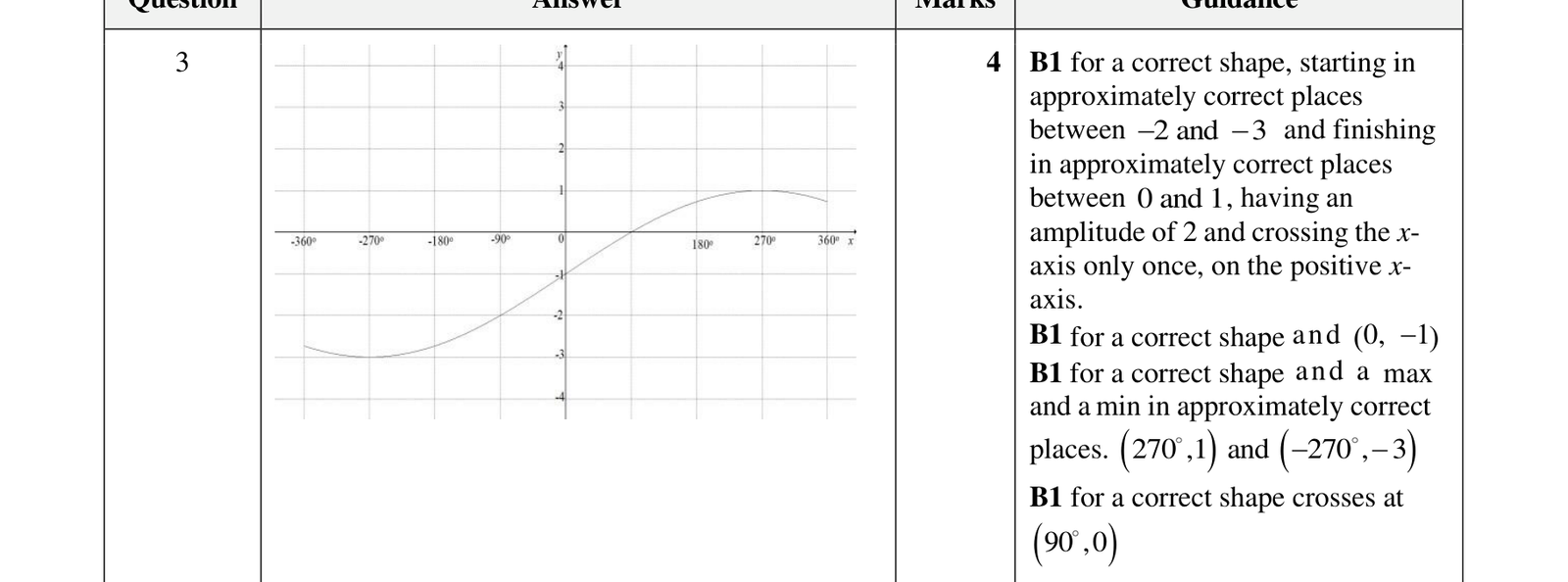
Past Exam Questions
← Back0606 P22 - Nov 2022 - Q9 - 11 marks
In this question all lengths are in centimetres.
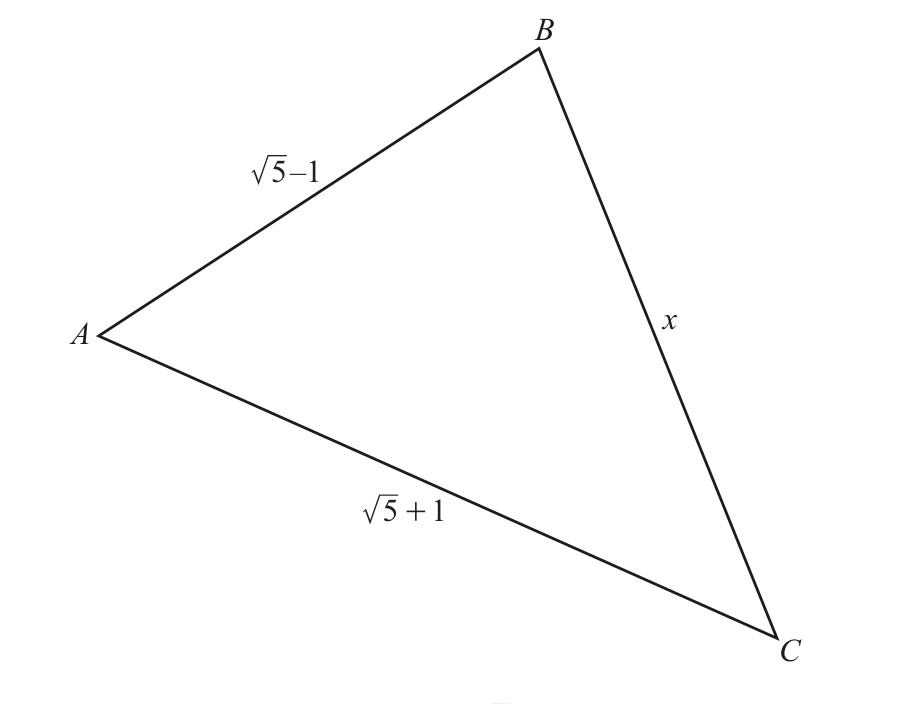
The diagram shows triangle \(ABC\) with \(AB=\sqrt5-1\), \(AC=\sqrt5+1\) and \(BC=x\). The area of triangle \(ABC\) is \(\frac{2\sqrt5}{3}\text{ cm}^2\). Angle \(A\) is acute.
(a) Find the exact value of \(\sin A\).
(b) Find the exact value of \(\cos A\) and hence find the exact value of \(x\).
(c) Find the exact value of \(\sin B\).

0606 P22 - Nov 2021 - Q6 - 7 marks
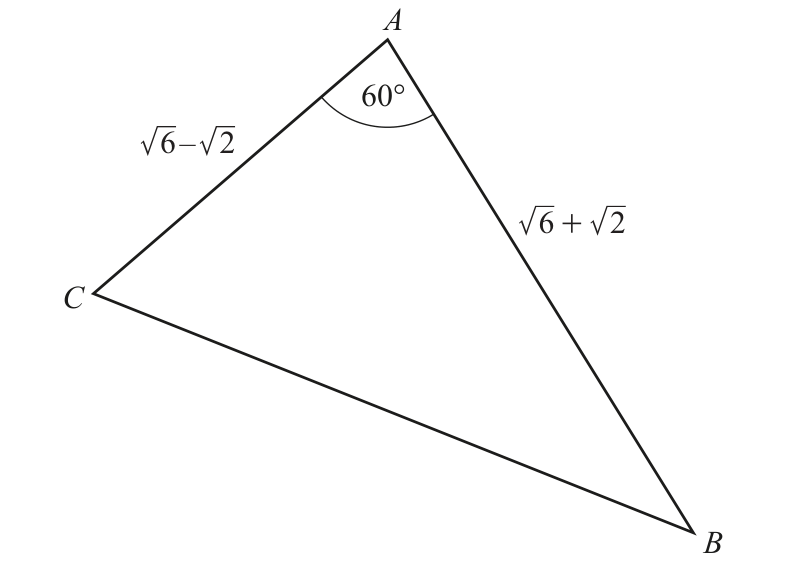
The diagram shows triangle \(ABC\) with
\(AC=\sqrt6-\sqrt2,\quad AB=\sqrt6+\sqrt2\)
and angle \(CAB=60^\circ\).
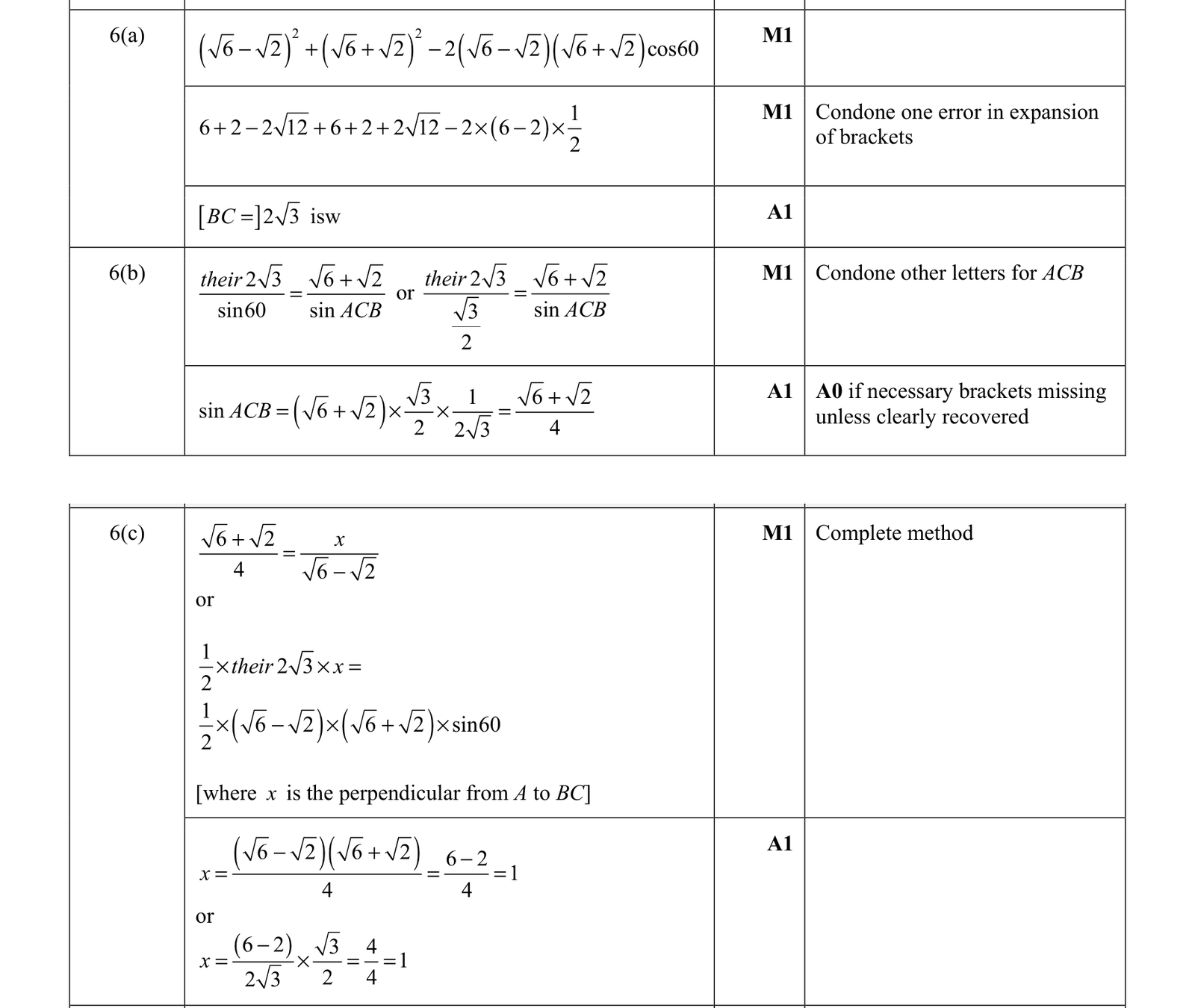
(a) Find the exact length of \(BC\).
(b) Show that
\(\sin ACB=\frac{\sqrt6+\sqrt2}{4}.\)
(c) Show that the perpendicular distance from \(A\) to the line \(BC\) is \(1\).
0606 P12 - Mar 2019 - Q7 - 6 marks
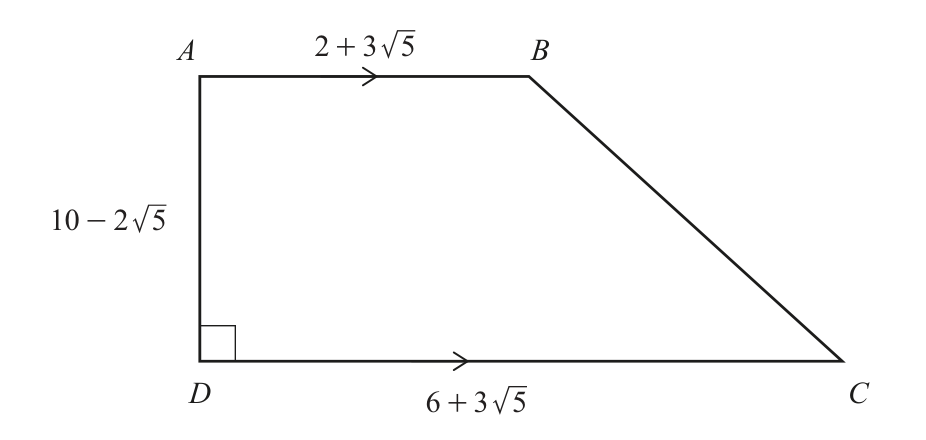
The diagram shows a trapezium \(ABCD\), where \(AB\) is parallel to \(DC\), \(AD\) is perpendicular to \(DC\),
\(AB=2+3\sqrt5,\qquad DC=6+3\sqrt5,\qquad AD=10-2\sqrt5.\)
(i) Find the area of the trapezium in the form \(a+b\sqrt5\), where \(a\) and \(b\) are integers.
(ii) Find \(\operatorname{cot} BCD\) in the form \(c+d\sqrt5\), where \(c\) and \(d\) are constants.

0606 P13 - Jun 2019 - Q7 - 8 marks
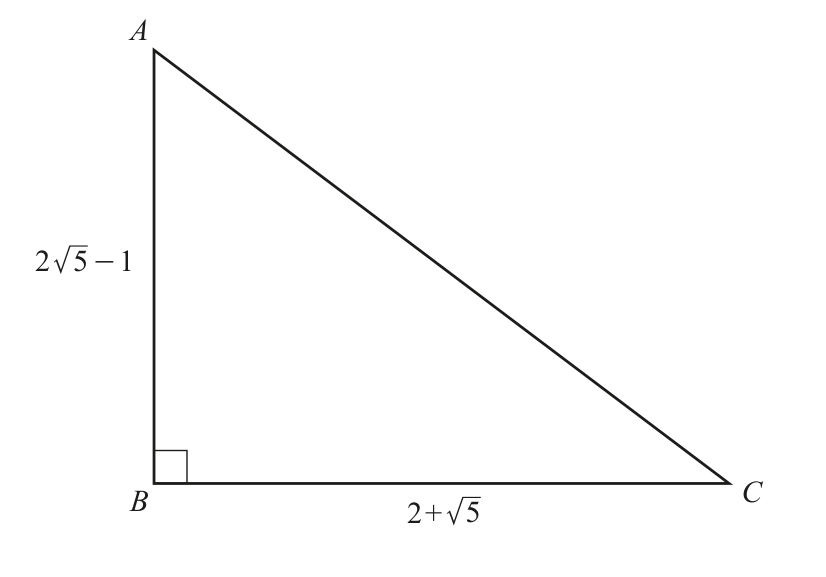
Do not use a calculator in this question. In triangle \(ABC\), \(AB=2\sqrt5-1\), \(BC=2+\sqrt5\), and angle \(ABC=90^\circ\).
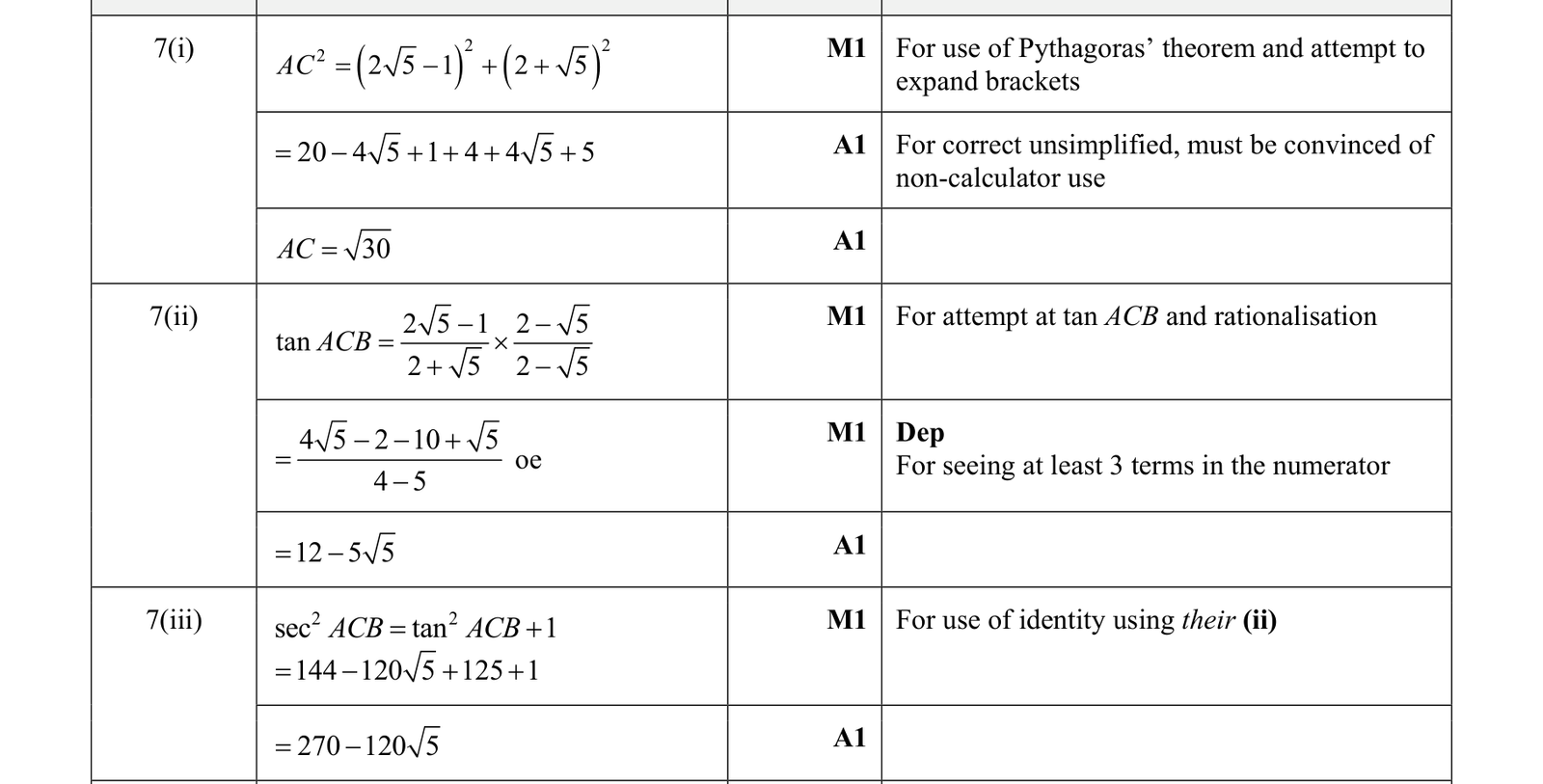
(i) Find the exact length of \(AC\).
(ii) Find \(\tan ACB\), giving your answer in the form \(p+q\sqrt r\), where \(p\), \(q\) and \(r\) are integers.
(iii) Hence find \(\operatorname{sec}^2ACB\), giving your answer in the form \(s+t\sqrt u\), where \(s\), \(t\) and \(u\) are integers.
0606 P11 - Nov 2025 - Q1 - 5 marks
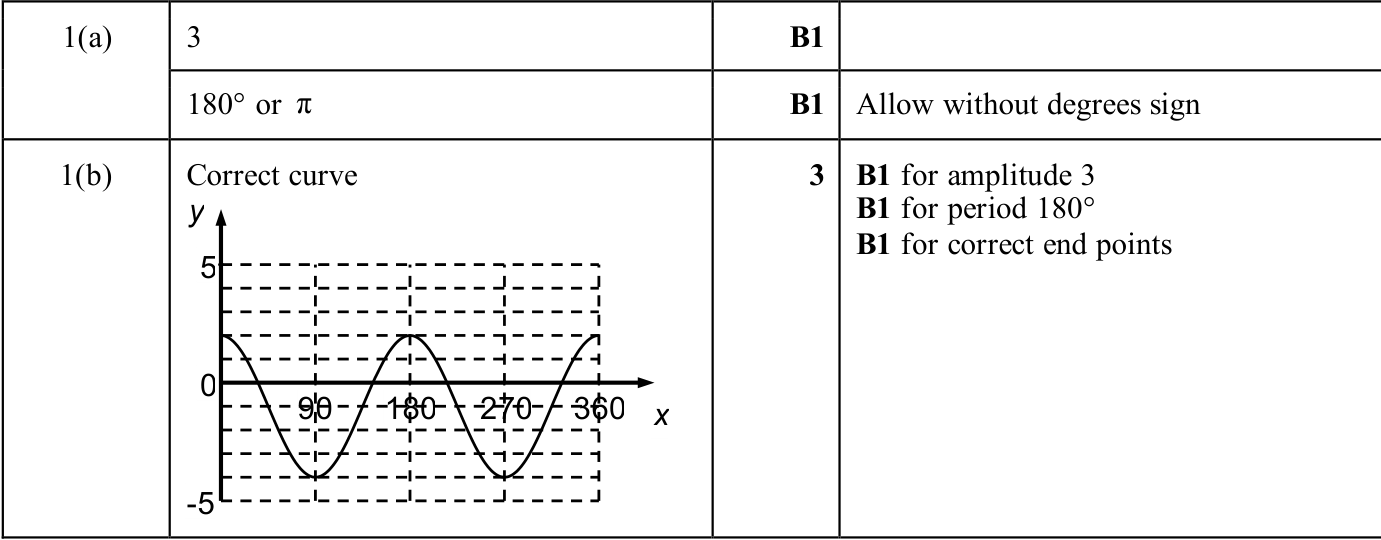
The diagram shows the graph of \(y=3\cos2x-1\) for \(0^\circ\leqslant x\leqslant360^\circ\).
(a) Write down the amplitude and period of the graph.
(b) Sketch the graph, showing its key points.
0606 P23 - Jun 2025 - Q5 - 4 marks
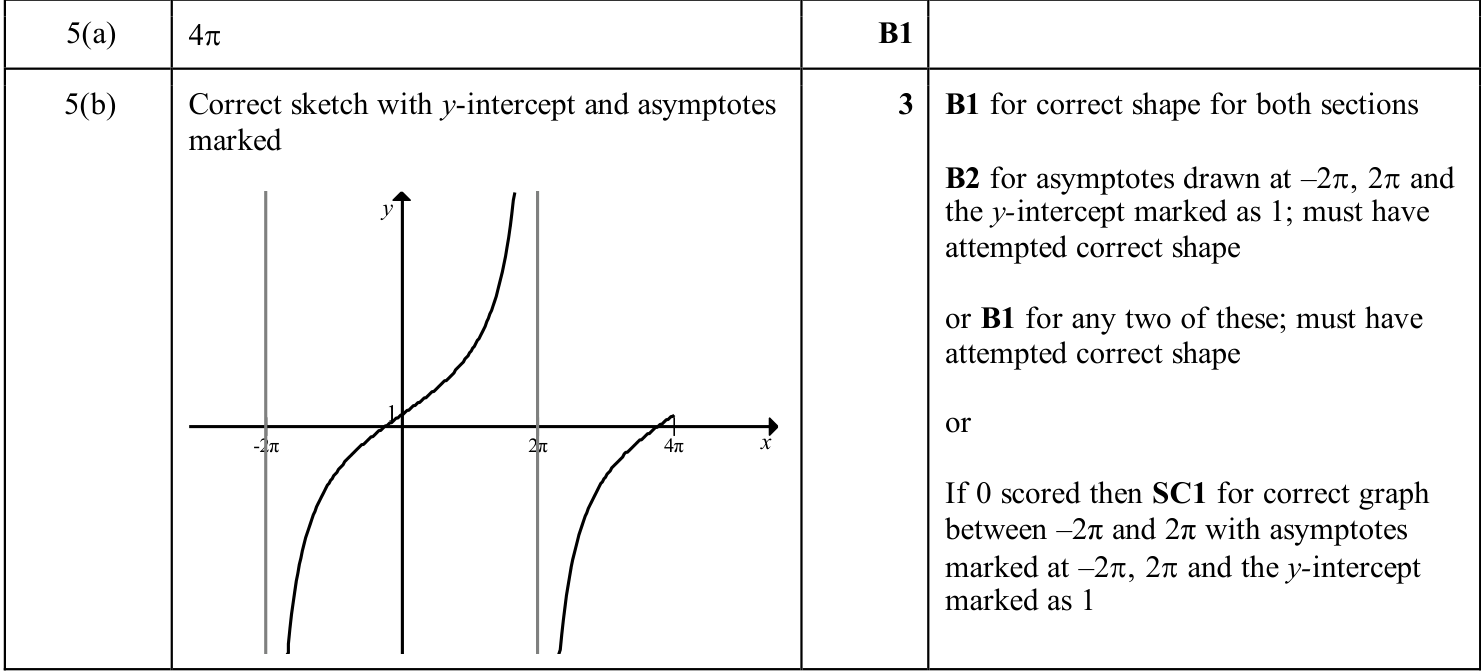
In this question, all angles are in radians. (a) Write down the period of \(5 \tan \left(\frac{x}{4}\right)+1\).
(b) On the axes, sketch the graph of \(y=5 \tan \left(\frac{x}{4}\right)+1\) for \(-2 \pi \leqslant x \leqslant 4 \pi\).
State the intercept with the \(y\)-axis. Show clearly the positions of any asymptotes.
0606 P12 - Mar 2025 - Q2 - 3 marks
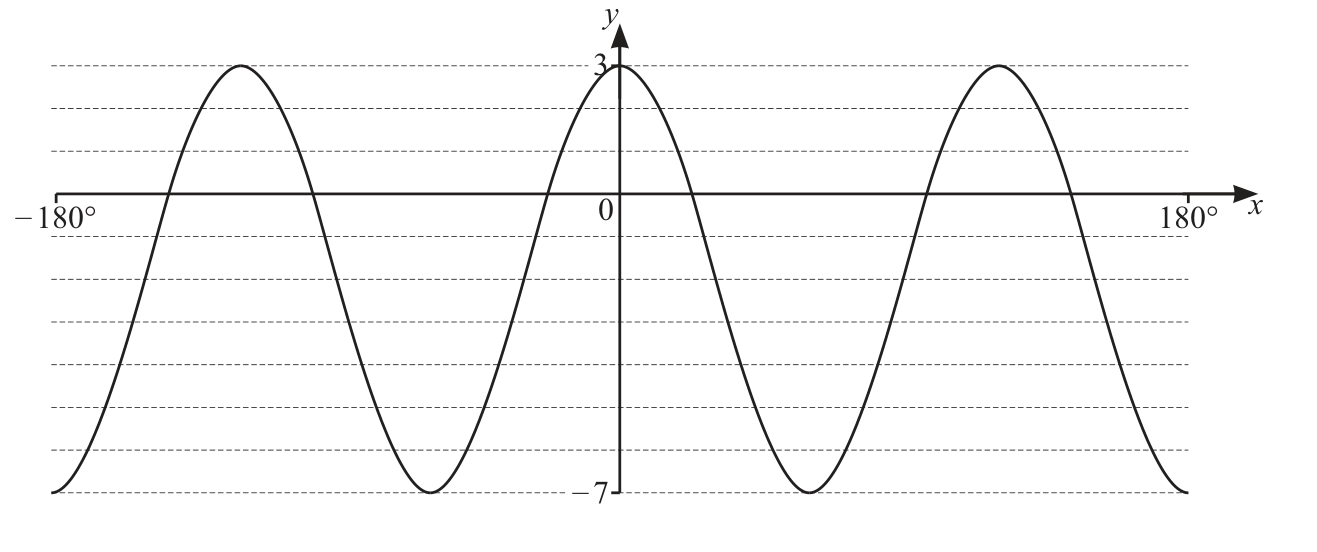
The diagram shows the curve \(y=a\cos bx+c\) for \(-180^\circ\leqslant x\leqslant180^\circ\).
It is given that \(a\), \(b\) and \(c\) are integers.
Find the values of \(a\), \(b\) and \(c\).

0606 P11 - Nov 2024 - Q3 - 4 marks
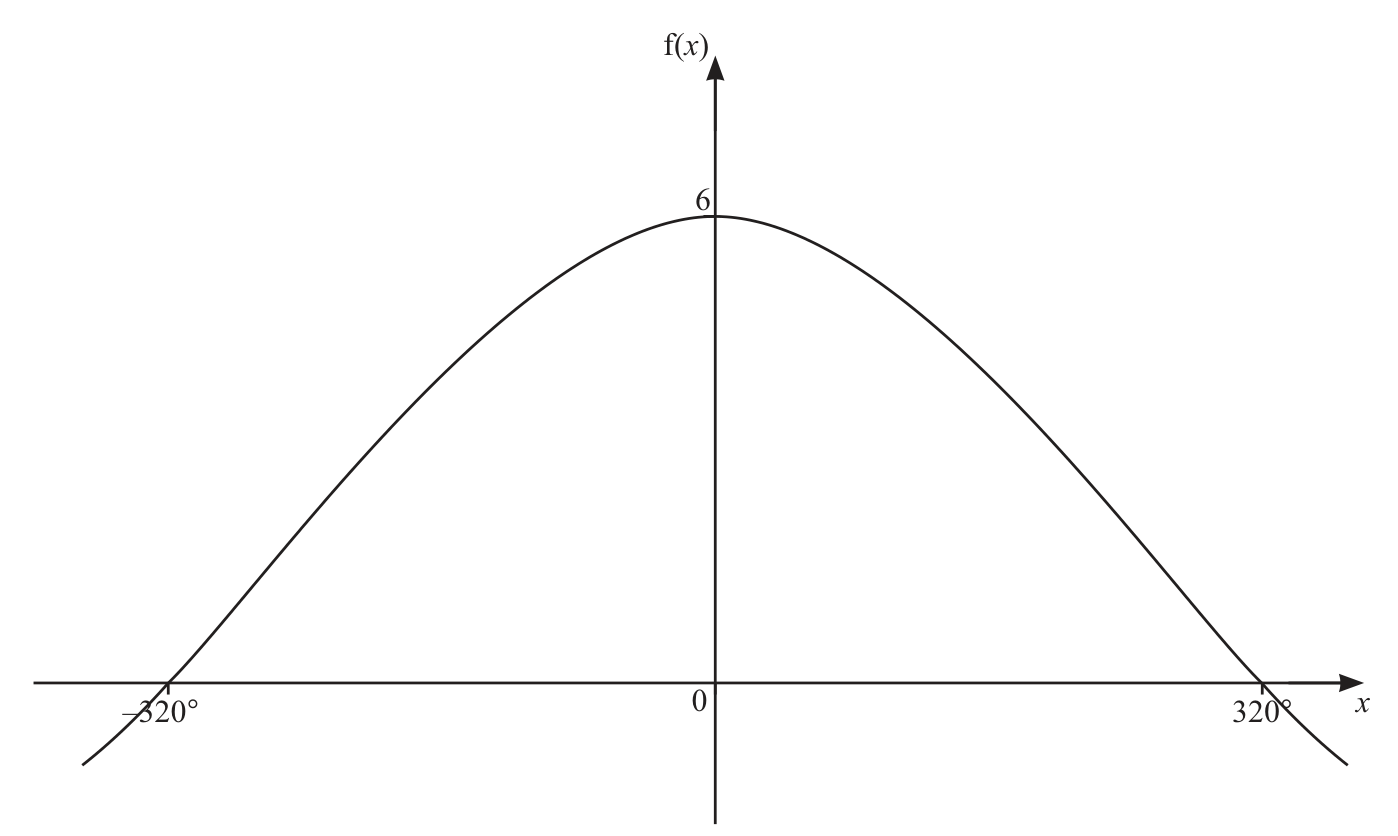
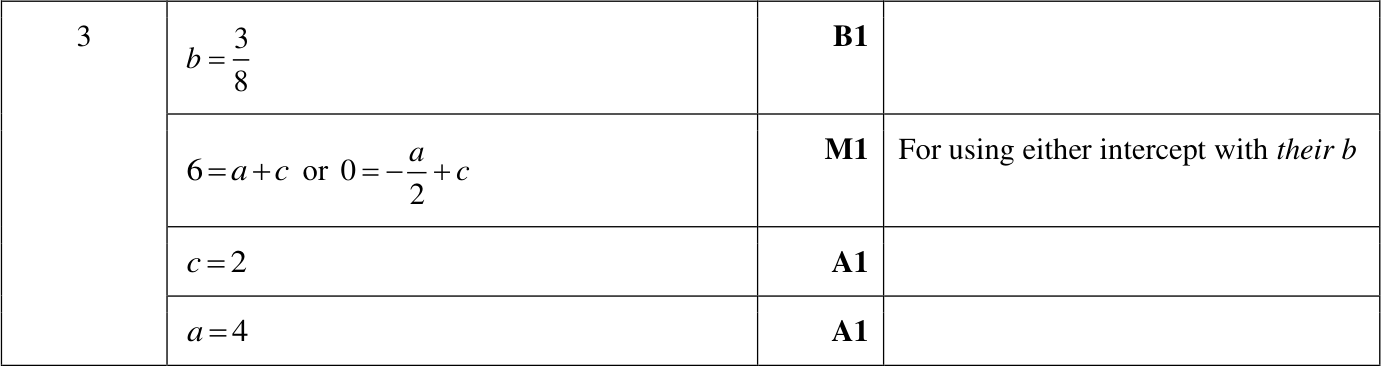
The diagram shows part of the graph of \(\mathrm{f}(x)=a \cos b x+c\), where \(a, b\) and \(c\) are constants. Given that \(\mathrm{f}(x)\) has a period of \(960^{\circ}\), find the values of \(a, b\) and \(c\).
0606 P12 - Nov 2024 - Q1 - 7 marks
The curve \(y=a \cos b x+c\), where \(a, b\) and \(c\) are integers, passes through the points \(\left(-\frac{\pi}{6},-2\right)\) and \(\left(\frac{\pi}{9}, \frac{1}{2}\right)\). The curve has a period of \(\frac{2 \pi}{3}\). (a) Find the values of \(a, b\) and \(c\). (b) Find the least value of \(y\) on the curve for \(0 \leqslant x \leqslant \frac{\pi}{2}\), and state the value of \(x\) at which this occurs.
0606 P13 - Nov 2024 - Q2 - 4 marks
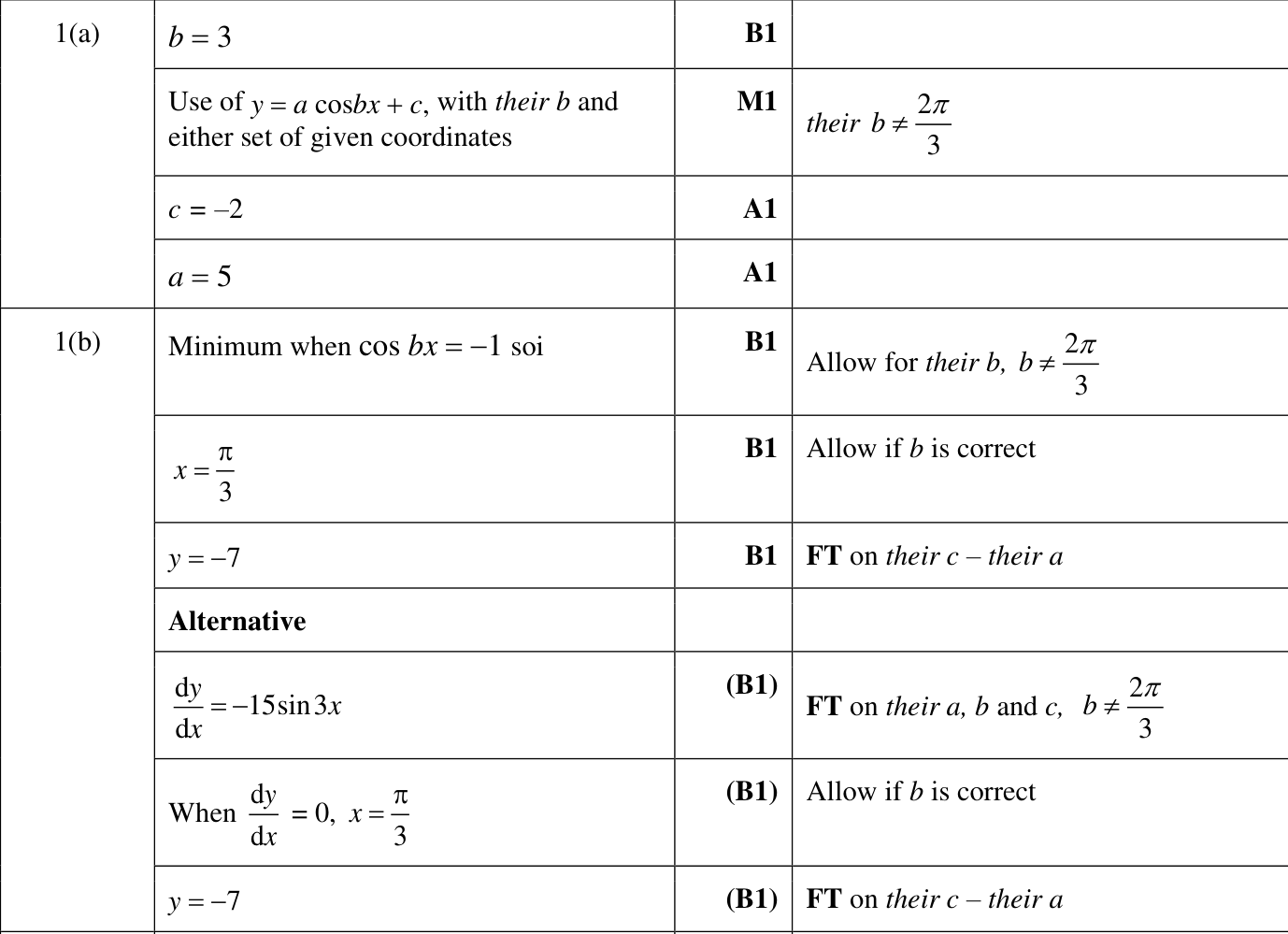
On the axes, sketch the graph of \(y=4+5 \sin \frac{\theta}{2}\), for \(-360^{\circ} \leqslant \theta \leqslant 360^{\circ}\). State the intercept with the \(y\)-axis.
0606 P12 - Mar 2024 - Q1 - 5 marks
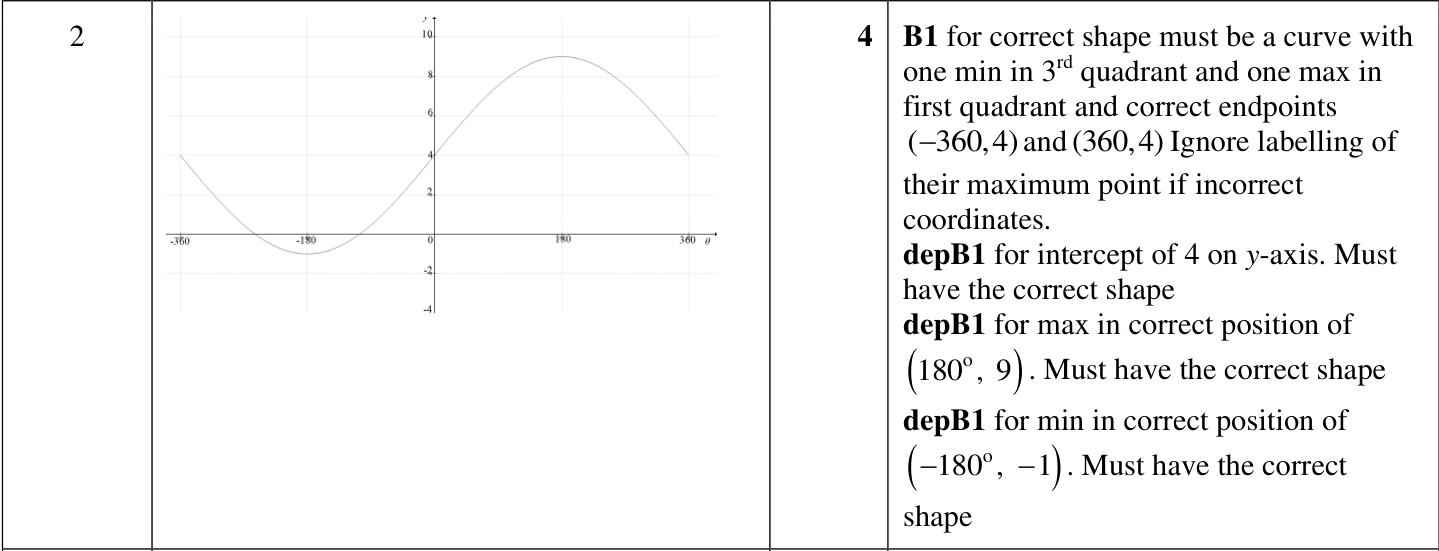
Given that \(y=2+4 \cos 3 \theta\), for \(-120^{\circ} \leqslant \theta \leqslant 120^{\circ}\), (a) write down the amplitude of \(y\)
(b) write down the period of \(y\).
(c) On the axes, sketch the graph of \(y\).
0606 P11 - Jun 2024 - Q5 - 5 marks
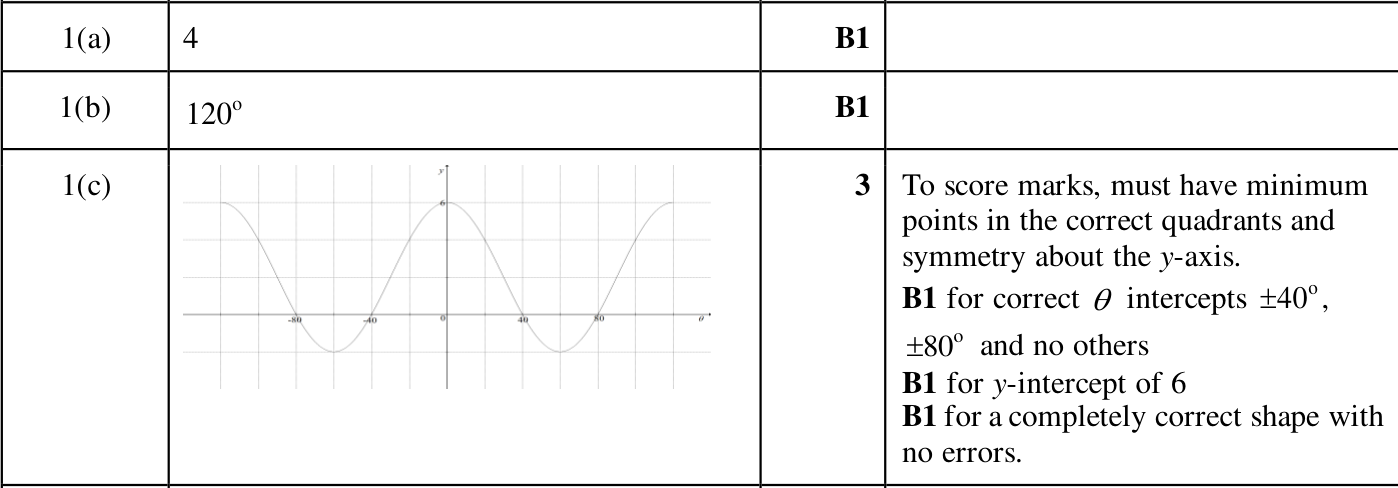
(a) The diagram shows the graph of \(y=a \cos b x+c\), for \(-360^{\circ} \leqslant x \leqslant 360^{\circ}\), where \(a, b\) and \(c\) are constants. Find the values of \(a, b\) and \(c\).
(b) The line \(y=p\) is a tangent to the curve \(y=3-2 \sin 6 \theta\). Write down the possible values of \(p\).

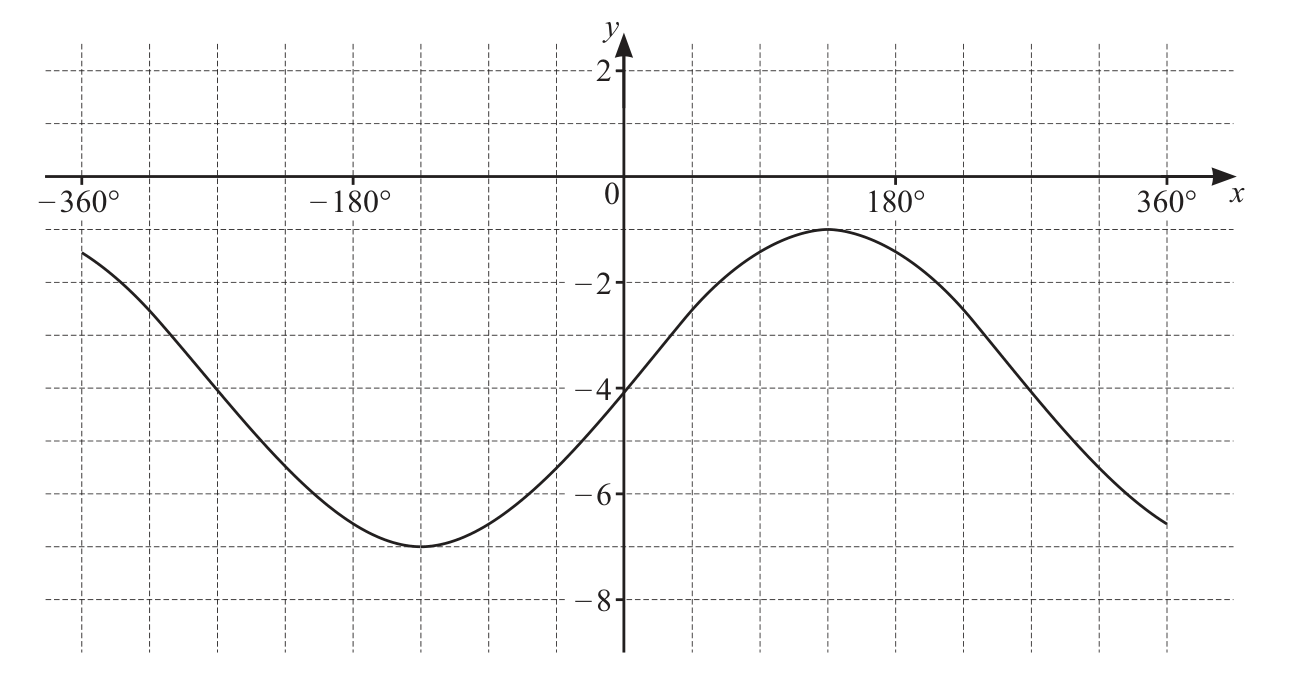
0606 P12 - Jun 2024 - Q1 - 3 marks
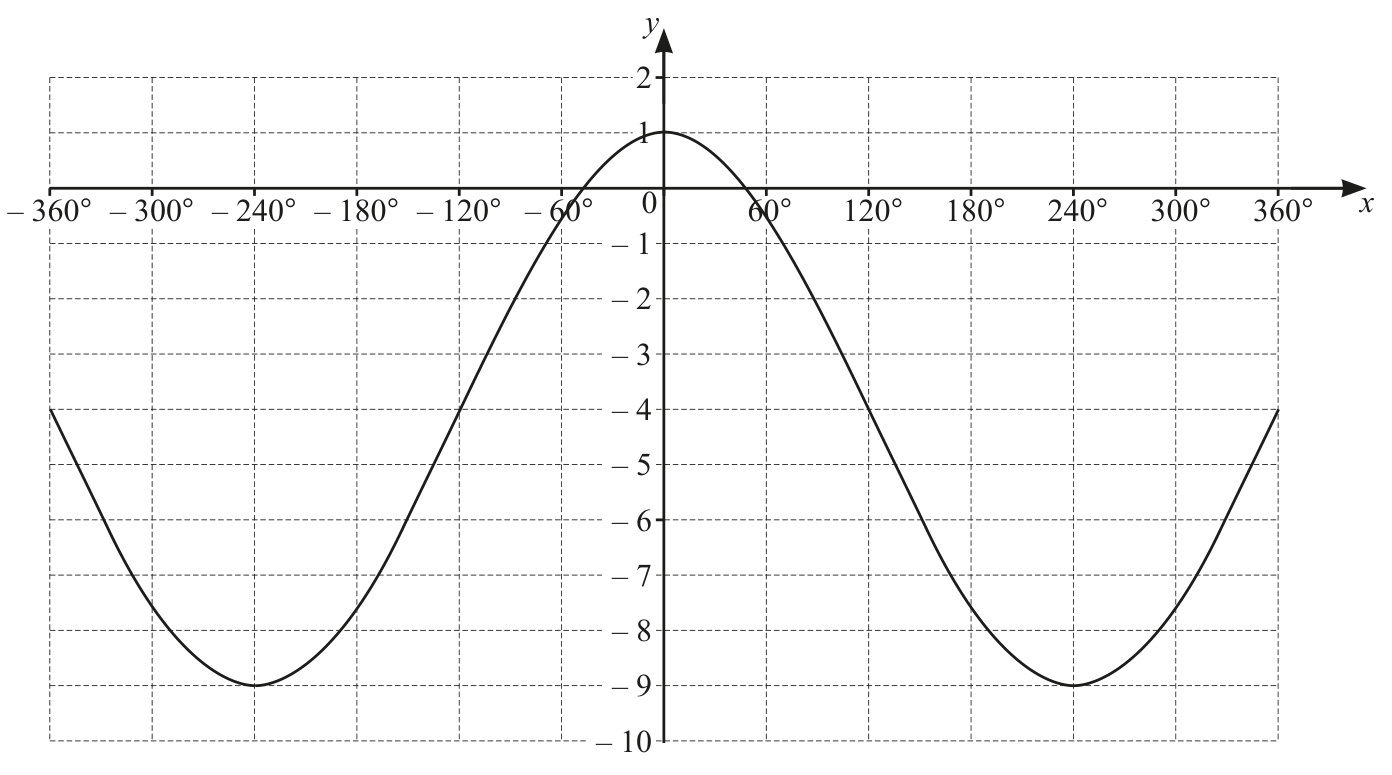
The diagram shows the graph of \(\quad y=a \sin b x+c\) for \(-360^{\circ} \leqslant x \leqslant 360^{\circ}\), where \(a, b\) and \(c\) are constants. Find the values of \(a, b\) and \(c\).

0606 P13 - Jun 2024 - Q1 - 3 marks
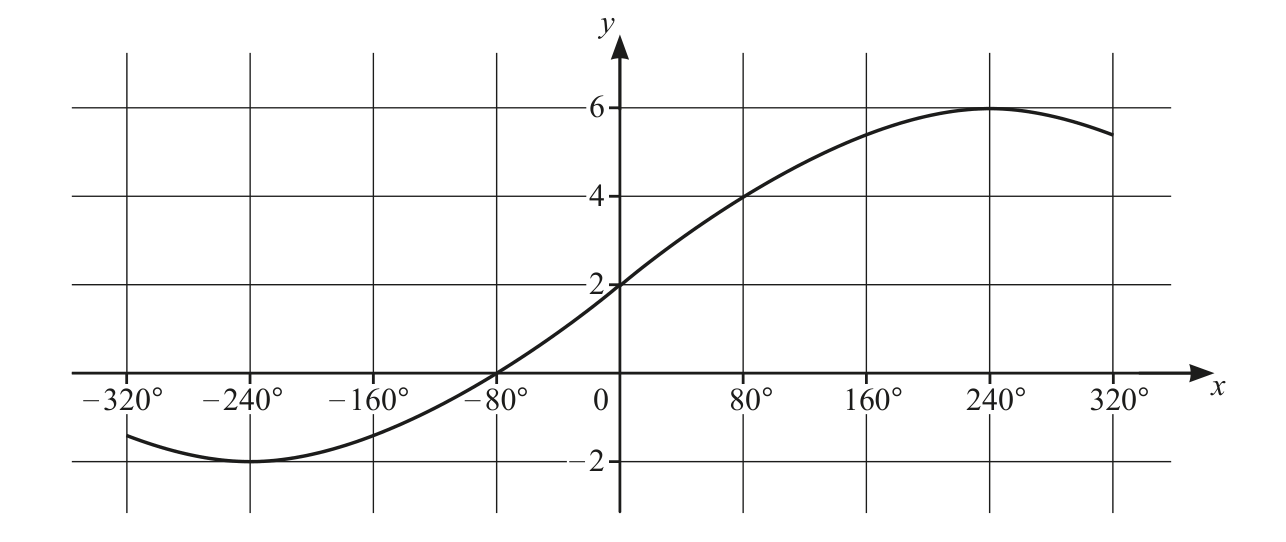
The diagram shows the graph of \(y=a \sin b x+c\), for \(-320^{\circ} \leqslant x \leqslant 320^{\circ}\), where \(a, b\) and \(c\) are constants. Find the values of \(a, b\) and \(c\).

0606 P12 - Jun 2023 - Q1 - 3 marks
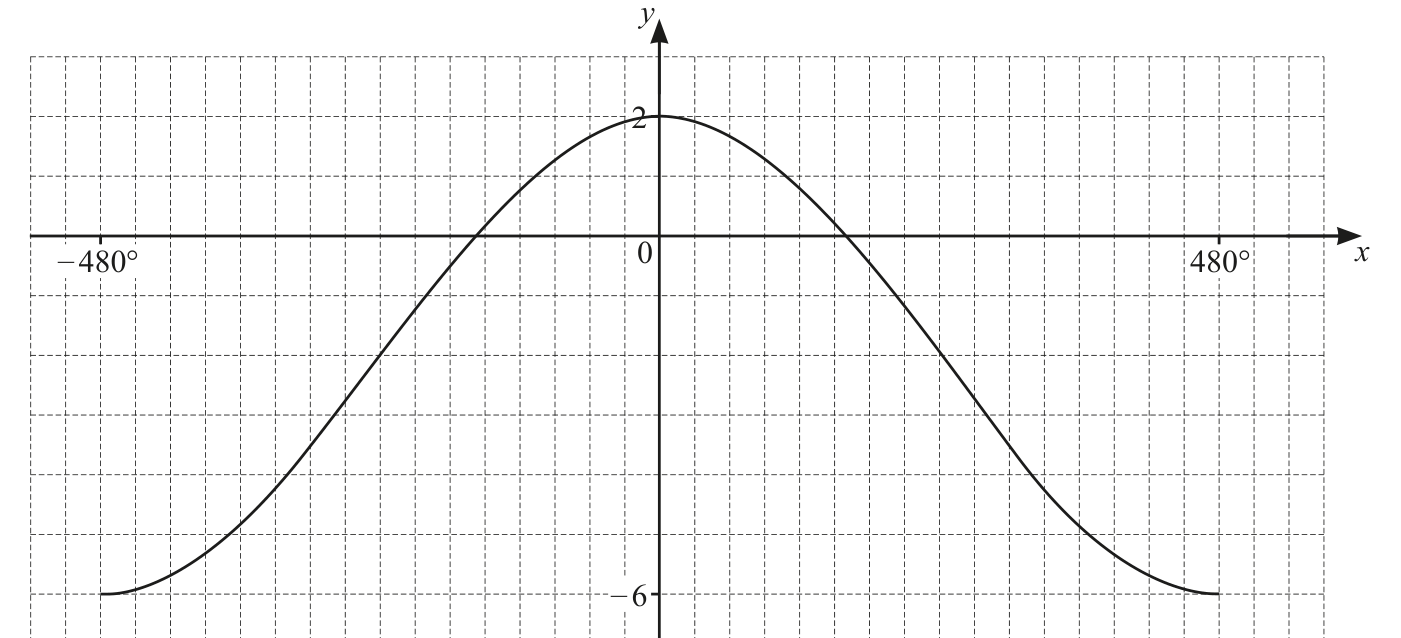
The diagram shows the graph of \(y=a\cos bx+c\). Find the values of the constants \(a\), \(b\) and \(c\).

0606 P13 - Jun 2023 - Q1 - 4 marks
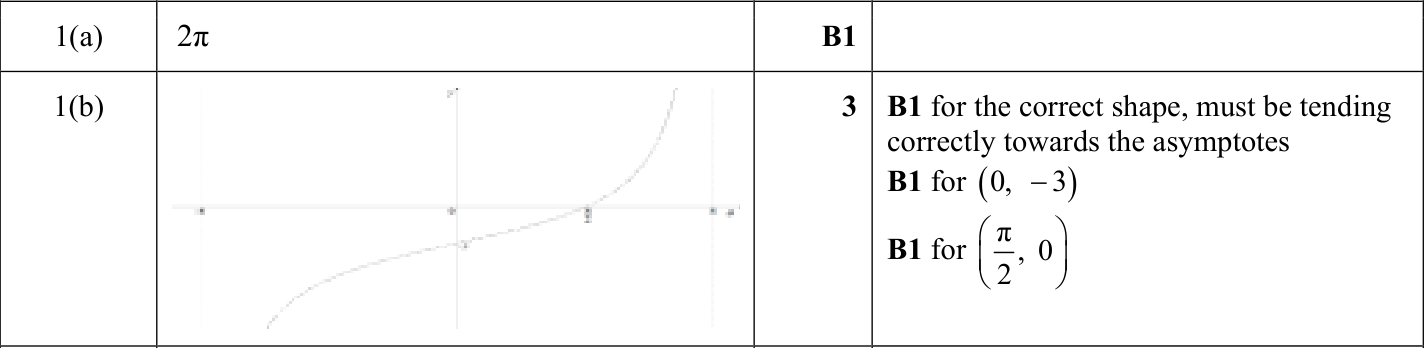
(a) Write down the period, in radians, of \(3\tan\frac{\theta}{2}-3\).
(b) On the axes, sketch the graph of \(y=3\tan\frac{\theta}{2}-3\) for \(-\pi\leq\theta\leq\pi\), stating the coordinates of the points where the graph meets the axes.
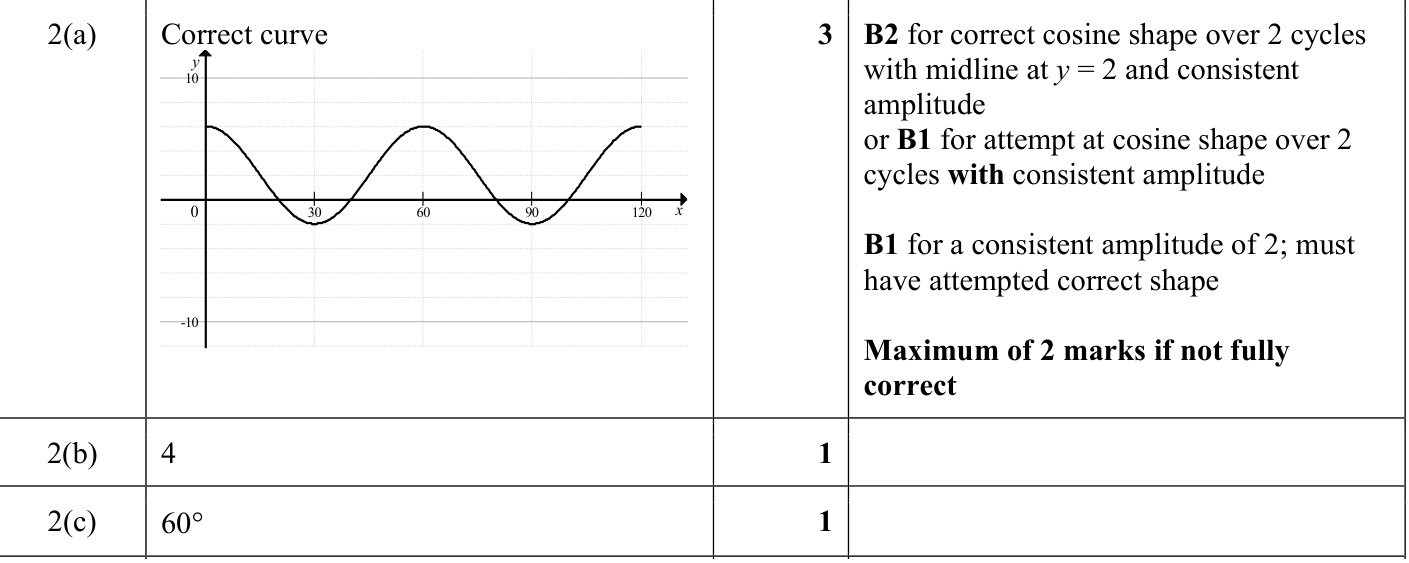
0606 P21 - Jun 2023 - Q2 - 5 marks
The function \(g\) is defined for \(0^\circ\leq x\leq120^\circ\) by
\(g(x)=2+4\cos6x.\)
(a) Sketch the graph of \(y=g(x)\).
(b) State the amplitude of \(g\).
(c) State the period of \(g\).
0606 P11 - Nov 2023 - Q1 - 3 marks
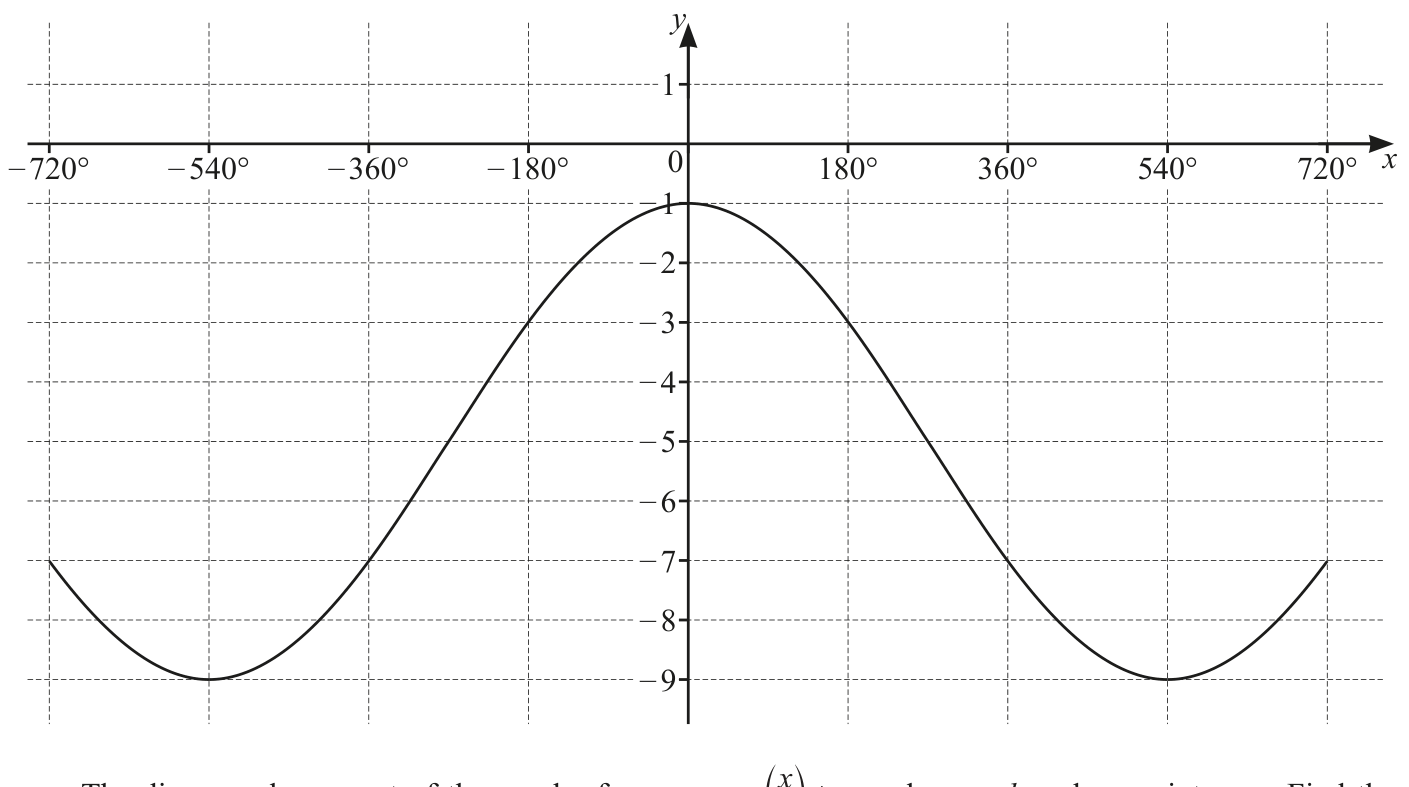
The diagram shows part of the graph of
\(y=a\cos\left(\frac{x}{b}\right)+c,\)
where \(a\), \(b\) and \(c\) are integers. Find the values of \(a\), \(b\) and \(c\).

0606 P12 - Nov 2023 - Q2 - 5 marks
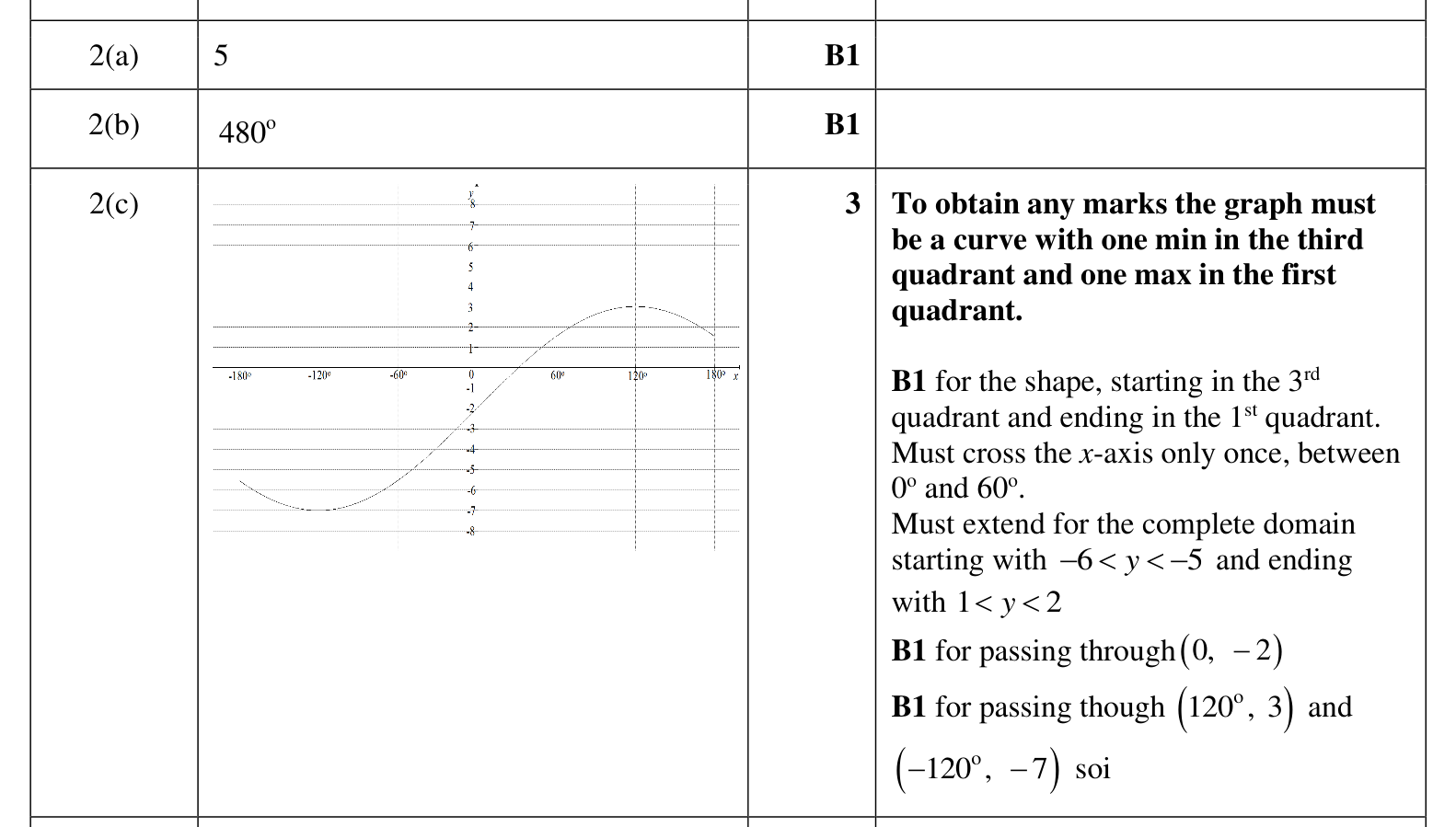
The function \(g\) is defined by
\(g(x)=5\sin\left(\frac{3x}{4}\right)-2\)
for all values of \(x\).
(a) Write down the amplitude of \(g\).
(b) Write down the period of \(g\) in degrees.
(c) Sketch the graph of \(y=g(x)\), for \(-180^\circ\leq x\leq180^\circ\).
0606 P13 - Nov 2023 - Q3 - 4 marks
On the axes, draw the graph of
\(y=2\sin\frac{x}{3}-1\)
for \(-360^\circ \leq x \leq 360^\circ\).