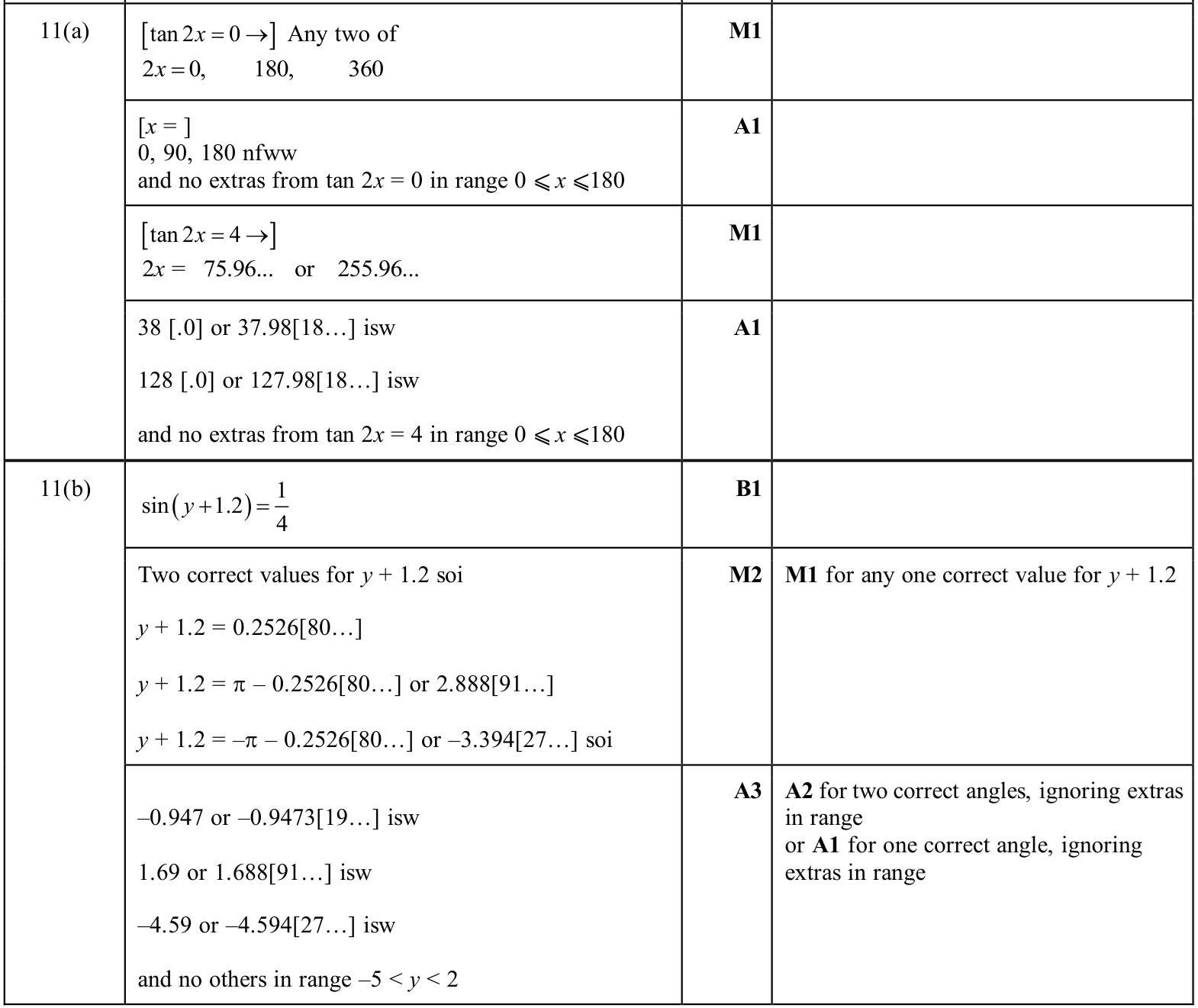
Answer: \(x=0^\circ,38.0^\circ,90^\circ,128^\circ,180^\circ\), and \(y=-4.59,-0.947,1.69\).
(a) Factorise the equation:
\(\tan^2(2x)-4\tan(2x)=\tan(2x)(\tan(2x)-4)=0\).
So
\(\tan(2x)=0\quad\text{or}\quad \tan(2x)=4\).
Since \(0^\circ\leqslant x\leqslant180^\circ\), we have
\(0^\circ\leqslant2x\leqslant360^\circ\).
For \(\tan(2x)=0\),
\(2x=0^\circ,180^\circ,360^\circ\),
so
\(x=0^\circ,90^\circ,180^\circ\).
For \(\tan(2x)=4\),
\(2x=\tan^{-1}4=75.963\ldots^\circ\)
or, adding \(180^\circ\),
\(2x=255.963\ldots^\circ\).
Thus
\(x=37.981\ldots^\circ\quad\text{or}\quad x=127.981\ldots^\circ\).
To 3 significant figures, the solutions are
\(x=0^\circ,38.0^\circ,90^\circ,128^\circ,180^\circ\).
(b) Since
\(\operatorname{cosec}(y+1.2)=4\),
we have
\(\sin(y+1.2)=\frac14\).
Let
\(u=y+1.2\).
The given interval \(-5\lt y\lt2\) becomes
\(-3.8\lt u\lt3.2\).
The principal value is
\(\sin^{-1}\left(\frac14\right)=0.25268\ldots\).
In the interval \(-3.8\lt u\lt3.2\), the solutions are
\(u=0.25268\ldots,\quad u=\pi-0.25268\ldots,\quad u=-\pi-0.25268\ldots\).
Subtracting \(1.2\) from each value gives
\(y=-0.947\ldots,\quad y=1.688\ldots,\quad y=-4.594\ldots\).
Therefore, to 3 significant figures,
\(y=-4.59,-0.947,1.69\).