Past Exam Questions
← Back9231 P41 - Nov 2025 - Q1 - 6 marks
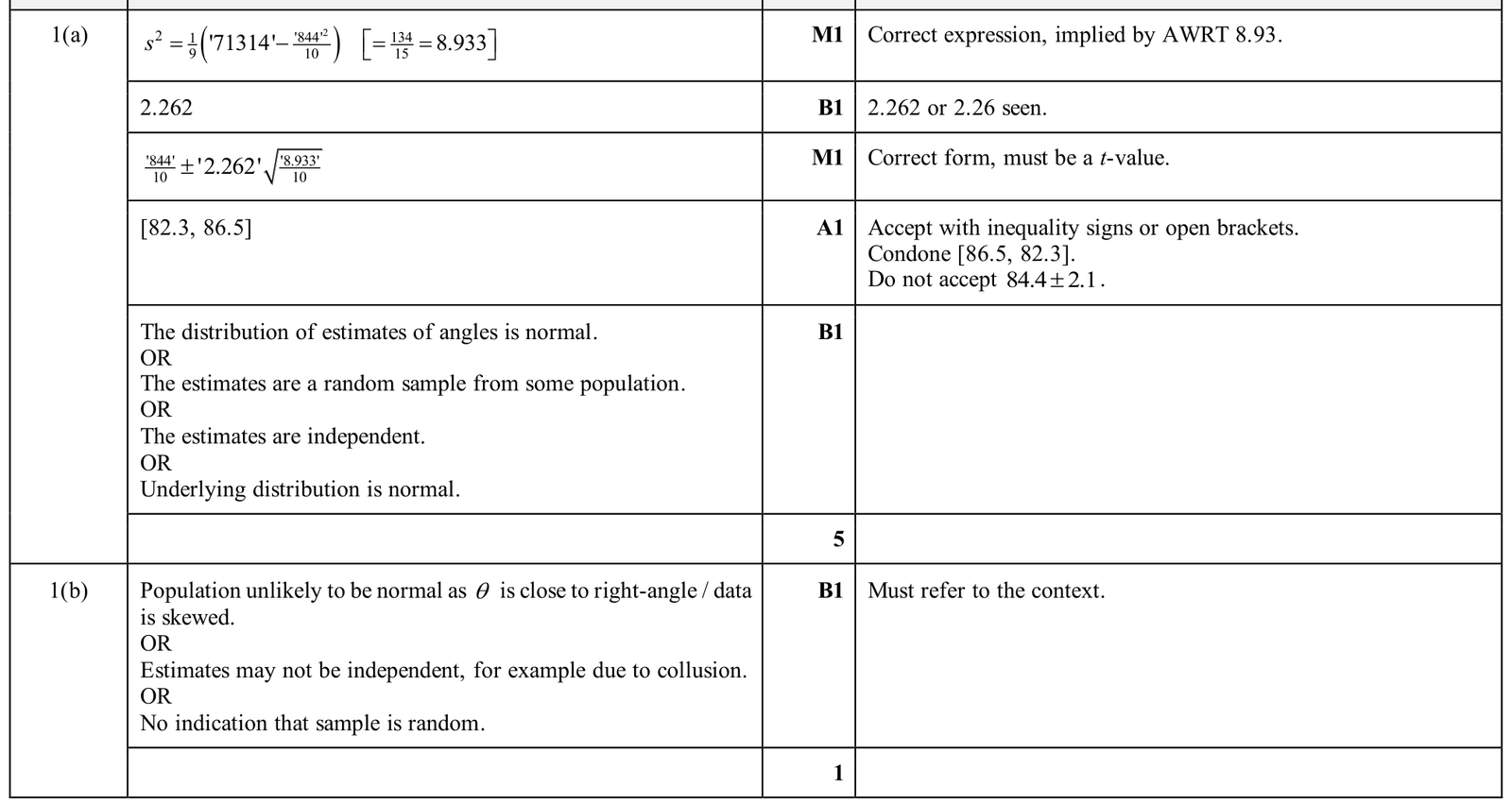
A group of 10 school children are asked to estimate the size of an angle \(\theta^{\circ}\) in a given acute angled triangle. These estimates, in degrees, are as follows.
| \(84\) | \(85\) | \(77\) | \(85\) | \(84\) | \(87\) | \(86\) | \(88\) | \(83\) | \(85\) |
(a) Stating any assumptions you make, calculate a \(95\%\) confidence interval for \(\theta\).
(b) Give a reason why the assumptions made in part (a) may not be appropriate in this case.
9231 P42 - Nov 2025 - Q2 - 7 marks
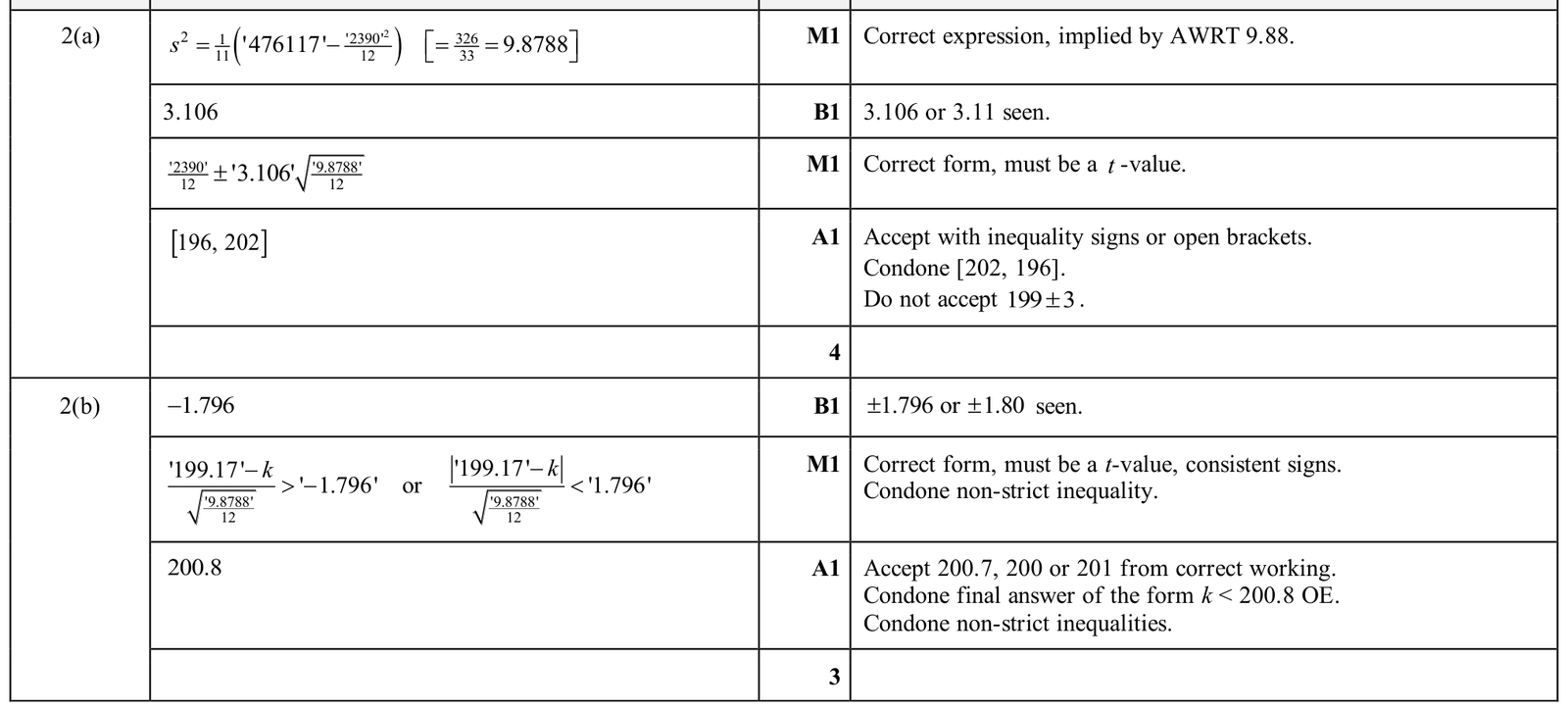
A factory produces packets of biscuits. The total mass of biscuits in a packet has a normal distribution with mean \(\mu\). A random sample of 12 packets is taken and the mass of the contents of each packet, \(x\) g, is recorded. The results are summarised as follows.
\(\sum x=2390 \quad \sum x^2=476117\)
(a) Find a \(99\%\) confidence interval for \(\mu\).
A test of the null hypothesis \(\mu=k\) is carried out on this sample using a \(5\%\) significance level. The test does not support the alternative hypothesis \(\mu\lt k\).
(b) Find the greatest possible value of \(k\).
9231 P44 - Nov 2025 - Q1 - 6 marks
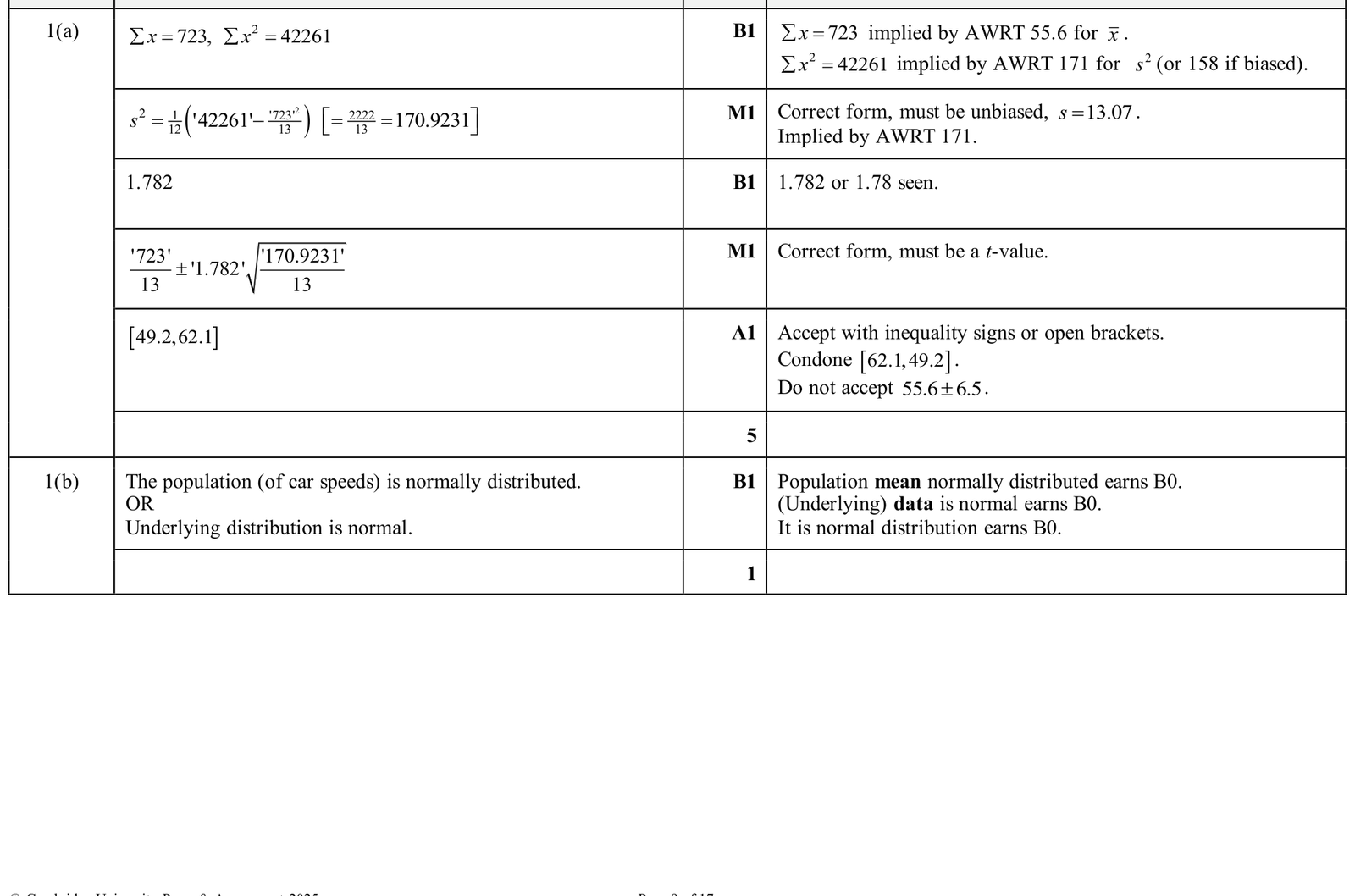
| 40 | 53 | 59 | 42 | 43 | 48 | 62 | 67 | 46 | 82 | 66 | 45 | 70 |
9231 P41 - Jun 2024 - Q1 - 4 marks
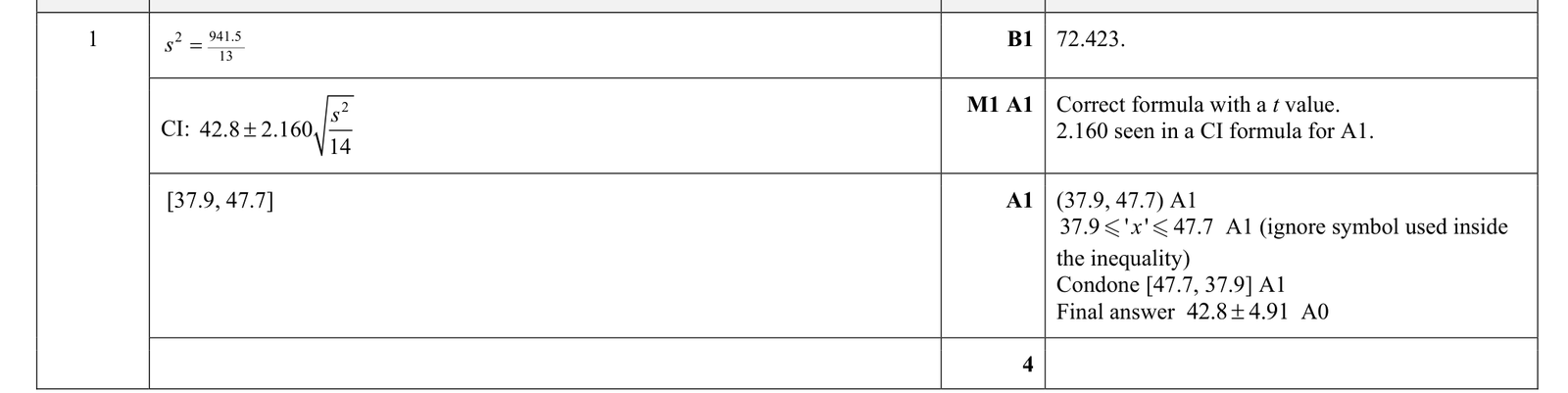
The times taken by members of a large cycling club to complete a cross-country circuit have a normal distribution with mean \(\mu\) minutes. The times taken, \(x\) minutes, are recorded for a random sample of 14 members of the club. The results are summarised as follows, where \(\bar{x}\) is the sample mean.
\(\bar{x}=42.8 \quad \sum(x-\bar{x})^{2}=941.5\)
Find a \(95 \%\) confidence interval for \(\mu\).
9231 P43 - Jun 2024 - Q2 - 7 marks
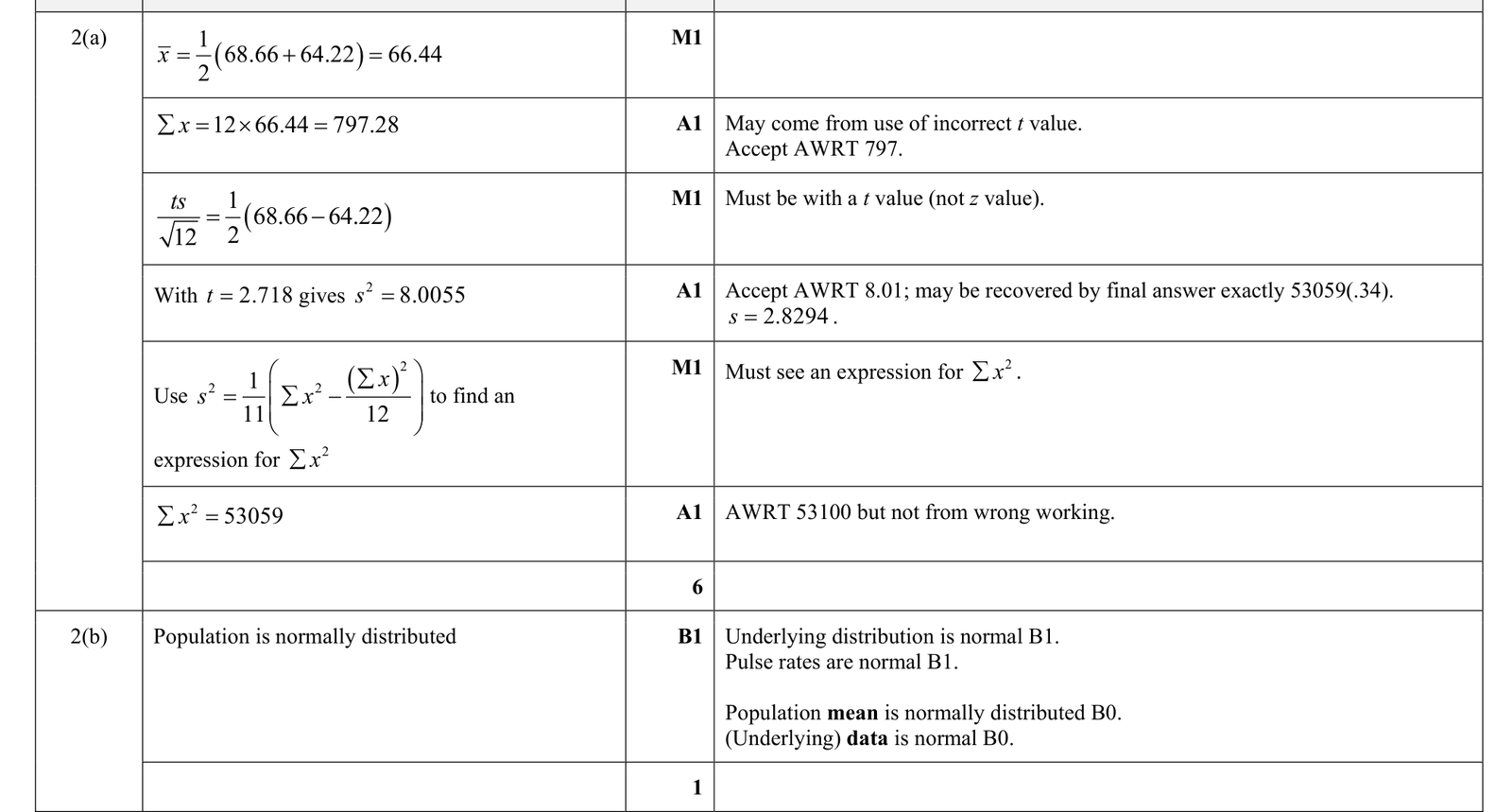
A rowing club has a large number of members. A random sample of 12 of these members is taken and the pulse rate, \(x\) beats per minute (bpm), of each is measured after a 30 -minute training session. A \(98 \%\) confidence interval for the population mean pulse rate, \(\mu \mathrm{bpm}\), is calculated from the sample as \(64.22\lt \mu\lt 68.66\).
(a) Find the values of \(\sum x\) and \(\sum x^{2}\).
(b) State an assumption that is necessary for the confidence interval to be valid.
9231 P41 - Jun 2023 - Q1 - 4 marks
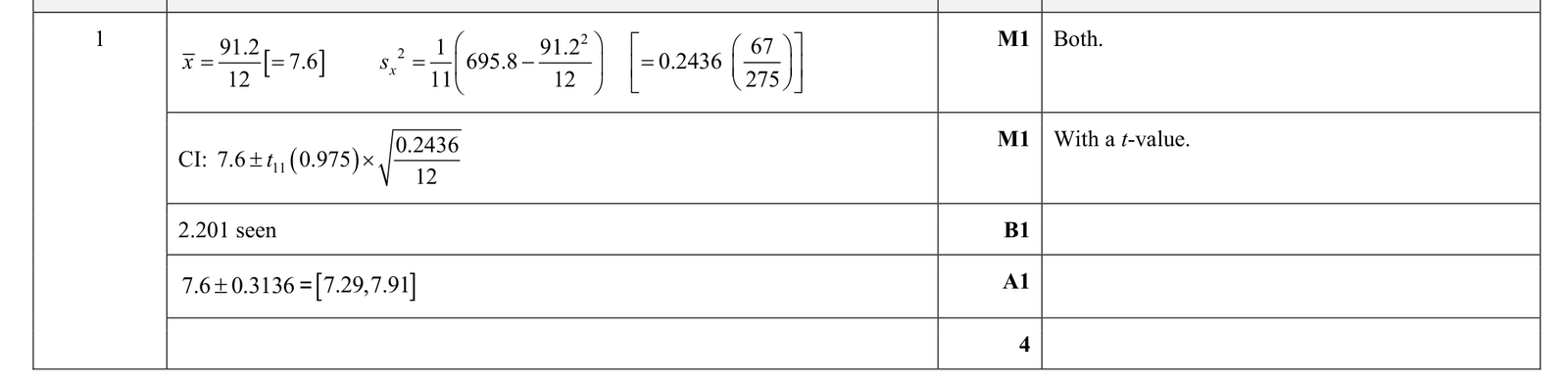
The lengths of the leaves of a particular type of tree are normally distributed with mean \(\mu \mathrm{cm}\). The lengths, \(x \mathrm{~cm}\), of a random sample of 12 leaves of this type are recorded. The results are summarised as follows.
\(\sum x=91.2 \quad \sum x^{2}=695.8\)
Find a \(95 \%\) confidence interval for \(\mu\).
9231 P43 - Jun 2023 - Q2 - 6 marks
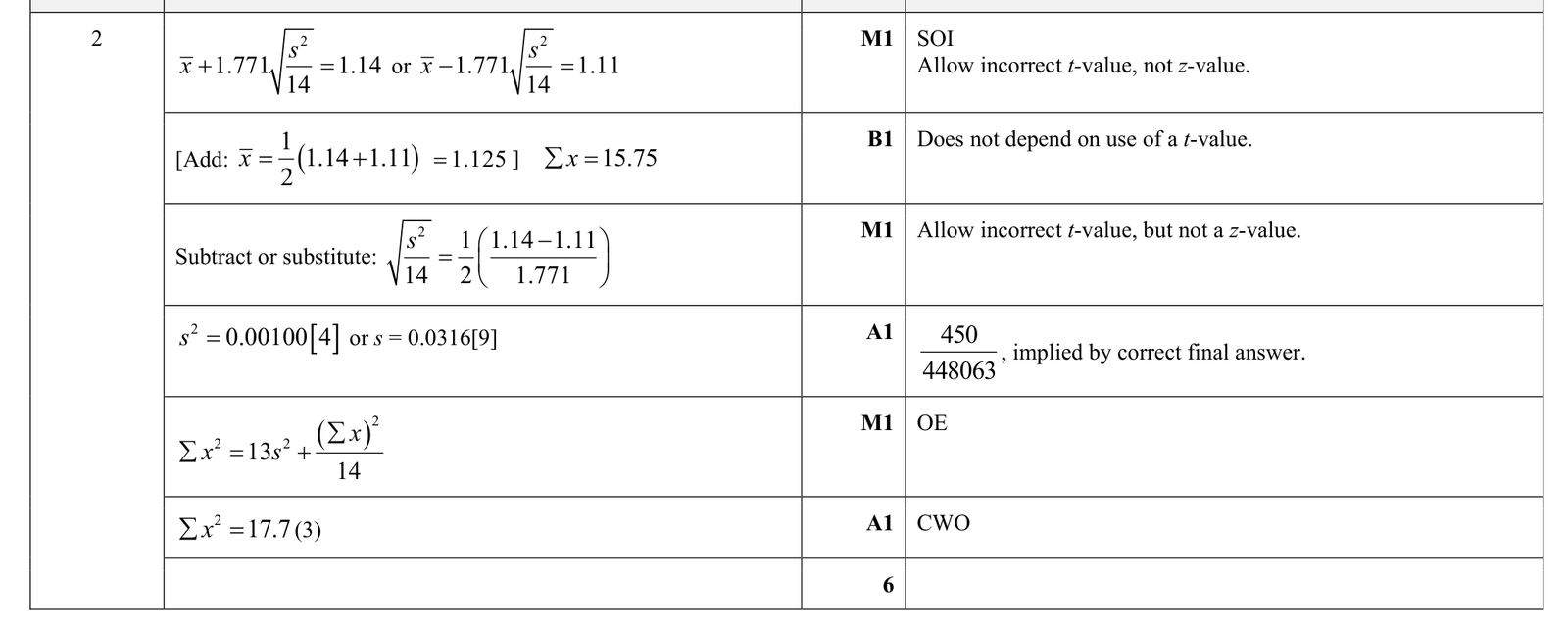
Shane is studying the lengths of the tails of male red kangaroos. He takes a random sample of 14 male red kangaroos and measures the length of the tail, \(x \mathrm{~m}\), for each kangaroo. He then calculates a \(90 \%\) confidence interval for the population mean tail length, \(\mu \mathrm{m}\), of male red kangaroos. He assumes that the tail lengths are normally distributed and finds that \(1.11 \leqslant \mu \leqslant 1.14\).
Find the values of \(\sum x\) and \(\sum x^{2}\) for this sample.
9231 P41 - Jun 2022 - Q5 - 9 marks
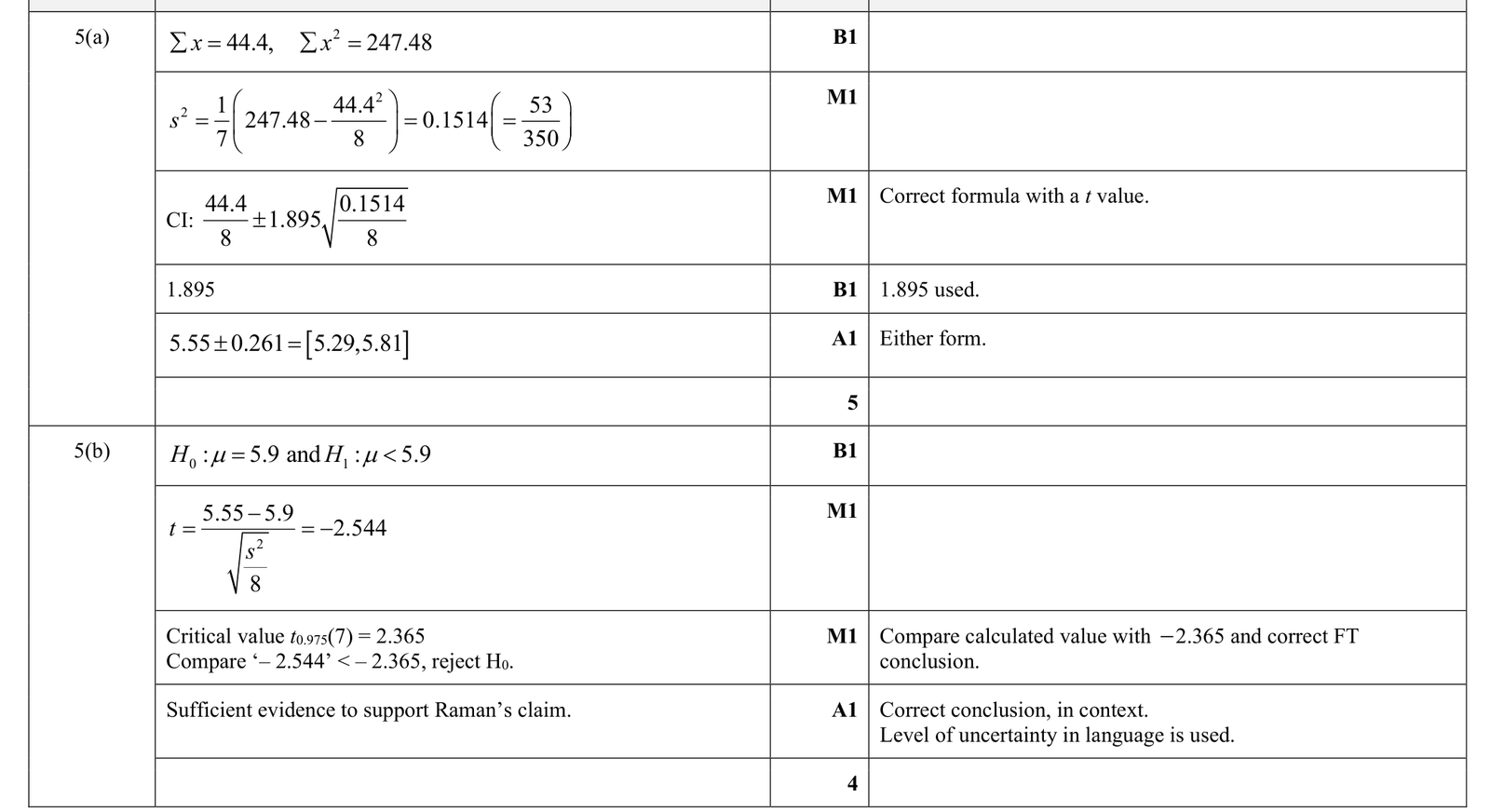
Raman is researching the heights of male giraffes in a particular region. Raman assumes that the heights of male giraffes in this region are normally distributed. He takes a random sample of 8 male giraffes from the region and measures the height, in metres, of each giraffe. These heights are as follows.
| 5.2 | 5.8 | 4.9 | 6.1 | 5.5 | 5.9 | 5.4 | 5.6 |
(a) Find a 90% confidence interval for the population mean height of male giraffes in this region.
Raman claims that the population mean height of male giraffes in the region is less than 5.9 metres.
(b) Test at the 2.5% significance level whether this sample provides sufficient evidence to support Raman's claim.
9231 P43 - Jun 2022 - Q1 - 4 marks
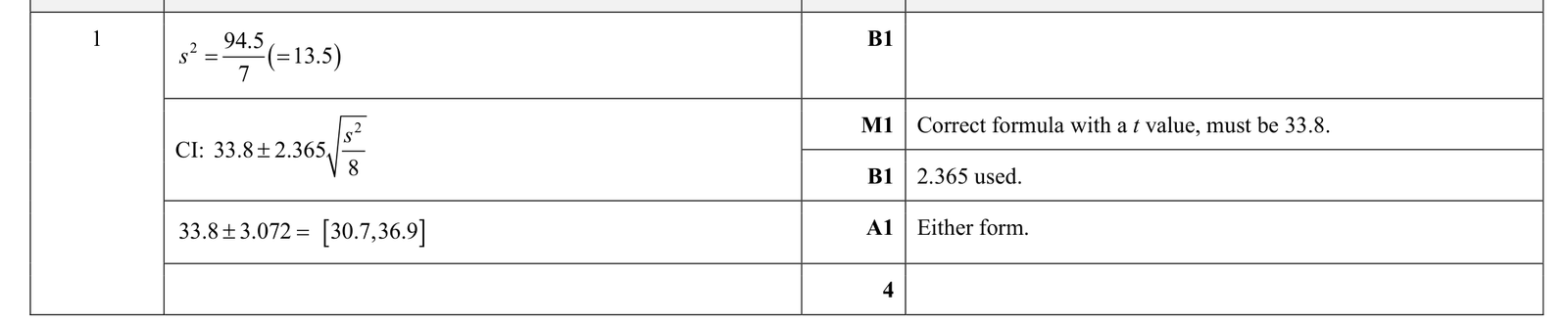
The times taken by members of a large quiz club to complete a challenge have a normal distribution with mean \(\mu\) minutes. The times, \(x\) minutes, are recorded for a random sample of 8 members of the club. The results are summarised as follows, where \(ar{x}\) is the sample mean.
\(ar{x}=33.8 \quad \sum(x-ar{x})^{2}=94.5\)
Find a 95% confidence interval for \(\mu\).
9231 P42 - Nov 2022 - Q1 - 6 marks
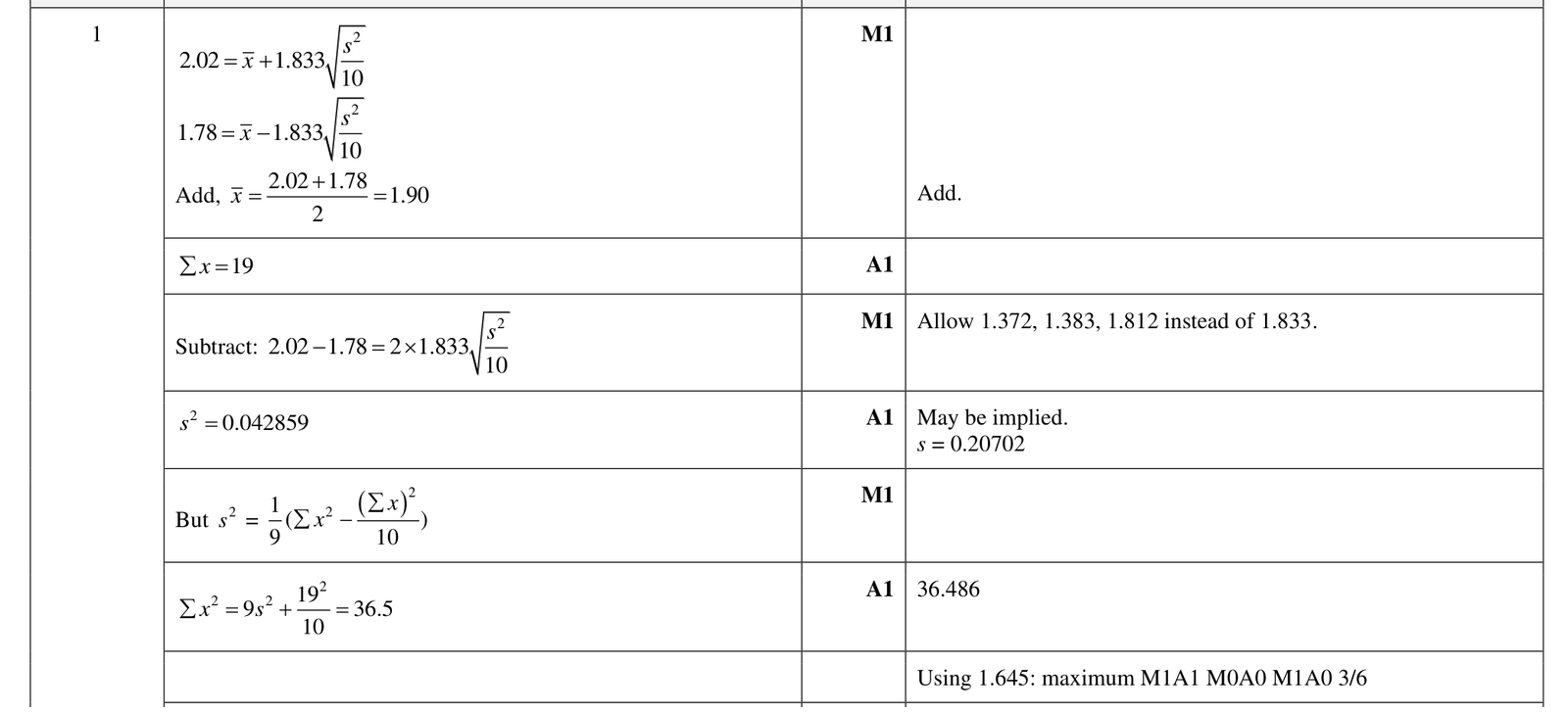
A basketball club has a large number of players. The heights, \(x\) m, of a random sample of 10 of these players are measured. A 90% confidence interval for the population mean height, \(\mu\) m, of players in this club is calculated. It is assumed that heights are normally distributed. The confidence interval is \(1.78 \leqslant \mu \leqslant 2.02\).
Find the values of \(\sum x\) and \(\sum x^2\) for this sample.
9231 P41 - Nov 2021 - Q1 - 7 marks
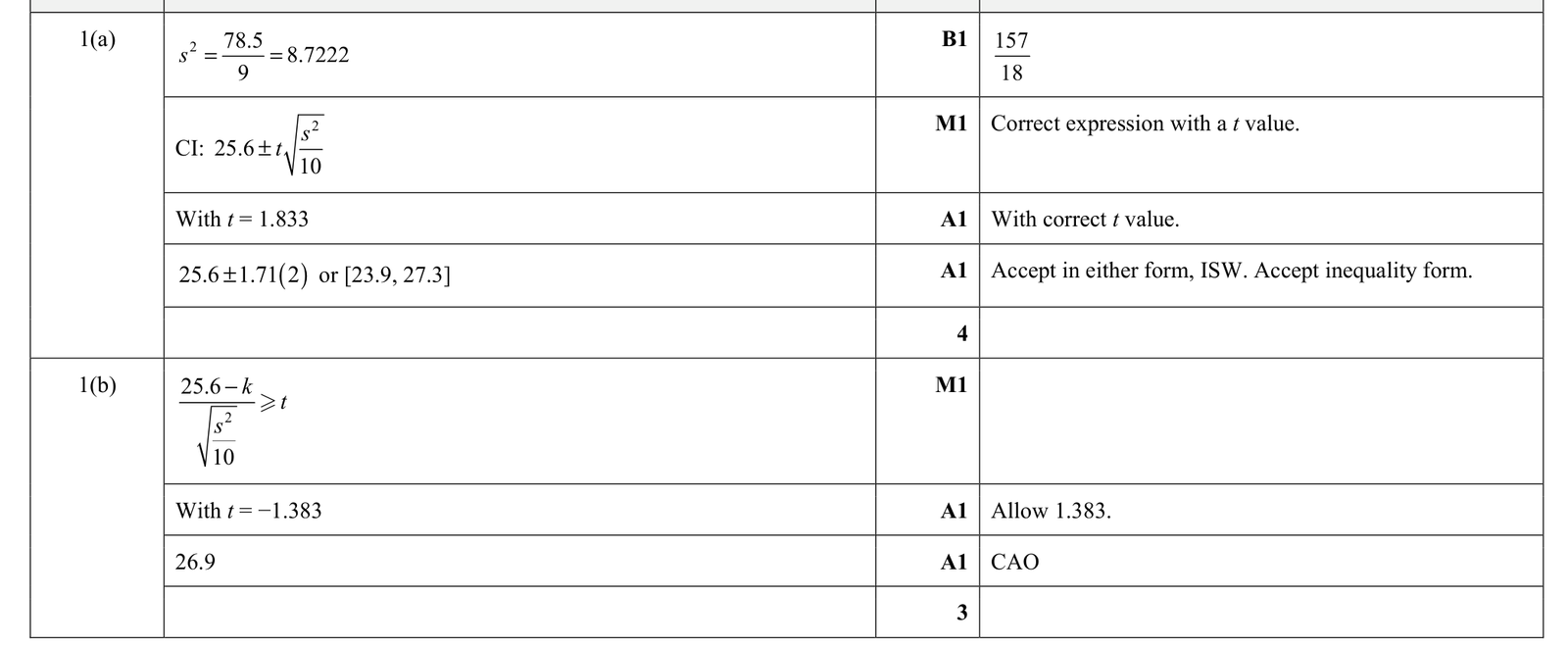
The times taken for students at a college to run 200 m have a normal distribution with mean \(\mu \mathrm{s}\). The times, \(x \mathrm{~s}\), are recorded for a random sample of 10 students from the college. The results are summarised as follows, where \(\bar{x}\) is the sample mean.
\(\bar{x}=25.6 \quad \sum(x-\bar{x})^{2}=78.5\)
(a) Find a 90\% confidence interval for \(\mu\).
A test of the null hypothesis \(\mu=k\) is carried out on this sample, using a \(10 \%\) significance level. The test does not support the alternative hypothesis \(\mu\lt k\).
(b) Find the greatest possible value of \(k\).
9231 P41 - Jun 2020 - Q5 - 10 marks
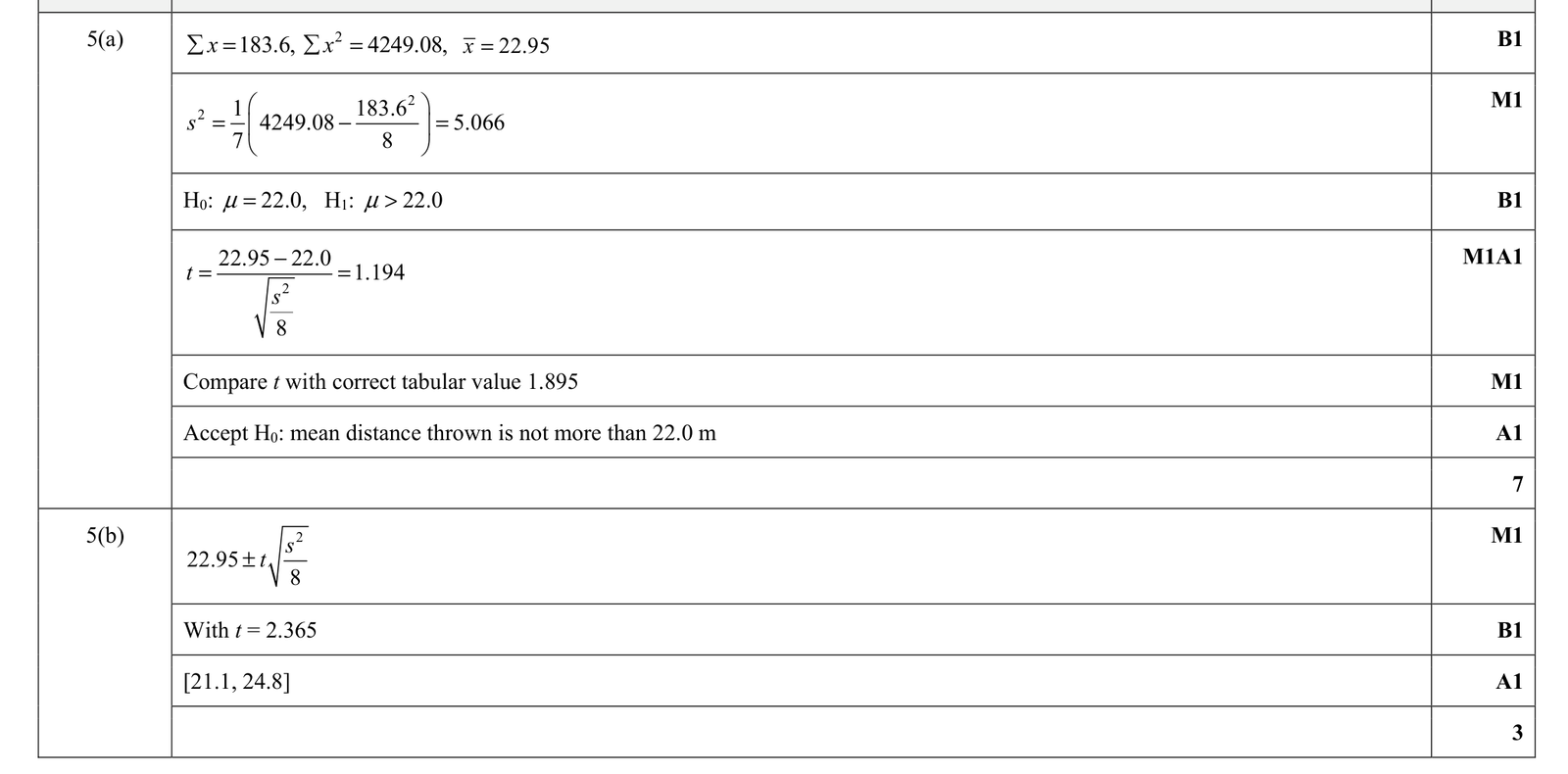
A large number of children are competing in a throwing competition. The distances, in metres, thrown by a random sample of 8 children are as follows.
| 19.8 | 22.1 | 24.4 | 21.5 | 20.8 | 26.3 | 23.7 | 25.0 |
(a) Assuming that distances are normally distributed, test, at the \(5 \%\) significance level, whether the population mean distance thrown is more than 22.0 metres.
(b) Find a 95% confidence interval for the population mean distance thrown.
9231 P42 - Nov 2020 - Q6 - 12 marks
Nassa is researching the lengths of a particular type of snake in two countries, \(A\) and \(B\).
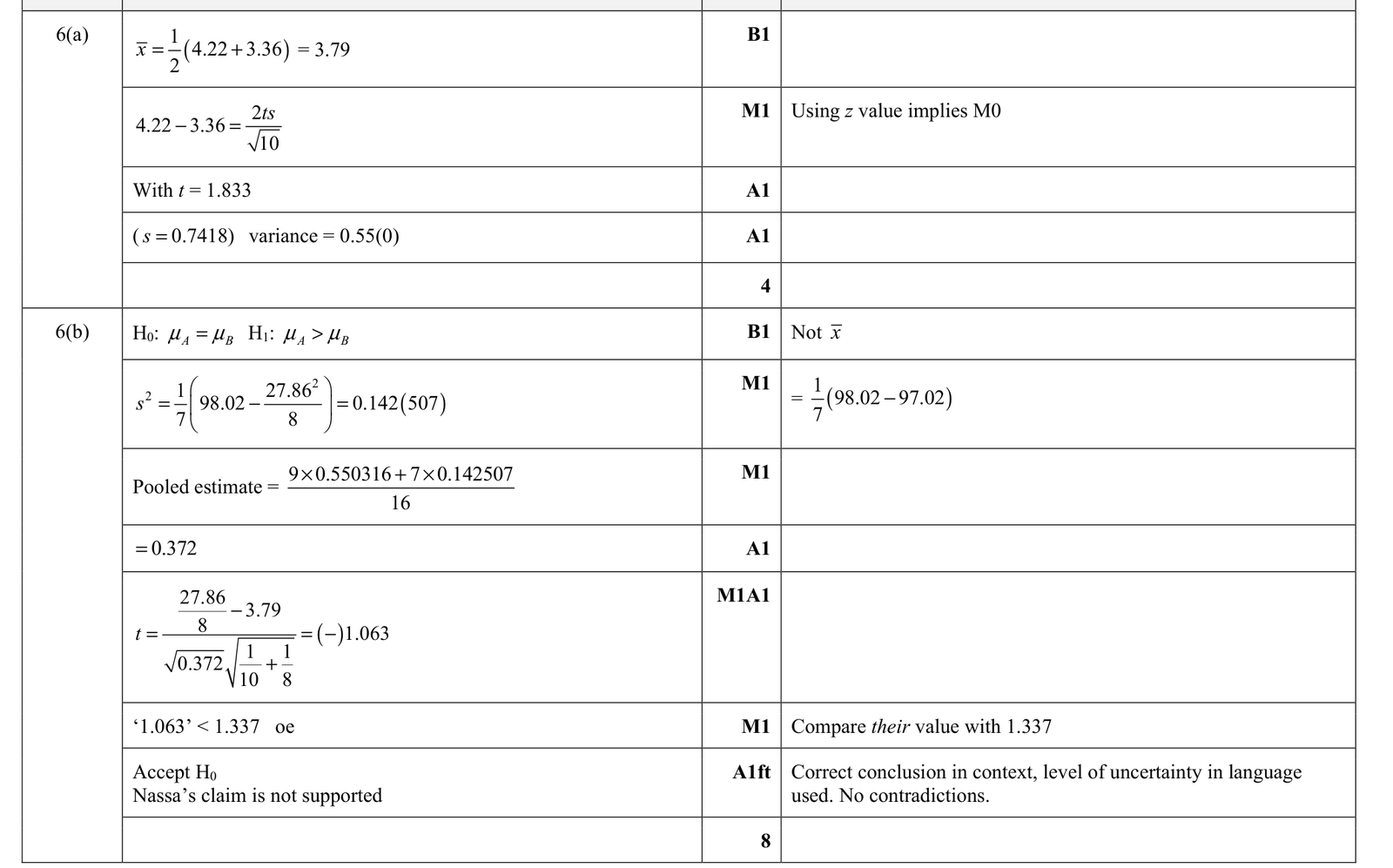
(a) He takes a random sample of 10 snakes of this type from country \(A\) and measures the length, \(x \mathrm{~m}\), of each snake. He then calculates a \(90 \%\) confidence interval for the population mean length, \(\mu \mathrm{m}\), for snakes of this type, assuming that snake lengths have a normal distribution. This confidence interval is \(3.36 \leqslant \mu \leqslant 4.22\).
Find the sample mean and an unbiased estimate for the population variance.
(b) Nassa also measures the lengths, \(y \mathrm{~m}\), of a random sample of 8 snakes of this type taken from country \(B\). His results are summarised as follows.
\(\sum y=27.86 \quad \sum y^{2}=98.02\)
Nassa claims that the mean length of snakes of this type in country \(B\) is less than the mean length of snakes of this type in country \(A\). Nassa assumes that his sample from country \(B\) also comes from a normal distribution, with the same variance as the distribution from country \(A\).
Test at the \(10 \%\) significance level whether there is evidence to support Nassa's claim.
9231 P42 - Nov 2024 - Q1 - 4 marks
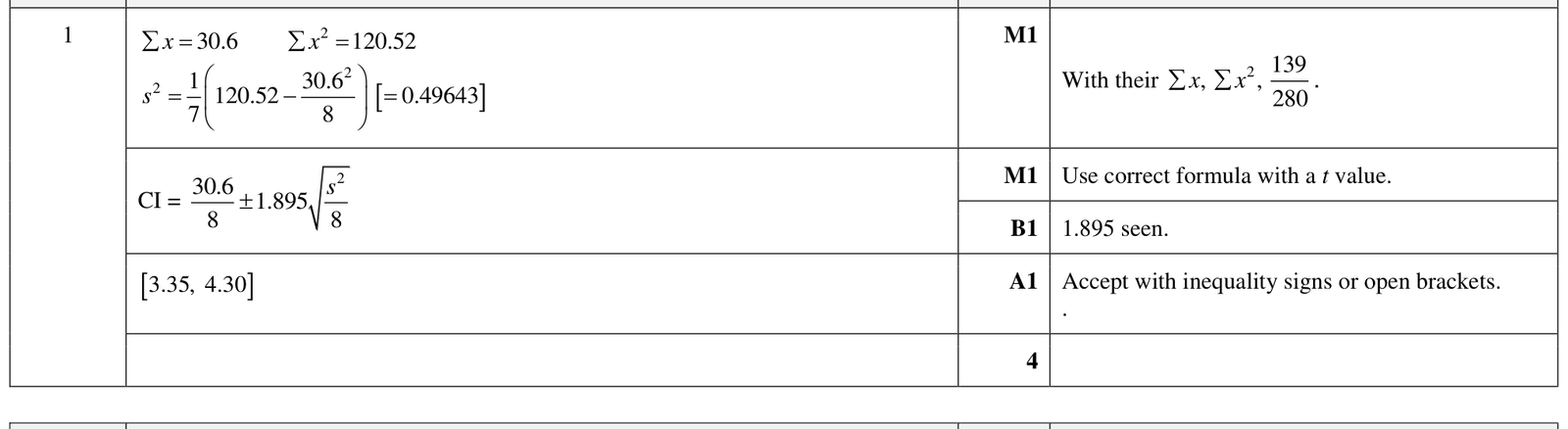
A scientist is investigating the lengths of the leaves of a certain type of plant. The scientist assumes that the lengths of the leaves of this type of plant are normally distributed. He measures the lengths, \(x \mathrm{~cm}\), of the leaves of a random sample of 8 plants of this type. His results are as follows.
| 3.5 | 4.2 | 3.8 | 5.2 | 2.9 | 3.7 | 4.1 | 3.2 |
Find a \(90 \%\) confidence interval for the population mean length of leaves of this type of plant.
9231 P44 - Jun 2025 - Q6 - 13 marks
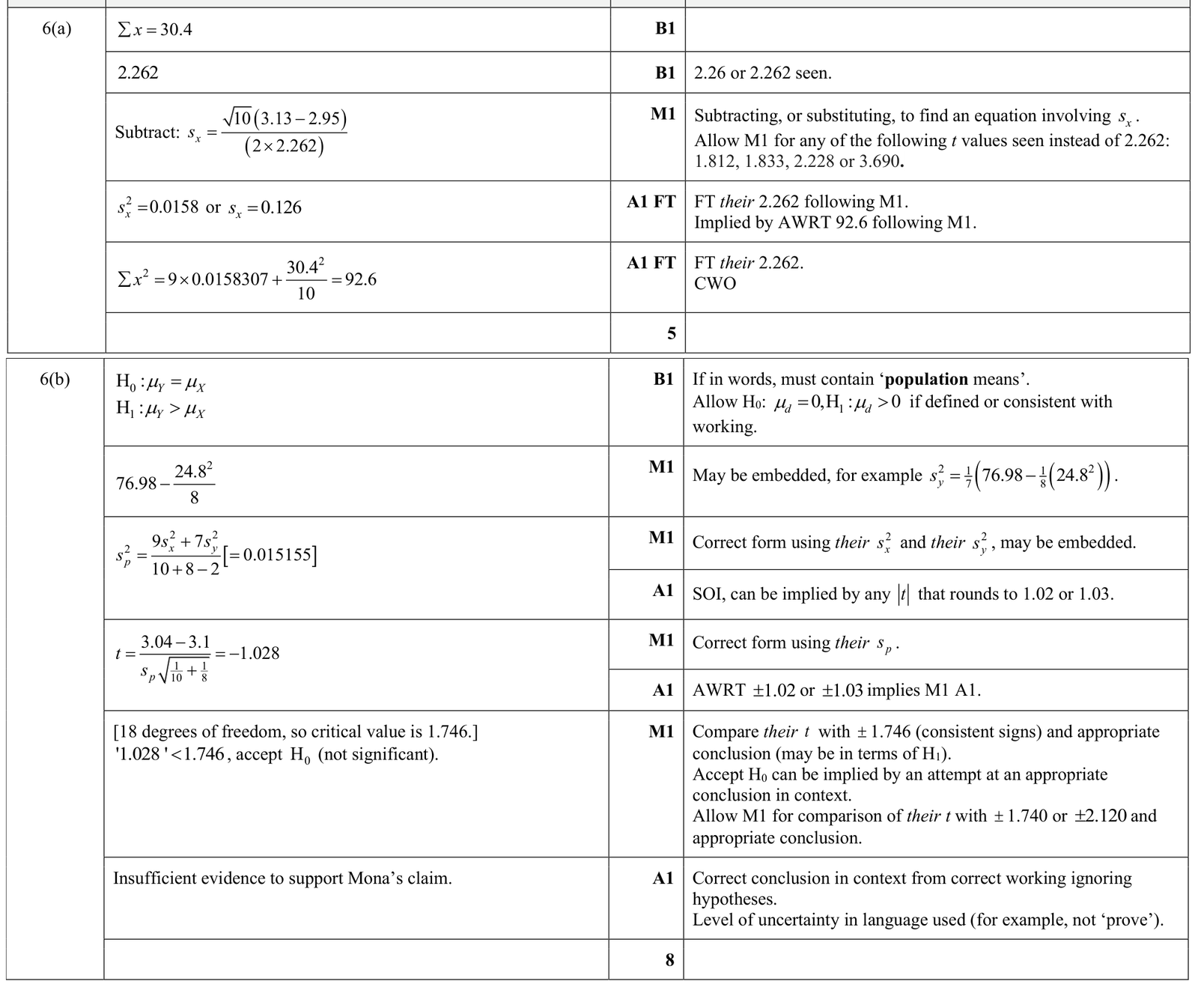
Lina and Mona are two statisticians who also write songs. The 'time' of a song is the number of minutes for which it lasts. For a random sample of 10 of her songs, Lina calculates a \(95 \%\) confidence interval for the population mean time, \(\mu\) minutes. This confidence interval is \(2.95 \leqslant \mu \leqslant 3.13\). The times, \(x\) minutes, of Lina's songs are normally distributed.
(a) Find the values of \(\sum x\) and \(\sum x^{2}\) for the 10 songs in Lina's sample.
Mona's songs have times, \(y\) minutes, that are normally distributed. The times for a random sample of 8 of Mona's songs are summarised as follows.
\(\sum y=24.8 \quad \sum y^{2}=76.98\)
Mona claims that the population mean time of her songs is greater than the population mean time of Lina's songs.
(b) Assuming that the two distributions have the same population variance, test at the \(5 \%\) significance level whether there is evidence to support Mona's claim.
9231 P23 - Jun 2017 - Q8 - 9 marks
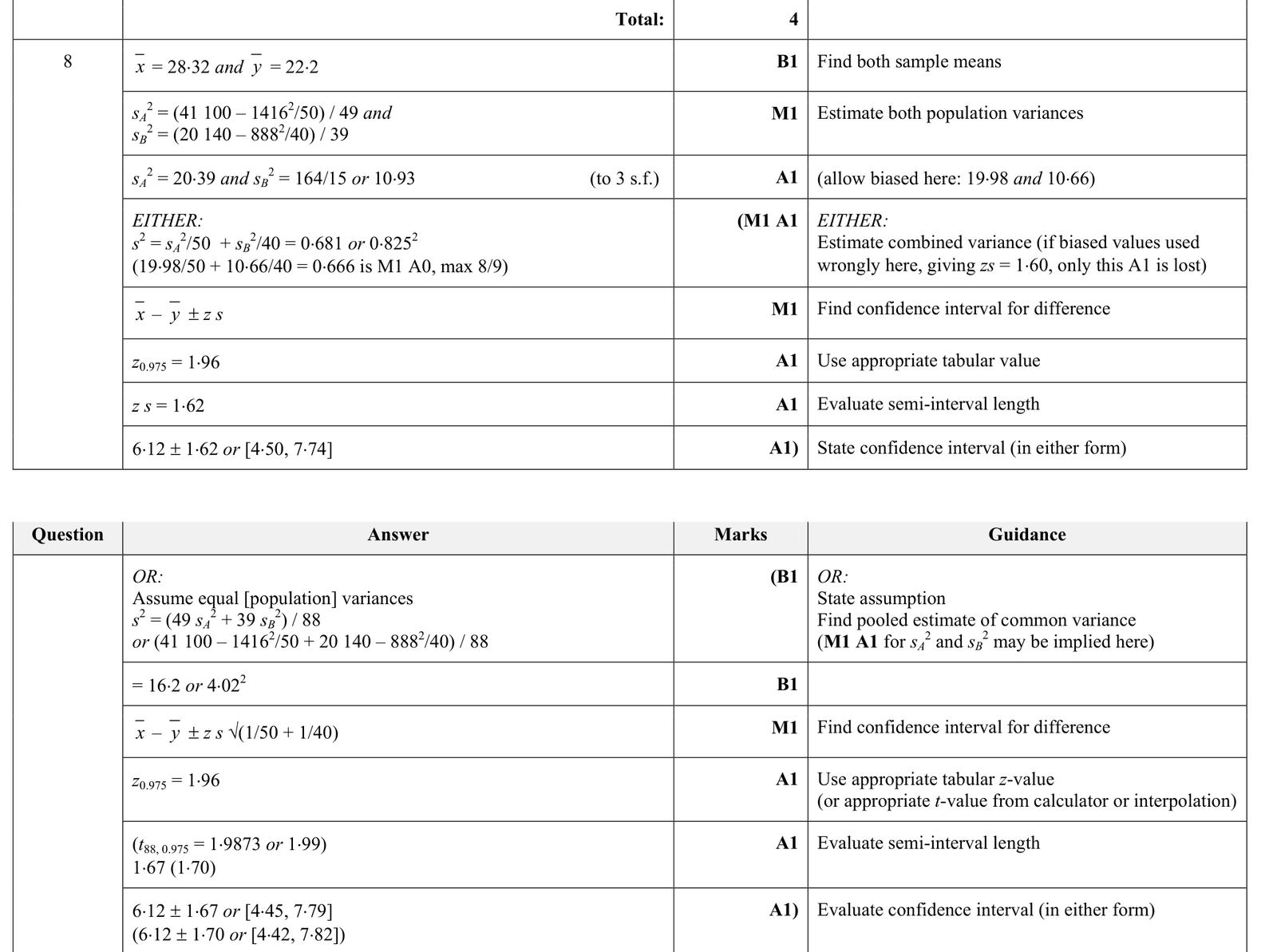
The number, \(x\), of beech trees was counted in each of 50 randomly chosen regions of equal size in beech forests in country \(A\). The number, \(y\), of beech trees was counted in each of 40 randomly chosen regions of the same equal size in beech forests in country \(B\). The results are summarised as follows.
\[\Sigma x=1416 \quad \Sigma x^{2}=41100 \quad \Sigma y=888 \quad \Sigma y^{2}=20140\]
Find a 95\% confidence interval for the difference between the mean number of beech trees in regions of this size in country \(A\) and in country \(B\).
9231 P41 - Jun 2025 - Q4 - 7 marks
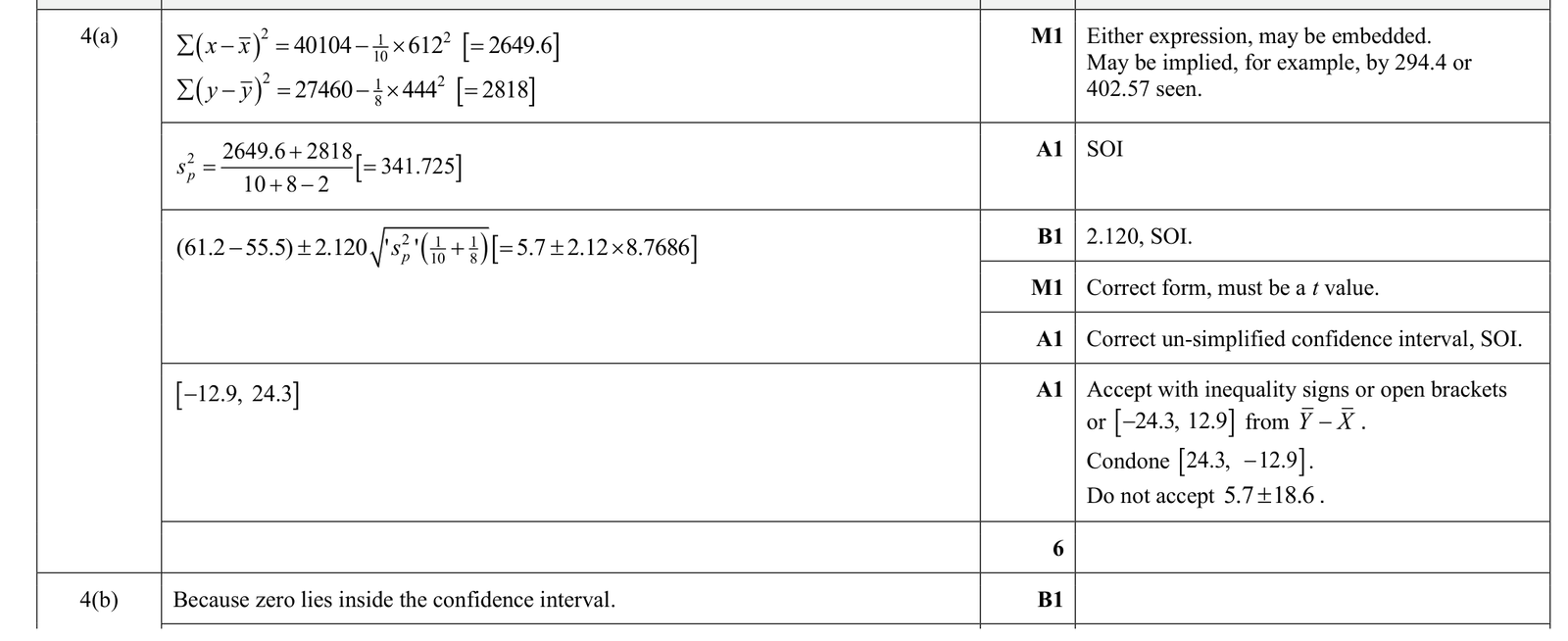
A researcher is interested in whether there is a difference between two schools in students' aptitude for English. She randomly chooses 10 students from school \(X\) and 8 students of a similar age from school \(Y\) to take a written English test. The scores for the students from school \(X(x)\) and school \(Y(y)\) are summarised as follows.
\(\sum x=612 \quad \sum x^{2}=40104 \quad \sum y=444 \quad \sum y^{2}=27460\)
You should assume that the two distributions are normal and have the same population variance.
(a) Find a 95\% confidence interval for the difference in the mean scores for students from school \(X\) and students from school \(Y\) in the written English test.
(b) Use the confidence interval you found in part (a) to explain why there is insufficient evidence at a 5\% significance level to suggest that the English scores of students from school \(X\) and students from school \(Y\) are different.
9231 P43 - Jun 2025 - Q2 - 7 marks
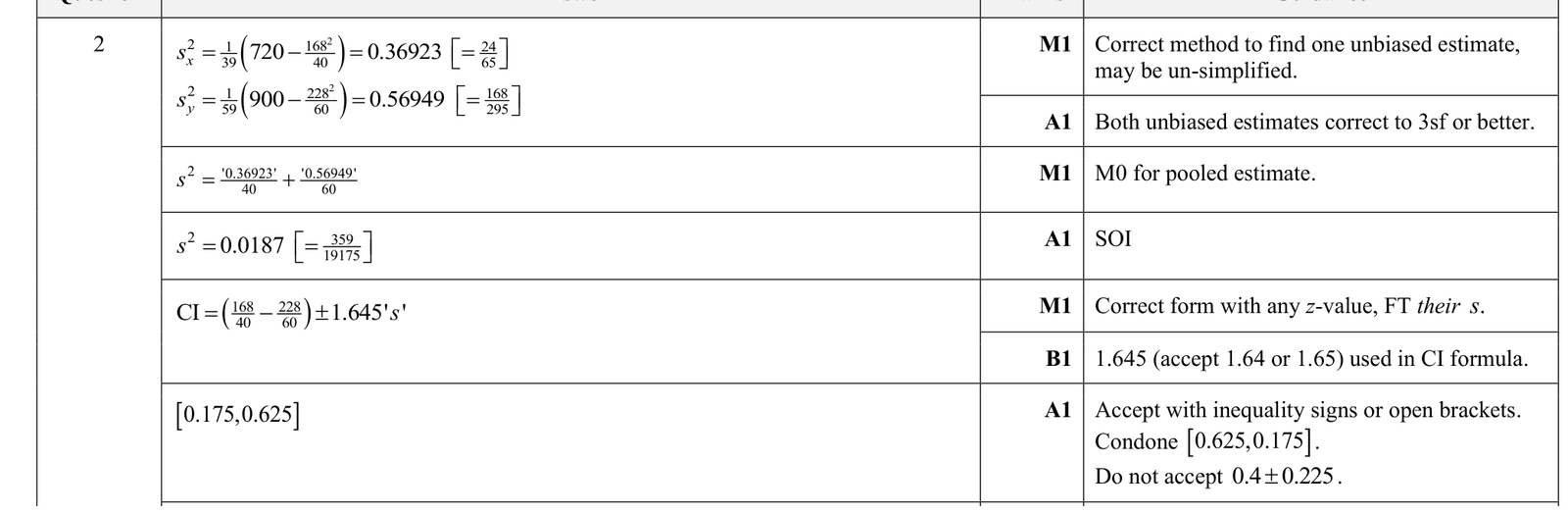
A farmer is investigating whether using a new fertiliser will increase the yield of tomato plants. The farmer selects 40 tomato plants at random and gives them the new fertiliser. The crop mass, \(x \mathrm{~kg}\), of each of these 40 plants is recorded. The farmer selects a further 60 tomato plants at random and gives them a standard fertiliser. The crop mass, \(y \mathrm{~kg}\), of each of these 60 plants is recorded. The results are summarised as follows.
\(\sum x=168 \quad \sum x^{2}=720 \quad \sum y=228 \quad \sum y^{2}=900\)
Find a \(90 \%\) confidence interval for the difference in mean crop mass associated with each type of fertiliser.
9231 P43 - Jun 2024 - Q6 - 10 marks
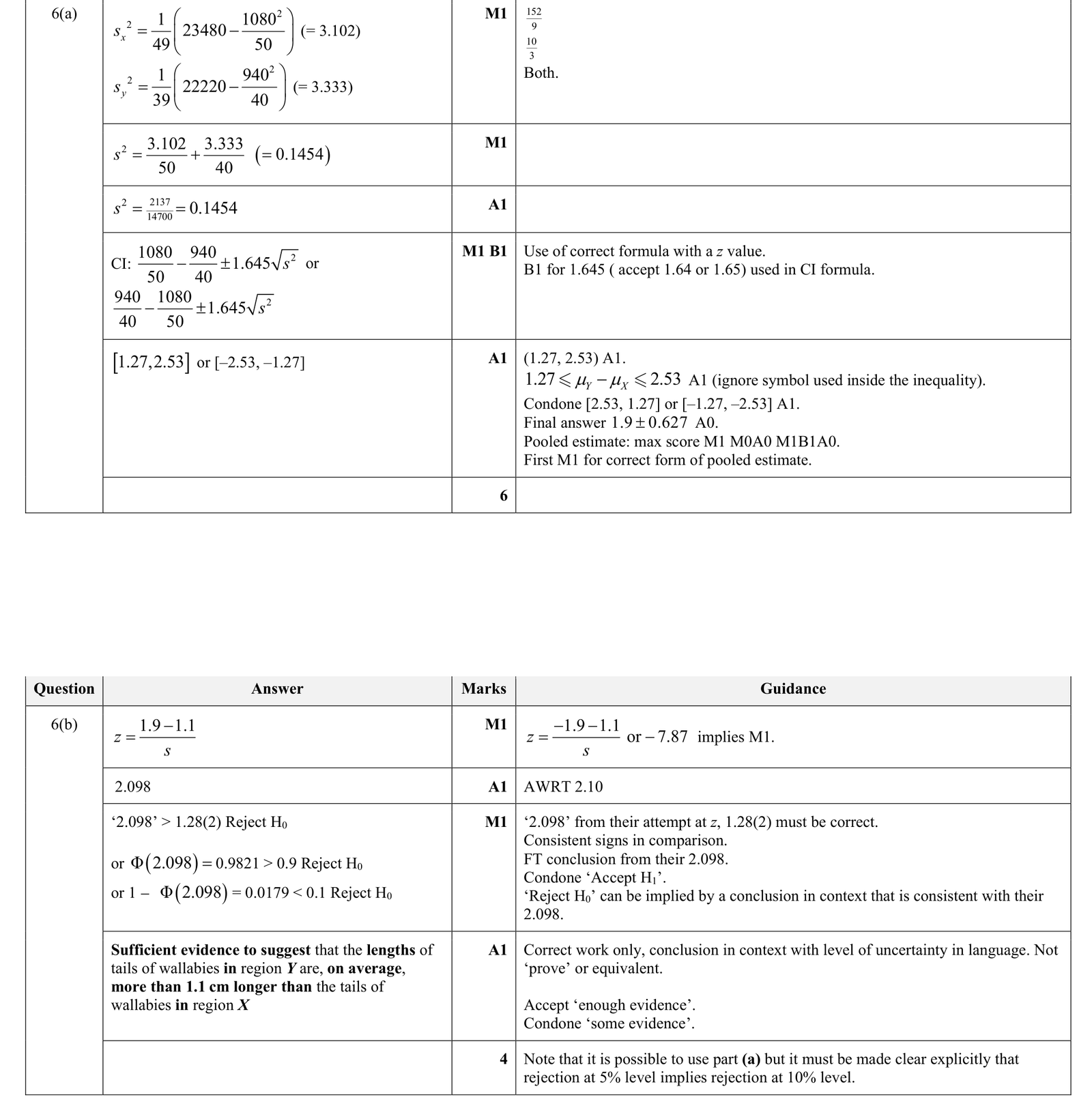
Seva is investigating the lengths of the tails of adult wallabies in two regions of Australia, \(X\) and \(Y\). He chooses a random sample of 50 adult wallabies from region \(X\) and records the lengths, \(x \mathrm{~cm}\), of their tails. He also chooses a random sample of 40 adult wallabies from region \(Y\) and records the lengths, \(y \mathrm{~cm}\), of their tails. His results are summarised as follows.
\(\sum x=1080 \quad \sum x^{2}=23480 \quad \sum y=940 \quad \sum y^{2}=22220\)
It cannot be assumed that the population variances of the two distributions are the same.
(a) Find a \(90 \%\) confidence interval for the difference between the population mean lengths of the tails of adult wallabies in regions \(X\) and \(Y\).
The population mean lengths of the tails of adult wallabies in regions \(X\) and \(Y\) are \(\mu_{X} \mathrm{~cm}\) and \(\mu_{Y} \mathrm{~cm}\) respectively.
(b) Test, at the \(10 \%\) significance level, the null hypothesis \(\mu_{Y}-\mu_{X}=1.1\) against the alternative hypothesis \(\mu_{Y}-\mu_{X}\gt 1.1\). State your conclusion in the context of the question.
9231 P42 - Nov 2023 - Q1 - 6 marks
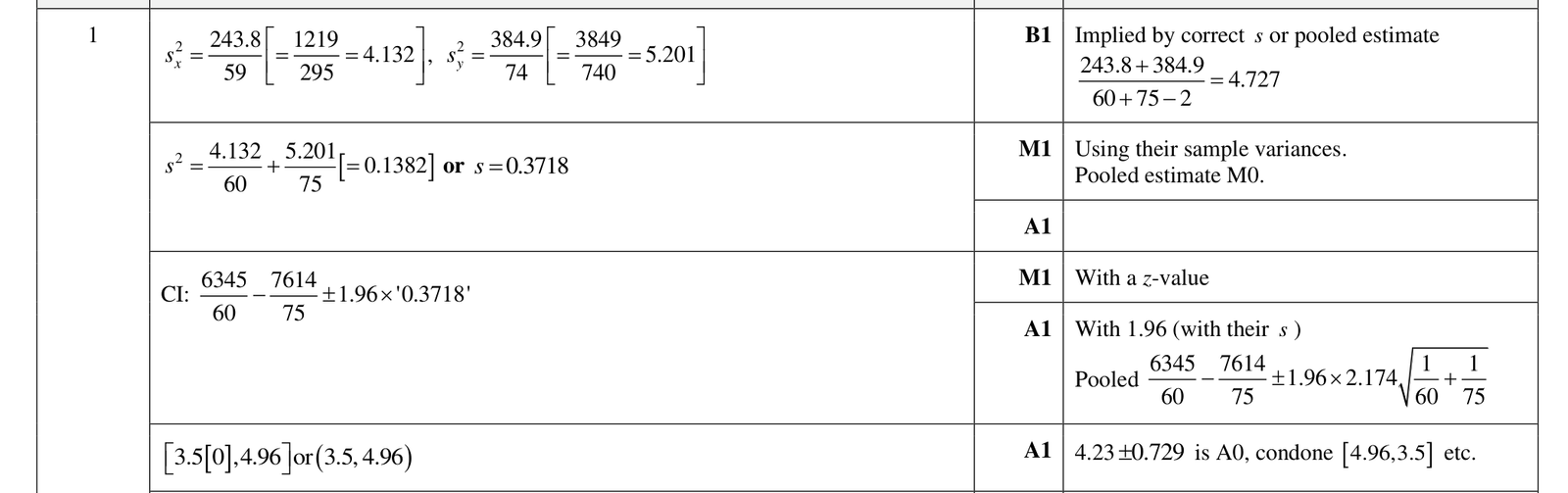
A factory produces small bottles of natural spring water. Two different machines, \(X\) and \(Y\), are used to fill empty bottles with the water. A quality control engineer checks the volumes of water in the bottles filled by each of the machines. He chooses a random sample of 60 bottles filled by machine \(X\) and a random sample of 75 bottles filled by machine \(Y\). The volumes of water, \(x\) and \(y\) respectively, in millilitres, are summarised as follows.
\(\sum x=6345 \quad \sum(x-\bar{x})^{2}=243.8 \quad \sum y=7614 \quad \sum(y-\bar{y})^{2}=384.9\)
\(\bar{x}\) and \(\bar{y}\) are the sample means of the volume of water in the bottles filled by machines \(X\) and \(Y\) respectively.
Find a \(95 \%\) confidence interval for the difference between the mean volume of water in bottles filled by machine \(X\) and the mean volume of water in bottles filled by machine \(Y\).