Past Exam Questions
← Back9231 P41 - Nov 2022 - Q1 - 7 marks
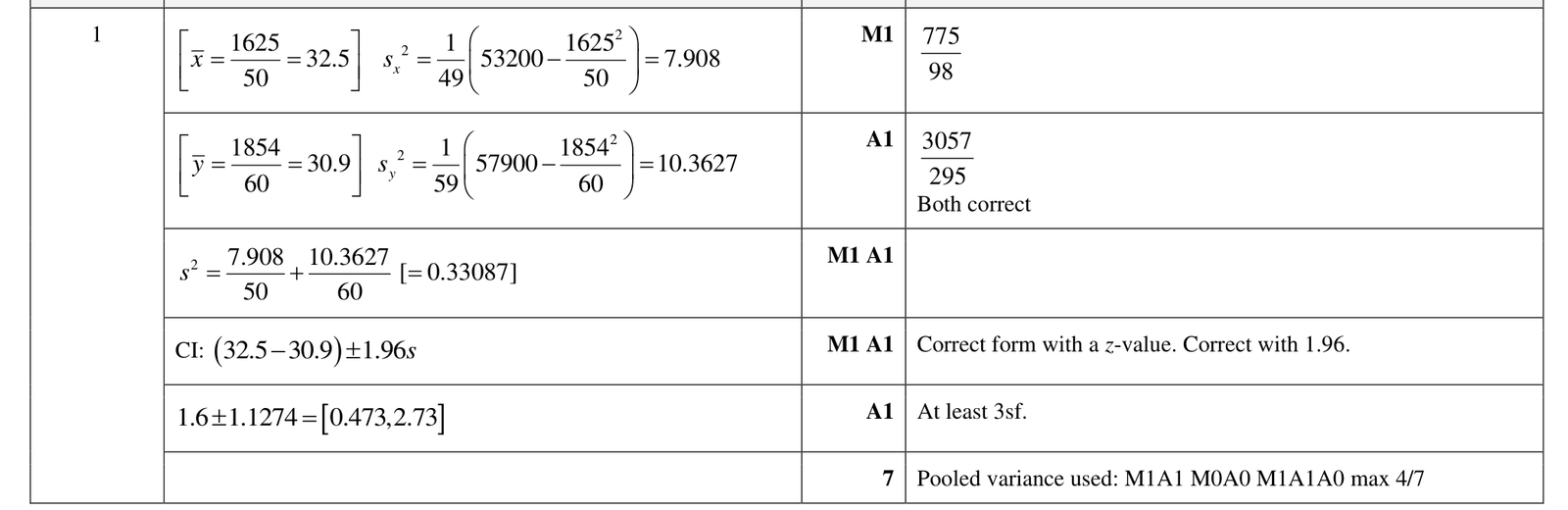
A scientist is investigating the heights of pine trees in two regions, \(A\) and \(B\). She takes a random sample of 50 pine trees in region \(A\) and records their heights, \(x\) m. She takes a random sample of 60 pine trees in region \(B\) and records their heights, \(y\) m. Her results are summarised as follows.
\(\sum x=1625 \quad \sum x^{2}=53200 \quad \sum y=1854 \quad \sum y^{2}=57900\)
Find a 95% confidence interval for the difference between the population mean heights of pine trees in regions \(A\) and \(B\).
9231 P43 - Jun 2021 - Q3 - 8 marks
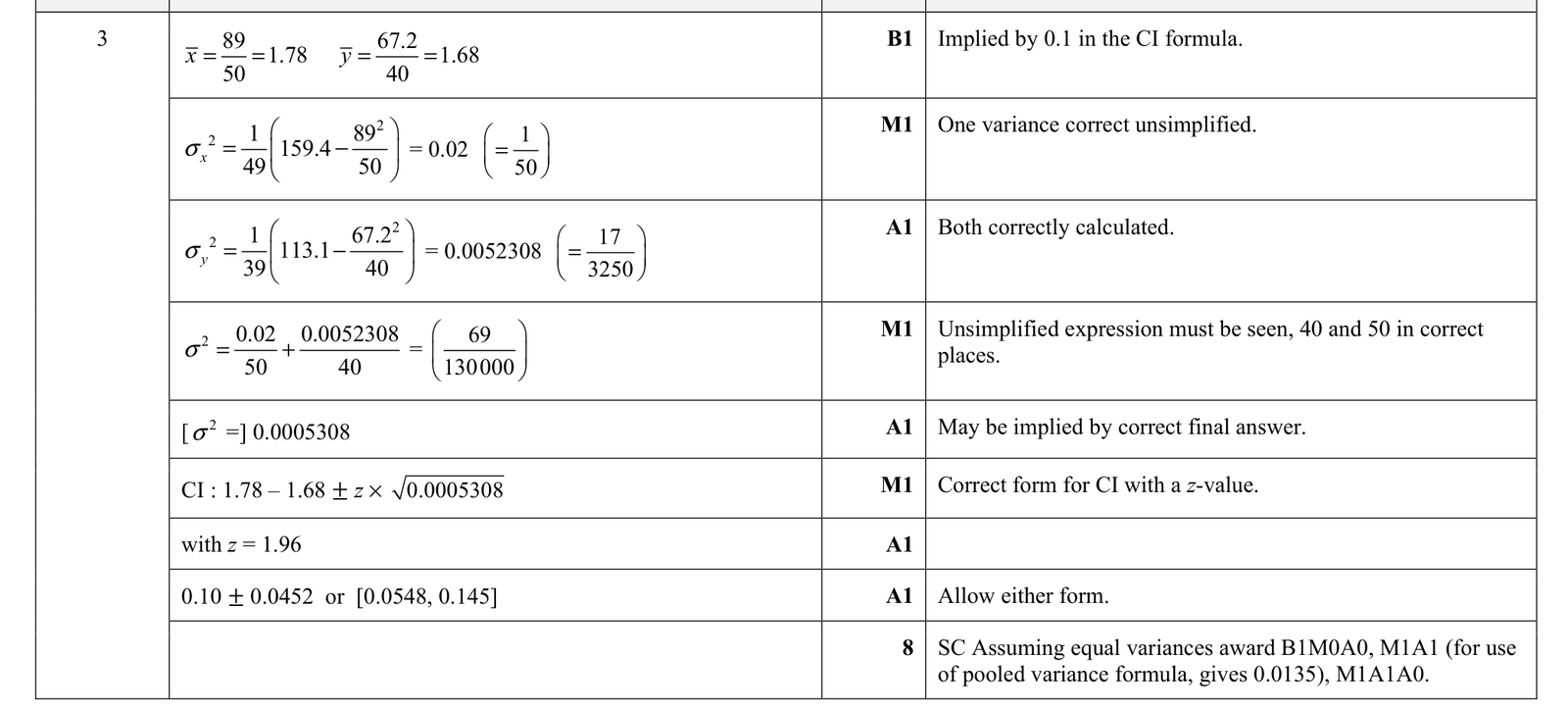
The heights, \(x \mathrm{~m}\), of a random sample of 50 adult males from country \(A\) were recorded. The heights, \(y \mathrm{~m}\), of a random sample of 40 adult males from country \(B\) were also recorded. The results are summarised as follows.
\(\sum x=89.0 \quad \sum x^{2}=159.4 \quad \sum y=67.2 \quad \sum y^{2}=113.1\)
Find a \(95 \%\) confidence interval for the difference between the mean heights of adult males from country \(A\) and adult males from country \(B\).
9231 P42 - Nov 2021 - Q1 - 7 marks
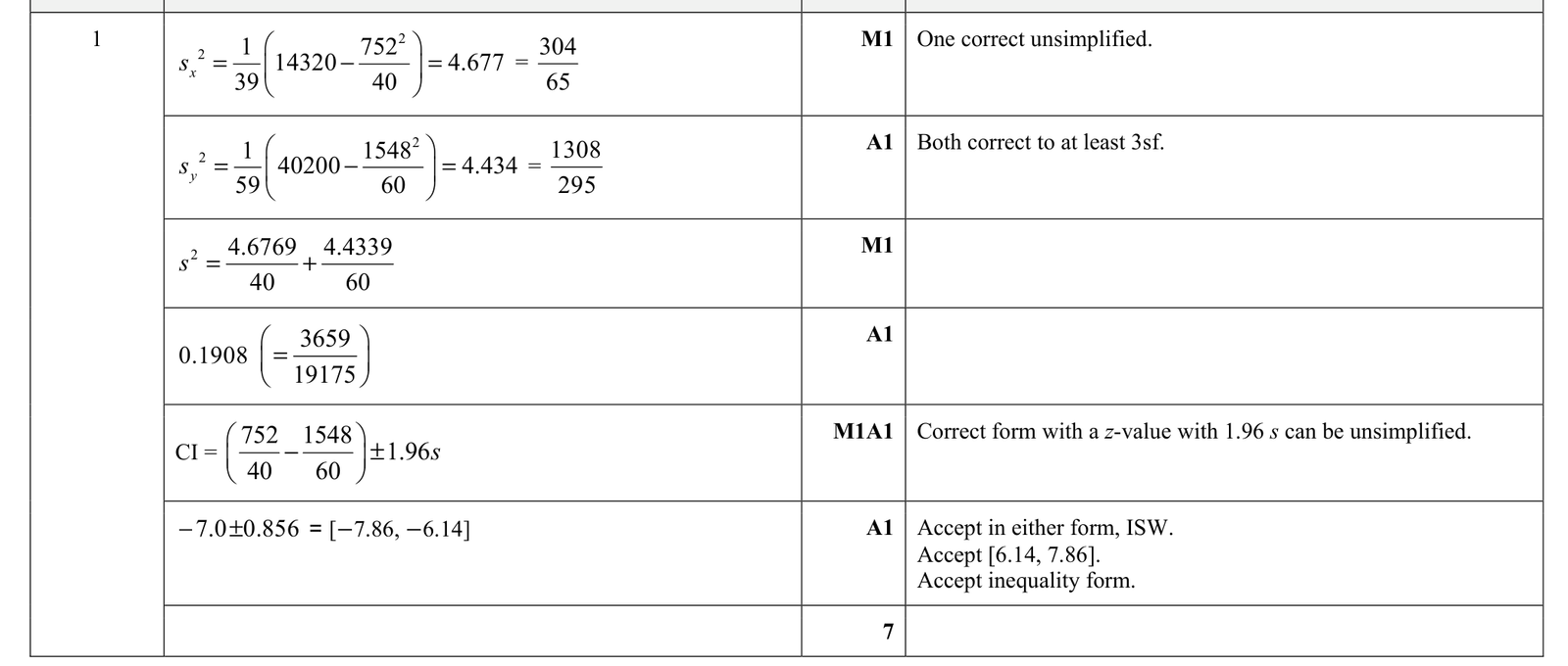
The number, \(x\), of pine trees was counted in each of 40 randomly chosen regions of equal size in country \(A\). The number, \(y\), of pine trees was counted in each of 60 randomly chosen regions of the same equal size in country \(B\). The results are summarised as follows.
\(\sum x=752 \quad \sum x^{2}=14320 \quad \sum y=1548 \quad \sum y^{2}=40200\)
Find a \(95 \%\) confidence interval for the difference between the mean number of pine trees in regions of this size in countries \(A\) and \(B\).
9231 P43 - Jun 2020 - Q2 - 5 marks
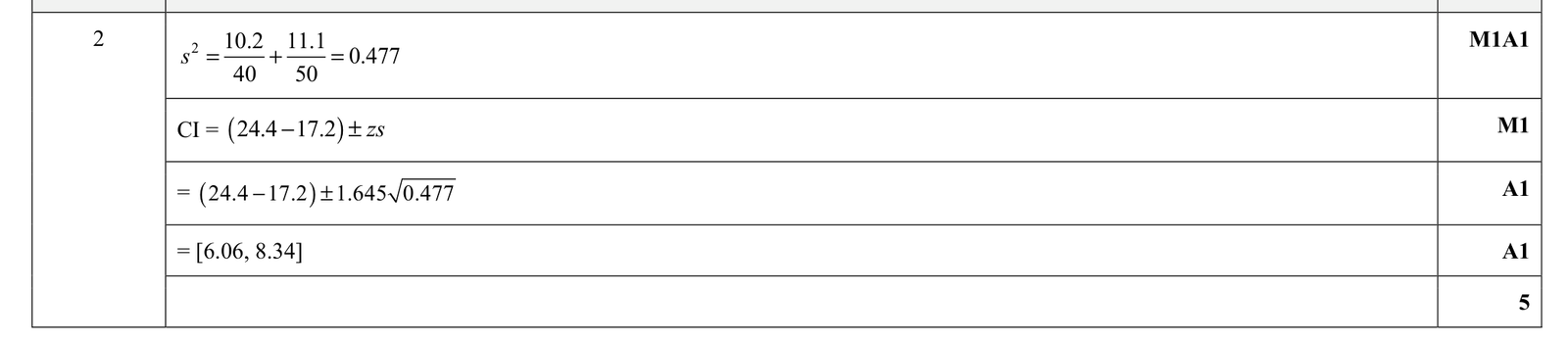
A random sample of 40 observations of a random variable \(X\) and a random sample of 50 observations of a random variable \(Y\) are taken. The resulting values for the sample means, \(\bar{x}\) and \(\bar{y}\), and the unbiased estimates, \(s_{x}^{2}\) and \(s_{y}^{2}\), for the population variances are as follows.
\(\bar{x}=24.4 \quad \bar{y}=17.2 \quad s_{x}^{2}=10.2 \quad s_{y}^{2}=11.1\)
Find a \(90 \%\) confidence interval for the difference between the population means of \(X\) and \(Y\).
9231 P41 - Nov 2020 - Q1 - 7 marks
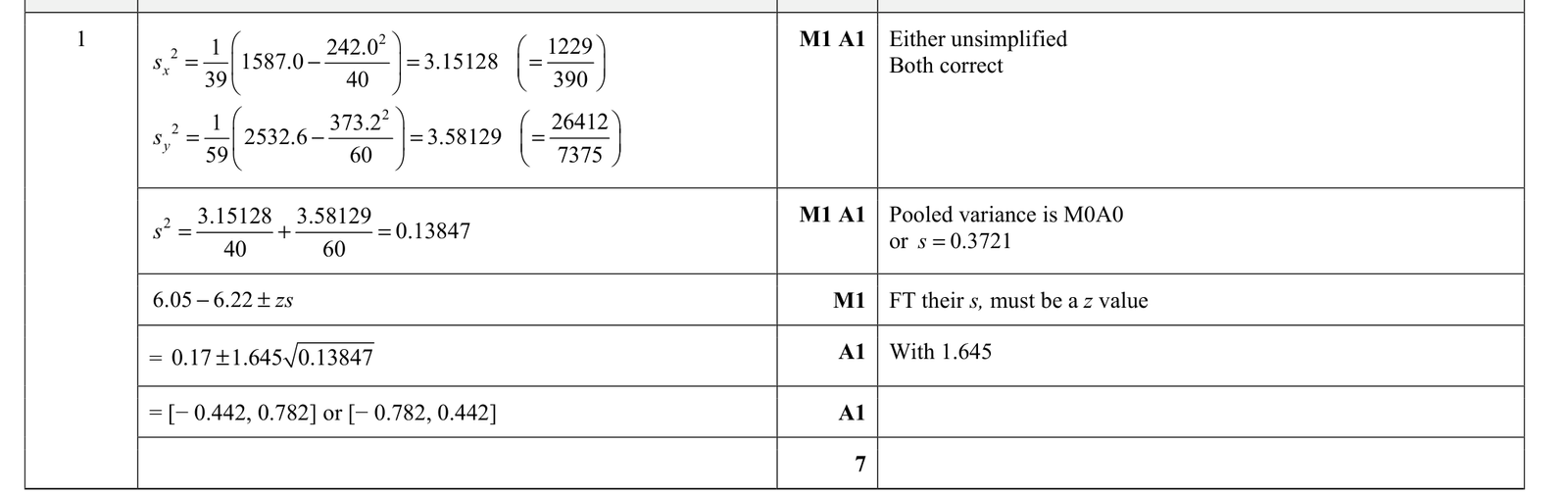
Kayla is investigating the lengths of the leaves of a certain type of tree found in two forests \(X\) and \(Y\). She chooses a random sample of 40 leaves of this type from forest \(X\) and records their lengths, \(x \mathrm{~cm}\). She also records the lengths, \(y \mathrm{~cm}\), for a random sample of 60 leaves of this type from forest \(Y\). Her results are summarised as follows.
\(\sum x=242.0 \quad \sum x^{2}=1587.0 \quad \sum y=373.2 \quad \sum y^{2}=2532.6\)
Find a \(90 \%\) confidence interval for the difference between the population mean lengths of leaves in forests \(X\) and \(Y\).
9231 P41 - Nov 2024 - Q1 - 6 marks
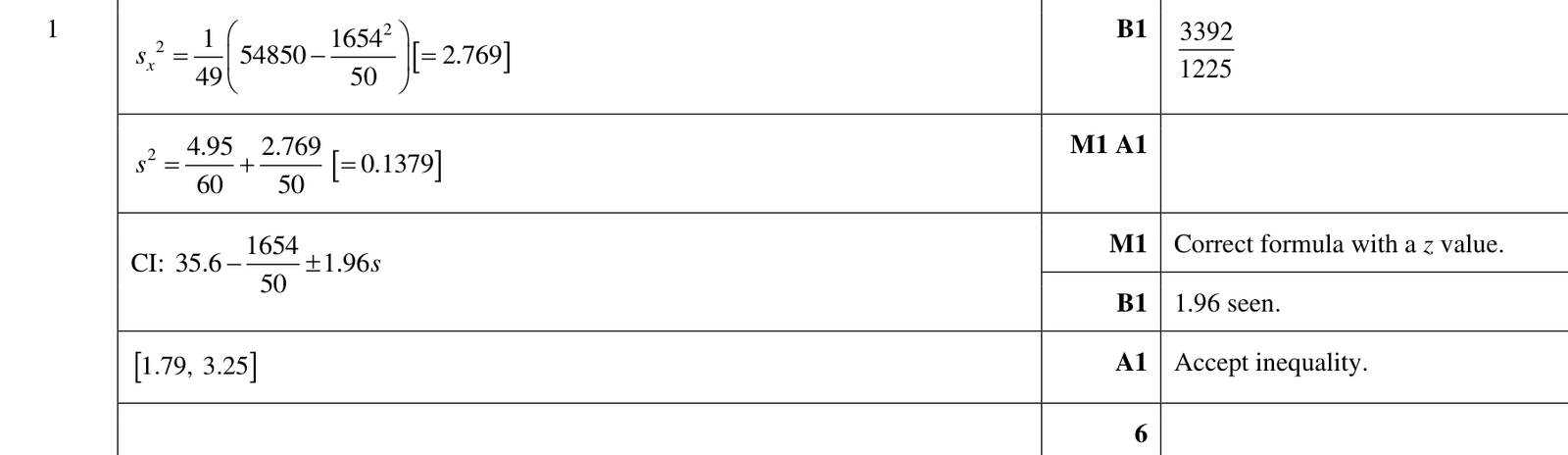
Ellie is investigating the heights of two types of beech tree, \(A\) and \(B\), in a certain region. She has chosen a random sample of 60 beech trees of type \(A\) in the region, recorded their heights, \(x \mathrm{~m}\), and calculated unbiased estimates for the population mean and population variance as 35.6 m and \(4.95 \mathrm{~m}^{2}\) respectively.
Ellie also chooses a random sample of 50 beech trees of type \(B\) in the region and records their heights, \(y \mathrm{~m}\). Her results are summarised as follows.
\(\sum y=1654 \quad \sum y^{2}=54850\)
Find a \(95 \%\) confidence interval for the difference between the population mean heights of type \(A\) and type \(B\) beech trees in the region.
0606 P22 - Nov 2023 - Q3 - 4 marks
Do not use a calculator in this question.
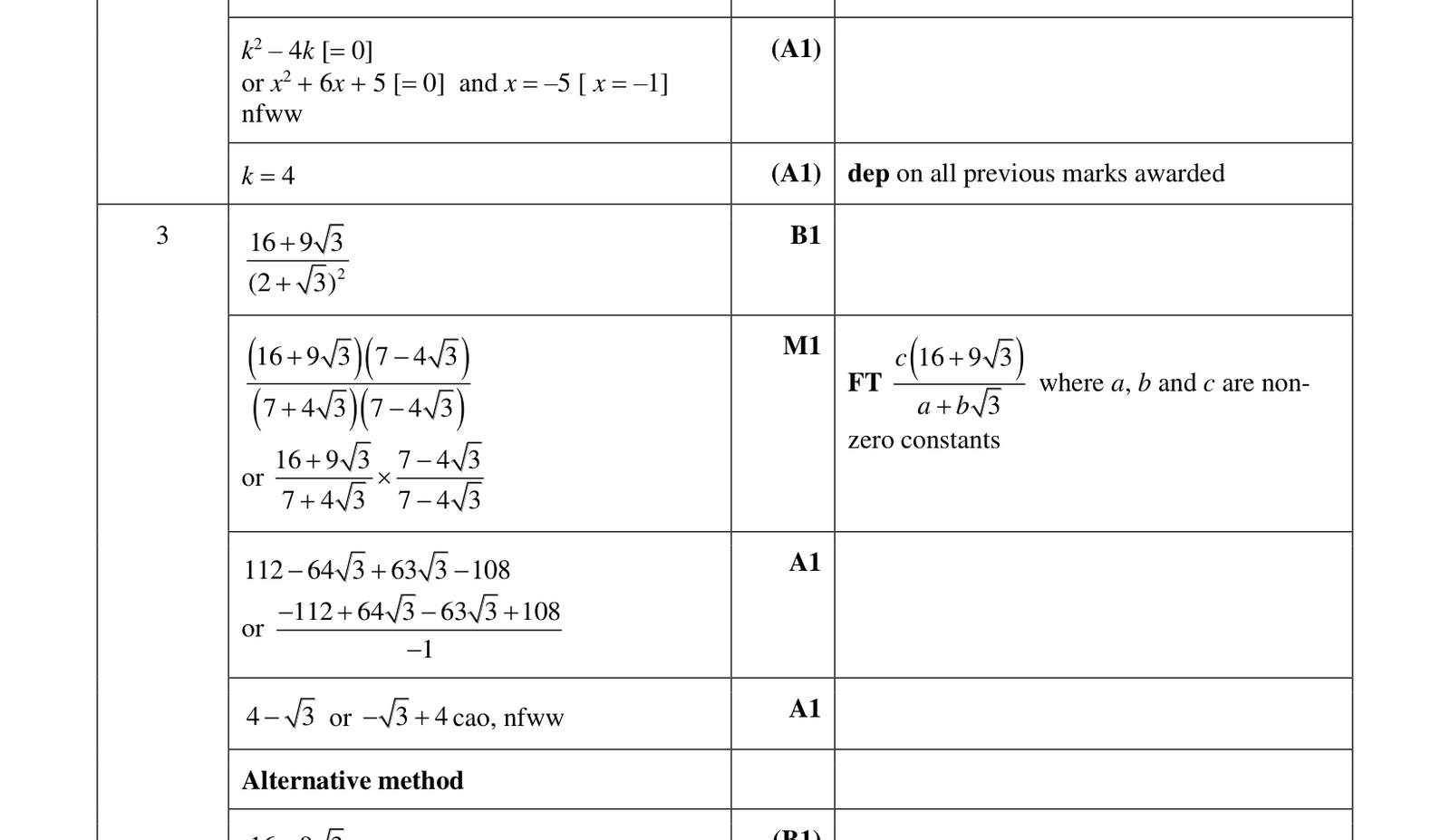
A cylinder has base radius \((2+\sqrt3)\text{ m}\) and volume \(\pi(16+9\sqrt3)\text{ m}^3\). Find the exact value of its height, giving your answer in its simplest form.
0606 P12 - Mar 2021 - Q7 - 9 marks
Do not use a calculator in this question.
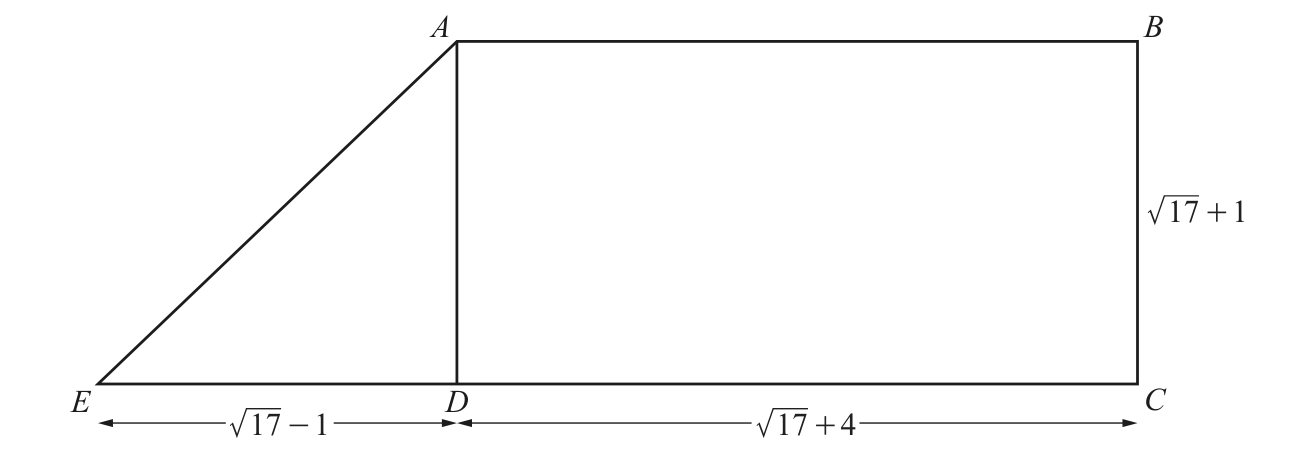
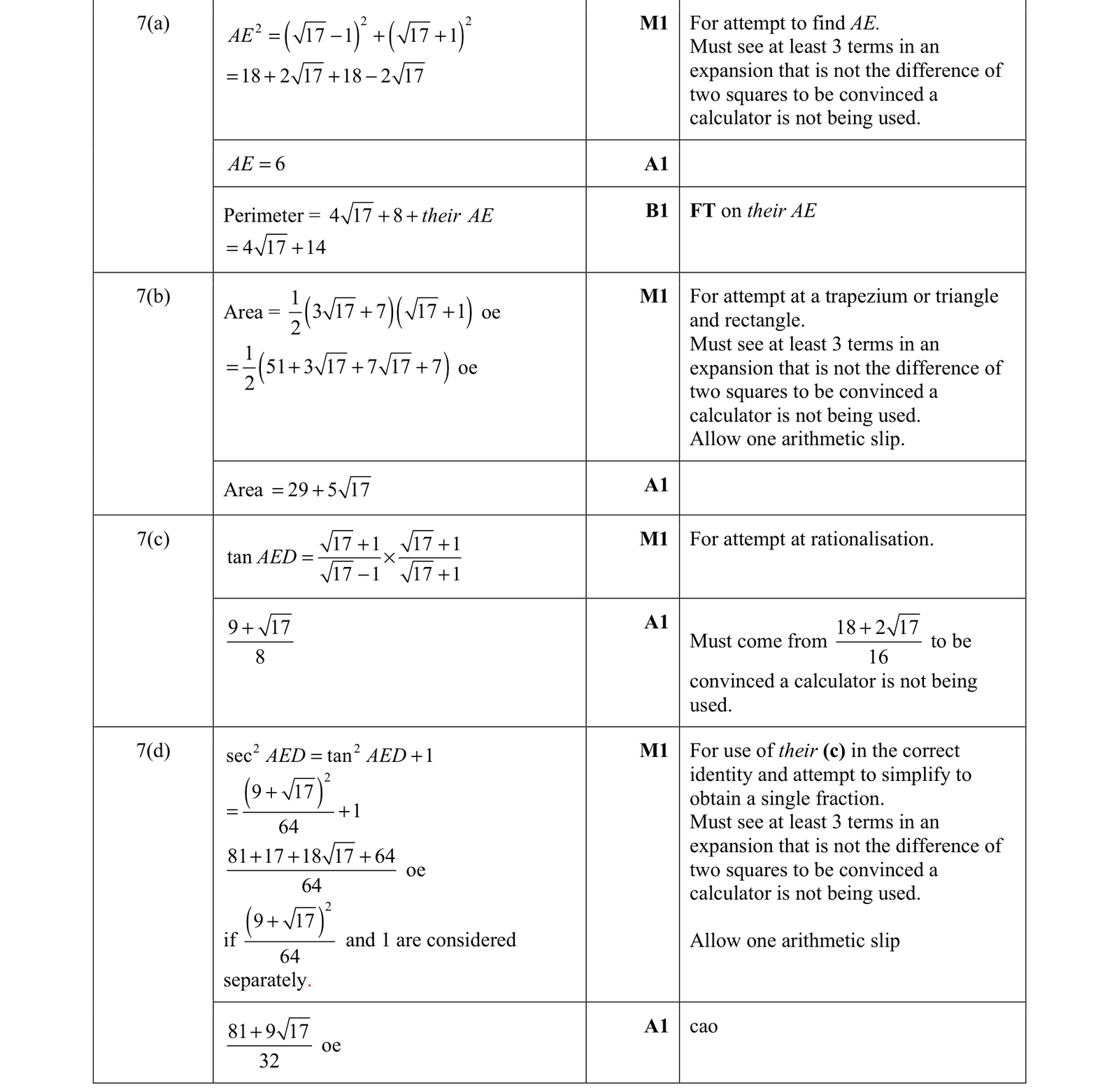
The diagram shows a trapezium \(ABCDE\) such that \(AB\) is parallel to \(EC\) and \(ABCD\) is a rectangle. It is given that \(BC=\sqrt{17}+1\), \(ED=\sqrt{17}-1\) and \(DC=\sqrt{17}+4\).
(a) Find the perimeter of the trapezium, giving your answer in the form \(a+b\sqrt{17}\), where \(a\) and \(b\) are integers.
(b) Find the area of the trapezium, giving your answer in the form \(c+d\sqrt{17}\), where \(c\) and \(d\) are integers.
(c) Find \(\tan AED\), giving your answer in the form \(\dfrac{e+f\sqrt{17}}{8}\), where \(e\) and \(f\) are integers.
(d) Hence show that \(\operatorname{sec}^2 AED=\dfrac{81+9\sqrt{17}}{32}\).
0606 P12 - Mar 2020 - Q5 - 7 marks
Do not use a calculator in this question.
The diagram shows the isosceles triangle \(ABC\), where \(AB=AC\) and \(BC=2+4\sqrt3\). The height, \(AD\), of the triangle is \(5-\sqrt3\).
(a) Find the area of the triangle \(ABC\), giving your answer in the form \(a+b\sqrt3\), where \(a\) and \(b\) are integers.
(b) Find \(\tan ABC\), giving your answer in the form \(c+d\sqrt3\), where \(c\) and \(d\) are integers.
(c) Find \(\operatorname{sec}^2 ABC\), giving your answer in the form \(e+f\sqrt3\), where \(e\) and \(f\) are integers.


0606 P21 - Nov 2020 - Q6 - 5 marks
In the diagram, all lengths are in centimetres. The triangle has \(\angle CAB=90^\circ\), \(AC=\sqrt3-1\), \(AB=\sqrt3+1\), and \(\angle ABC=15^\circ\).
(a) Show that \(\tan15^\circ=2-\sqrt3\).
(b) Find the exact length of \(BC\).


0606 P22 - Nov 2020 - Q8 - 8 marks
In triangle \(ABC\), \(AB=2\sqrt3+1\) cm and \(\angle BAC=30^\circ\). Given that the area of triangle \(ABC\) is \(5.5\text{ cm}^2\), find the exact length of \(AC\). Write your answer in the form \(a+b\sqrt3\), where \(a\) and \(b\) are integers.
(b) Show that \(BC^2=c+d\sqrt3\), where \(c\) and \(d\) are integers to be found.


0606 P23 - Nov 2019 - Q6 - 6 marks
Do not use a calculator in this question.
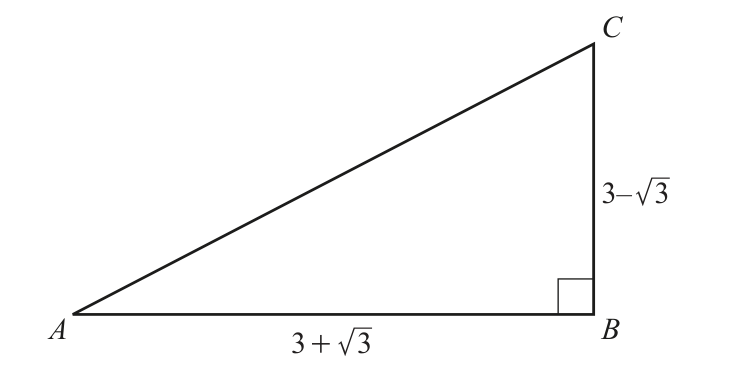
In the right-angled triangle, \(AB=3+\sqrt3\) and \(BC=3-\sqrt3\).
(i) Find \(\tan ACB\) in the form \(r+s\sqrt3\), where \(r\) and \(s\) are integers.
(ii) Find \(AC\) in the form \(t\sqrt u\), where \(t\) and \(u\) are integers and \(t\neq1\).

0606 P12 - Jun 2018 - Q10 - 8 marks
Do not use a calculator in this question.
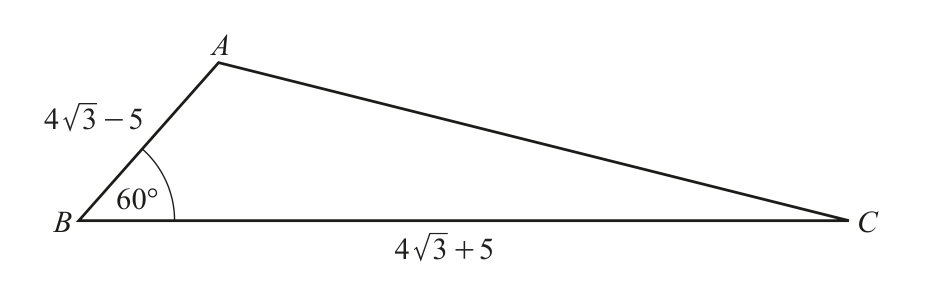
The triangle \(ABC\) has \(AB=4\sqrt3-5\), \(BC=4\sqrt3+5\) and \(\angle ABC=60^\circ\).
It is known that \(\sin60^\circ=\dfrac{\sqrt3}{2}\), \(\cos60^\circ=\dfrac12\), \(\tan60^\circ=\sqrt3\).
(i) Find the exact value of \(AC\).
(ii) Hence show that
\(\operatorname{cosec}ACB=\frac{2\sqrt p}{q}(4\sqrt3+5),\)
where \(p\) and \(q\) are integers.

0606 P13 - Nov 2018 - Q3 - 6 marks
Do not use a calculator in this question.
In this question, all lengths are in centimetres.
A triangle \(ABC\) is such that angle \(B=90^\circ\), \(AB=5\sqrt3+5\) and \(BC=5\sqrt3-5\).
(i) Find, in its simplest surd form, the length of \(AC\).
(ii) Find \(\tan BCA\), giving your answer in the form \(a+b\sqrt3\), where \(a\) and \(b\) are integers.

0606 P13 - Jun 2017 - Q4 - 5 marks
In this question, all dimensions are in centimetres.
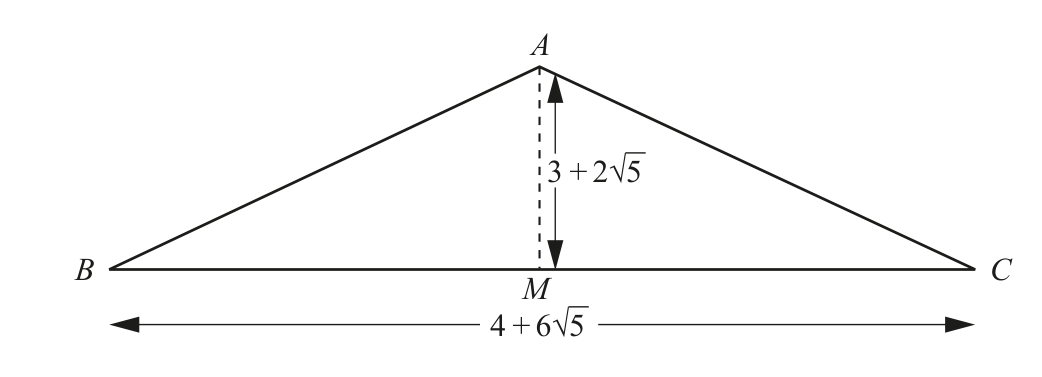
The diagram shows an isosceles triangle \(ABC\), where \(AB=AC\). The point \(M\) is the mid-point of \(BC\).
Given that \(AM=3+2\sqrt5\) and \(BC=4+6\sqrt5\), find, without using a calculator,
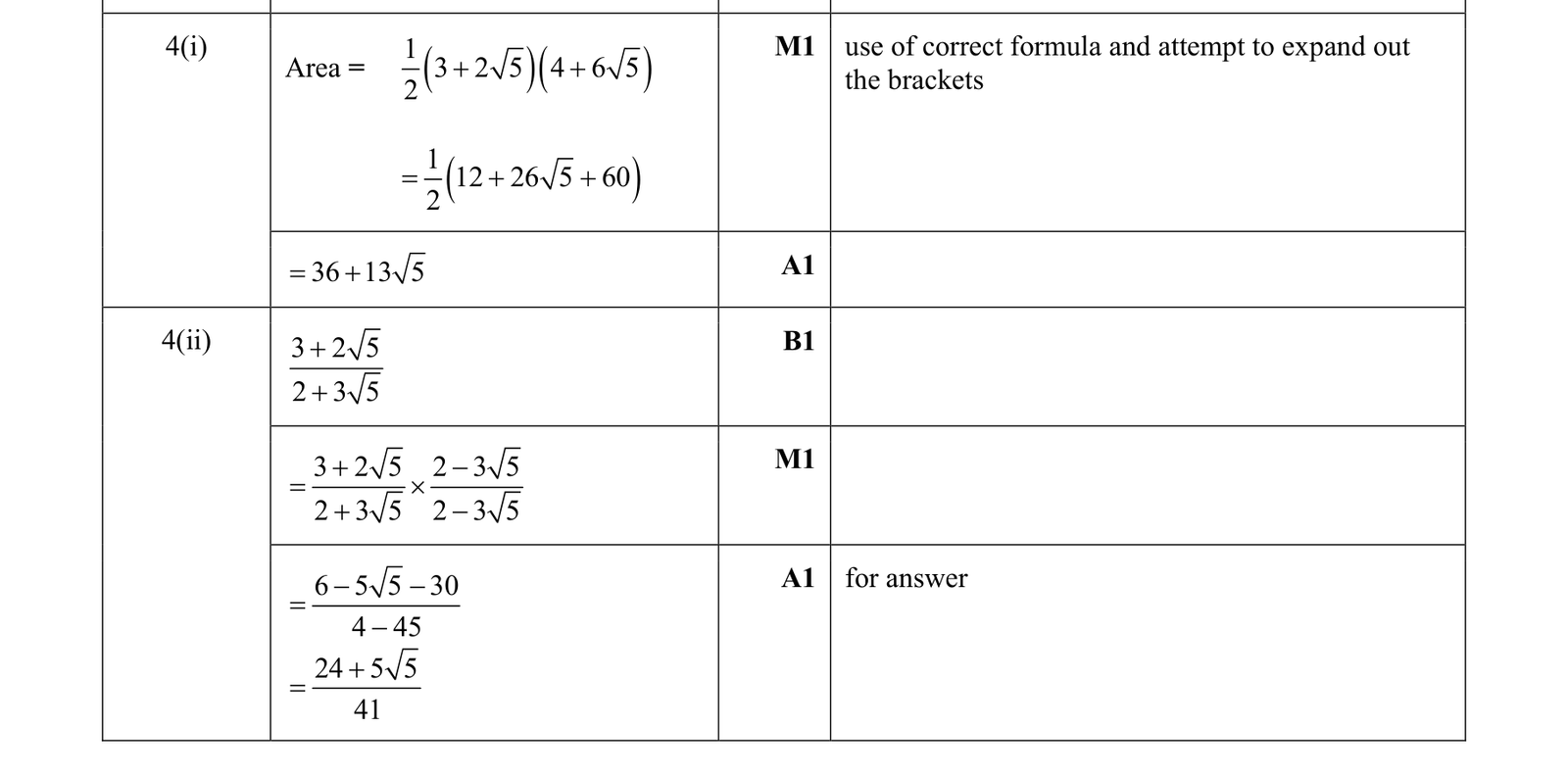
(i) the area of triangle \(ABC\),
(ii) \(\tan ABC\), giving your answer in the form \(\frac{a+b\sqrt5}{c}\), where \(a\), \(b\) and \(c\) are positive integers.
0606 P12 - Mar 2025 - Q6 - 5 marks
It is given that \(\tan\theta=\frac{\sqrt5}{5}\) and \(180^\circ\lt \theta\lt 360^\circ\).
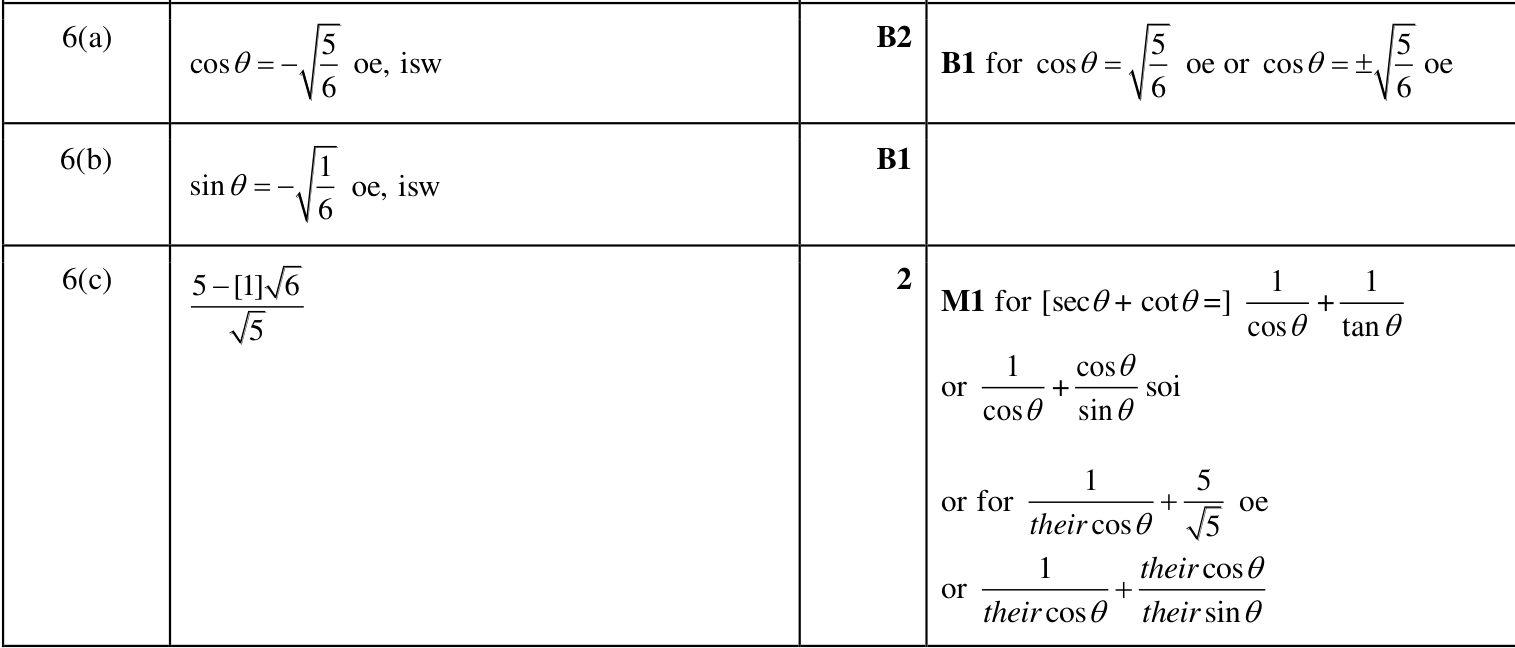
(a) Find the value of \(\cos\theta\).
(b) Find the value of \(\sin\theta\).
(c) Find the value of \(\sec\theta+\cot\theta\). Give your answer in the form \(\frac{a+b\sqrt c}{\sqrt5}\), where \(a\), \(b\) and \(c\) are integers.
0606 P23 - Nov 2023 - Q7 - 7 marks
Do not use a calculator in this question.
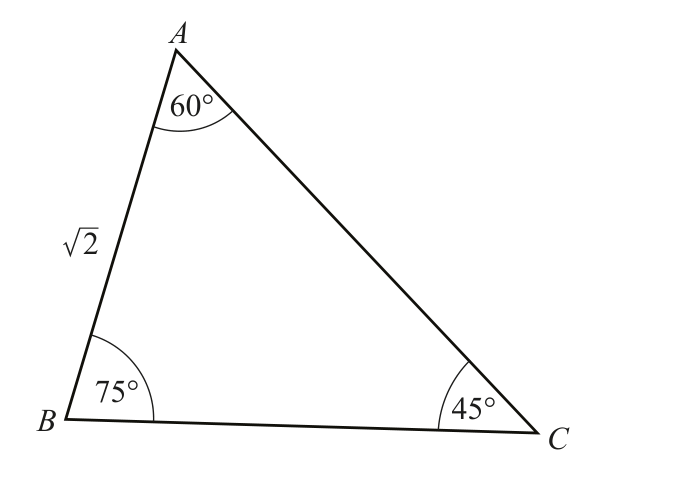
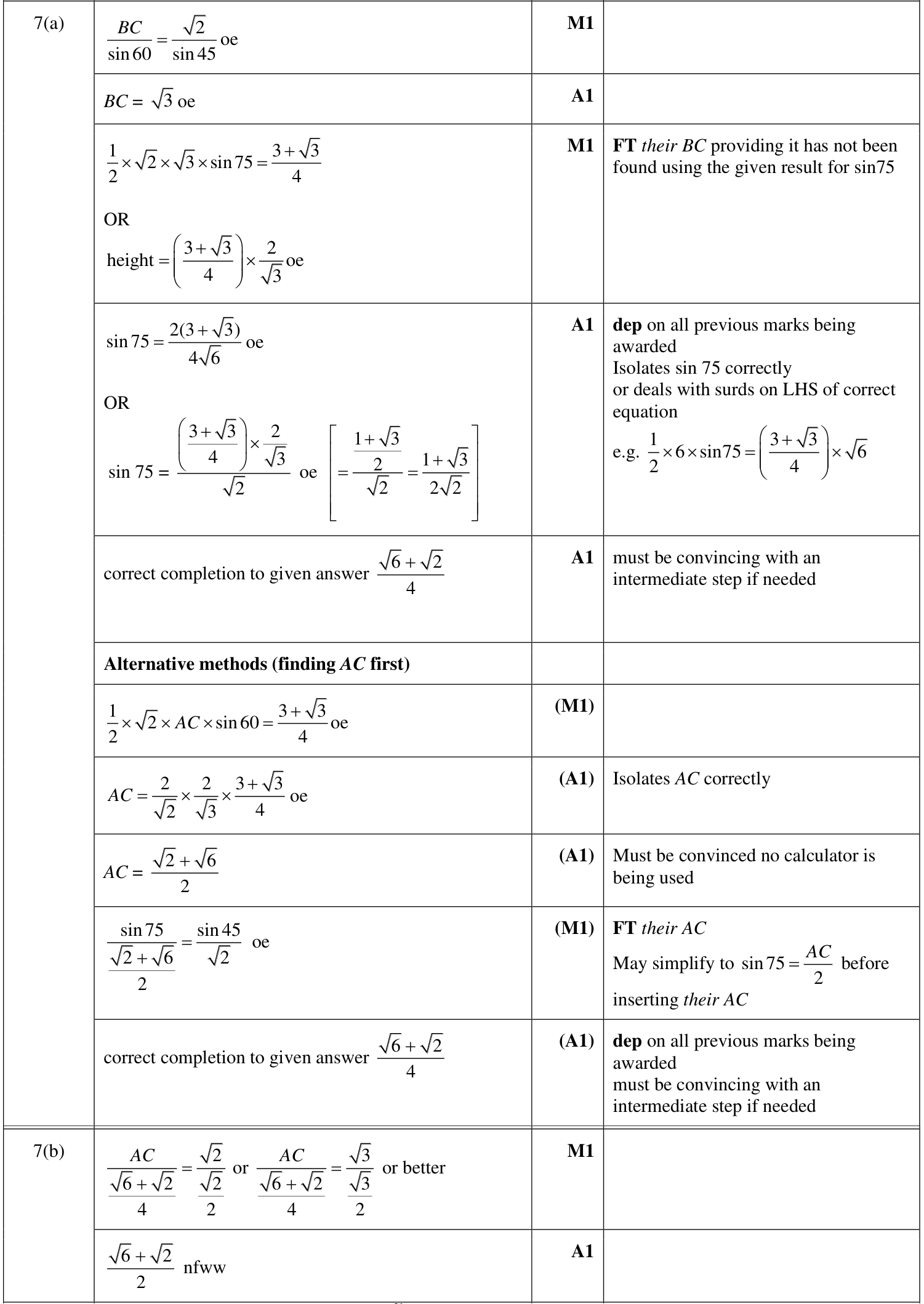
The diagram shows triangle \(ABC\), where \(AB=\sqrt2\), \(\angle A=60^\circ\), \(\angle B=75^\circ\) and \(\angle C=45^\circ\).
You may use \(\sin60^\circ=\frac{\sqrt3}{2}\), \(\sin45^\circ=\frac{\sqrt2}{2}\), \(\cos60^\circ=\frac12\), \(\cos45^\circ=\frac{\sqrt2}{2}\), \(\tan60^\circ=\sqrt3\) and \(\tan45^\circ=1\).
(a) Given that the area of triangle \(ABC\) is \(\frac{3+\sqrt3}{4}\), show that
\(\sin75^\circ=\frac{\sqrt6+\sqrt2}{4}.\)
(b) Hence find the exact length of \(AC\).
0606 P11 - Jun 2023 - Q5 - 8 marks
This question is to be answered without using a calculator.
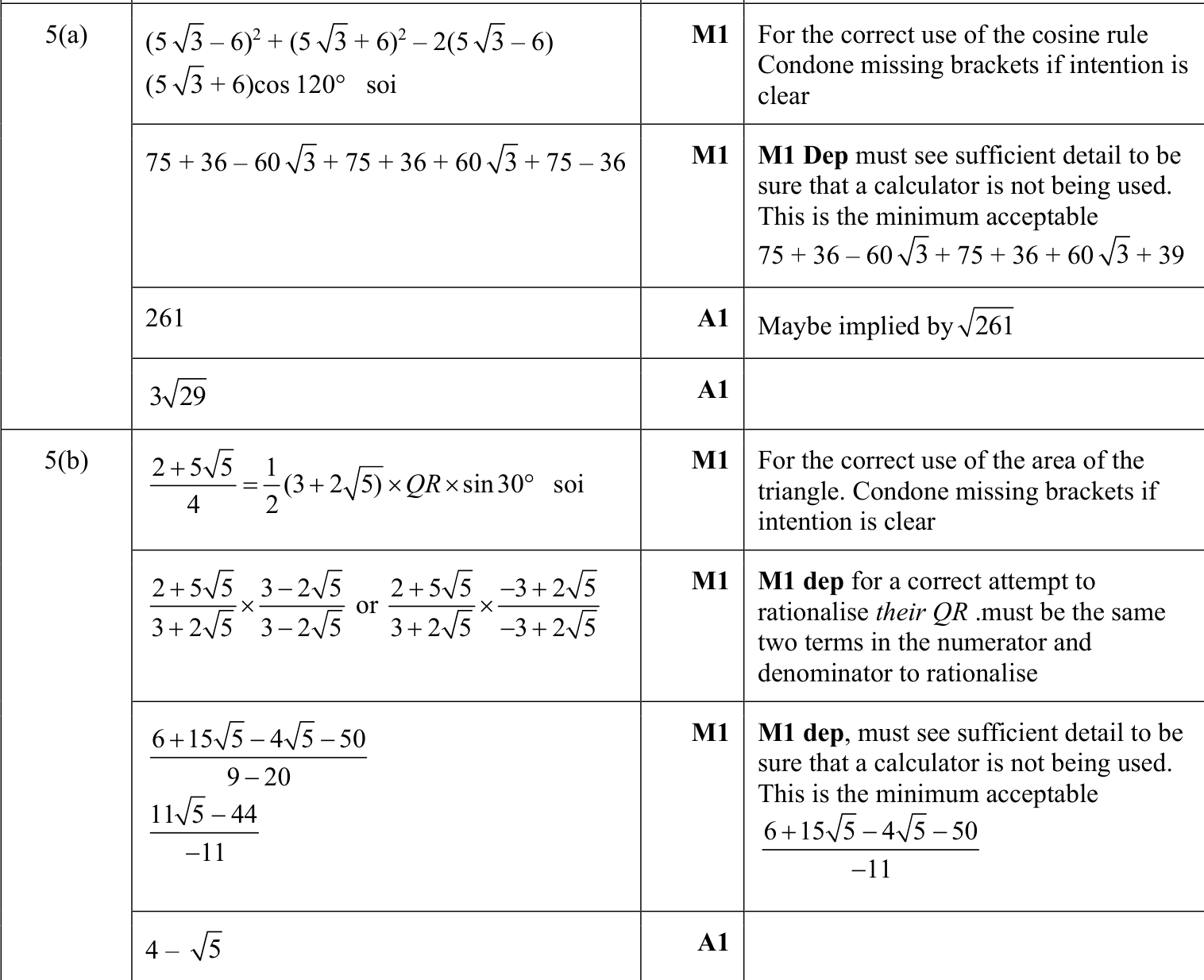
(a) In triangle \(ABC\), \(AB=5\sqrt3-6\), \(BC=5\sqrt3+6\) and angle \(ABC=120^\circ\). Find \(AC\) in the form \(a\sqrt b\), where \(a\) and \(b\) are integers.
(b) In triangle \(PQR\), \(PQ=3+2\sqrt5\), angle \(PQR=30^\circ\) and the area of triangle \(PQR\) is \(\frac14(2+5\sqrt5)\). Find \(QR\) in the form \(c+d\sqrt5\), where \(c\) and \(d\) are integers.
0606 P11 - Jun 2022 - Q8 - 9 marks
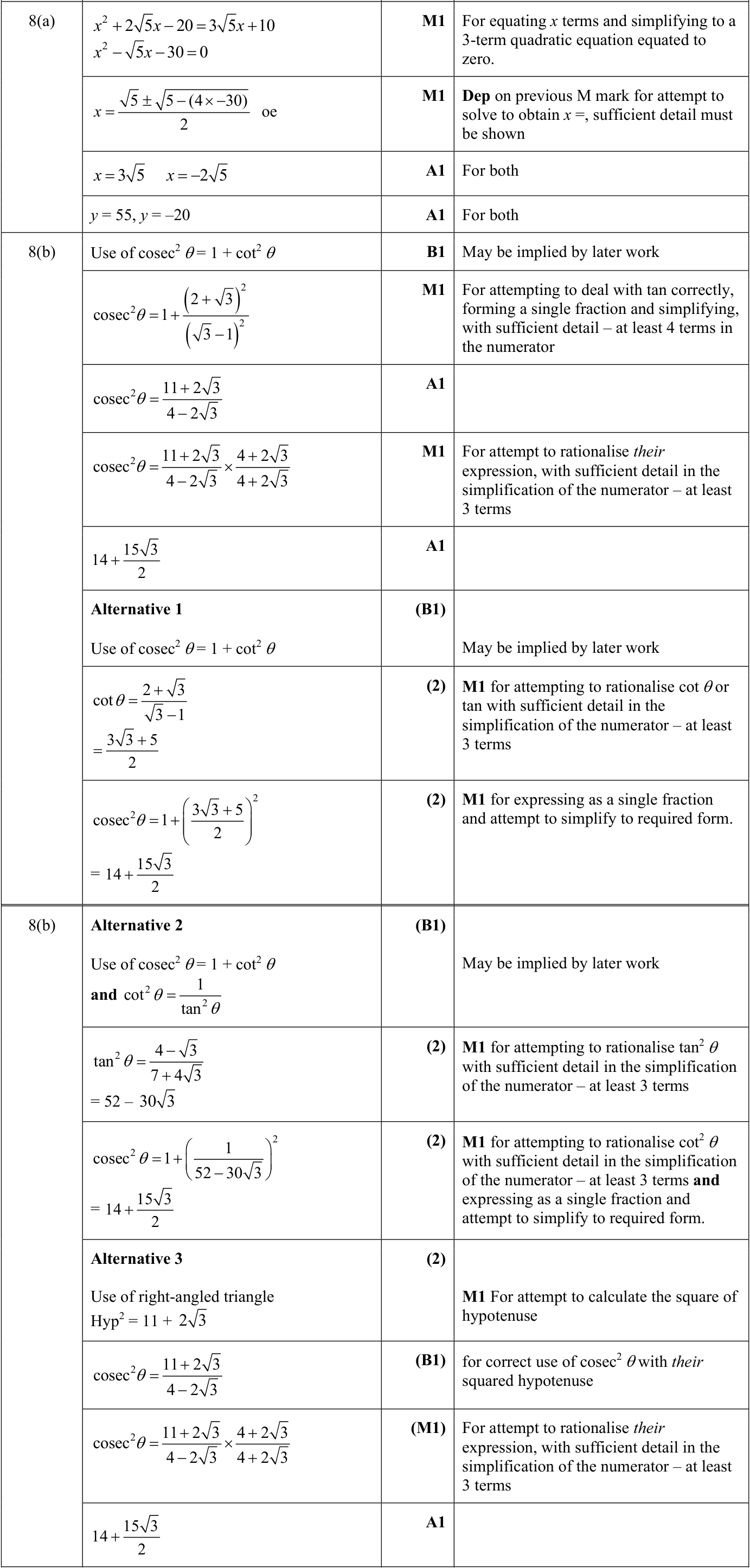
(a) Find the exact coordinates of the points of intersection of \(y=x^2+2\sqrt5x-20\) and \(y=3\sqrt5x+10\).
(b) Given \(\tan\theta=\frac{\sqrt3-1}{2+\sqrt3}\), for \(0\lt \theta\lt \frac\pi2\), find \(\operatorname{cosec}^2\theta\) in the form \(a+b\sqrt3\).
0606 P12 - Jun 2022 - Q2 - 4 marks
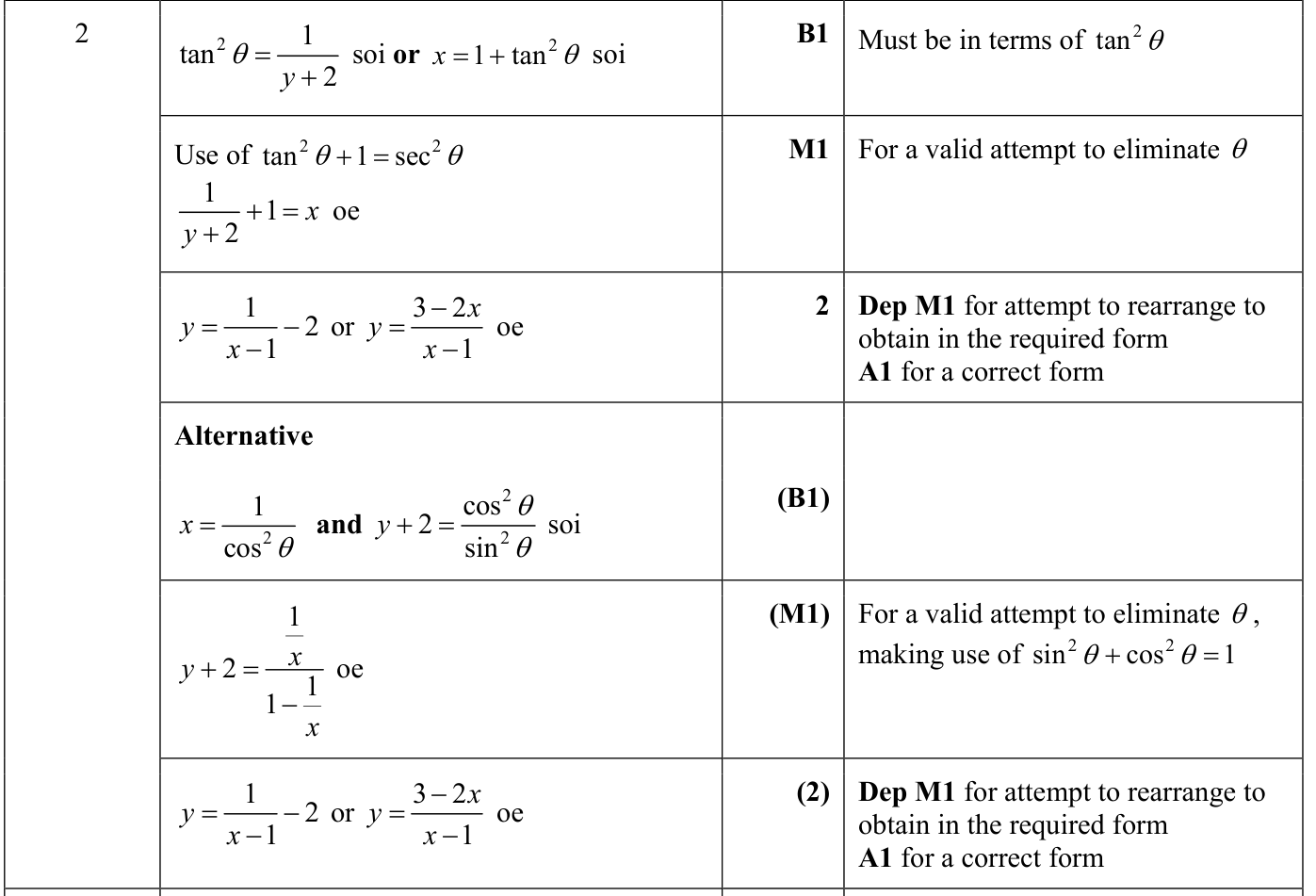
Given that \(x=\operatorname{sec}^{2}\theta\) and \(y+2=\operatorname{cot}^{2}\theta\), find \(y\) in terms of \(x\).