Past Exam Questions
← Back0606 P12 - Mar 2022 - Q3 - 8 marks
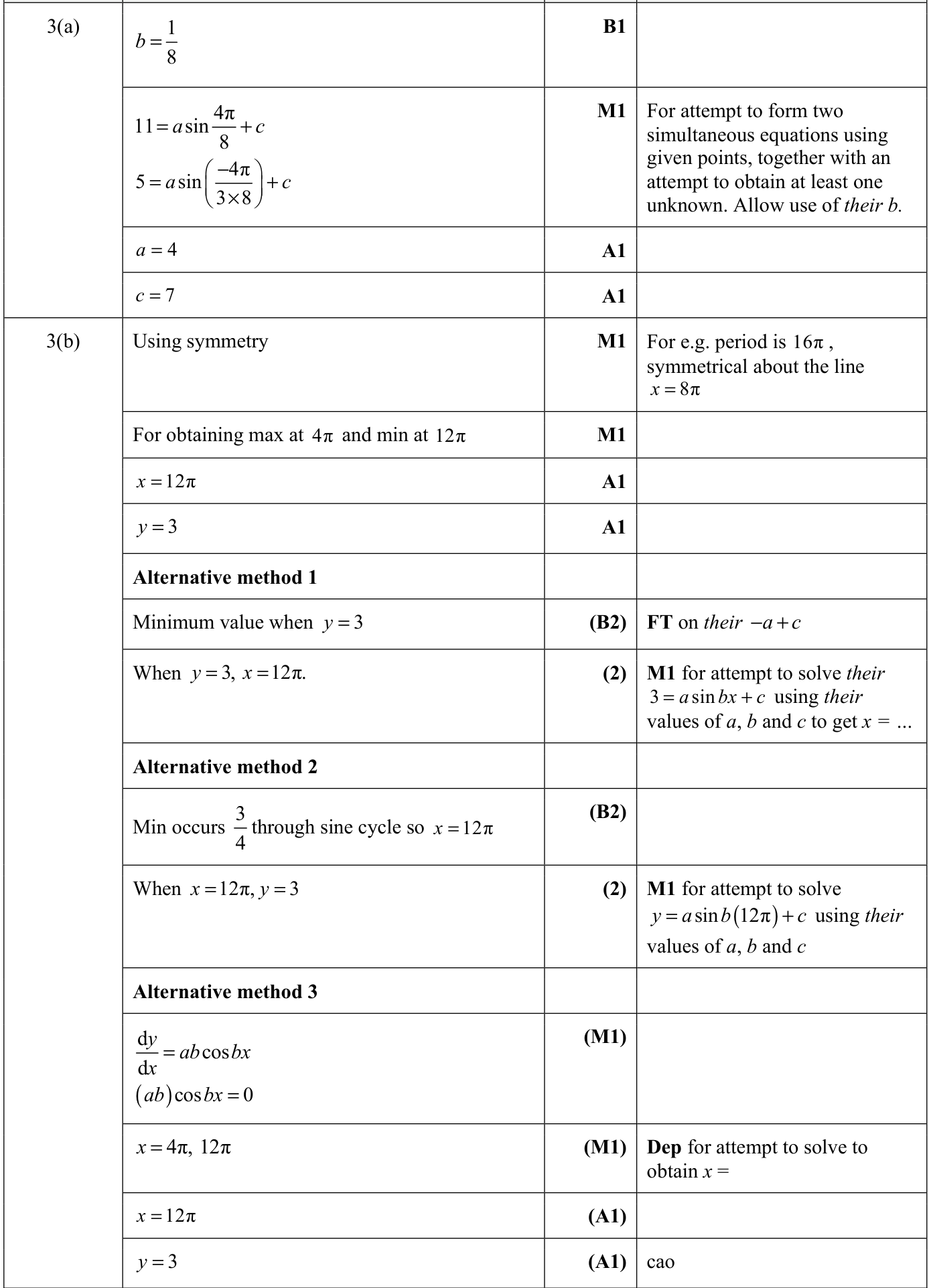
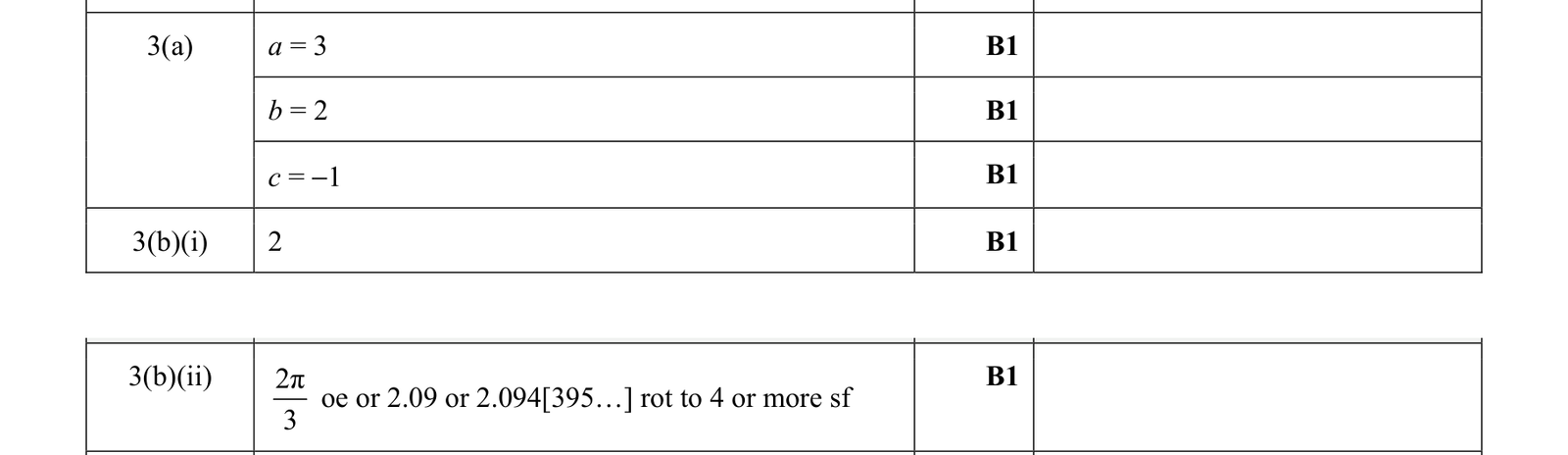
The curve with equation \(y=a\sin bx+c\), where \(a\), \(b\) and \(c\) are constants, passes through the points \((4\pi,11)\) and \(\left(-\frac{4\pi}{3},5\right)\). It is given that \(a\sin bx+c\) has period \(16\pi\).
(a) Find the exact values of \(a\), \(b\) and \(c\).
(b) Using your answer to part (a), find the coordinates of the minimum point on the curve for \(0\le x\le16\pi\).
0606 P22 - Mar 2023 - Q1 - 3 marks
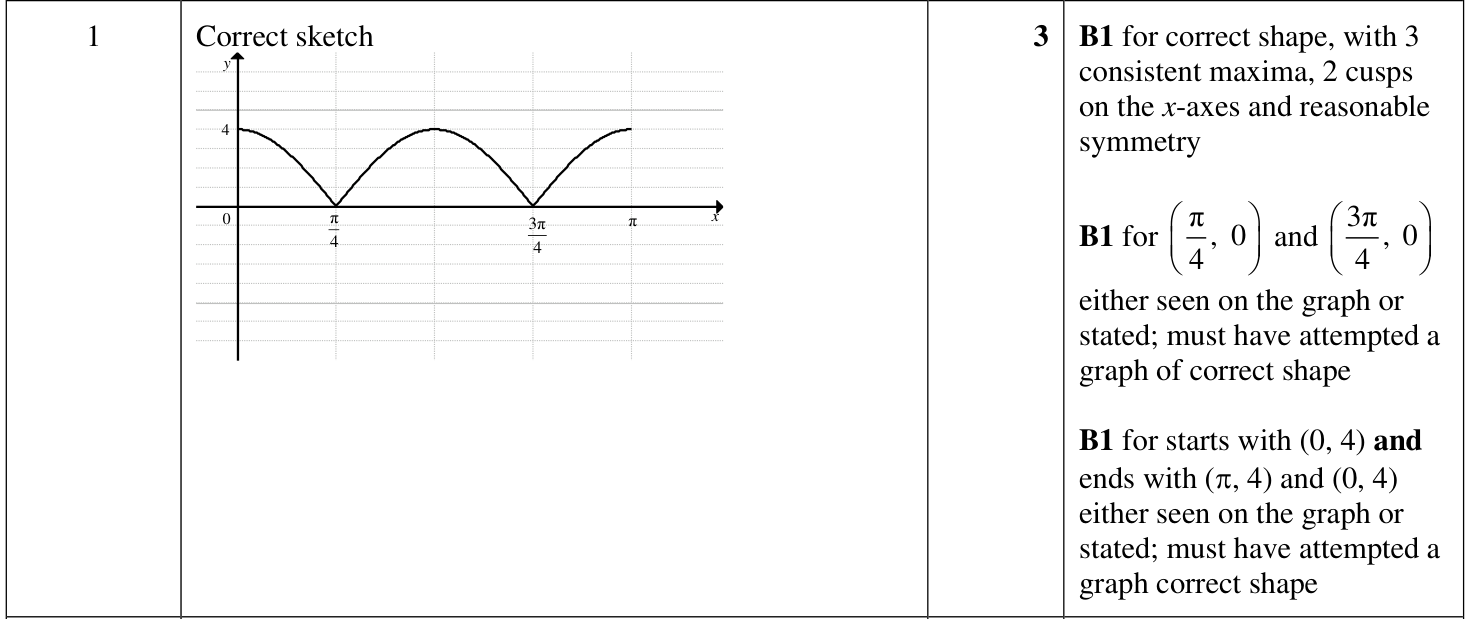
Sketch the graph of
\(y=\left|4\cos 2x\right|\)
for \(0\leq x\leq \pi\), giving the coordinates of the points where the graph meets the axes.
0606 P12 - Jun 2022 - Q1 - 3 marks
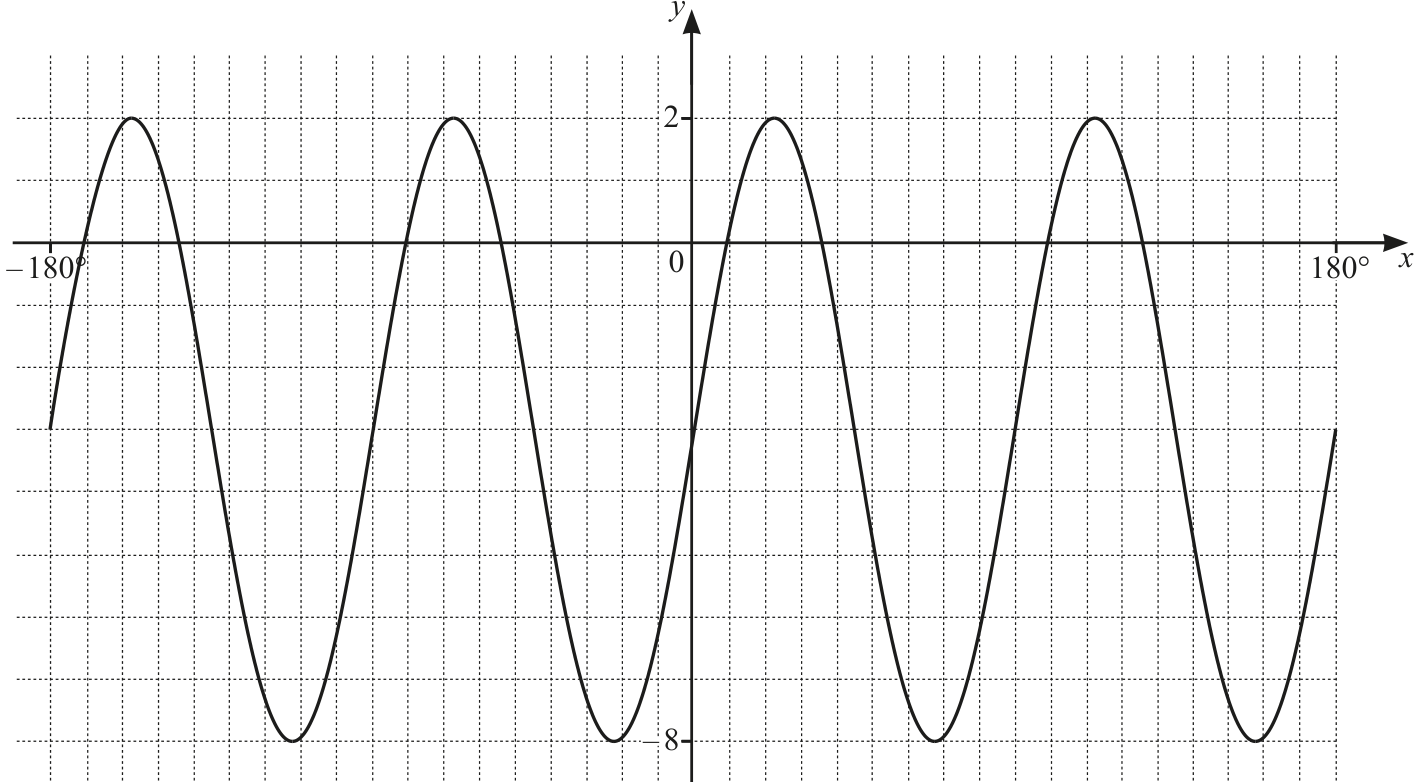
The diagram shows the graph of \(y=a\sin bx+c\), where \(a\), \(b\) and \(c\) are integers, for \(-180^{\circ}\le x\le 180^{\circ}\). Find the values of \(a\), \(b\) and \(c\).

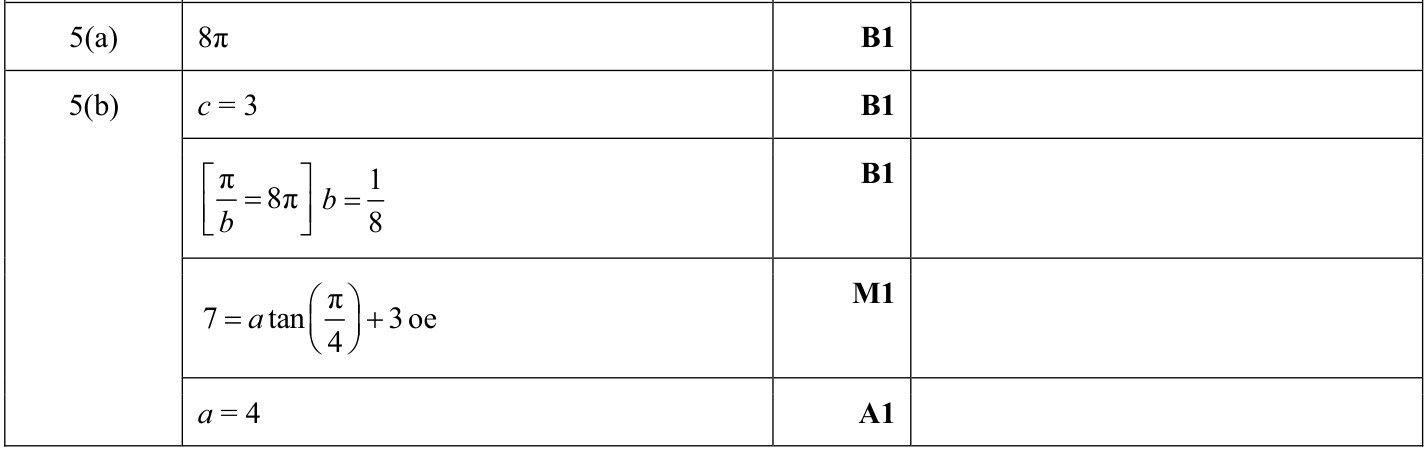
0606 P23 - Jun 2022 - Q5 - 5 marks
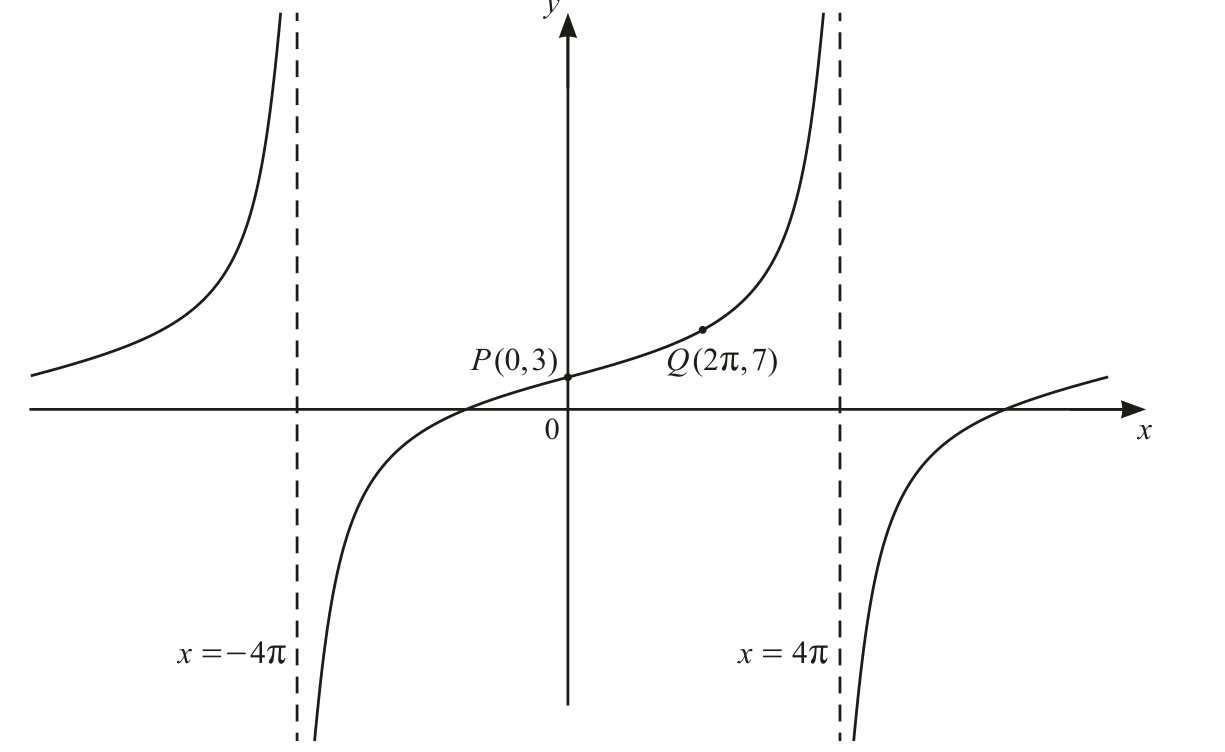
The graph of \(y=a\tan bx+c\) has asymptotes at \(x=-4\pi\) and \(x=4\pi\), and passes through the points \(P(0,3)\) and \(Q(2\pi,7)\).
(a) Find the period of the graph.
(b) Find the values of \(a\), \(b\) and \(c\).
0606 P11 - Nov 2022 - Q2 - 5 marks
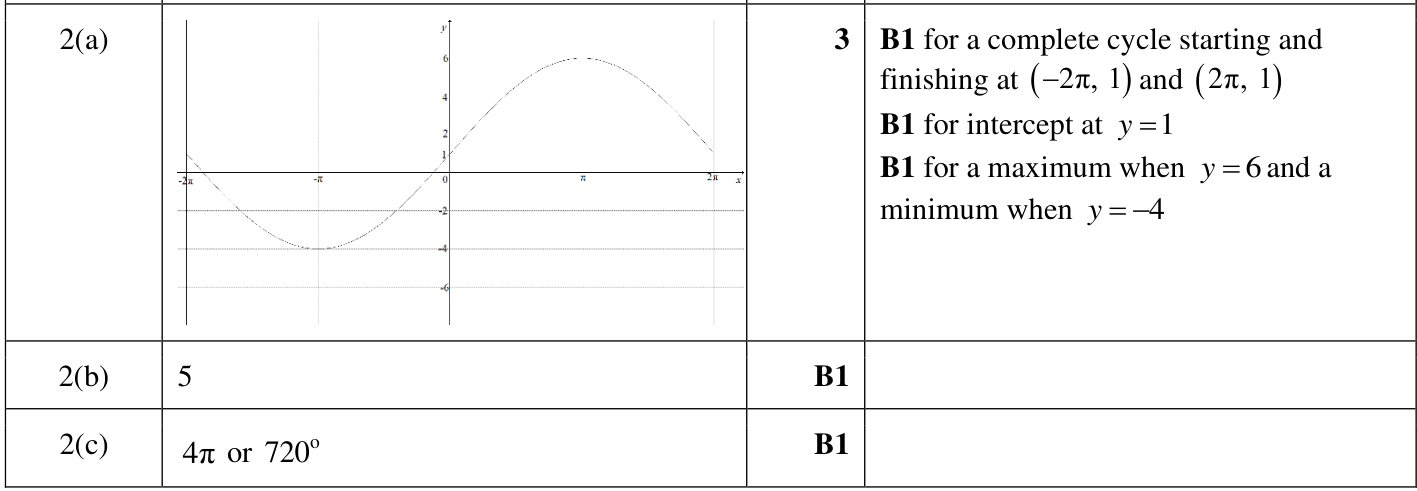
(a) On the axes, sketch the graph of
\(y=5\sin\frac{x}{2}+1\)
for \(-2\pi\leq x\leq 2\pi\).
(b) Write down the amplitude of \(5\sin\frac{x}{2}+1\).
(c) Write down the period of \(5\sin\frac{x}{2}+1\).
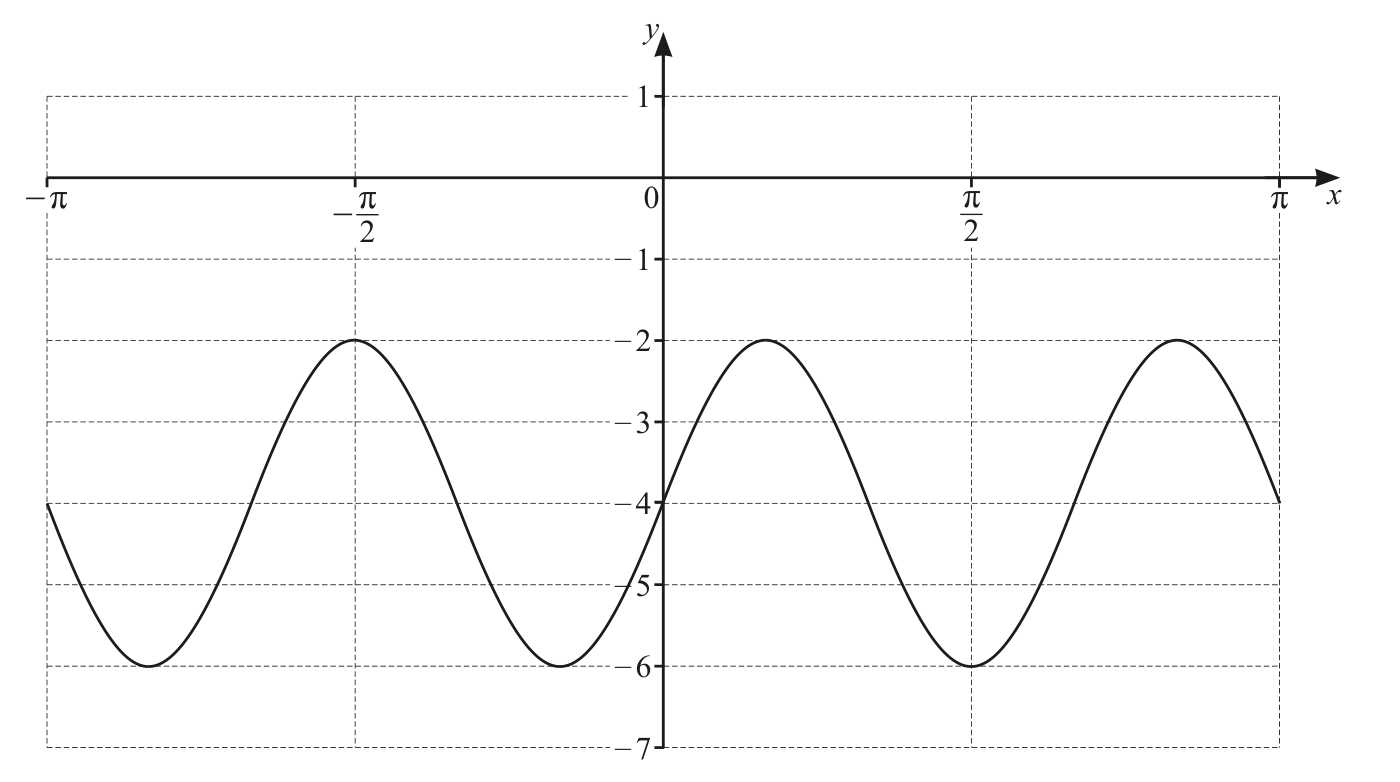
0606 P12 - Nov 2022 - Q1 - 3 marks
The diagram shows the graph of \(y=a\sin bx+c\), where \(a\), \(b\) and \(c\) are integers. Find the values of \(a\), \(b\) and \(c\).

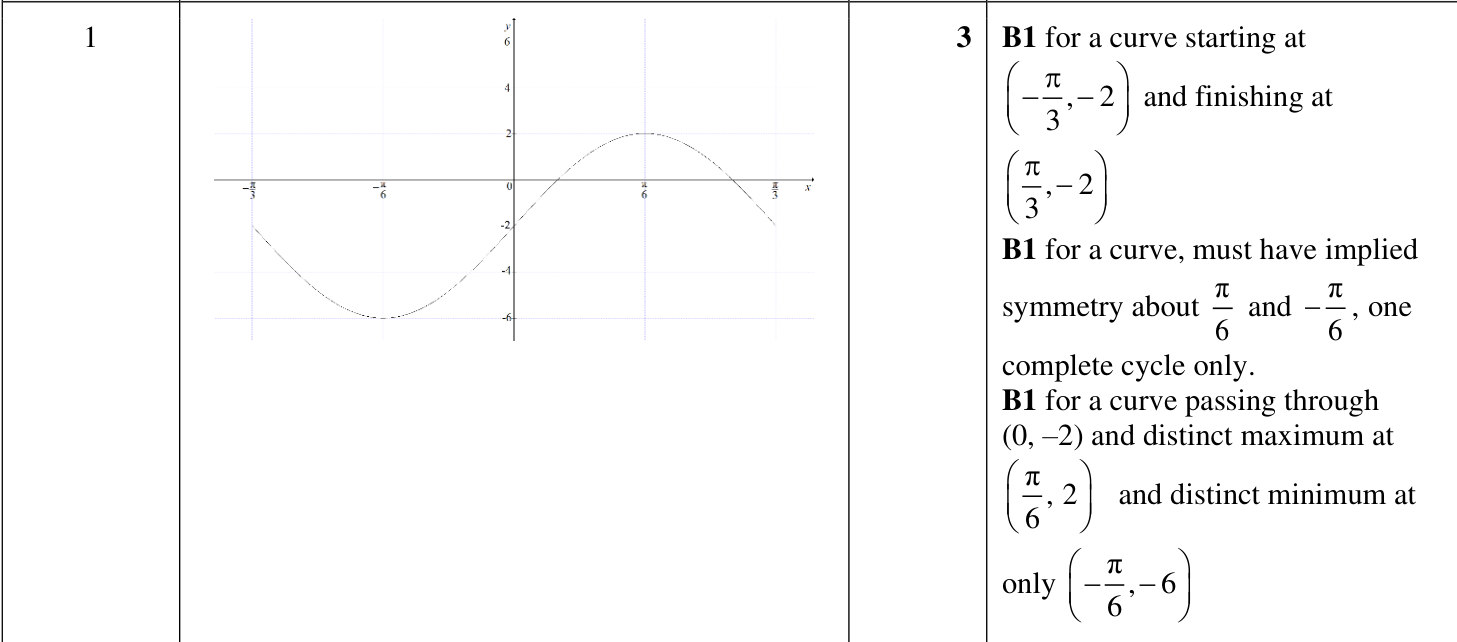
0606 P13 - Nov 2022 - Q1 - 3 marks
On the axes, sketch the graph of
\(y=4\sin3x-2\)
for \(-\frac{\pi}{3}\leq x\leq\frac{\pi}{3}\).
0606 P12 - Mar 2021 - Q2 - 3 marks
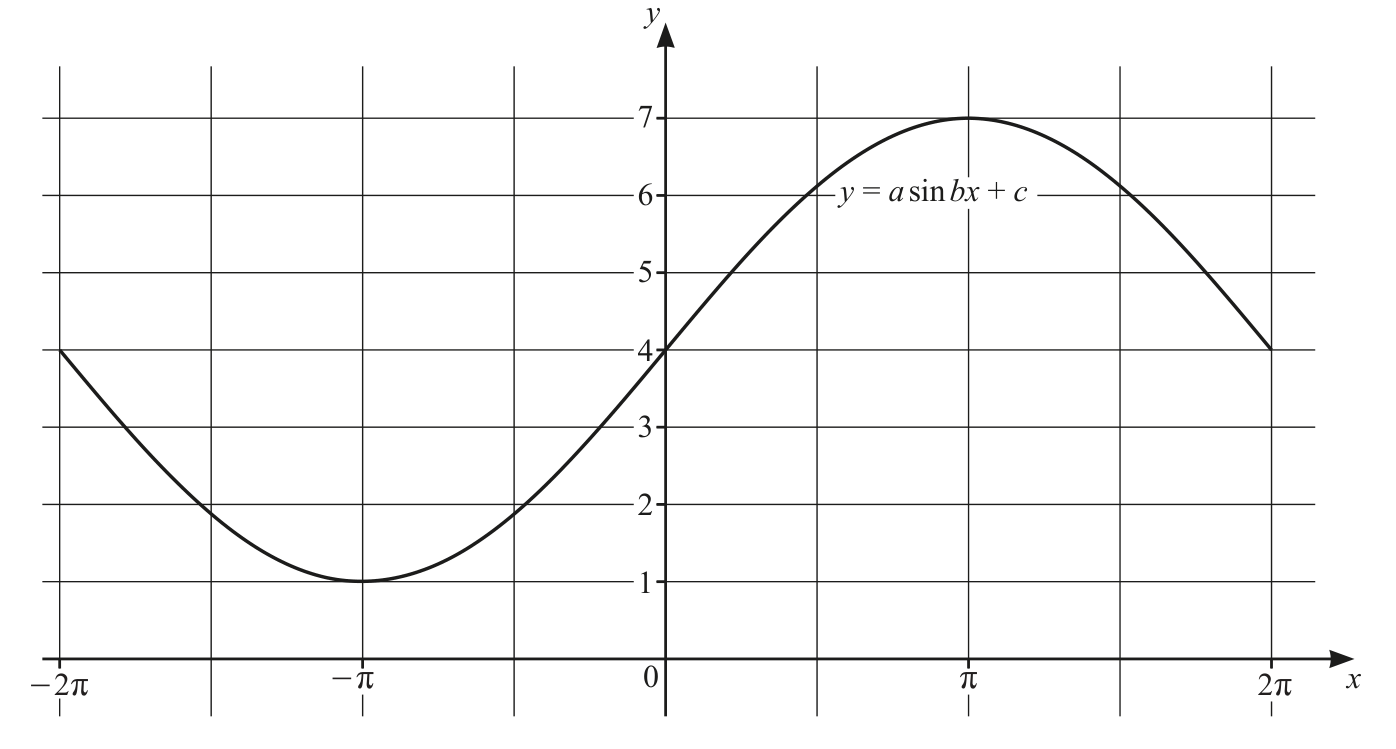
The diagram shows the graph of \(y=a\sin bx+c\), where \(x\) is in radians and \(-2\pi\leqslant x\leqslant2\pi\), and where \(a\), \(b\) and \(c\) are positive constants.
Find the value of each of \(a\), \(b\) and \(c\).

0606 P13 - Jun 2021 - Q8 - 7 marks
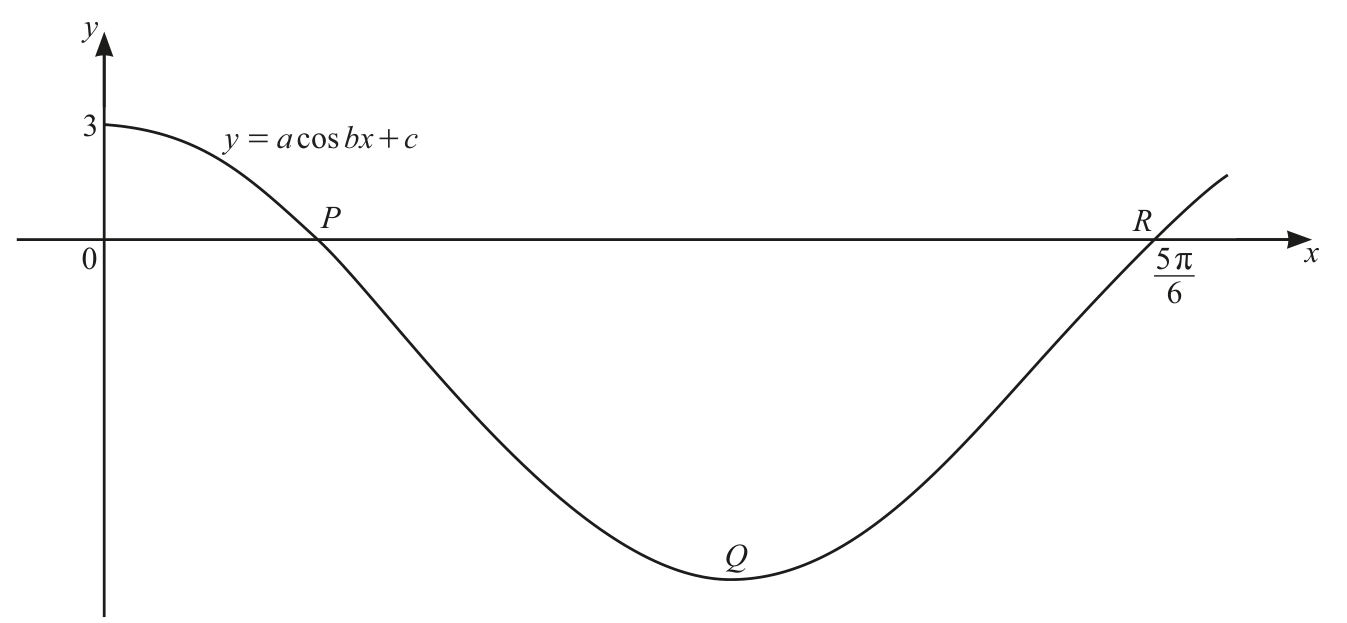
The graph shows the curve
\(y=a\cos bx+c,\)
for \(0\leq x\leq2.8\), where \(a\), \(b\) and \(c\) are constants and \(x\) is in radians. The curve meets the \(y\)-axis at \((0,3)\) and the \(x\)-axis at the point \(P\) and point \(R\left(\frac{5\pi}{6},0\right)\).
The curve has a minimum at point \(Q\). The period of \(a\cos bx+c\) is \(\pi\) radians.
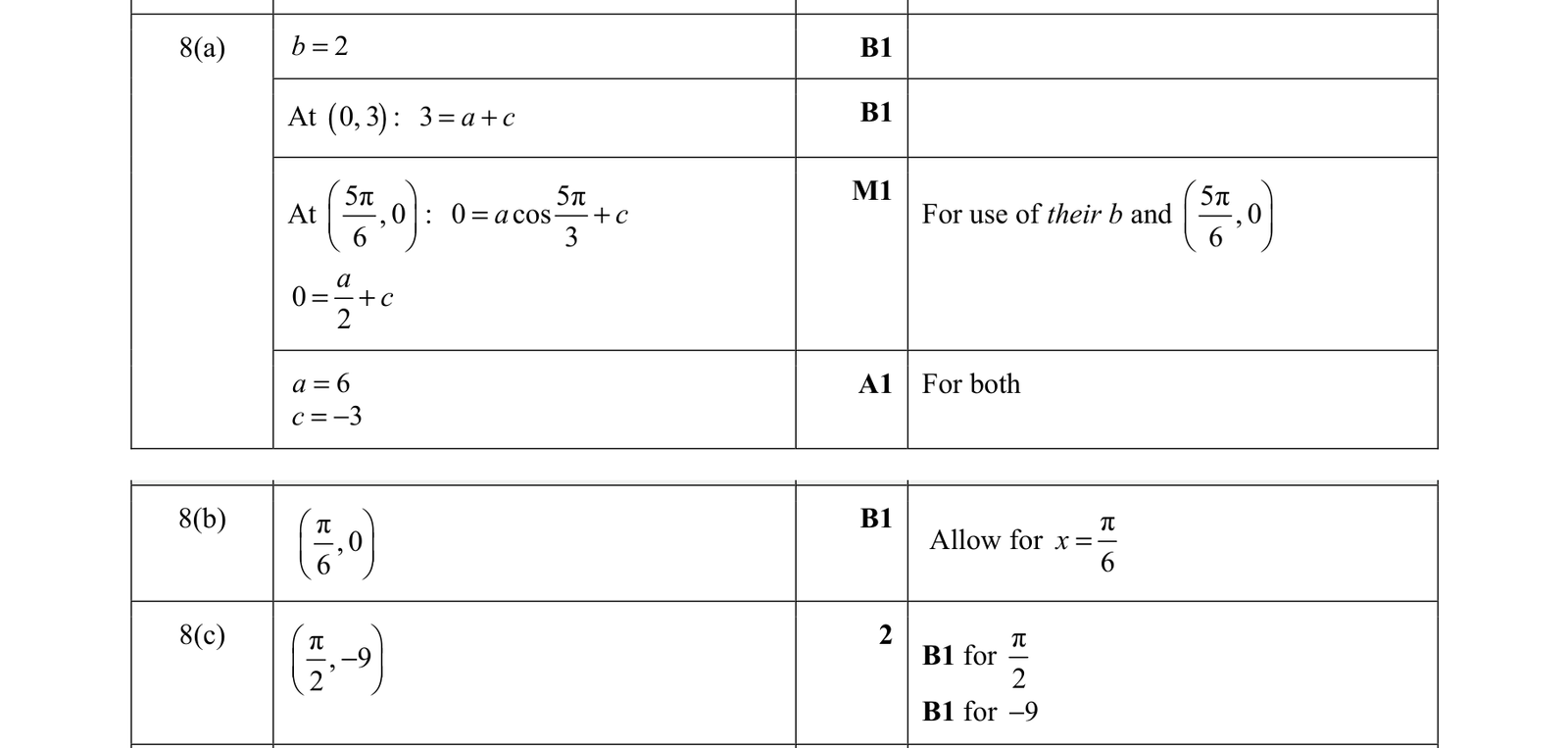
(a) Find the value of each of \(a\), \(b\) and \(c\).
(b) Find the coordinates of \(P\).
(c) Find the coordinates of \(Q\).
0606 P21 - Jun 2021 - Q4 - 5 marks
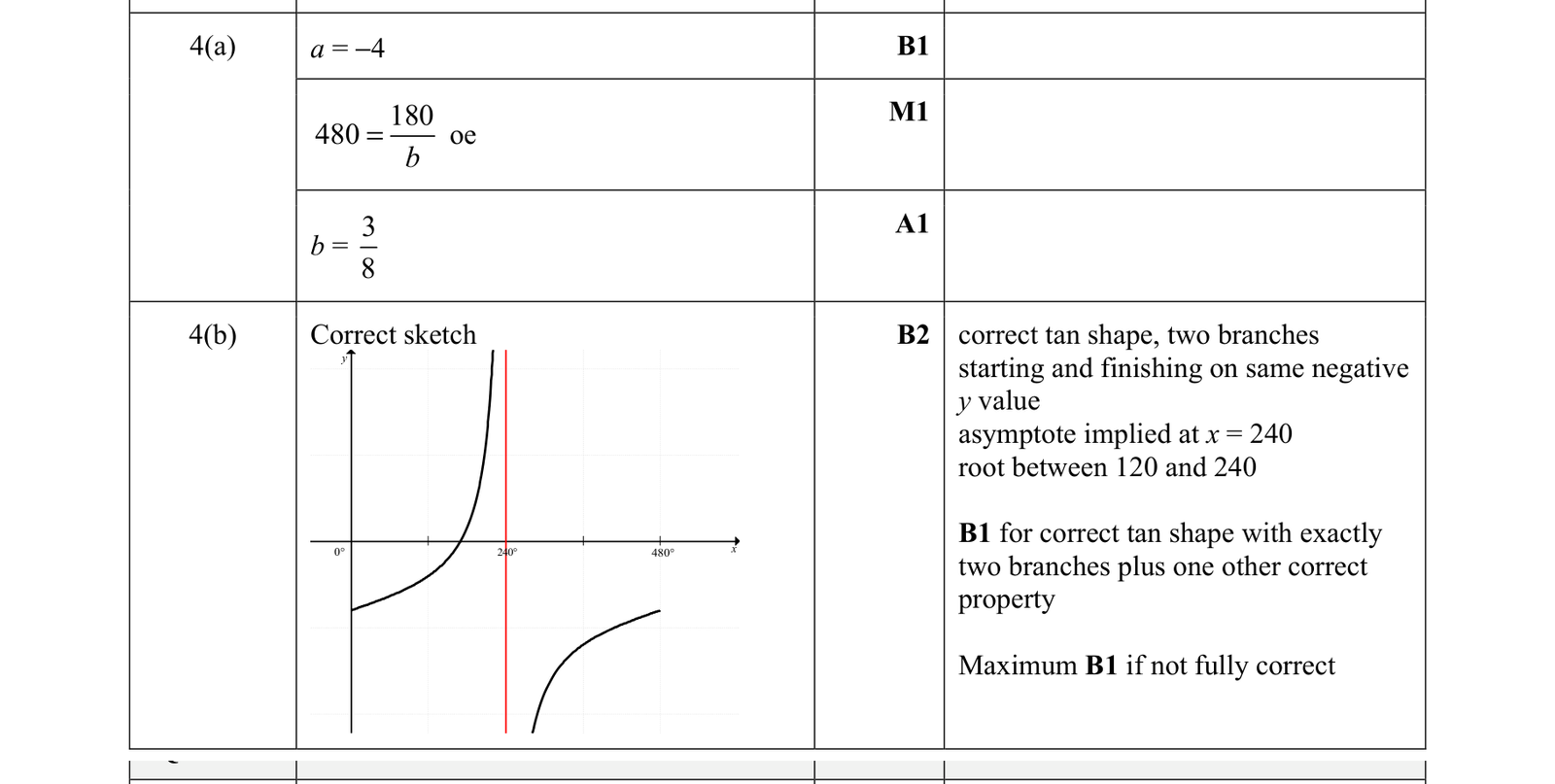
The graph of
\(y=a+2\tan bx,\)
where \(a\) and \(b\) are constants, passes through the point \((0,-4)\) and has period \(480^\circ\).
(a) Find the value of \(a\) and of \(b\).
(b) On the axes, sketch the graph of \(y\) for values of \(x\) between \(0^\circ\) and \(480^\circ\).
0606 P22 - Jun 2021 - Q5 - 5 marks
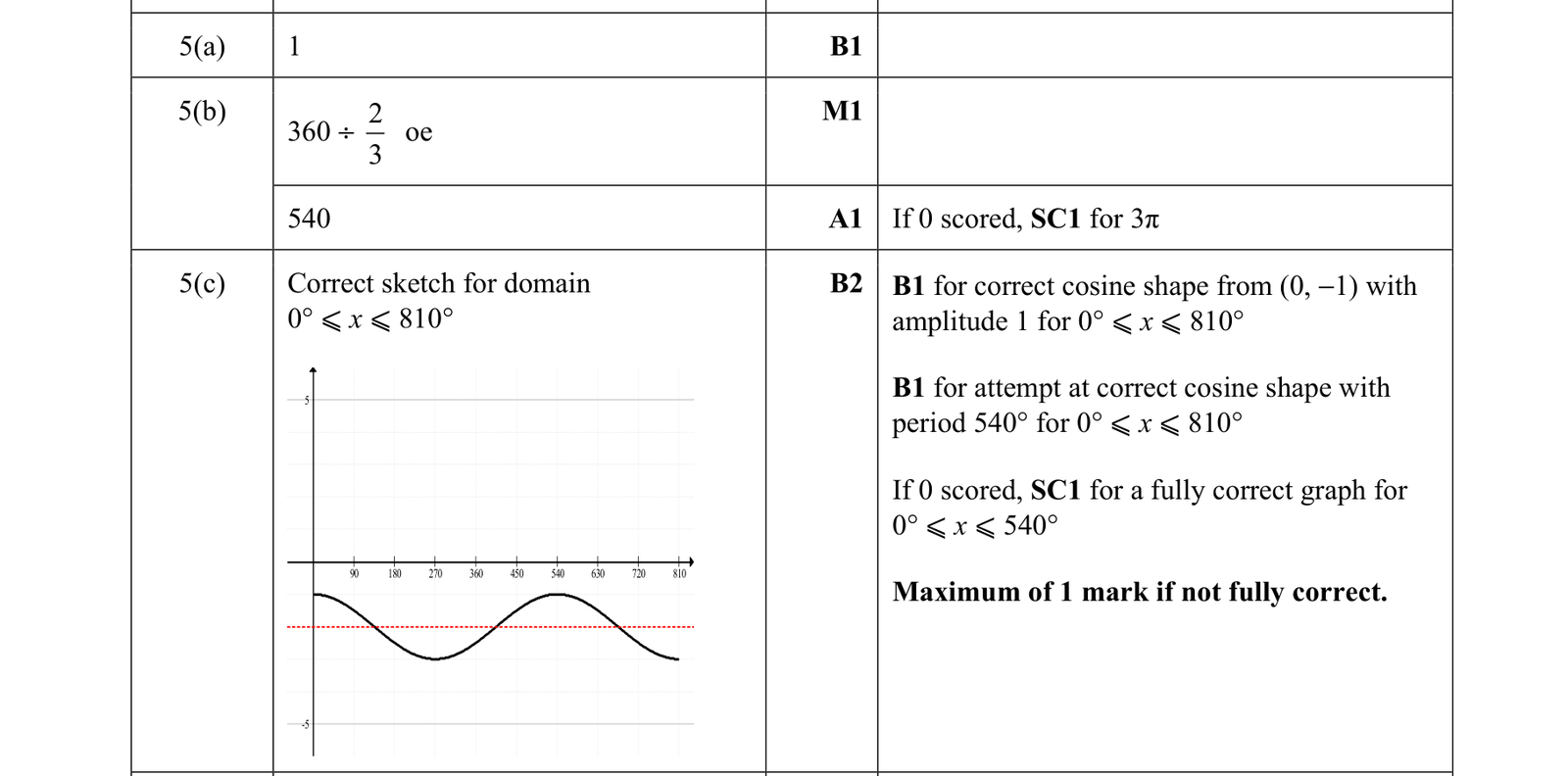
The function \(\mathrm f\) is defined, for \(0^\circ\leq x\leq810^\circ\), by
\(\mathrm f(x)=-2+\cos\frac{2x}{3}.\)
(a) Write down the amplitude of \(\mathrm f\).
(b) Find the period of \(\mathrm f\).
(c) On the axes, sketch the graph of \(y=\mathrm f(x)\).
0606 P11 - Nov 2021 - Q1 - 4 marks
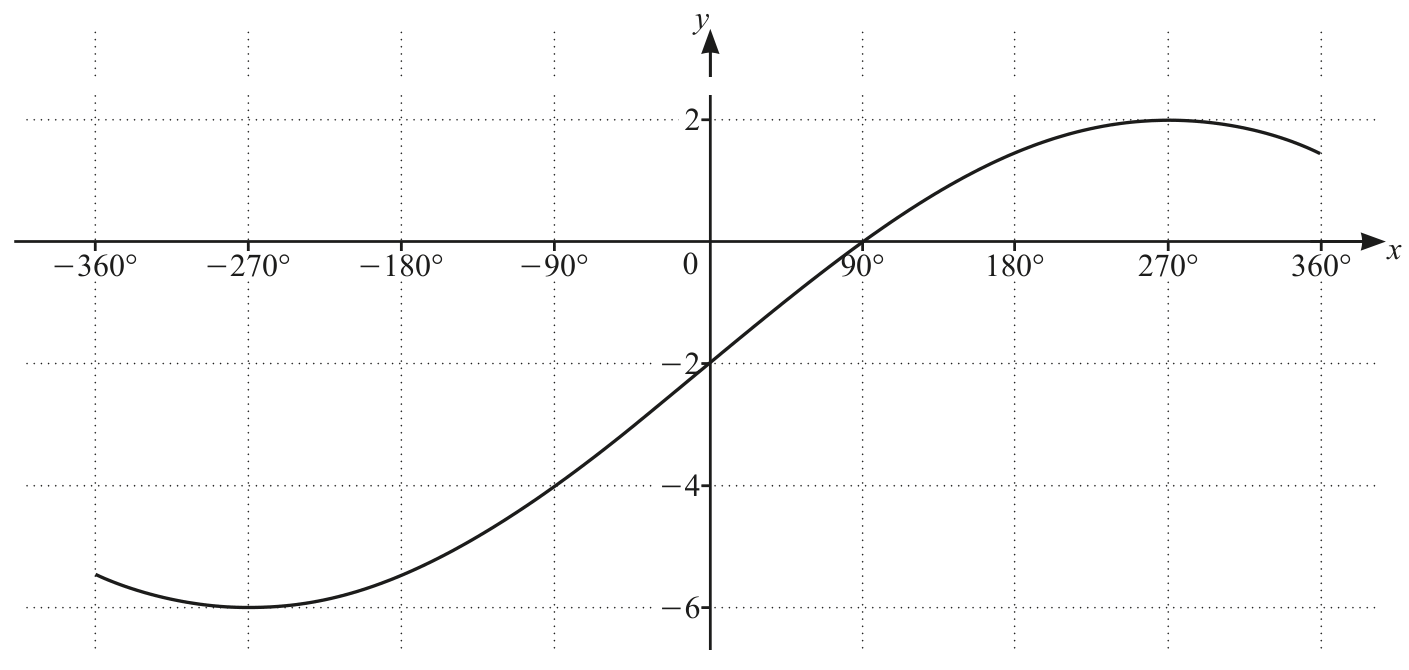
The diagram shows the graph of \(y=a\sin\frac{x}{b}+c\) for \(-360^\circ\leq x\leq 360^\circ\), where \(a\), \(b\) and \(c\) are integers.
(a) Write down the period of \(a\sin\frac{x}{b}+c\).
(b) Find the value of \(a\), of \(b\) and of \(c\).

0606 P12 - Nov 2021 - Q5 - 3 marks
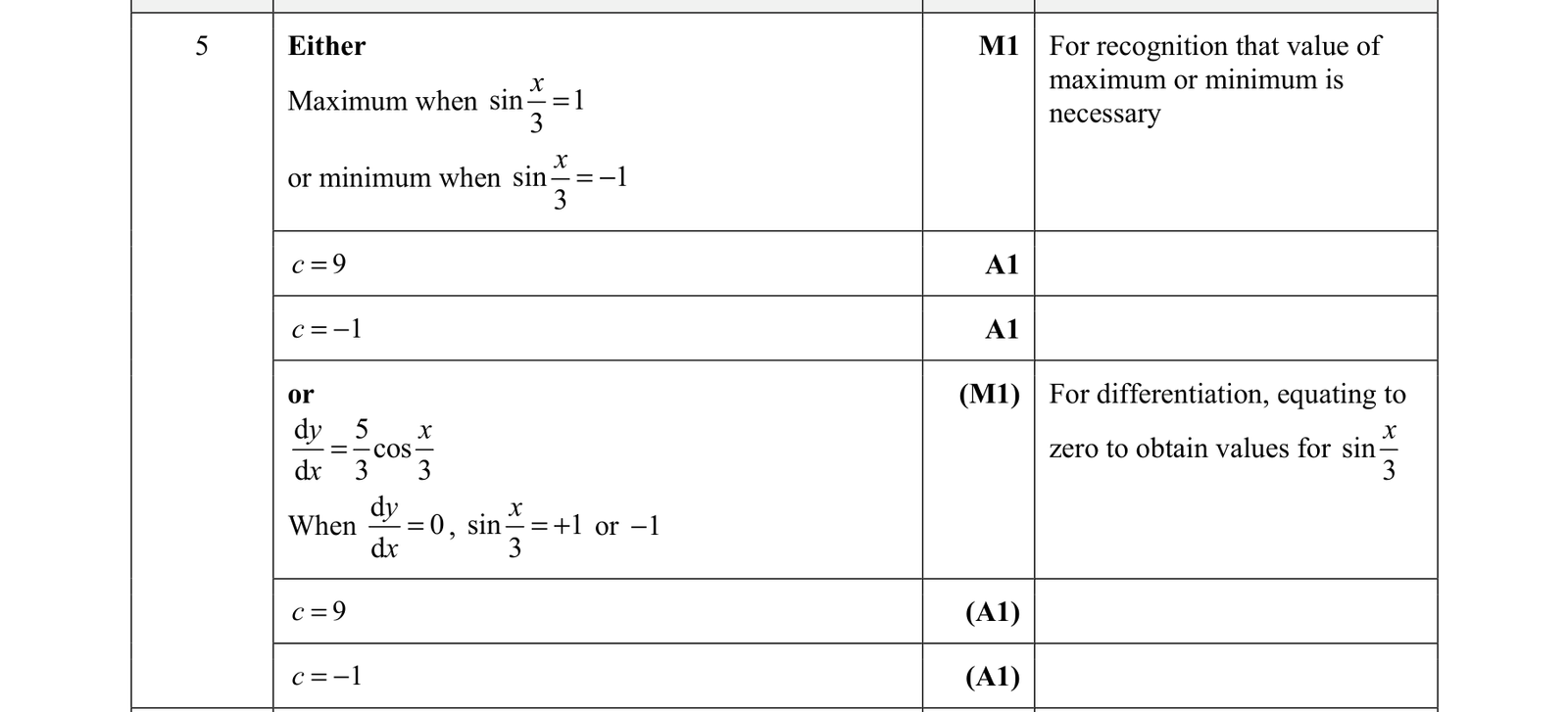
Find the possible values of the constant \(c\) for which the line \(y=c\) is a tangent to the curve
\(y=5\sin\frac{x}{3}+4.\)
0606 P23 - Nov 2021 - Q3 - 5 marks
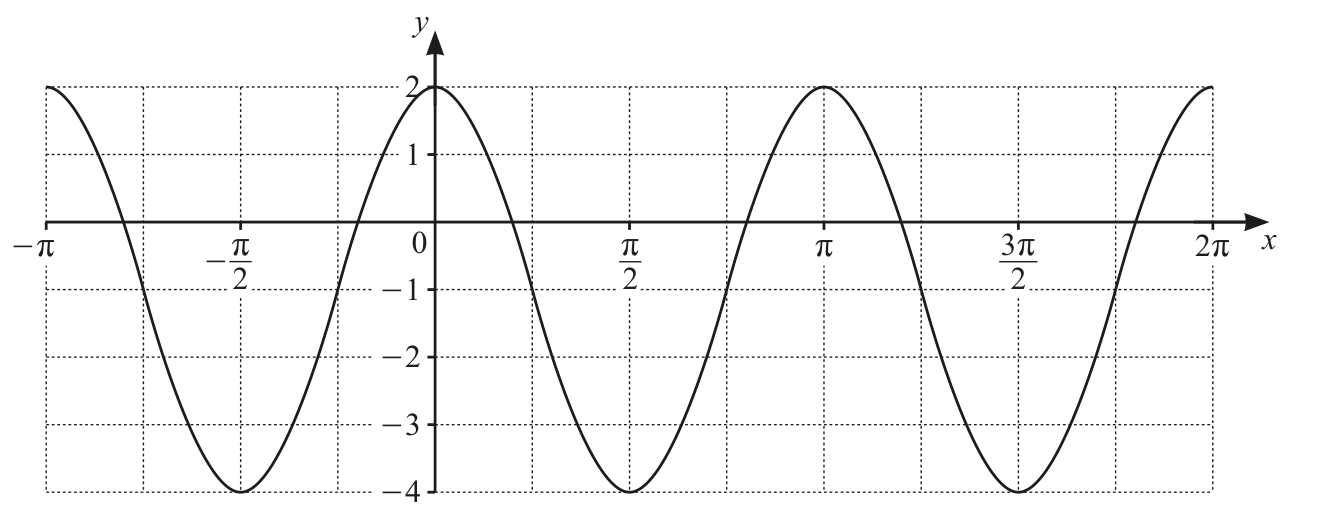
(a) The curve has equation
\(y=a\cos bx+c,\)
where \(a\), \(b\) and \(c\) are integers. Find the values of \(a\), \(b\) and \(c\).
(b) Another curve has equation
\(y=2\sin3x+4.\)
Write down:
(i) the amplitude,
(ii) the period in radians.
0606 P22 - Mar 2020 - Q8 - 6 marks
The diagram shows the graph of \(y=f(x)\), where
\(f(x)=a\cos bx+c\)
for \(0\leq x\leq \frac{8\pi}{3}\).
Explain why \(f\) is a function, state the range of \(f\), and find the values of \(a\), \(b\) and \(c\).


0606 P11 - Jun 2020 - Q2 - 4 marks
(a) Write down the period of
\(2\cos\frac{x}{3}-1.\)
(b) Sketch the graph of
\(y=2\cos\frac{x}{3}-1\)
for \(-360^\circ\leq x\leq360^\circ\).

0606 P12 - Jun 2020 - Q10 - 7 marks
(a) Solve
\(\tan3x=-1\)
for \(-\frac{\pi}{2}\leq x\leq\frac{\pi}{2}\) radians, giving your answers in terms of \(\pi\).
(b) Use your answers to part (a) to sketch the graph of
\(y=4\tan3x+4\)
for \(-\frac{\pi}{2}\leq x\leq\frac{\pi}{2}\) radians. Show the coordinates of the points where the curve meets the axes.

0606 P23 - Jun 2020 - Q6 - 5 marks
(a) The curve \(y=a\sin bx+c\) has a period of \(180^\circ\), an amplitude of \(20\) and passes through the point \((90^\circ,-3)\). Find the value of each of the constants \(a\), \(b\) and \(c\).
(b) The function \(g\) is defined, for \(-135^\circ\leq x\leq135^\circ\), by
\(g(x)=3\tan\frac{x}{2}-4.\)
Sketch the graph of \(y=g(x)\), stating the coordinates of the point where the graph crosses the y-axis.

0606 P11 - Nov 2020 - Q2 - 5 marks
(a) Write down the amplitude of \(1+4\cos\frac{x}{3}\).
(b) Write down the period of \(1+4\cos\frac{x}{3}\).
(c) Sketch the graph of \(y=1+4\cos\frac{x}{3}\) for \(-180^\circ\leq x\leq180^\circ\).

0606 P12 - Nov 2020 - Q3 - 5 marks
The function \(\mathrm{f}\) is given by
\(\mathrm{f}(x)=2\cos\frac{x}{3}-1.\)
(a) Write down the amplitude of \(\mathrm{f}\).
(b) Write down the period of \(\mathrm{f}\).
(c) Sketch the graph of \(y=\mathrm{f}(x)\) for \(-\pi\leq x\leq3\pi\).
