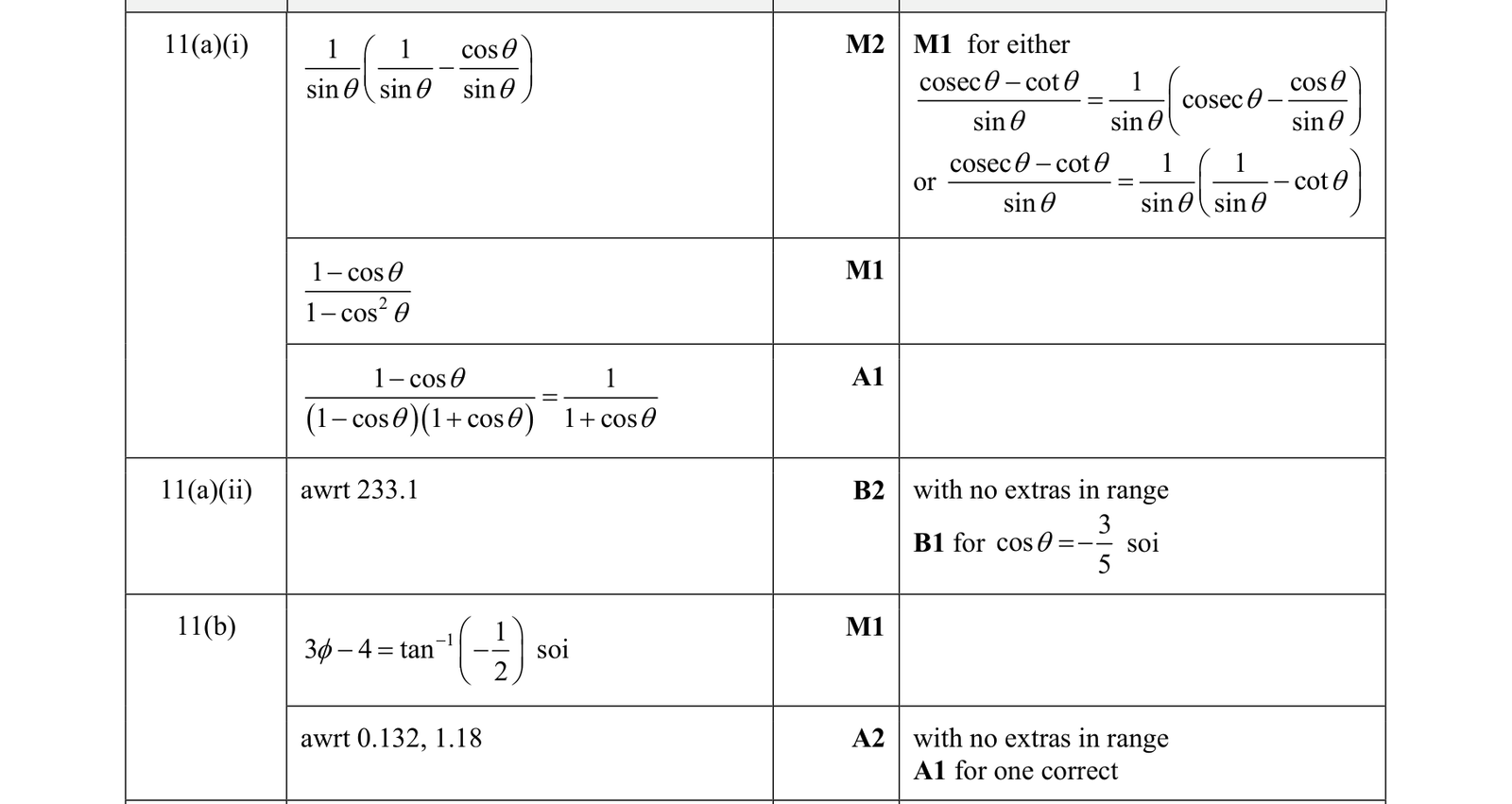
Answer: \(\theta=233.1^\circ\) approximately; \(\phi=0.132,\ 1.18\) approximately.
Using \(\operatorname{cosec}\theta=\frac1{\sin\theta}\) and \(\operatorname{cot}\theta=\frac{\cos\theta}{\sin\theta}\),
\(\frac{\operatorname{cosec}\theta-\operatorname{cot}\theta}{\sin\theta} =\frac{\frac1{\sin\theta}-\frac{\cos\theta}{\sin\theta}}{\sin\theta}.\)
So
\(\frac{\operatorname{cosec}\theta-\operatorname{cot}\theta}{\sin\theta} =\frac{1-\cos\theta}{\sin^2\theta}.\)
Since \(\sin^2\theta=1-\cos^2\theta=(1-\cos\theta)(1+\cos\theta)\),
\(\frac{1-\cos\theta}{\sin^2\theta} =\frac{1-\cos\theta}{(1-\cos\theta)(1+\cos\theta)} =\frac1{1+\cos\theta}.\)
Hence the equation becomes
\(\frac1{1+\cos\theta}=\frac52.\)
Therefore
\(2=5(1+\cos\theta),\)
so
\(\cos\theta=-\frac35.\)
In the interval \(180^\circ\lt \theta\lt 360^\circ\), this gives the third-quadrant solution
\(\boxed{\theta=233.1^\circ}\)
approximately.
For part (b), let
\(u=3\phi-4.\)
Then
\(\tan u=-\frac12.\)
Since \(0\lt \phi\lt \frac{\pi}{2}\),
\(-4\lt u\lt \frac{3\pi}{2}-4.\)
The relevant values of \(u\) in this interval are
\(u=-3.605\ldots,\quad -0.4636\ldots.\)
Hence
\(\phi=\frac{u+4}{3}.\)
This gives
\(\boxed{\phi=0.132,\ 1.18}\)
to 3 significant figures.