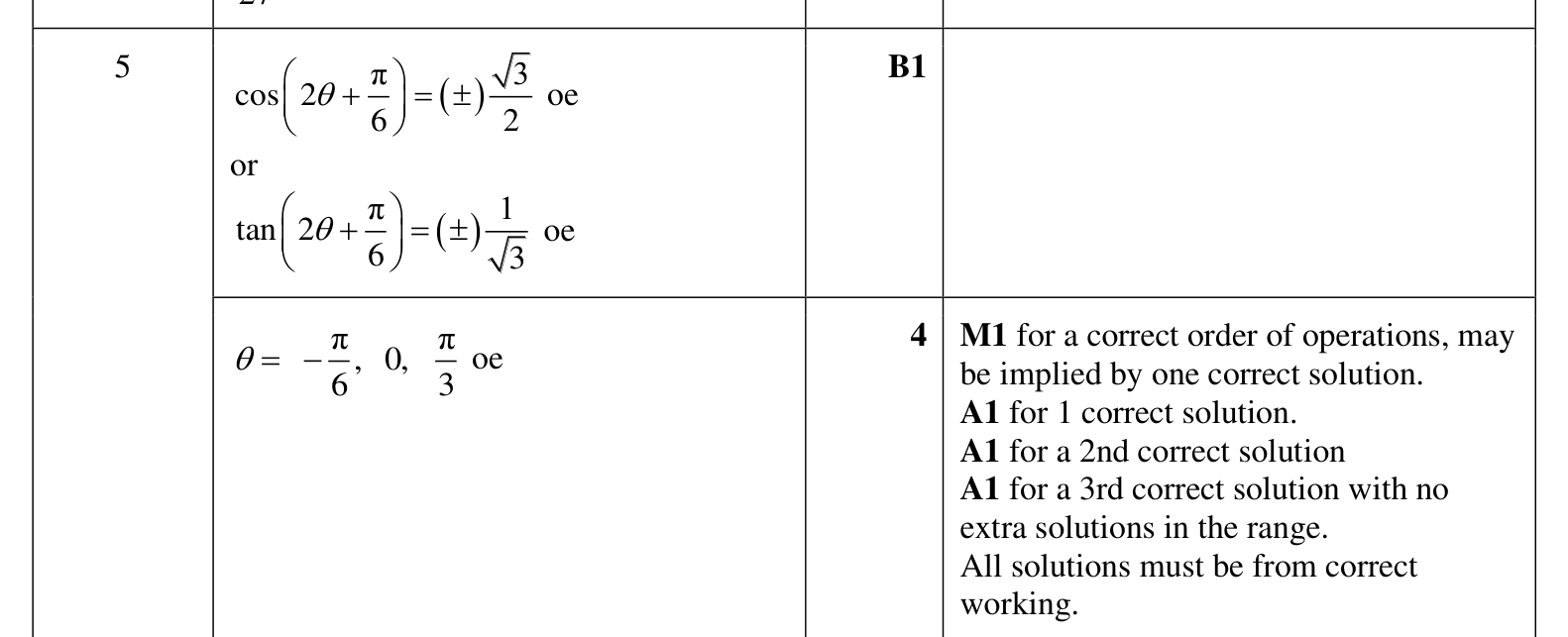
Answer: \(\theta=-\frac\pi6,\ 0,\ \frac\pi3\).
Reduce the equation to a standard trigonometric form, find the principal solutions, then add the correct multiples of the period to cover the required interval.
Let
\(u=2\theta+\frac\pi6\).
The equation is
\(3\operatorname{sec}^2u=4\).
So
\(\operatorname{sec}^2u=\frac43\),
and hence
\(\cos^2u=\frac34\).
Thus
\(\cos u=\pm\frac{\sqrt3}{2}\).
Equivalently, within the required range for \(u\), the possible values are
\(u=-\frac\pi6,\ \frac\pi6,\ \frac{5\pi}{6}\).
Since \(u=2\theta+\frac\pi6\), solve each one.
If \(u=-\frac\pi6\), then \(2\theta=-\frac\pi3\), so \(\theta=-\frac\pi6\).
If \(u=\frac\pi6\), then \(2\theta=0\), so \(\theta=0\).
If \(u=\frac{5\pi}{6}\), then \(2\theta=\frac{2\pi}{3}\), so \(\theta=\frac\pi3\).
All three values lie in \(-\frac\pi2\lt \theta\lt \frac\pi2\).
Therefore
\(\theta=-\frac\pi6,\ 0,\ \frac\pi3\).