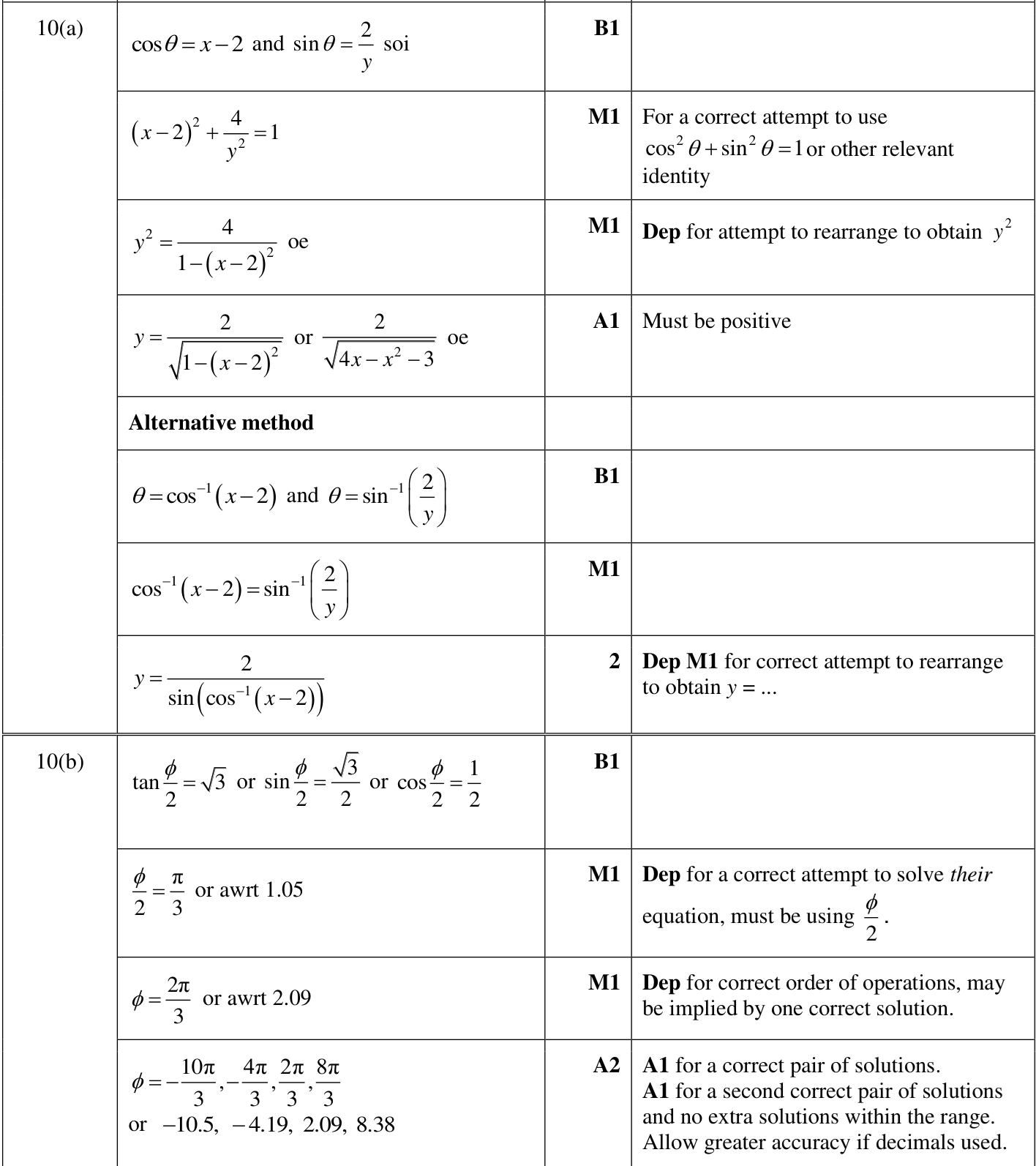
Answer: (a) \(\displaystyle y=\frac{2}{\sqrt{4x-x^2-3}}\); (b) \(\displaystyle \phi=-\frac{10\pi}{3},-\frac{4\pi}{3},\frac{2\pi}{3},\frac{8\pi}{3}\).
Reduce the equation to a standard trigonometric form, find the principal solutions, then add the correct multiples of the period to cover the required interval.
(a) From
\(2+\cos\theta=x,\)
we get
\(\cos\theta=x-2.\)
From
\(2\operatorname{cosec}\theta=y,\)
we have
\(\operatorname{cosec}\theta=\frac{y}{2},\)
so
\(\sin\theta=\frac{2}{y}.\)
Use the identity
\(\sin^2\theta+\cos^2\theta=1.\)
This gives
\(\left(\frac{2}{y}\right)^2+(x-2)^2=1.\)
So
\(\frac{4}{y^2}=1-(x-2)^2.\)
Therefore
\(y^2=\frac{4}{1-(x-2)^2}.\)
Since \(y\gt 2\), take the positive square root:
\(y=\frac{2}{\sqrt{1-(x-2)^2}}.\)
Equivalently,
\(y=\frac{2}{\sqrt{4x-x^2-3}}.\)
(b) Let
\(u=\frac{\phi}{2}.\)
The equation becomes
\(3\cos u=\sqrt3\sin u.\)
So
\(\tan u=\frac{3}{\sqrt3}=\sqrt3.\)
Therefore
\(u=\frac{\pi}{3}+n\pi,\)
where \(n\) is an integer. Hence
\(\phi=\frac{2\pi}{3}+2n\pi.\)
Now require
\(-4\pi\lt \phi\lt 4\pi.\)
The values that satisfy this are
\(\phi=-\frac{10\pi}{3},\quad -\frac{4\pi}{3},\quad \frac{2\pi}{3},\quad \frac{8\pi}{3}.\)