Past Exam Questions
← Back9231 P23 - Jun 2019 - Q9 - 10 marks
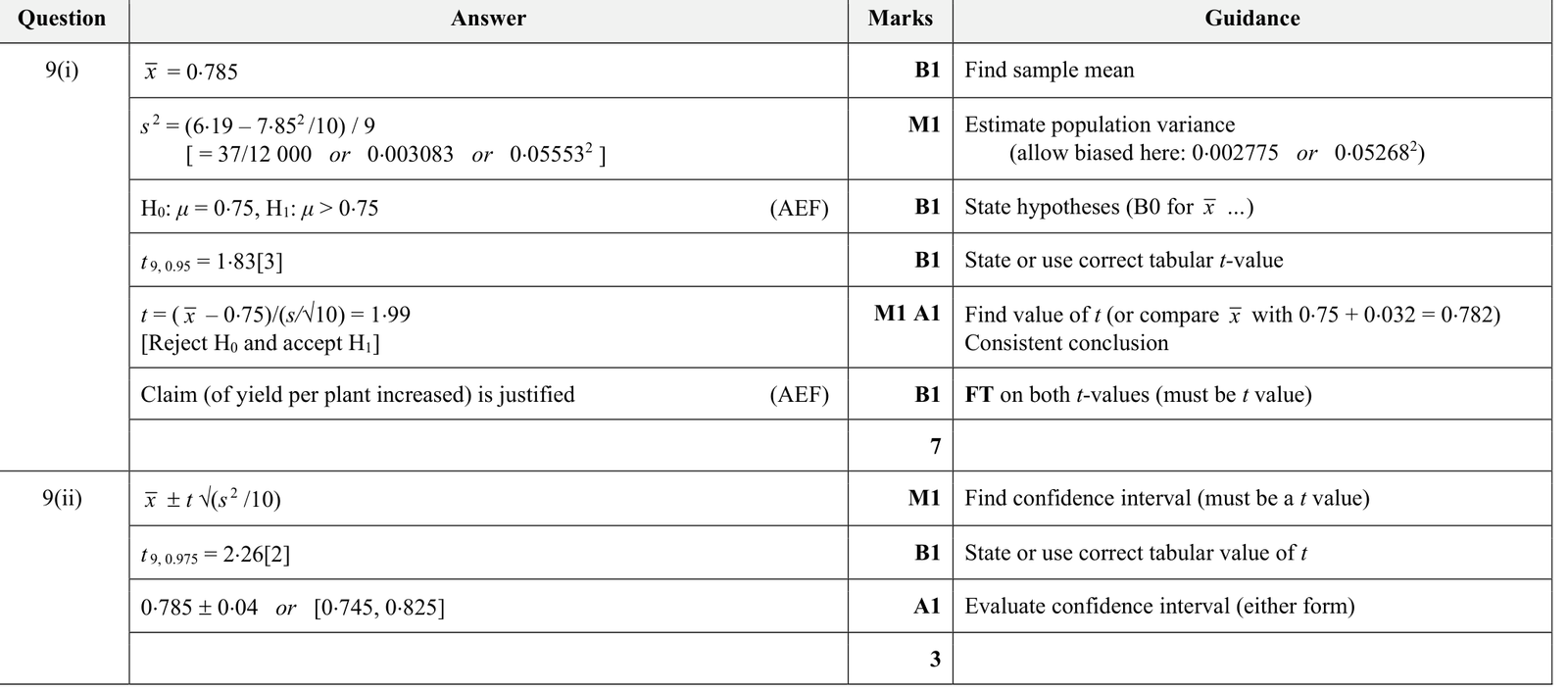
A farmer grows large amounts of a certain crop. On average, the yield per plant has been 0.75 kg . The farmer has improved the soil in which the crop grows, and she claims that the yield per plant has increased. A random sample of 10 plants grown in the improved soil is chosen. The yields, \(x \mathrm{~kg}\), are summarised as follows.
\[\Sigma x=7.85 \quad \Sigma x^{2}=6.19\]
(i) Test at the 5\% significance level whether the farmer's claim is justified, assuming a normal distribution.
(ii) Find a 95\% confidence interval for the population mean yield for plants grown in the new soil.
9231 P21 - Jun 2017 - Q7 - 7 marks
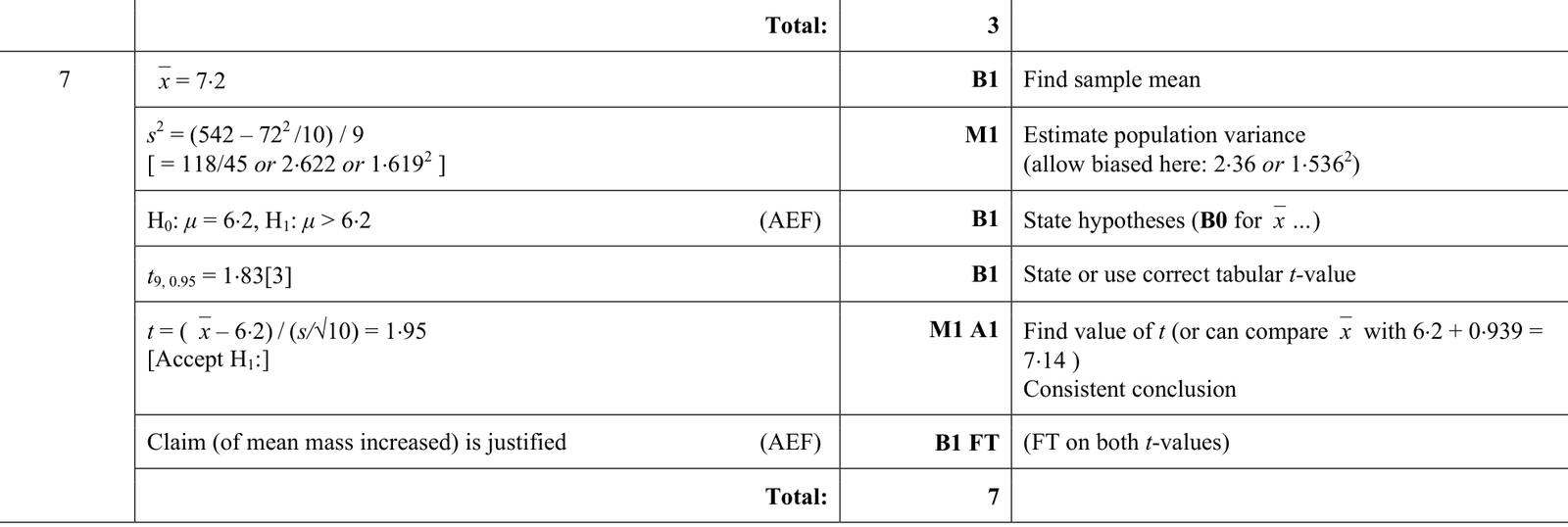
A farmer grows a particular type of fruit tree. On average, the mass of fruit produced per tree has been 6.2 kg . He has developed a new kind of soil and claims that the mean mass of fruit produced per tree when growing in this new soil has increased. A random sample of 10 trees grown in the new soil is chosen. The masses, \(x \mathrm{~kg}\), of fruit produced are summarised as follows.
\[\Sigma x=72.0 \quad \Sigma x^{2}=542.0\]
Test at the 5\% significance level whether the farmer's claim is justified, assuming a normal distribution.
9231 P21 - Jun 2018 - Q7 - 7 marks
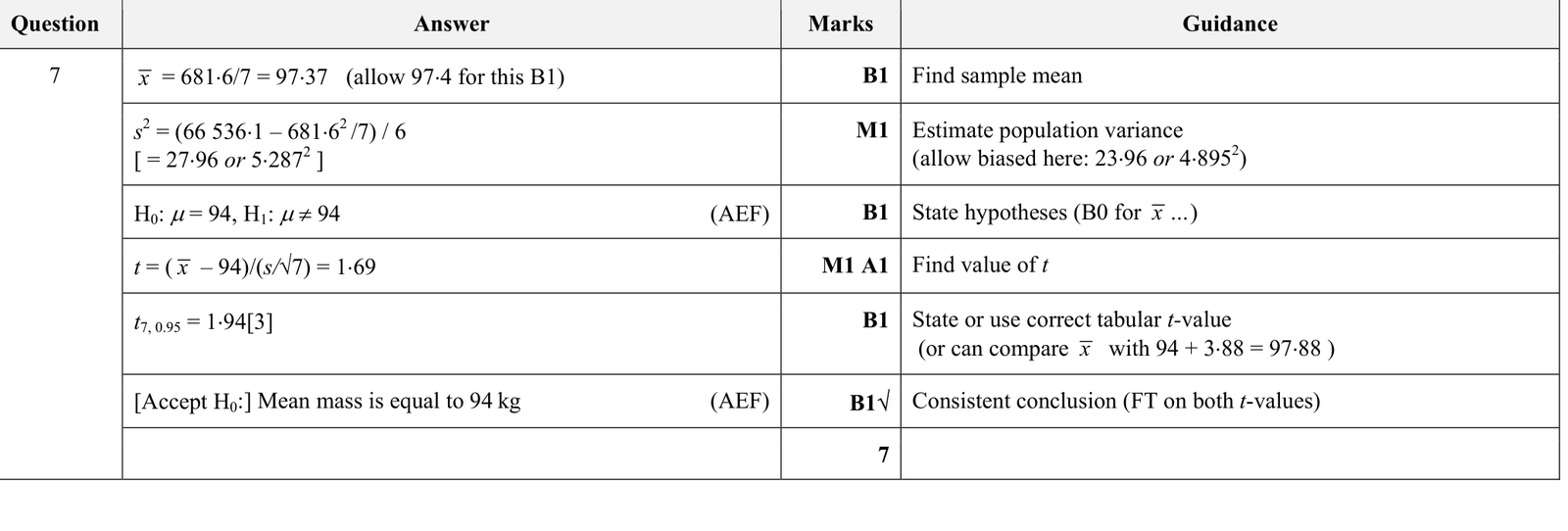
A large number of athletes are taking part in a competition. The masses, in kg , of a random sample of 7 athletes are as follows.
\[\begin{array}{lllllll}
98.1 & 105.0 & 92.2 & 89.8 & 99.9 & 95.4 & 101.2
\end{array}\]
Assuming that masses are normally distributed, test, at the \(10 \%\) significance level, whether the mean mass of athletes in this competition is equal to 94 kg .
9231 P43 - Jun 2025 - Q5 - 8 marks
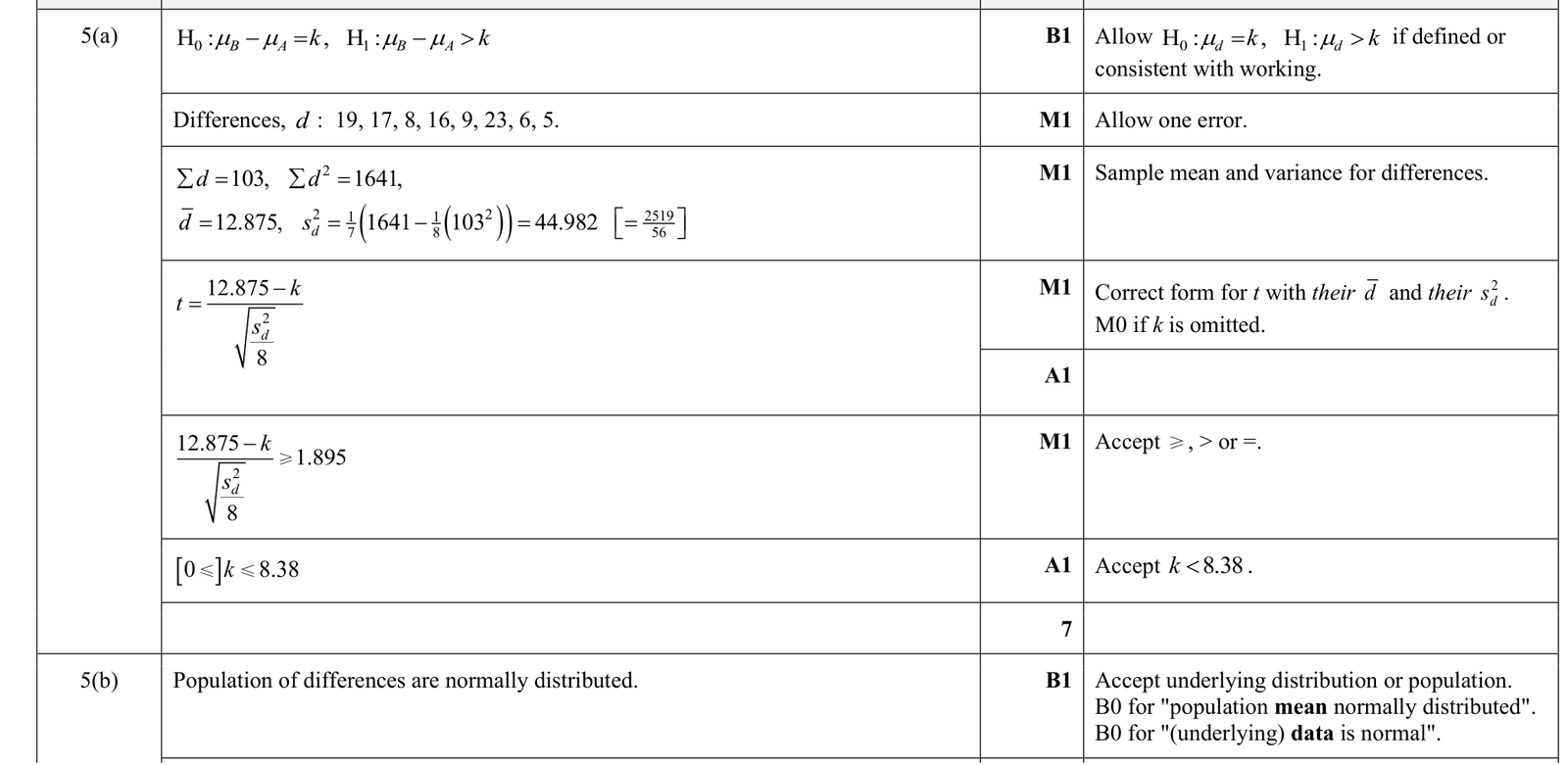
A doctor is investigating the concentration of blood glucose in patients at risk of developing type 2 diabetes, where blood glucose is measured in appropriate units. The doctor claims that a particular intervention reduces the concentration by more than \(k\) units on average. A group of 8 at risk patients is selected at random and each patient follows the intervention for six months. The blood glucose concentrations before and after the intervention are given in the following table.
Patient | \(A\) | \(B\) | \(C\) | \(D\) | \(E\) | \(F\) | \(G\) | \(H\) |
|---|---|---|---|---|---|---|---|---|
Before | 183 | 165 | 172 | 165 | 143 | 176 | 161 | 153 |
After | 164 | 148 | 164 | 149 | 134 | 153 | 155 | 148 |
(a) Use a \(t\)-test at the \(5 \%\) significance level to find the range of values of \(k\) for which the result of the test is to reject the null hypothesis.
(b) State an assumption necessary for the test in part (a) to be valid.
9231 P41 - Nov 2023 - Q1 - 6 marks
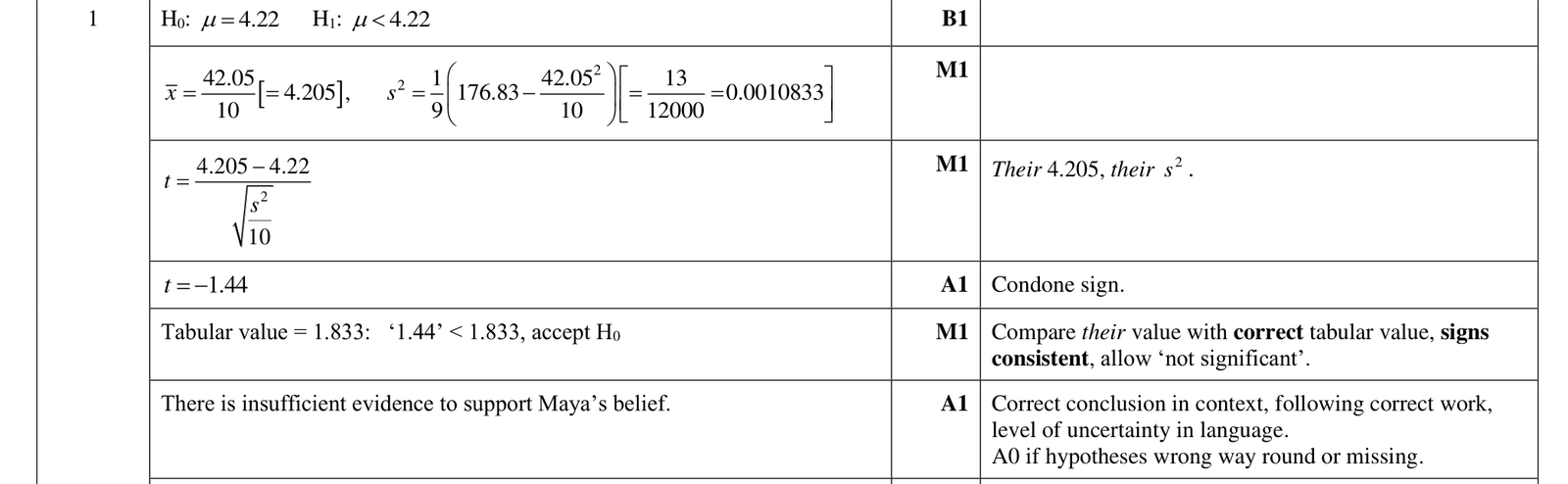
Maya is an athlete who competes in 1500 -metre races. Last summer her practice run times had mean 4.22 minutes. Over the winter she has done some intense training to try to improve her times. A random sample of 10 of her practice run times, \(x\) minutes, this summer are summarised as follows.
\(\sum x=42.05 \quad \sum x^{2}=176.83\)
Maya's new practice run times are normally distributed. She believes that on average her times have improved as a result of her training.
Test, at the \(5 \%\) significance level, whether Maya's belief is supported by the data.
9231 P41 - Jun 2021 - Q1 - 7 marks
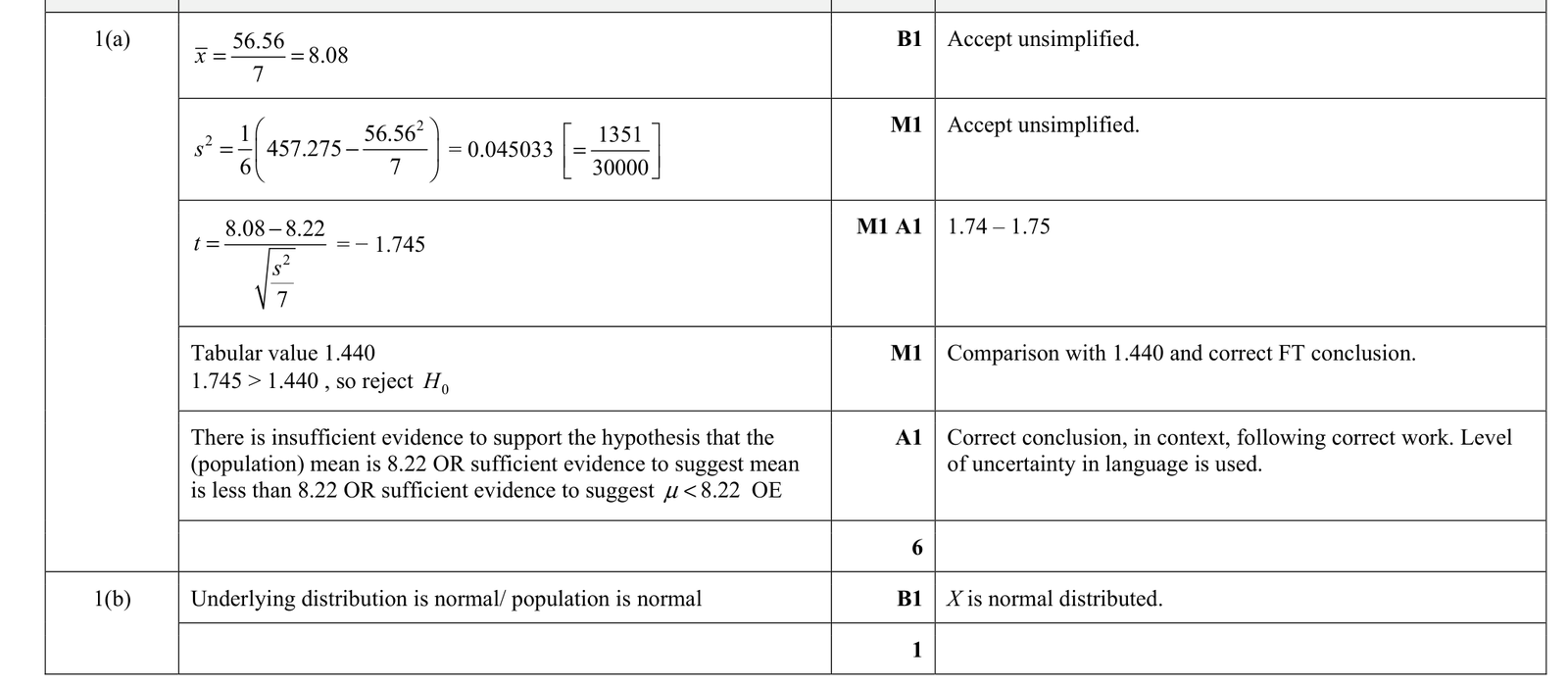
A random sample of 7 observations of a variable \(X\) are as follows.
| 8.26 | 7.78 | 7.92 | 8.04 | 8.27 | 7.95 | 8.34 |
The population mean of \(X\) is \(\mu\).
(a) Test, at the \(10 \%\) significance level, the null hypothesis \(\mu=8.22\) against the alternative hypothesis \(\mu\lt 8.22\).
(b) State an assumption necessary for the test in part (a) to be valid.
9231 P43 - Jun 2021 - Q1 - 6 marks
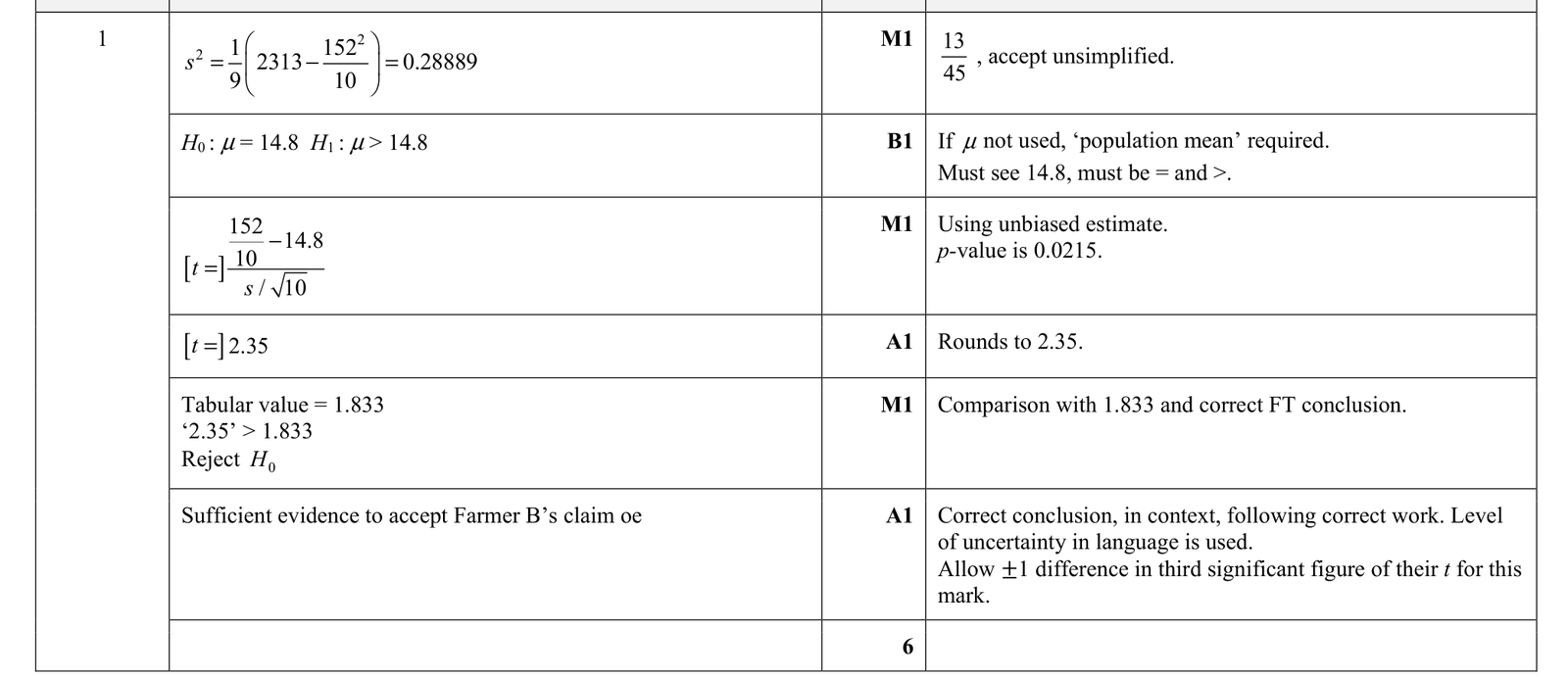
Farmer \(A\) grows apples of a certain variety. Each tree produces 14.8 kg of apples, on average, per year. Farmer \(B\) grows apples of the same variety and claims that his apple trees produce a higher mass of apples per year than Farmer \(A\) 's trees. The masses of apples from Farmer \(B\) 's trees may be assumed to be normally distributed.
A random sample of 10 trees from Farmer \(B\) is chosen. The masses, \(x \mathrm{~kg}\), of apples produced in a year are summarised as follows.
\(\sum x=152.0 \quad \sum x^{2}=2313.0\)
Test, at the \(5 \%\) significance level, whether Farmer \(B\) 's claim is justified.
9231 P41 - Nov 2021 - Q4 - 8 marks
Manet has developed a new training course to help athletes improve their time taken to run 800 m . Manet claims that his course will decrease an athlete's time by more than 2 s on average. For a random sample of 10 athletes the times taken, in seconds, before and after the course are given in the following table.
Athlete | \(A\) | \(B\) | \(C\) | \(D\) | \(E\) | \(F\) | \(G\) | \(H\) | \(I\) | \(J\) |
|---|---|---|---|---|---|---|---|---|---|---|
Before | 150 | 146 | 131 | 135 | 126 | 142 | 130 | 129 | 137 | 134 |
After | 145 | 138 | 129 | 135 | 122 | 135 | 132 | 128 | 127 | 137 |
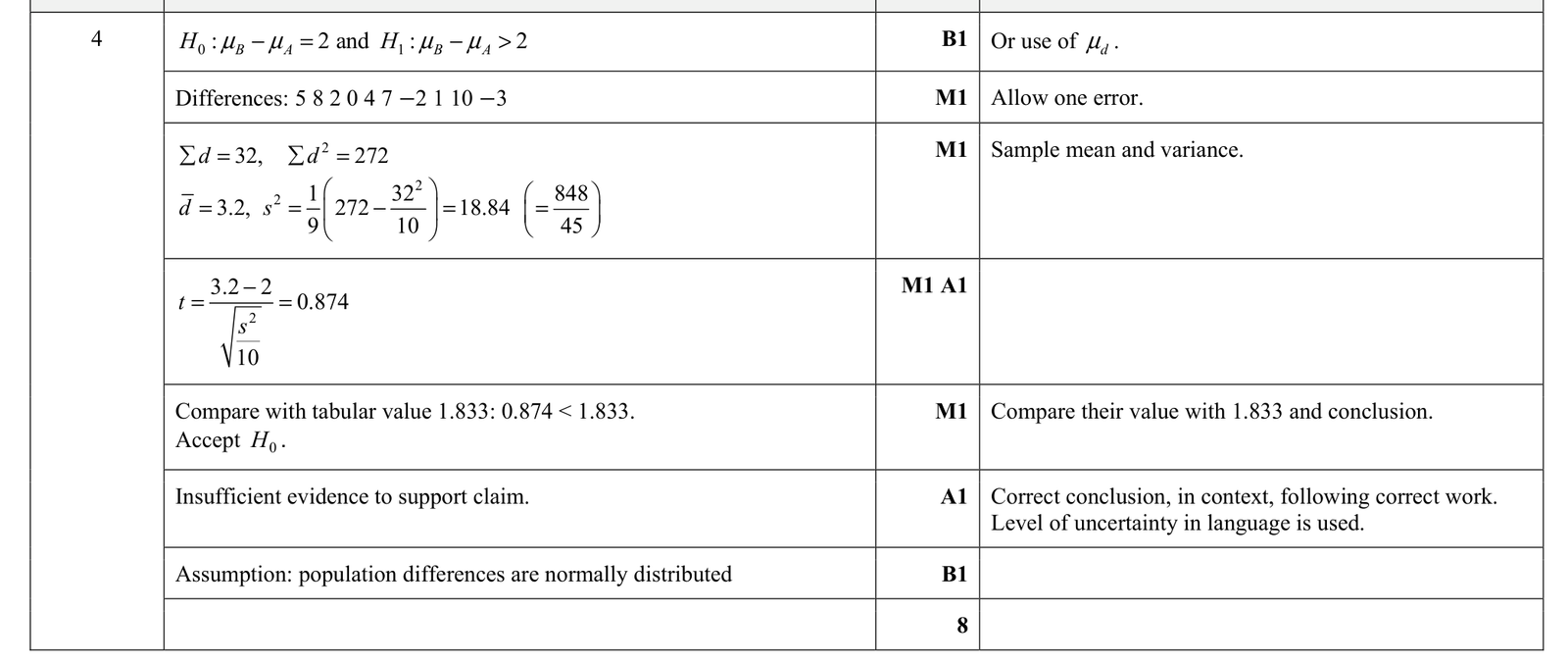
Use a \(t\)-test, at the \(5 \%\) significance level, to test whether Manet's claim is justified, stating any assumption that you make.
9231 P21 - Nov 2018 - Q8 - 9 marks
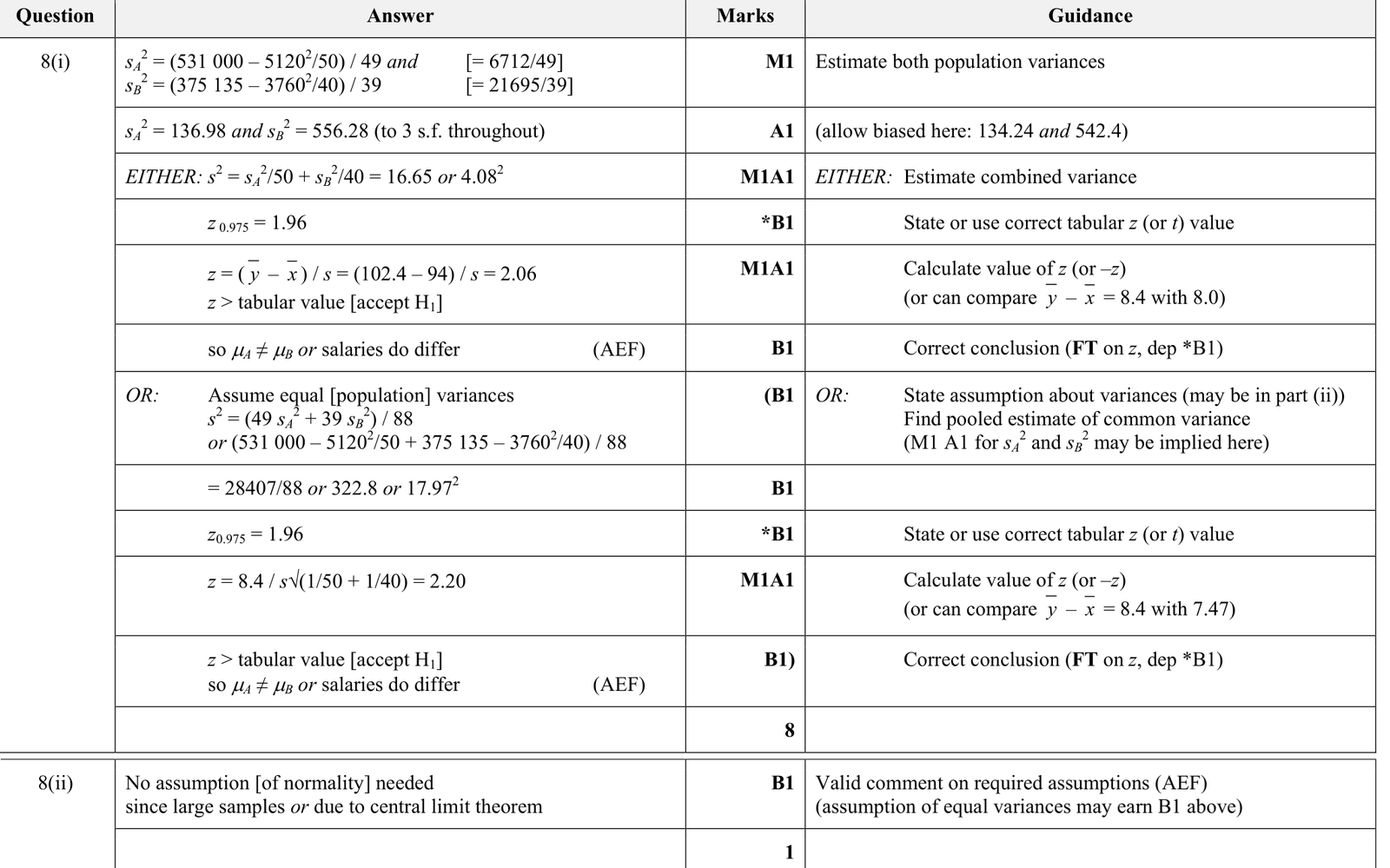
The weekly salaries of employees at two large electronics companies, \(A\) and \(B\), are being compared. The weekly salaries of an employee from company \(A\) and an employee from company \(B\) are denoted by \(\$ x\) and \(\$ y\) respectively. A random sample of 50 employees from company \(A\) and a random sample of 40 employees from company \(B\) give the following summarised data.
\[\Sigma x=5120 \quad \Sigma x^{2}=531000 \quad \Sigma y=3760 \quad \Sigma y^{2}=375135\]
(i) The population mean salaries of employees from companies \(A\) and \(B\) are denoted by \(\$ \mu_{A}\) and \(\$ \mu_{B}\) respectively. Using a \(5 \%\) significance level, test the null hypothesis \(\mu_{A}=\mu_{B}\) against the alternative hypothesis \(\mu_{A} \neq \mu_{B}\).
(ii) State, with a reason, whether any assumptions about the distributions of employees' salaries are needed for the test in part (i).
9231 P21 - Nov 2019 - Q8 - 9 marks
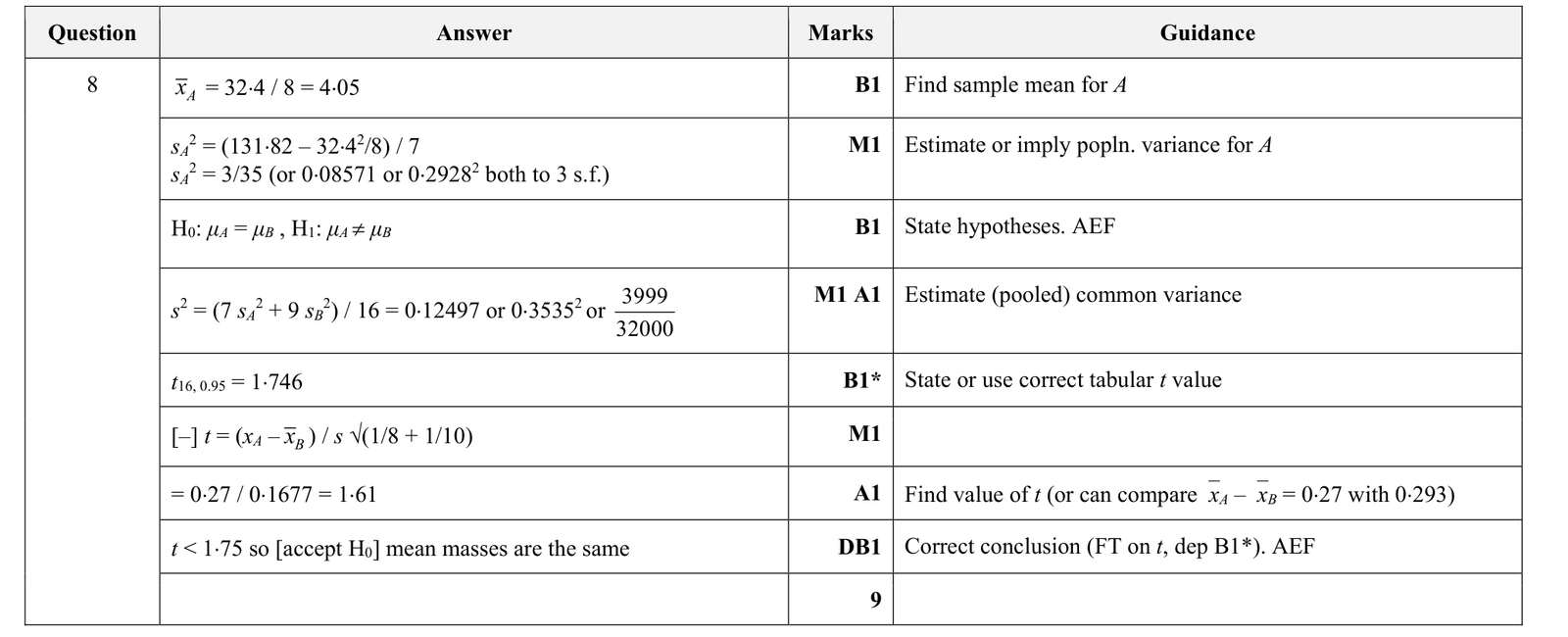
A random sample of 8 elephants from region \(A\) is taken and their weights, \(x\) tonnes, are recorded. ( 1 tonne \(=1000 \mathrm{~kg}\).) The results are summarised as follows.
\[\Sigma x=32.4 \quad \Sigma x^{2}=131.82\]
A random sample of 10 elephants from region \(B\) is taken. Their weights give a sample mean of 3.78 tonnes and an unbiased variance estimate of 0.1555 tonnes \(^{2}\). The distributions of the weights of elephants in regions \(A\) and \(B\) are both assumed to be normal with the same population variance. Test at the 10\% significance level whether the mean weight of elephants in region \(A\) is the same as the mean weight of elephants in region \(B\).
9231 P23 - Jun 2019 - Q11O - 12 marks
Question 11 OR alternative.
A company produces packets of sweets. Two different machines, \(A\) and \(B\), are used to fill the packets. The manager decides to assess the performance of the two machines. He selects a random sample of 50 packets filled by machine \(A\) and a random sample of 60 packets filled by machine \(B\). The masses of sweets, \(x \mathrm{~kg}\), in packets filled by machine \(A\) and the masses of sweets, \(y \mathrm{~kg}\), in packets filled by machine \(B\) are summarised as follows.
\[\Sigma x=22.4 \quad \Sigma x^{2}=10.1 \quad \Sigma y=28.8 \quad \Sigma y^{2}=16.3\]
A test at the \(\alpha \%\) significance level provides evidence that the mean mass of sweets in packets filled by machine \(A\) is less than the mean mass of sweets in packets filled by machine \(B\). Find the set of possible values of \(\alpha\).

9231 P21 - Jun 2019 - Q11O - 12 marks
Question 11 OR alternative.
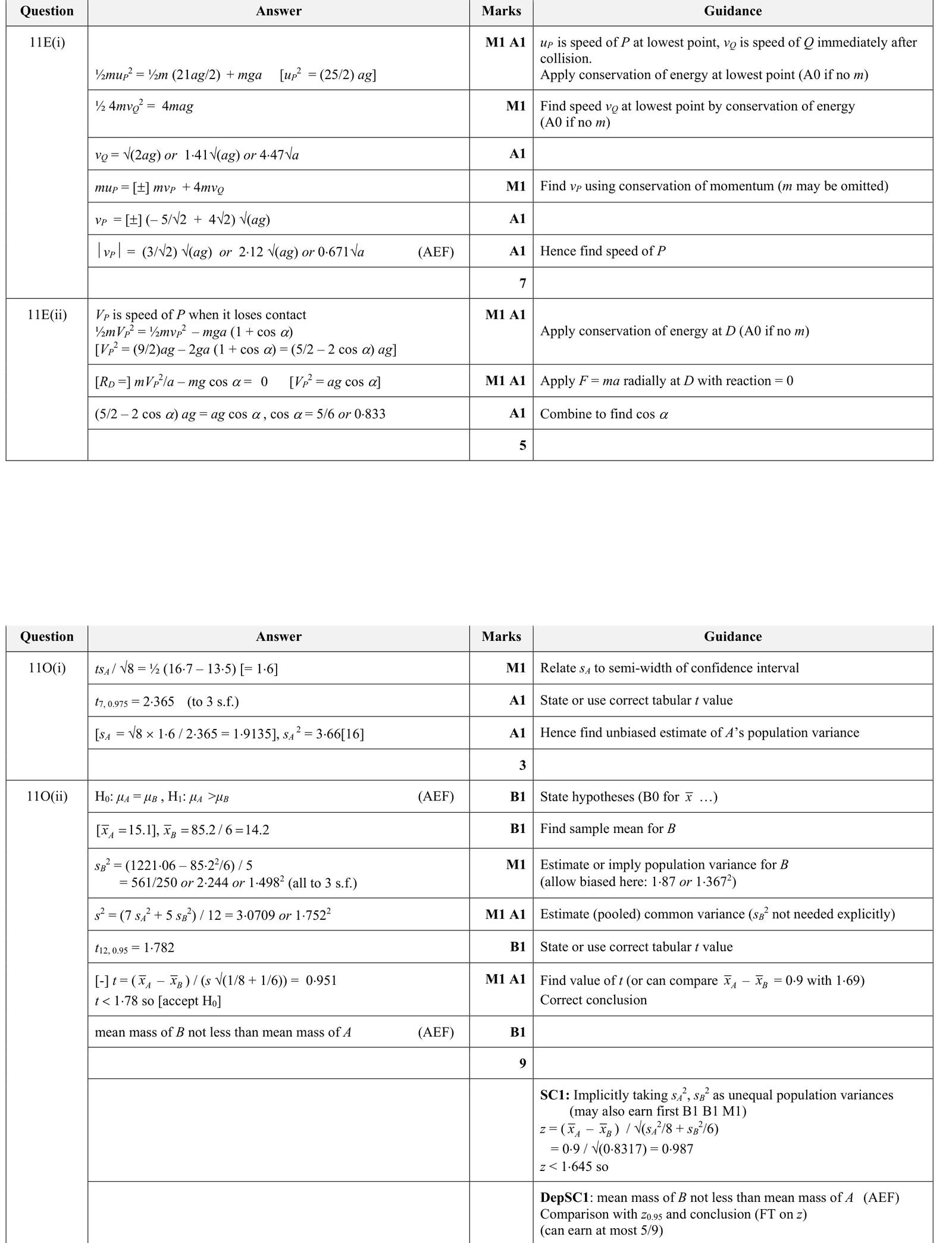
A farmer grows two different types of cherries, Type \(A\) and Type \(B\). He assumes that the masses of each type are normally distributed. He chooses a random sample of 8 cherries of Type \(A\). He finds that the sample mean mass is 15.1 g and that a \(95\%\) confidence interval for the population mean mass, \(\mu\) g, is \(13.5\leqslant\mu\leqslant16.7\).
(i) Find an unbiased estimate for the population variance of the masses of cherries of Type \(A\).
The farmer now chooses a random sample of 6 cherries of Type \(B\) and records their masses as follows.
| 12.2 | 13.3 | 16.4 | 14.0 | 13.9 | 15.4 |
(ii) Test at the \(5\%\) significance level whether the mean mass of cherries of Type \(B\) is less than the mean mass of cherries of Type \(A\). You should assume that the population variances for the two types of cherry are equal.
9231 P22 - Nov 2018 - Q11O - 14 marks
Question 11 OR alternative.
In a particular country, large numbers of ducks live on lakes \(A\) and \(B\). The mass, in kg, of a duck on lake \(A\) is denoted by \(x\) and the mass, in kg, of a duck on lake \(B\) is denoted by \(y\). A random sample of 8 ducks is taken from lake \(A\) and a random sample of 10 ducks is taken from lake \(B\). Their masses are summarised as follows.
\[\sum x=10.56\quad \sum x^2=14.1775\quad \sum y=12.39\quad \sum y^2=15.894\]
A scientist claims that ducks on lake \(A\) are heavier on average than ducks on lake \(B\).
(i) Test, at the \(10\%\) significance level, whether the scientist's claim is justified. You should assume that both distributions are normal and that their variances are equal.
A second random sample of 8 ducks is taken from lake \(A\) and their masses are summarised as
\[\sum x=10.24\quad\text{and}\quad\sum(x-\bar{x})^2=0.294,\]
where \(\bar{x}\) is the sample mean. The scientist now claims that the population mean mass of ducks on lake \(A\) is greater than \(p\ \mathrm{kg}\). A test of this claim is carried out at the \(10\%\) significance level, using only this second sample from lake \(A\). This test supports the scientist's claim.
(ii) Find the greatest possible value of \(p\).

9231 P21 - Jun 2017 - Q9 - 10 marks
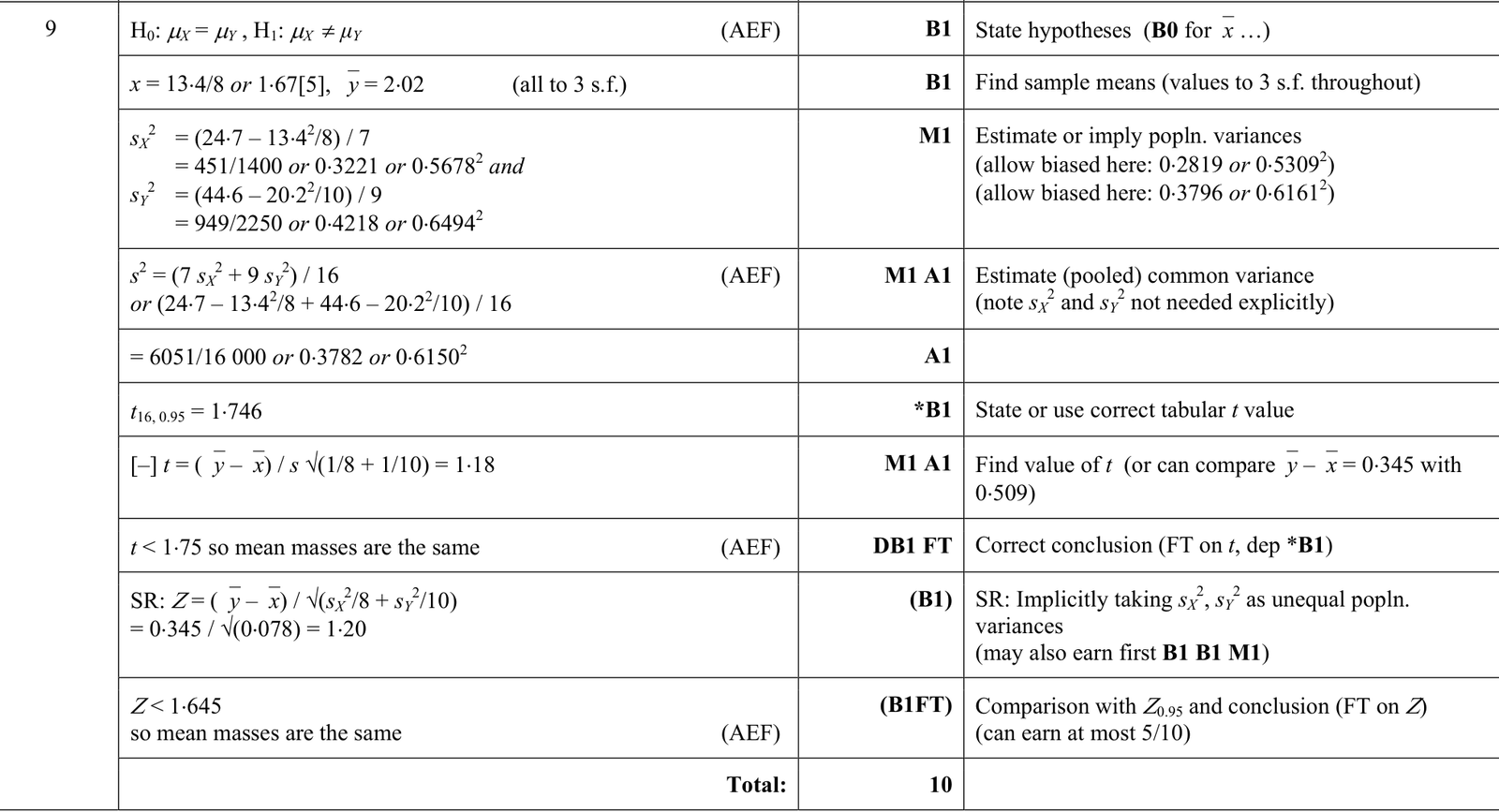
Two fish farmers \(X\) and \(Y\) produce a particular type of fish. Farmer \(X\) chooses a random sample of 8 of his fish and records the masses, \(x \mathrm{~kg}\), as follows.
\[\begin{array}{llllllll}
1.2 & 1.4 & 0.8 & 2.1 & 1.8 & 2.6 & 1.5 & 2.0
\end{array}\]
Farmer \(Y\) chooses a random sample of 10 of his fish and summarises the masses, \(y \mathrm{~kg}\), as follows.
\[\Sigma y=20.2 \quad \Sigma y^{2}=44.6\]
You should assume that both distributions are normal with equal variances. Test at the \(10 \%\) significance level whether the mean mass of fish produced by farmer \(X\) differs from the mean mass of fish produced by farmer \(Y\).
9231 P23 - Jun 2017 - Q6 - 5 marks
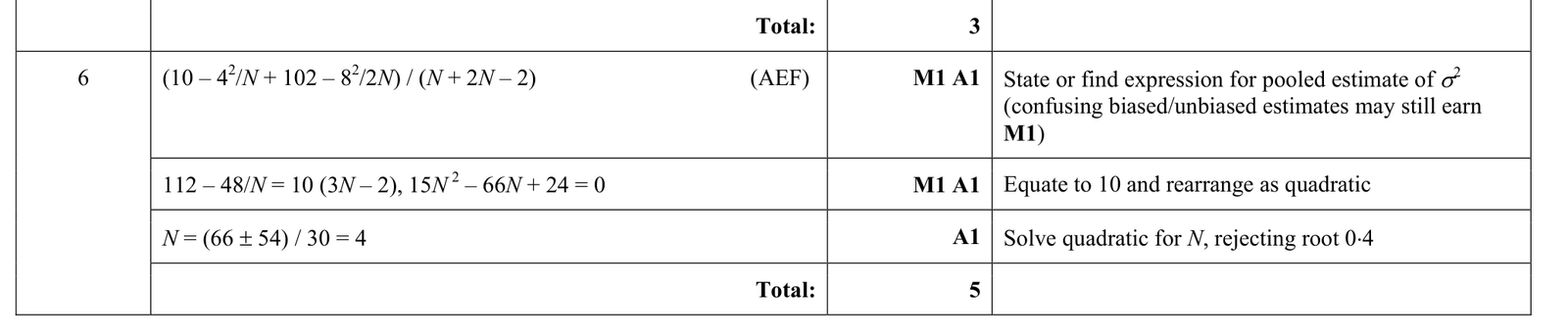
The independent variables \(X\) and \(Y\) have distributions with the same variance \(\sigma^{2}\). Random samples of \(N\) observations of \(X\) and \(2 N\) observations of \(Y\) are taken, and the results are summarised by
\[\Sigma x=4, \quad \Sigma x^{2}=10, \quad \Sigma y=8, \quad \Sigma y^{2}=102 .\]
These data give a pooled estimate of 10 for \(\sigma^{2}\). Find \(N\).
9231 P21 - Nov 2017 - Q10 - 13 marks
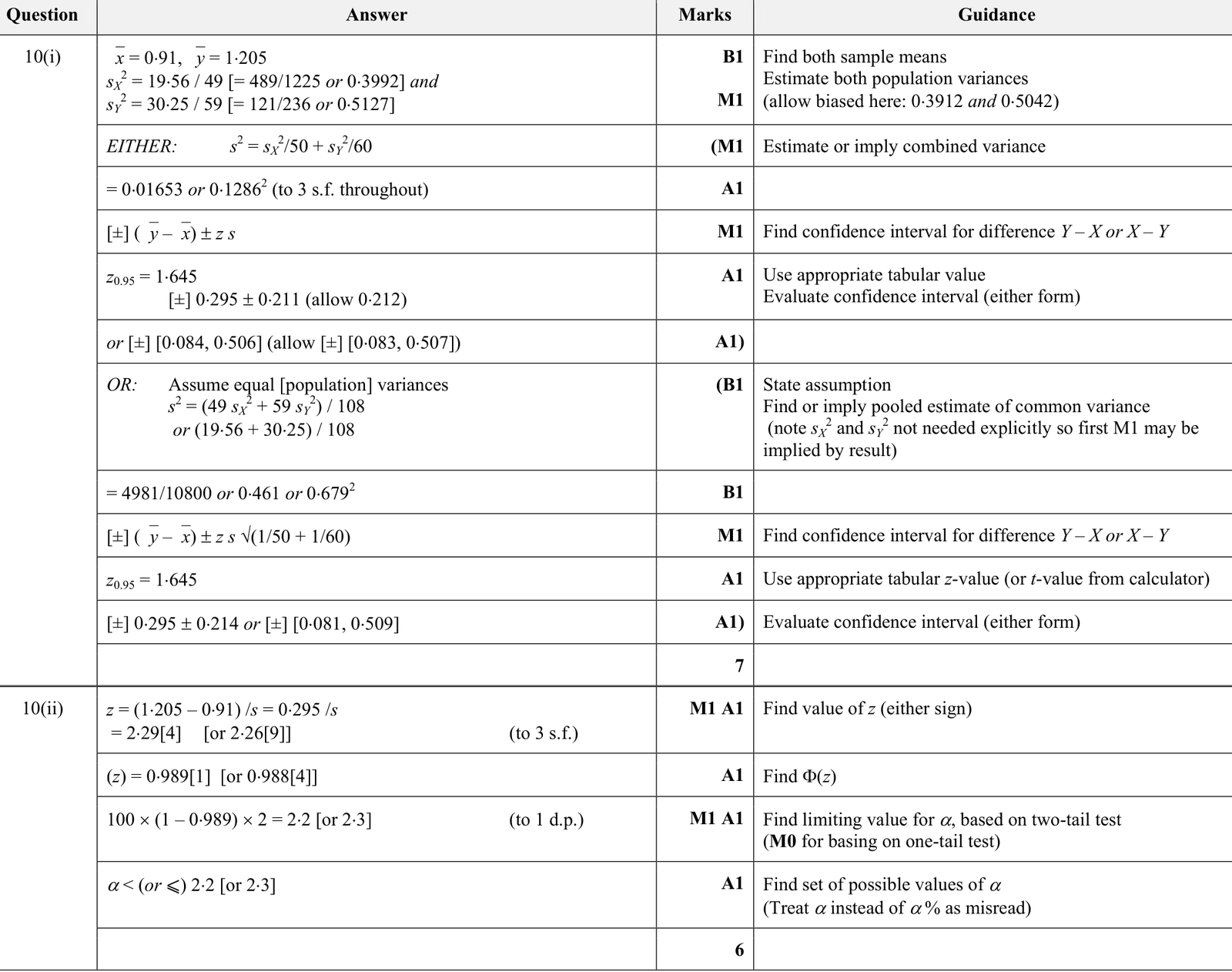
A factory produces bottles of an energy juice. Two different machines are used to fill empty bottles with the juice. The manager chooses a random sample of 50 bottles filled by machine \(X\) and a random sample of 60 bottles filled by machine \(Y\). The volumes of juice, \(x\) and \(y\) respectively, measured in appropriate units, are summarised by
\[\Sigma x=45.5, \quad \Sigma(x-\bar{x})^{2}=19.56, \quad \Sigma y=72.3, \quad \Sigma(y-\bar{y})^{2}=30.25,\]
where \(\bar{x}\) and \(\bar{y}\) are the sample means of the volume of juice in the bottles filled by \(X\) and \(Y\) respectively.
(i) Find a \(90 \%\) confidence interval for the difference between the mean volume of juice in bottles filled by machine \(X\) and the mean volume of juice in bottles filled by machine \(Y\).
A test at the \(\alpha \%\) significance level does not provide evidence that there is any difference in the means of the volume of juice in bottles filled by machine \(X\) and the volume of juice in bottles filled by machine \(Y\).
(ii) Find the set of possible values of \(\alpha\).
9231 P21 - Jun 2018 - Q10 - 12 marks
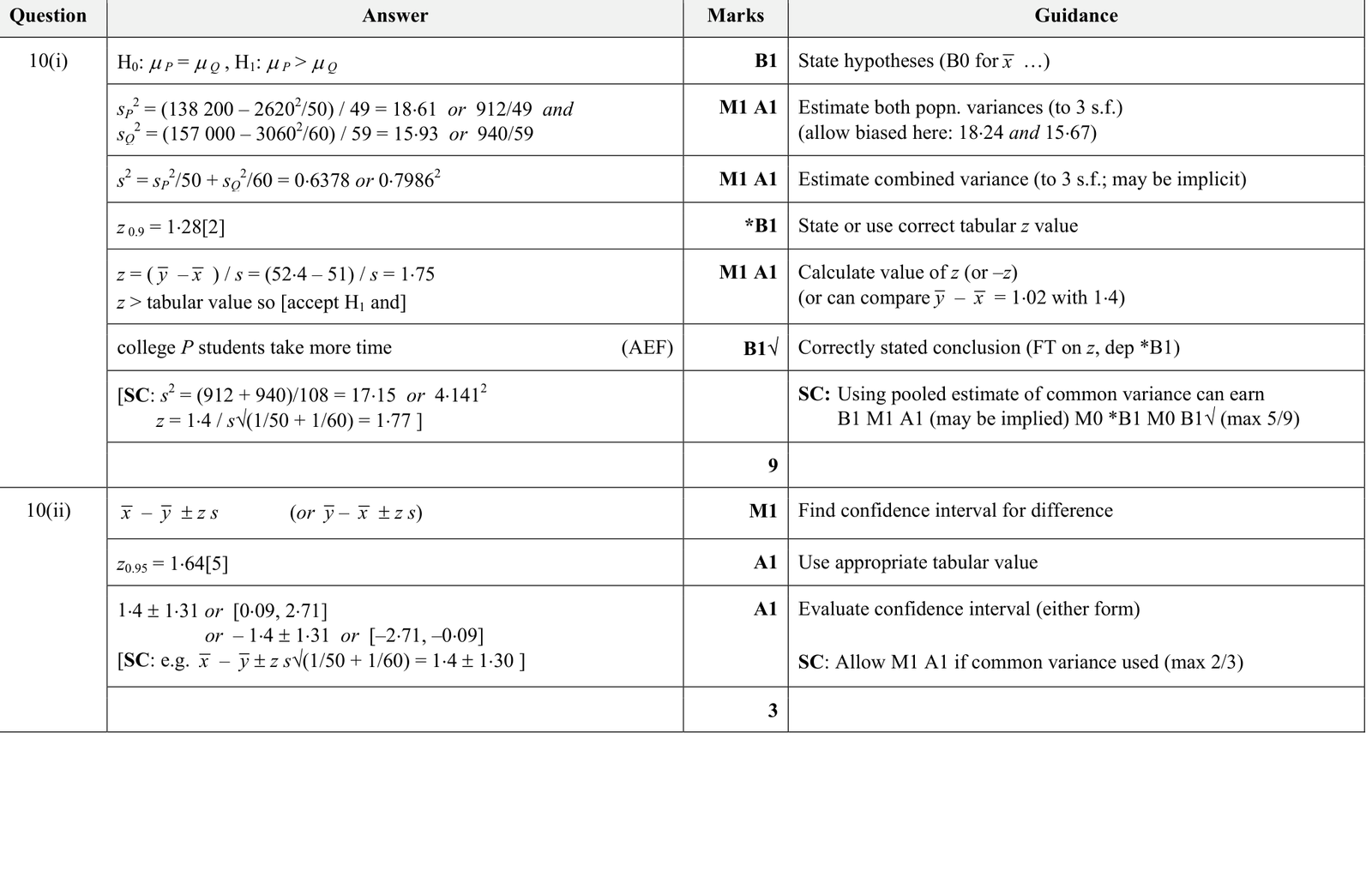
The times taken to run 400 metres by students at two large colleges \(P\) and \(Q\) are being compared. There is no evidence that the population variances are equal. The time taken by a student at college \(P\) and the time taken by a student at college \(Q\) are denoted by \(x\) seconds and \(y\) seconds respectively. A random sample of 50 students from college \(P\) and a random sample of 60 students from college \(Q\) give the following summarised data.
\[\Sigma x=2620 \quad \Sigma x^{2}=138200 \quad \Sigma y=3060 \quad \Sigma y^{2}=157000\]
(i) Using a \(10 \%\) significance level, test whether, on average, students from college \(P\) take longer to run 400 metres than students from college \(Q\).
(ii) Find a \(90 \%\) confidence interval for the difference in the mean times taken to run 400 metres by students from colleges \(P\) and \(Q\).
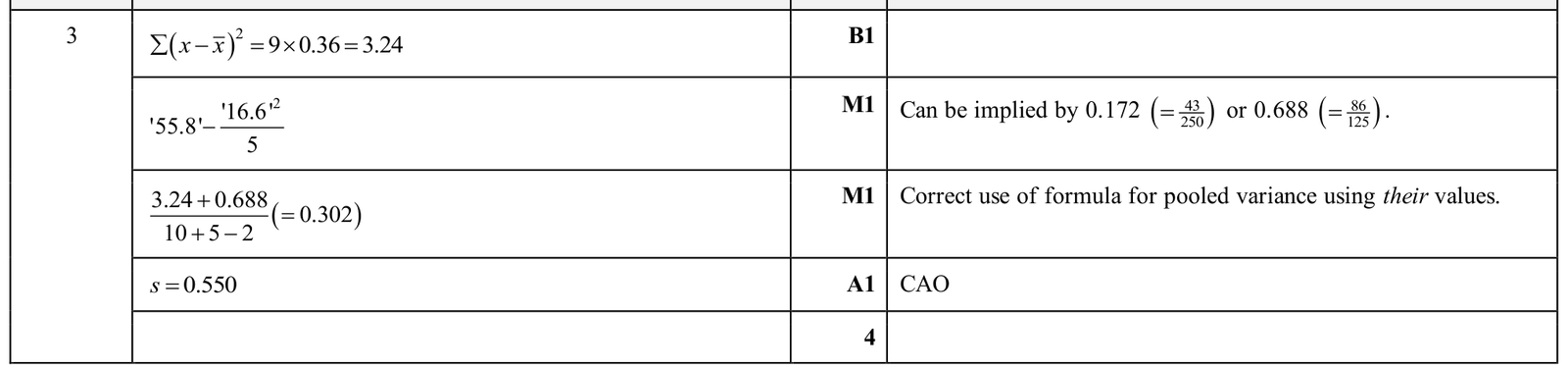
9231 P41 - Nov 2025 - Q3 - 4 marks
A random sample of 10 newborn baby boys is taken and their masses in kg are recorded. From this sample, the population standard deviation of all newborn baby boys is estimated as \(0.6\) kg. A random sample of 5 newborn baby girls is taken and their masses in kg are recorded as follows.
| \(3.9\) | \(3.1\) | \(2.9\) | \(3.1\) | \(3.6\) |
It is assumed that the masses of newborn baby boys and girls have the same population standard deviation, \(\sigma\) kg.
By pooling the two samples, calculate an estimate of \(\sigma\).
9231 P42 - Nov 2025 - Q5 - 9 marks
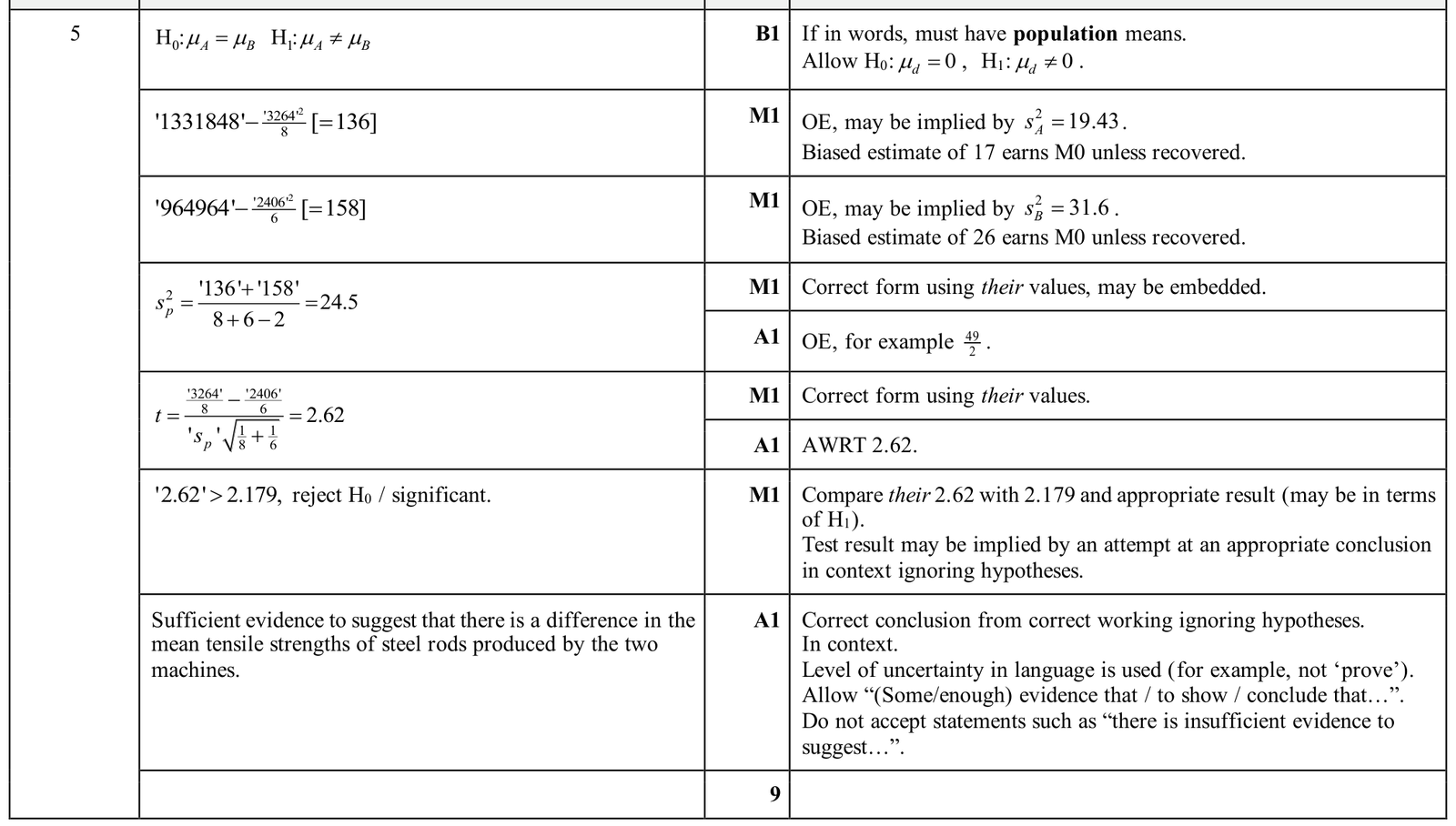
An engineer is comparing the tensile strengths of steel rods made from two machines, \(A\) and \(B\). The engineer randomly selects 8 rods from machine \(A\) and 6 rods from machine \(B\). The tensile strengths, in appropriate units, are given in the following table.
| Machine \(A\) | \(402\) | \(403\) | \(415\) | \(412\) | \(409\) | \(407\) | \(406\) | \(410\) |
|---|---|---|---|---|---|---|---|---|
| Machine \(B\) | \(401\) | \(398\) | \(395\) | \(397\) | \(410\) | \(405\) |
You should assume that the two distributions are normal and have the same population variance. Use a \(t\)-test at the \(5\%\) significance level to test whether there is any difference in the mean tensile strengths of steel rods from the two machines.
9231 P41 - Jun 2025 - Q1 - 7 marks
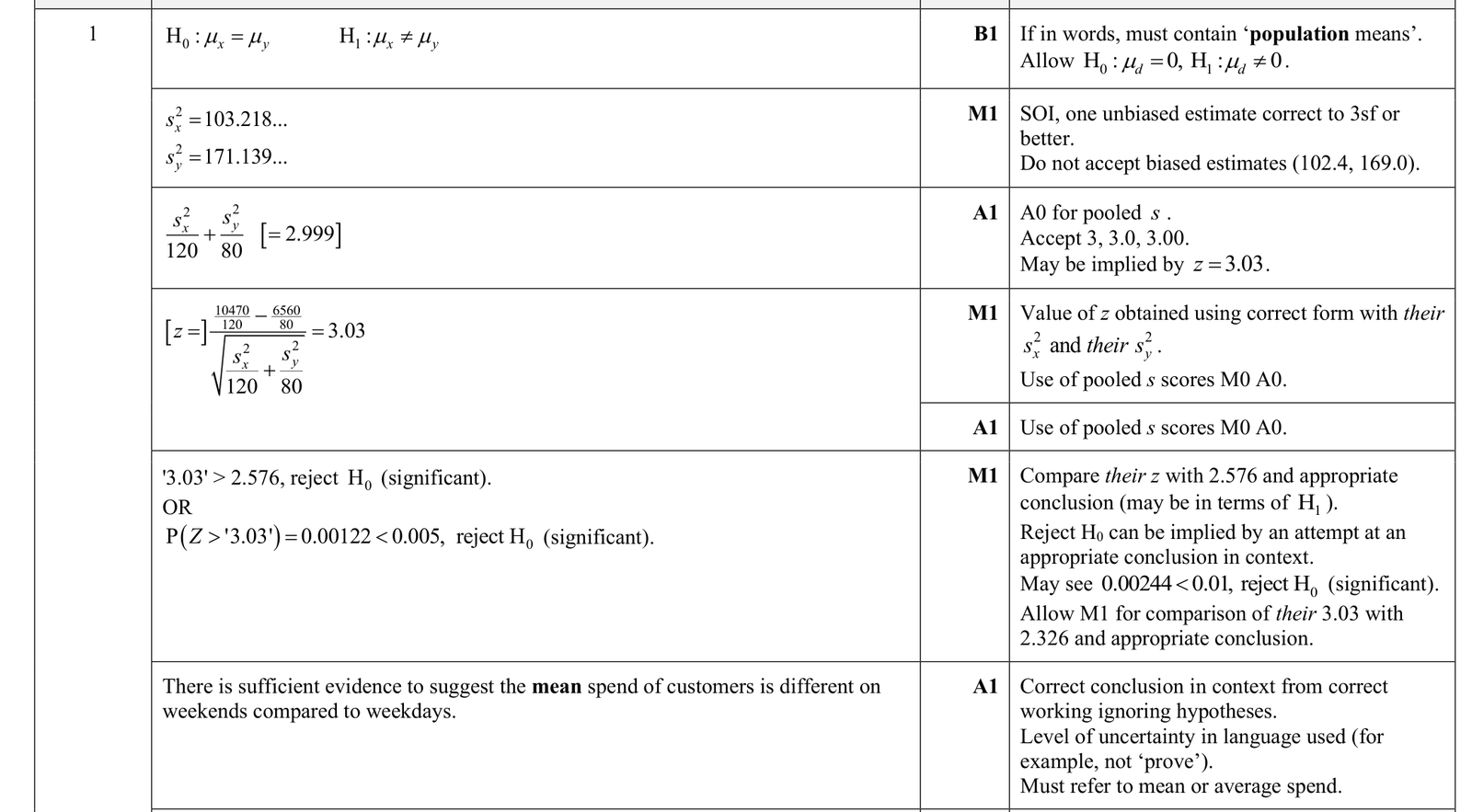
The manager of a hardware store is interested in whether there is a difference in the amount spent per customer on weekdays ( \(\$ x\) ) compared to weekends ( \(\$ y\) ). Random samples of 120 customers on weekdays and 80 customers on weekends are taken and the amount spent by each customer is recorded. The results are summarised as follows.
\(\sum x=10470 \quad \sum(x-\bar{x})^{2}=12283 \quad \sum y=6560 \quad \sum(y-\bar{y})^{2}=13520\)
Test at the \(1 \%\) significance level whether there is a difference in the mean amount spent per customer on weekdays compared to weekends. You should not assume that the population variances of the amounts spent on weekdays and weekends are equal.