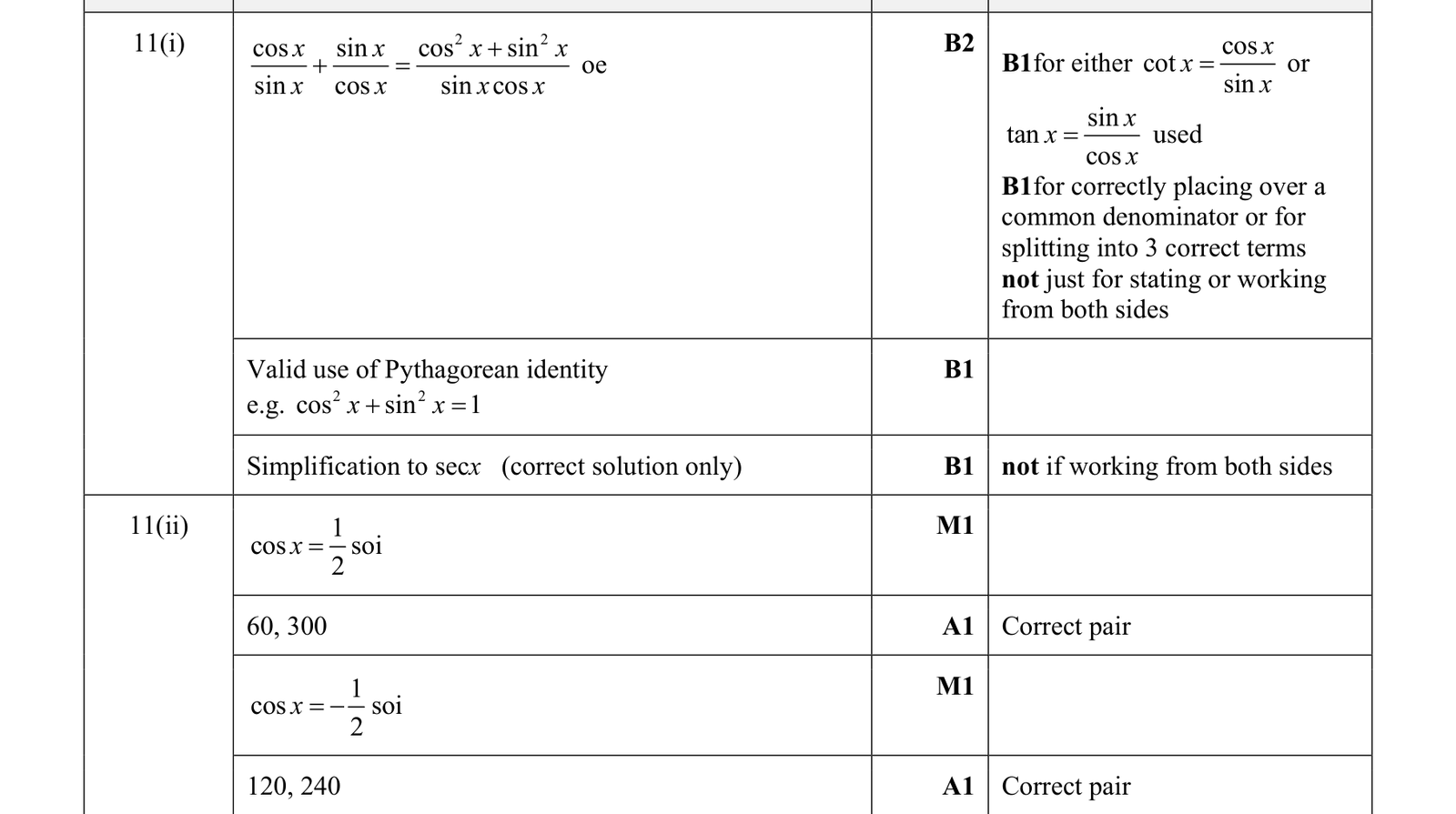
Answer: \(\sin x(\operatorname{cot} x+\tan x)=\operatorname{sec} x\), so the solutions are \(x=60^\circ,120^\circ,240^\circ,300^\circ\).
(i) Start from the left-hand side:
\(\sin x(\operatorname{cot} x+\tan x) =\sin x\left(\frac{\cos x}{\sin x}+\frac{\sin x}{\cos x}\right).\)
Distribute \(\sin x\):
\(\sin x(\operatorname{cot} x+\tan x) =\cos x+\frac{\sin^2x}{\cos x}.\)
Write over a common denominator:
\(\cos x+\frac{\sin^2x}{\cos x} =\frac{\cos^2x+\sin^2x}{\cos x}.\)
Using \(\cos^2x+\sin^2x=1\), this becomes
\(\frac{1}{\cos x}=\operatorname{sec} x.\)
Hence
\(\sin x(\operatorname{cot} x+\tan x)=\operatorname{sec} x.\)
(ii) Using part (i), the equation becomes
\(|\operatorname{sec} x|=2.\)
So
\(\operatorname{sec} x=2 \quad\text{or}\quad \operatorname{sec} x=-2.\)
Equivalently,
\(\cos x=\frac12 \quad\text{or}\quad \cos x=-\frac12.\)
For \(0^\circ\le x\le360^\circ\):
\(\cos x=\frac12 \Rightarrow x=60^\circ,300^\circ,\)
\(\cos x=-\frac12 \Rightarrow x=120^\circ,240^\circ.\)
Therefore the solutions are
\(\boxed{x=60^\circ,120^\circ,240^\circ,300^\circ}.\)