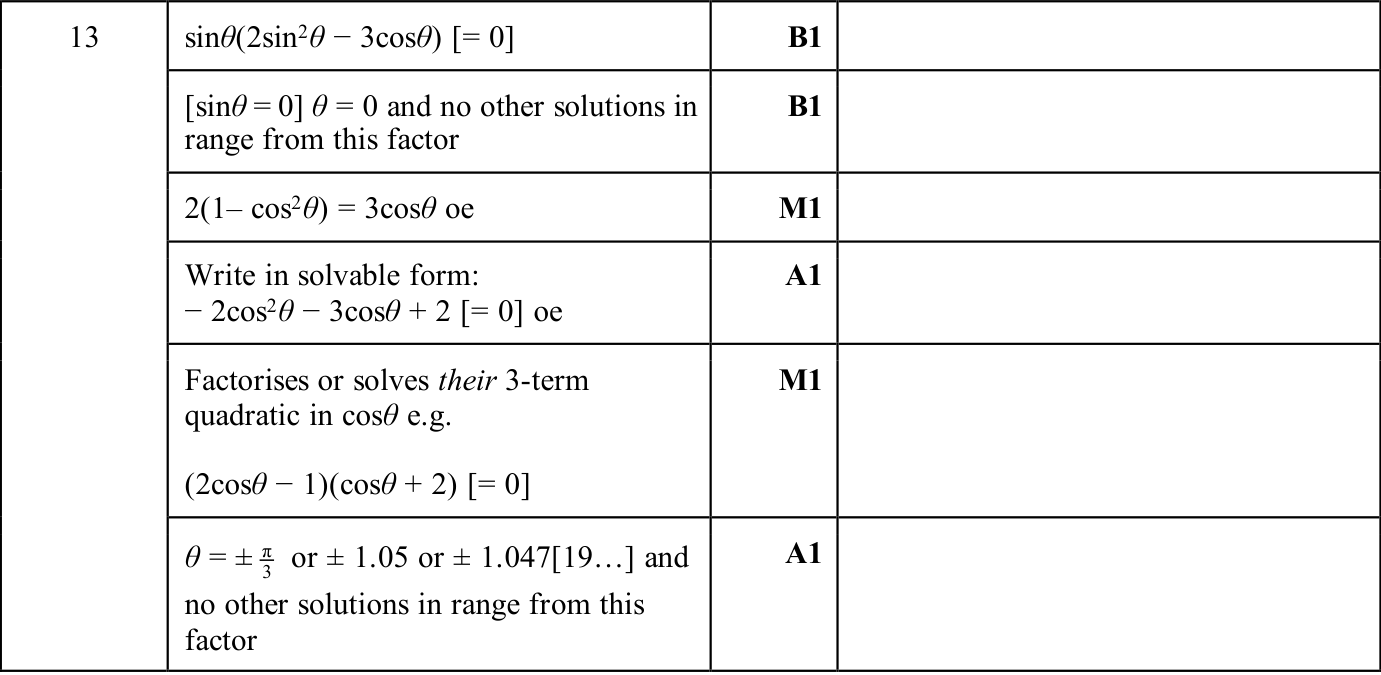
Answer: \(\theta=-\dfrac{\pi}{3},\,0,\,\dfrac{\pi}{3}\).
Start with
\(2\sin^3\theta=3\sin\theta\cos\theta.\)
Bring all terms to one side:
\(2\sin^3\theta-3\sin\theta\cos\theta=0.\)
Factor out \(\sin\theta\):
\(\sin\theta(2\sin^2\theta-3\cos\theta)=0.\)
Therefore either
\(\sin\theta=0\)
or
\(2\sin^2\theta-3\cos\theta=0.\)
From \(\sin\theta=0\), in the interval
\(-\dfrac\pi2\leqslant\theta\leqslant\dfrac\pi2,\)
we get
\(\theta=0.\)
For the second factor, use \(\sin^2\theta=1-\cos^2\theta\):
\(2(1-\cos^2\theta)-3\cos\theta=0.\)
Expanding,
\(2-2\cos^2\theta-3\cos\theta=0.\)
Multiply by \(-1\):
\(2\cos^2\theta+3\cos\theta-2=0.\)
Factorise:
\((2\cos\theta-1)(\cos\theta+2)=0.\)
The equation \(\cos\theta=-2\) has no solution, so
\(\cos\theta=\dfrac12.\)
In the interval \(-\dfrac\pi2\leqslant\theta\leqslant\dfrac\pi2\), this gives
\(\theta=-\dfrac\pi3\quad\text{or}\quad\theta=\dfrac\pi3.\)
Including the solution from \(\sin\theta=0\), the solutions are
\(\theta=-\dfrac\pi3,\quad0,\quad\dfrac\pi3.\)